


AI has become a cornerstone in defining the future of mobile app development as it offers a myriad of opportunities for improving user experiences, better app performance, and out-of-the-box functionalities. The subset technologies of AI, such as machine learning, natural language processing (NLP), and computer vision, are leading the path of these advancements.
Today’s modern AI Development technologies allow mobile apps to deliver personalized experiences through real-time adaptation to user preferences. In the highly competitive environment, AI is required to improve both functionality and engagement.
In this article, we will explore all the aspects of how AI has evolved in the mobile app development industry and what lies ahead in the future.
Role of an AI Development Company in Mobile App Development:
In the mobile app development process, AI now plays a crucial role by completely changing the development process. It has revolutionized how apps are made, optimized, and customized. You can hire mobile app developers, and they will improve the user experience by leveraging AI for purposes like personalized suggestions, handling natural language, and performing predictive analytics.
AI has also sped up the development processes. This results in reduced time to market and improved app quality. Furthermore, AI developers can now easily implement advanced features such as augmented reality, virtual helpers, and edge computing, expanding the horizon and capabilities of apps. In the future, we will surely witness AI leading to new ideas, better efficiency, and higher engagement in mobile apps.
AI Evolution in Mobile App Development:
It wasn’t long ago that mobile app development was in its early stages. Nonetheless, it marked the beginning of a technological revolution that would transform how we use our phones. Let’s tread through the aisle of the AI journey in mobile app development:’
Mobile App Development: Nascent Stage
During the initial stages, the processing power and storage space of mobile apps were quite low. Due to this, the developers had to work in a pretty limited way. Also, the apps used to be quite simpler than what we use today. Most mobile apps were just daily utility apps like calculators, calendars, and message apps.
The creation process was equally time-consuming and labour-intensive. The developers had to pay strong attention to coding and testing to ensure the app could work on all mobile platforms.
Historical Progression:
During the early 2000s, a simpler form of ML (machine learning) began to appear in mobile apps.
At first, the work was focused on making simple algorithms for speech recognition and analyzing spoken writing. With the improvement in computer technologies in the late 2000s, the role of AI in mobile apps grew, though it was still small.
Major Milestones and Breakthroughs:
In the mobile app development process, we have witnessed a plethora of important milestones and new ideas. Deep learning algorithms, particularly neural networks, allow mobile apps to learn from data and make changes based on it. It was a big turning point.
The introduction of AI-based virtual assistants like Siri and Google Assistant was another major turning point, exemplifying the power of understanding natural language and context. The programmers could now use ML models and AI toolkits such as TensorFlow and PyTorch.
Furthermore, in the last decade, we have seen the rise of computer vision and picture recognition in AI. Facial recognition and augmented reality in mobile apps are the perfect examples.
Transformative Impact on Traditional Processes:
In today’s time, we can’t undermine the role of AI in overtaking conventional mobile app development methods. Traditionally, programmers used to follow a rule-based approach, which detailed each conceivable action an app may do. However, with AI, apps can adapt and evolve in reaction to user input.
Now, ML algorithms allow mobile apps to analyze the users’ actions and preferences. It will not just increase the interaction of users with the app but also open the gateways to predictive analytics for real-time optimization of features.
How AI Development is Transforming Mobile App Development?
An AI development company like us is leveraging AI on two major fronts. Firstly, our developers are leveraging it to streamline routine tasks and simplify plus accelerate product development. Second, we integrate AI technologies into apps to unlock out-of-the-box capabilities for a better user experience.
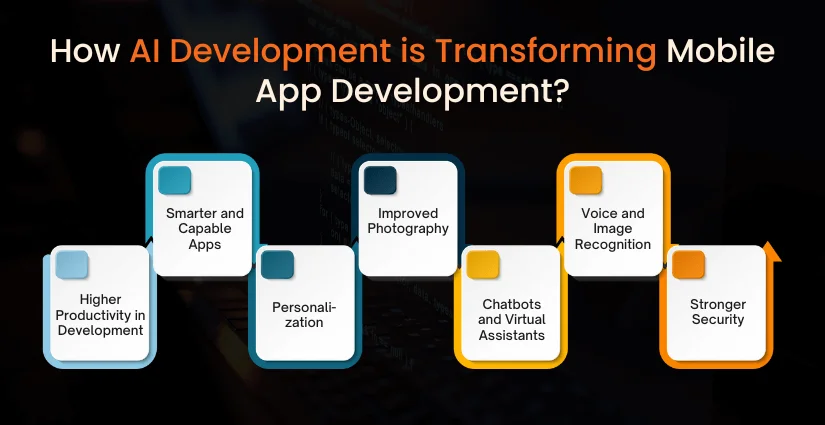
Higher Productivity in Development:
At the developer’s end, AI takes up a lot of the repetitive and time-consuming tasks, clearing the developers’ table. It includes tasks like bug detection, code suggestions, test automation, and others. It is like a highly intelligent assistant that can speed up everything with no errors.
The ML tools can automate tasks such as writing and optimizing code, resulting in time savings and lower errors. AI also catches bugs and security issues in real-time, making apps more stable and secure right from the beginning.
The benefits are not just limited to professional developers, but thanks to low-code and no-code AI platforms, people with little or no experience can also be involved in building apps. Plus, AI-powered tools allow teams to check the performance of apps, helping them make smarter decisions about updates and improvements.
Smarter and Capable Apps:
Whether it is a voice-assistant-based app, smart chatbot, or personalized content recommendations and real-time language translation, AI is making apps more capable, intuitive, and engaging.
AI is not just for features and frills, but for delivering experiences that keep the user engaged with apps.
Personalization:
AI subset technology ML can analyze the preferences and interactions of users with the app, and forecast what they might want next. It results in more tailored recommendations, such as product suggestions on Amazon or movie suggestions on Netflix.
Improved Photography:
AI has a significant contribution to improving the photography and media industry. With computer vision, apps can recognize faces, objects, and scenes for improved quality of photos and videos. Popular features such as portrait mode, scene optimization, and auto-enhancements are all AI-driven.
Chatbots and Virtual Assistants:
Popular AI-based smart assistants such as Siri, Google Assistant, and Alexa are playing an important role in our daily lives. They can’t just answer questions about our common queries but also do tasks like setting reminders, booking tickets, and scheduling appointments.
Voice and Image Recognition:
The common features of mobile apps, such as voice search and visual search, are built on AI. These features make it easier for users to give commands by speaking.
Stronger Security:
AI is also improving the security of the apps. ML-based algorithms can spot anomalies in user behaviors, block potential fraud, and support biometric login options like fingerprint, facial, and even voice recognition.
Thus, AI has a predominant role in every aspect of mobile app development, from faster processes to exciting features and higher security.

Key AI Technologies Behind Smarter Mobile Apps:
AI isn’t a single technology but a combined pack of various powerful technologies that work in synchronization to make mobile apps smart and fast. Here are the major AI technologies that are revolutionizing mobile app development:
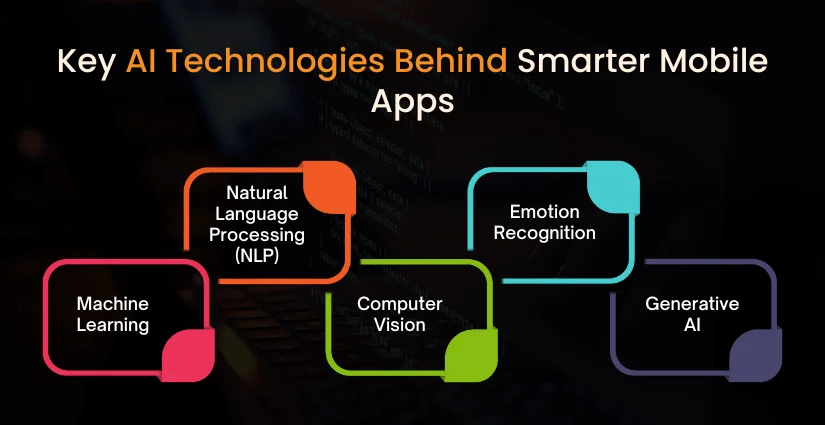
Machine Learning:
Machine learning is a subset of AI that allows mobile apps to learn and improve without external supervision. With ML, apps are not limited to following a fixed set of rules but leverage data for learning.
In mobile apps, ML offers personalized recommendations and makes forecasts based on users’ habits. The common examples are product recommendations on various e-commerce sites, song suggestions on Spotify, and movie suggestions on Netflix.
The more you use the app, the better the suggestions get. Ultimately, the focus is on delivering an experience that keeps users engaged and connected with the app.
Natural Language Processing (NLP):
If you have ever interacted with a chatbot or a voice search assistant, then you must have been amazed by its underlying technology. It works by leveraging NLP. NLP helps apps understand and respond to human language – whether you are typing or speaking.
All virtual assistants like Google Assistant, Siri, and others are using NLP to answer users’ questions. It is also used for voice-driven features like hands-free search or voice shopping. NLP makes the app experience more natural and overcomes the hindrance of typing for users.
Computer Vision:
Today’s smart apps can make a search by capturing images of objects. It is possible with the Computer Vision technology that enables apps to “see” and understand images and video. All the popular cool features, such as facial recognition to unlock your phone, scanning of documents or handwritten notes, and recognizing objects in a photo.
Computer Vision also has a profound role in augmented reality and virtual reality apps. It helps in creating immersive experiences for apps of any kind, from gaming to online shopping.
Emotion Recognition:
It may sound superficial, but yes, today’s AI is capable of reading your emotions. It uses factors like facial expressions, tone of voice, and even the words you speak. All this information will allow AI to adjust as per your responses, what content to show, and how the interface looks, all based on how you might feel.
However, this intelligence is still in development. Emotion detection has the potential to improve empathetic encounters, but technology also raises ethical concerns regarding privacy and how emotional data is handled. So, while intriguing, this technology should be utilized with caution.
Generative AI:
Generative AI is undoubtedly the most popular outcome of AI that is being used by a vast population across the globe. This tech allows the creation of new content, such as writing text, generative images, and even building simple app layouts.
Best Practices for AI Integration in Mobile Apps:
You must hire AI developers for successful AI development in mobile apps. It requires careful planning, strategic implementation, and a user-centric approach. Here are the important aspects to consider:
Start with a Purpose and Value Proposition:
You can’t just begin development at the first step; instead, you have to first clearly define the problems that your AI features can solve. You also have to justify the value that will add to the user experience. AI incorporation is not just for its own sake; it must meet a purpose and improve the app’s functionality.
Strong Emphasis on User Experience:
The AI-powered features should seamlessly integrate into the overall UX structure of the app. The overall UX must be intuitive and easy to navigate with clear instructions and explanations for AI functionalities.
Prioritize User Privacy and Security:
Data privacy and security are paramount in a mobile app. You must be upfront about what data is being collected, along with the implementation of robust security measures. Also, adhere to security regulations like HIPAA and GDPR compliance.
Start Small and Iterate:
Implementing complex AI features right from the beginning can be overwhelming. Start by integrating a few core functionalities and gathering user feedback. With positive feedback, you can iterate on the features and improve your AI models based on users’ data and real-world usage.
Focus on Explainability and Transparency:
If possible, go for explainable AI. The users should have a basic knowledge of how AI features make decisions or recommendations within the app. It will help you build trust and allow users to feel more comfortable interacting with AI functionalities.
Address Potential Biases:
Biases can arise in AI decisions if the data fed for training is aligned with particular outcomes. Implement techniques to mitigate bias and ensure your AI features are fair and inclusive for all users.
Tie Up with the Right AI Development Company:
AI development highly depends on the skills and expertise of your development team. You must partner with a reputable AI development company with a strong reputation and commitment.

Wrapping Up:
In this article, we have understood all the major aspects of AI development in the mobile app development process. AI has become a game-changer in almost every industry and every aspect of technology. As a leading AI development company, we can help you build AI-based mobile apps from scratch.
Our developers have vast experience with advanced features and functionalities. Let us know your requirements.


 Get in Touch
 By
By October 7, 2026