


In today’s globalized digital economy, accurate and fast translation is no longer a luxury; it’s a necessity. DeepL has redefined language translation using neural networks, setting new standards for accuracy and tone preservation.
Businesses, developers, and entrepreneurs now recognize the rising demand for AI-based translation apps like DeepL that go beyond conventional machine translation. These apps combine the power of artificial intelligence, machine learning, and natural language processing (NLP) to provide context-aware, grammatically accurate results.
Whether you’re running an e-commerce platform, educational portal, or global enterprise, investing in a custom translation solution can boost user engagement and market accessibility.
If you’re partnering with an Artificial Intelligence Development company, you gain access to specialized expertise in building scalable, high-performance translation apps with cutting-edge language models and neural processing frameworks.
This comprehensive guide explores why building an app like DeepL is a promising idea, what features it must include, the development process, associated costs, and the many benefits it offers. If you’re planning to develop a smart translation app, this blog will help you make informed, strategic decisions from concept to deployment.
Language Translator Apps: Global Market Size
The global market for language translation software was valued at approximately USD 10.9 billion in 2023 and is expected to reach around USD 34.7 billion by 2032, growing at a CAGR of about 11.8% from 2024 to 2032.
This surge is driven by the increasing need for multilingual content across various industries. Language translation software refers to digital tools that convert text or speech from one language into another using language databases and sophisticated algorithms. These tools generally fall into two categories: machine translation and computer-assisted translation (CAT) systems.
Why Develop an App Like DeepL?
With growing demand for real-time language solutions, apps like DeepL are revolutionizing communication. Businesses looking to expand globally should develop app like DeepL to offer accurate, AI-powered translations that enhance user experiences across regions and industries.
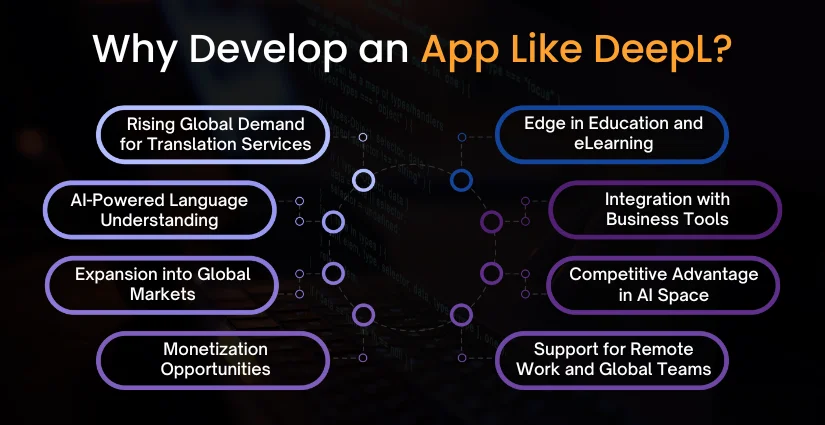
1. Rising Global Demand for Translation Services
With the explosion of digital content and cross-border communication, users and businesses increasingly seek accurate, fast, and multilingual translation tools. A DeepL-like app fulfils this growing need, especially for content localization and global communication.
2. AI-Powered Language Understanding
Unlike traditional translators, DeepL uses advanced neural networks to provide context-aware, grammatically precise translations. Building a similar app lets you offer more natural and fluent output, increasing accuracy and making it suitable for professional and enterprise use cases.
3. Expansion into Global Markets
A multilingual app removes language barriers and helps businesses tap into new international markets. With accurate translations, users can engage with diverse content, fostering cross-cultural engagement and enabling seamless global expansion across sectors like e-commerce, education, and SaaS.
4. Monetization Opportunities
Translation apps can generate steady revenue through multiple channels—freemium models, API access for developers, enterprise subscriptions, or ads. DeepL’s monetization strategies show how you can turn high-utility AI tools into sustainable business models with recurring income.
5. Edge in Education and eLearning
Students, researchers, and educators benefit from real-time translations for articles, research, and study materials. Your app can assist learning platforms and global classrooms by offering dynamic, accurate content translation that supports multilingual Education elearning solutions.
6. Integration with Business Tools
By offering APIs and SDKs, your translation app can integrate with CRMs, content management systems, email platforms, and collaboration tools. This B2B integration enhances operational workflows and boosts user adoption across corporate and enterprise environments.
7. Competitive Advantage in AI Space
AI-based translation is still an emerging field. Developing a DeepL-like app early allows you to capitalize on the innovation curve, establish brand authority, and gain a foothold in a less saturated but rapidly growing market niche.
8. Support for Remote Work and Global Teams
With remote and hybrid work becoming the norm, multilingual tools ensure seamless communication among globally distributed teams. A DeepL-like app supports internal collaboration, multilingual documentation, and real-time conversations, improving productivity and inclusivity.

Key Features to Develop an App Like DeepL
To match the quality of apps like DeepL, developers must focus on neural translation, voice input, document support, and multilingual interfaces. These features are essential if you plan to develop app like DeepL with competitive and user-friendly capabilities.
1. Neural Machine Translation (NMT)
Neural Machine Translation uses deep learning to understand sentence structure, context, tone, and meaning. It delivers highly accurate, natural translations that closely mimic human output—ideal for professional, academic, or commercial use across multiple languages and complex content types.
2. Language Detection
Automatic language detection identifies the input language without user intervention. This simplifies the translation process, improves accuracy, and is particularly useful when users input text in unknown or mixed languages, enhancing the overall user experience and app intelligence.
3. Multi-Language Support
Offering support for multiple global and regional languages allows your app to serve diverse user bases. It improves accessibility, expands market reach, and ensures the platform remains relevant across different geographies, industries, and user segments worldwide.
4. API Integration for Developers
Providing secure APIs enables other applications, platforms, or businesses to embed your translation capabilities. This expands your app’s ecosystem, opens revenue opportunities through licensing, and makes your solution valuable in enterprise software stacks and SaaS tools.
5. Document Translation Support
Allow users to upload documents in various formats like DOCX, PDF, or TXT. Maintain formatting and layout while translating text, which adds convenience for professionals, businesses, and students working with reports, manuals, or multilingual publications.
6. Glossary and Custom Terminology
Businesses can define brand-specific terms or industry jargon to ensure consistency across translations. This feature helps maintain tone and context, especially in legal, medical, or technical content, where accuracy and uniformity are critical to brand communication.
7. Voice Input and Speech Translation
Users can speak directly into the app for instant translation. This feature enhances mobility, accessibility, and usability, especially useful for travelers, language learners, and remote users who prefer or require hands-free interaction and real-time results.
8. Offline Translation
Allow users to download specific language packs for use without internet connectivity. This ensures the app remains functional in low-network environments, remote locations, or during travel, offering reliability and continuous utility regardless of connectivity issues.
Also Read: AI for Project Management: Tools and Best Practices
Advantages to Develop an App Like DeepL
When you develop app like DeepL, you unlock benefits such as global reach, AI-based personalization, and high-accuracy translation services. Apps like DeepL offer competitive advantages by enabling seamless communication across borders and boosting engagement for businesses and users alike.
1. High Accuracy and Contextual Translation
DeepL-like apps use neural networks to capture context, tone, and sentence structure more precisely than traditional translators. This results in natural, fluent outputs ideal for business communication, professional documents, academic use, and high-stakes multilingual content localization.
2. Scalable Enterprise Solution
Your app can scale to meet the needs of freelancers, small businesses, or large enterprises by offering customized features, language packs, and API access. This scalability ensures long-term usability across industries and adapts to growing user and data volumes.
3. Better User Engagement
Accurate and fast translations enhance the user experience, encouraging longer sessions, frequent usage, and positive reviews. This increases app retention rates, boosts organic growth through word-of-mouth, and enhances overall customer satisfaction and loyalty across your user base.
4. Enhances Content Localization
Businesses use translation apps to tailor content, websites, ads, and apps to local languages and cultures. This improves brand relevance, increases trust, and boosts conversions in regional markets where native-language content significantly influences purchasing decisions and user engagement.
5. Reduced Dependency on Human Translators
AI-driven translation apps automate bulk and repetitive translation tasks, cutting down on manual labor and turnaround time. This is cost-effective for businesses and provides faster content delivery without compromising too much on quality or consistency.
6. Competitive Positioning in App Stores
The AI translation segment is still maturing, with fewer players than traditional apps. Launching now allows you to gain visibility, leverage keyword optimization, attract early adopters, and build a loyal user base before the space becomes saturated.
7. Multilingual Customer Support
Businesses can use your app to support global clients via chatbots, support tickets, or live chat tools. This ensures seamless multilingual communication, reduces language barriers, and improves service quality, response time, and customer satisfaction across global markets.
8. Constant Improvement with AI
AI and machine learning algorithms evolve by learning from user interactions, translation history, and corrections. Over time, this leads to smarter, more context-aware outputs, making your app more accurate, adaptive, and reliable with continued usage.
Read More: AI in ERP: Key Trends, Use Cases and Benefits
Steps to Develop an App Like DeepL
To develop app like DeepL, a systematic approach is key—from market research and feature planning to AI model training and UI design. Building apps like DeepL requires expert development, smart integrations, and continual performance optimization for best results.
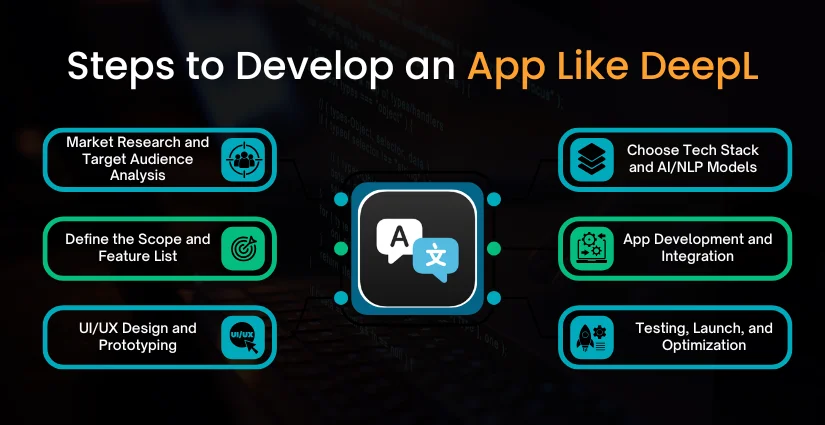
1. Market Research and Target Audience Analysis
Begin with deep competitor analysis and user research to identify current gaps in the AI translation market. Evaluate DeepL’s offerings, user feedback, and emerging trends to define a unique value proposition and tailor your app to user expectations.
2. Define the Scope and Feature List
Outline the languages, platforms (iOS, Android, Web), and functionalities like voice translation, document upload, and API access. Focus on creating an MVP that solves core user problems and can scale with advanced features based on future user demands.
3. UI/UX Design and Prototyping
Design intuitive, responsive, and minimalistic user interfaces. Use wireframes and clickable prototypes to map user flows and optimize the translation experience for speed, clarity, and ease of navigation across different device types and user personas.
4. Choose Tech Stack and AI/NLP Models
Select cutting-edge technologies such as TensorFlow, PyTorch, and the Transformer model for natural language processing. Use cloud platforms like AWS, Azure, or Google Cloud to ensure scalability, speed, and performance for real-time translation processing.
5. App Development and Integration
Develop the core backend infrastructure, frontend UI, and integrate AI translation engines. Ensure seamless interaction between components and include APIs for external integration. Implement multilingual datasets and test for speed, scalability, and cross-platform functionality.
Working with a provider of Android app development services ensures your translation app performs seamlessly across mobile platforms, catering to millions of Android users globally.
6. Testing, Launch, and Optimization
Conduct thorough testing including functional, performance, linguistic, and usability checks. Launch a beta version to gather user feedback, refine translation quality, resolve bugs, and optimize app performance before full-scale deployment on relevant app stores.
Cost to Develop an App Like DeepL
When anybody develops such a digital platform, the first question that comes to mind will be how much it costs to develop a mobile app like DeepL. Below, we have listed the major factors that impact the app development cost along with expenses involved in each phase.
1. Features and Functionalities
The overall cost increases based on the complexity and volume of features included, such as voice translation, document upload, glossary support, and offline mode. Each advanced feature requires extra development, testing, integration time, and specialized resources.
2. AI and Machine Learning Integration
Building neural machine translation systems involves training or fine-tuning large language models using vast multilingual datasets. This demands highly skilled AI engineers, computing infrastructure, and cloud processing power, which significantly raises both upfront and ongoing development costs.
3. Platform Choice (Web, Android, iOS)
Developing the app for multiple platforms—native or cross-platform—adds cost. Each platform may require a dedicated codebase, design adjustments, and additional testing, making platform selection crucial to balancing user reach with budget constraints.
4. Third-Party APIs and Tools
Integration of third-party services—such as speech-to-text APIs, translation engines, or cloud storage solutions—adds licensing, subscription, and implementation costs. While they speed up development, they also add to long-term operational expenses depending on usage.
5. UI/UX Design Complexity
Crafting a seamless, multilingual, and intuitive interface for various user roles—like casual users, premium subscribers, or developers requires specialized UI/UX expertise. Complex layouts, animations, and responsive design add to both time and cost of design execution.
6. Testing and Maintenance
Post-launch, your app requires frequent updates, bug fixes, new language additions, and AI model tuning. Ongoing QA testing, server monitoring, performance optimization, and user support collectively contribute to sustained maintenance and operational expenditures.

App Development Cost Breakdown Table
| Development Stage | Estimated Cost (USD) |
| Research & Planning | $5,000 – $8,000 |
| UI/UX Design | $6,000 – $10,000 |
| AI/NLP Model Integration | $15,000 – $30,000 |
| Frontend & Backend Development | $20,000 – $40,000 |
| API & Third-party Integrations | $5,000 – $12,000 |
| Testing, Deployment & Support | $8,000 – $15,000 |
| Total Estimated Cost | $59,000 – $115,000 |
Conclusion
Building an app like DeepL is a strategic investment for businesses, developers, and tech entrepreneurs aiming to innovate in the AI-powered language translation domain.
With increasing demand for real-time, accurate, and context-aware translations, such apps offer immense potential in global communication, education, content localization, and enterprise integration.
The growing relevance of AI in Education makes translation tools vital for global classrooms and inclusive eLearning platforms.
By focusing on key features like neural machine translation, voice input, offline support, and custom glossaries, your app can stand out in the competitive landscape.
Although development involves considerable investment, the long-term benefits—scalability, monetization, and global relevance make it worthwhile.
Octal IT Solution specializes in AI-based app development and can help you bring your vision to life with advanced technologies and scalable architecture. Partner with us to develop a powerful, user-centric translation app that rivals DeepL and taps into a growing global market.
FAQs
DeepL is an AI-powered translation tool that uses neural networks to provide highly accurate, context-sensitive translations. It analyzes entire sentences instead of individual words for better results.
Depending on the features and platform, it can take 4 to 8 months for development. AI training and testing may extend the timeline further, especially for multilingual support.
Yes, integrating neural machine translation models requires AI expertise, computing resources, and large datasets, which increase initial costs. However, it ensures long-term accuracy and scalability.
Yes, you can monetize via subscriptions, in-app purchases, premium translation limits, or by offering API access to enterprises and developers.
You can use Python (for AI/ML), React or Flutter (frontend), Node.js (backend), and cloud platforms like AWS or GCP. For NMT, use TensorFlow or Hugging Face models.
Octal IT Solution has proven experience in AI, machine learning, and custom app development. We offer end-to-end services, from concept to deployment, ensuring high-performance, scalable applications.
 By
By September 23, 2026



 Get in Touch