



Have you ever considered the question of which is better to build your software team in-house or to outsource it to experts from abroad?
When it comes to creating a software project, one of the biggest common quandaries for a business is they don’t know what approach to choose for their project. Both methods have their pros and cons. The correct option is determined by your goals, budget, timeline, and technical requirements.
In-house development has the advantage of full control and team alignment, while outsourcing is generally seen as more affordable and it can also be used to get talents from worldwide. But which one is really in line with your business strategy in 2025 and the future of in-house software development vs outsourcing?
Grand View Research has published a report noting that the market of IT services outsourcing globally was worth USD 744.6 billion in 2024. The report also mentions that this market is expected to hit USD 1.22 trillion by 2030, with a CAGR of approximately 8.6% from 2025 to 2030.

Furthermore, with the beginning of 2030, the in-house vs outsource software development model you choose can have a direct relationship to the success of your product as well as to certain more refined aspects of budget planning and speed-to-market. This blog post is aimed at outlining some of the most salient differences between in-house and outsourcing software development, looking at their individual pros and cons, followed by a conclusion as to which is the most suitable for your business.
What is In-House Software Development?
In house vs outsourcing software development is a critical decision for many businesses. Developing software in-house means engaging a software team to build and deliver software systems directly for the client company. These individuals are full-time employees or part of an internal IT department. They are supervised directly, operate under the company’s culture, and software development work entirely for the client’s objectives.
In-house generally means setting up and running your own in-house software development team to build and maintain digital products such as apps, websites, or enterprise systems.
Key Characteristics
- Full control over the project, team, and workflow
- Developers share the company culture, philosophy, and vision.
- Communication is direct and instant.
- Collaboration between departments is easy and transparent.
- Long-term commitment to the projects of the company
Team Structure and Control
With the in-house vs outsource software development model, your team composition depends on your requirements; it may consist of frontend/backend developers, UI/UX designers, QA testers, and project managers. You have the control to decide who shall do what, when, under whose supervision, and even the tools they use. This way, you can ensure the quality and security of your product, and change almost anything within minutes once priorities shift.
What is Outsourced Software Development?
Outsourced software development is the simplest definition is when you hire developers from another company or location who are not a part of your organization to create your software. This model for outsourcing enables businesses to not only speed up the process of carrying out their projects but also reduce costs and tap into the talent pool from different parts of the world without handling a local team.
Another way of saying this is that outsourced development is a case in which a company transfers its software development in house vs outsourcing tasks to another party, either partially or entirely, who is usually located in a different city, country, or continent.
Key Characteristics
- Access to a global pool of skilled developers
- Lower development costs compared to in-house teams
- Flexible team size based on project needs
- No need to handle recruitment, training, or HR processes
- Often works in different time zones, which can speed up delivery
Engagement Models
Software development outsourcing allows for different ways of collaboration with external teams based on the situation.
- Dedicated Team Model: You recruit a remote team that deals only with your project.
- Time and Material Model: You compensate for the time and work put into the project.
- Fixed-Price Model: You come to an agreement on a fixed budget and timeline for the whole project.
This is the perfect way for companies to concentrate on their core business with in house software development vs outsourcing, and at the same time have experts take care of their technical challenges and in-house vs outsourcing software development.
In-House vs. Outsourced Software Development: Key Differences
Choosing between in house vs outsourcing software development is very difficult, but this situation is made easier if you determine your company’s needs, goals, and resources. Both models are different by nature, and they provide unique advantages and disadvantages. The following are several key differences across multiple important factors:
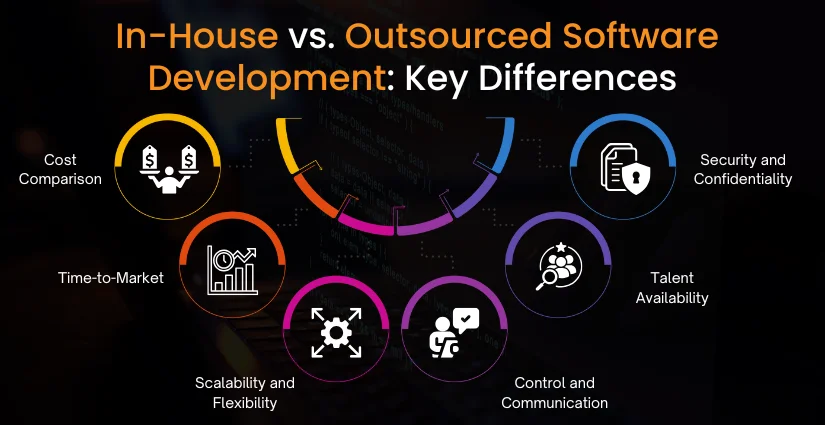
1. Cost Comparison
- In-House: Papering over an internal team is synonymous with high upfront and long-term costs because several resources are consumed in the form of salaries, benefits, office space, equipment, and ongoing training.
- Outsourced: Generally speaking, outsourcing is a less expensive option. You just cover the software consulting services needed, without bothering with the infrastructure or providing employee benefits.
2. Time-to-Market
- In-House: Setting up an in-house team means, however, a recruiting process which may be time-consuming and lead to a later project launch.
- Outsourced: The main advantage of the outsourcing team is that it consists of already existing experts and is always at your disposal. Hence, downtimes are reduced and the product can be brought to the market earlier.
3. Scalability and Flexibility
- In-House: Rising may prove to be a difficult and slow venture as it might necessitate the hiring of employees who, upon advertisement, would only be ready to get on board in a few weeks or even months at most.
- Outsourced: Finding suitable talent from the local market can be challenging and very time-consuming, especially if you require human resources with special skills.
4. Control and Communication
- In-House: Totally in-house imparts a lot of control over the project, so you can reach out to your devs at any time, making everything easier to work on.
- Outsourced: Communication tools are mostly key in bridging time zones or language differences that may hinder progress.
5. Talent Availability
- In-House: Finding just the right talent along the local lines is a tricky thing to do and can eat a lot of time, especially for hard-to-fill jobs.
- Outsourced: Draw from a global talent pool, where experts in practically any technology can be available on fair notice.
6. Security and Confidentiality
- In-House: If your internal development is working with the company’s walls as boundaries, thus making it easier to enforce stronger data and security protocols.
- Outsourced: A good outsourcing software product development company abides by strict security procedures; yet, the very nature of sharing sensitive data with an external party does bring a risk-it warrants that NDAs are signed and the company undergoes strict vetting.
Pros and Cons of In-House Software Development
With a choice of in-house software development, you have more control put over your team and project, which should ultimately affect the quality and alignment of your company goals positively. However, cases like this have higher costs and a slow hiring process. Knowing these pros and cons should help you decide whether or not this model fits your business needs.
In-House Software Development: Pros and Cons
| Pros | Cons |
| Development process under full control | High operation cost (salaries, tools, office, engineer, etc.) |
| Better communication and collaboration within a team | Time-consuming hiring and onboarding |
| More strongly aligned with the company’s goals | Limited access to niche or expert talent |
| Easier to keep data security within the company | Easier to scale down as project needs may shrink |
| Long-term commitment to business goals | Continuous training of employees and HR management |
Pros and Cons of Outsourced Software Development
An outsourcing mobile app development option apparently enables the business to explore talent across the world, cut costs, and deliver faster. That makes it authorized for startups and expanding companies or organizations that don’t have an in-house technical team. Let’s consider the pros and cons of making an informed decision for in house vs outsourcing software development.
Outsourced Software Development: Pros and Cons
| Pros | Cons |
| Lower development costs | Less control over day-to-day progress |
| It provides access to global and expert talent | It is considered a disadvantage due to time zone or communication issues |
| Faster time to kick-off and delivery | Data security is not adequately enforced, then concerns increase |
| Easy to scale up or down according to needs | Quality can fluctuate depending on the provider |
| No office space and no need for full-time hires should be an advantage | Proper vetting process, background checks, and contracts need to be in place |

When Should You Choose In-House Development?
When an enterprise wants absolute control over the work, long-term commitment from the workers, and familiar integration with existing processes of the company, then in-house development is the best option.
Such an environment is typically for companies building core products or solutions that require regular updates and extensive cooperation across departments. Here are some of the main situations when in house vs outsourcing software development makes the most sense:
1. When Your Project is Long-Term and Core to the Business
Ensure that the software development outsourcing vs in-house is central to your business (as a product or platform), and you keep in-house teams to ensure they have respect from those who dedicate their whole lives to it and have long-term product stability.
2. When You Need Full Control Over Development
In-house teams give control of times, priorities, and decisions. You are into managing all defines and workflows, features, and processes rather than those involved externally.
3. When Data Security is a Top Priority
If your precious one- or two-step sufficient customer data is the transaction of money for some other covert operation of the company, then with in-house development, you can impose such strict Security Protocols that you’ll maintain no information outside.
4. When You Want Seamless Team Communication
In-house teams collaborate closely with other departments like marketing, sales, and customer support. This improves cooperation and reduces delays caused by miscommunication.
5. When You Want to Build and Retain Internal Expertise
Developing an in-house team will set your company on the path to building internal expertise and knowledge, putting it to good use for future projects, maintenance, and innovation.
Also Read: iPhone App Development Outsourcing Benefits
When Should You Choose Outsourced Development?
It is a good choice to outsource development when you want to save costs, speed up your project, or want a global skill set for your project that is not present in-house. In short, it is a way for a company to allow its focus on core activities of marketing and customer satisfaction, and, meanwhile, divert its web development outsourcing aspect to a trustworthy external agent. Here are examples where outsourcing makes the most sense:
1. When You Have a Limited Budget
Outsourcing can be a valid option if your company is a startup or works on a limited budget. It helps you reduce costs. You get rid of expenses related to hiring, infrastructure, and employee benefits while still getting quality work.
2. When You Need to Launch Quickly
Teams that are outsourced do not need training as they already have experience. They are also able to start your project immediately, therefore reducing the development time and allowing you to launch the product faster compared to building an in-house team.
3. When You Need Specialized Skills
Outsourcing provides you with a pool of specialists in particular technologies or professions from areas that a local market may not have. For example, it is especially helpful in carrying out short-term or niche projects.
4. When You Want to Focus on Core Business Tasks
Outsourcing software development means that your internal team can remain focused on sales, marketing, and customer service while the technical team is taking care of the significance of outsource software development projects separately.
5. When You Need Flexibility in Team Size
Outsourcing software development means that your internal team can remain focused on sales, marketing, and customer service while the technical team takes care of development separately.
Hybrid Approach: Best of Both Worlds?
The hybrid approach leverages the strengths of both in house vs outsourcing software development. For companies choosing between in-house vs. outsourced software development, this model offers a balanced solution. It implies that a core team is kept internally while outsourcing only certain tasks or parts of the project to external experts. This model is less extreme, more flexible, and gives more control, a perfect fit for plenty of new-age companies.
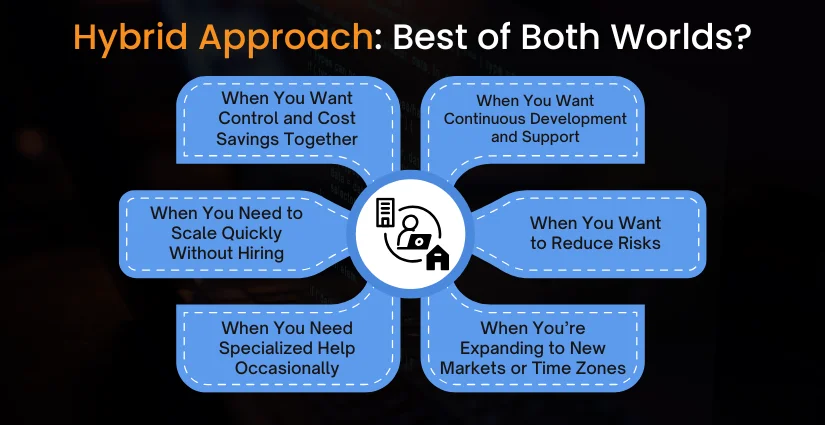
1. When You Want Control and Cost Savings Together
By using the hybrid model, you can hold the in-house team responsible for the core product and decision-making, but also delegate to others, like testing, design, or module development. Thus, you get control where it really counts, and at the same time, you save money on those tasks which are not central.
2. When You Need to Scale Quickly Without Hiring
In place of hurriedly recruiting new full-time employees, you can bring in outsourced developers for specific phases of the project without delay. This way, you can achieve your goals without resorting to hiring more permanent employees.
3. When You Need Specialized Help Occasionally
It is very likely that you are not using the services of a data scientist, AI expert, or blockchain developer on a daily basis. The hybrid model definitely lets you hire software developers from outside for a certain period of time if necessary, without obliging to any long-term commitments.
4. When You Want Continuous Development and Support
While the in-house team is occupied with product strategy and improvements, the outsourced team can be assigned tasks like maintenance, updates, or 24-h support. As a result, your internal resources will not be burdened; however, there will still be progress available.
5. When You Want to Reduce Risks
The in house vs outsource software development model allows sharing the risk between the parts of the project. If one side is in an emergency (be it the in-house or the outsourced side), the other can continue the work. Hence, it is like a buffer zone that absorbs the changes and enables the project to be stable and move forward.
6. When You’re Expanding to New Markets or Time Zones
Utilizing an outsourced team in a different time zone allows you to extend your coverage to multiple time zones, thus guaranteeing software development services that are available 24/7. At the same time, your in-house team takes care of the strategy and local.
Conclusion
Choosing between an in house vs outsourcing software development is not easy, it completely depends upon your business priorities, budget, and how quickly you want the project to be finished. In-house teams have greater control, better alignment, and are more suitable for long-term sustainability, while outsource app development cost reduction, flexibility, and fast turnaround.
In-house development is perfect for those who want full ownership and for the teams to work closely together day-to-day. On the other hand, outsourcing is ideal for companies looking for a fast launch, requiring cost savings, and access to the global talent pool. Hybrid models, however, are intuitively attractive for most companies, for they offer the best of both worlds, control combined with efficiency.
Know the advantages and disadvantages of in house vs outsourcing software development paths, and you will be able to decide which style best suits your attitude towards the project’s success. There is never a definitive, one-size-fits-all answer-there is just the great fit for your world at present and what you foresee in the near future.



 Get in Touch
 By
By October 8, 2026