



In the fast-evolving world of digital technology, businesses are pressured to innovate, scale, and deliver fast without compromising on performance or security. Customer expectations continue to rise, and markets become more competitive; enterprises thus require sturdy technology foundations that can ensure their growth for the long term and maintain adaptability and reliability.
In this dynamic tech environment, choosing the right programming language and development environment becomes essentially crucial for uninterrupted execution and scalable solution building. Among various options available today, the benefits of Java for enterprise software development stand out, offering a powerful combination of performance, security, and flexibility that modern businesses need.
The Opening Insights
For decades, Java has upheld its stature in enterprise software development. The most stable, cross-platform, and well-established ecosystem, Java allows enterprises to build secure, high-performing, and scalable applications on the complex enterprise needs. Be it is building large-scale ERP systems, financial platforms, or enterprise solutions over the cloud, Java is there with all the tools, frameworks, and community support that are necessary for the successful execution of the project over the long term.
Java became popular due to its general premise of “write once, run anywhere,” hence developers developed applications that would work seamlessly on any platform. Java takes the simplicity far by providing a vast set of open-source tools, APIs, and fully mature development frameworks such as Spring and Hibernate, which further ease any complicated software development services in delivering reliable solutions within time and cost.
Meanwhile, Java is continuously evolving with a huge supportive developer community across the world, long-term support from Oracle, and is currently implemented in the world of microservices, cloud computing, and artificial intelligence. Industrial enterprises such as finance, health care, e-commerce, and logistics utilise Java in providing robust backend systems and ensuring the application of high-security standards to support open mission operations on an industrial scale.
In this blog, the top 10 benefits of Java for enterprise software development are studied, including choosing Java for an enterprise software development company and why the language has remained trusted by businesses across the world. Whether you’re a CTO evaluating tech stacks or a developer curious about Java’s enterprise-grade capabilities, this guide offers much that will improve your understanding of Java’s capabilities and strategic benefits.
Why Enterprises Rely on Java for Building Robust Applications?
Java has traditionally been a trusted choice among enterprises in their building of reliable, secure, and high-performing applications. Its mature local infrastructure, cross-platform capabilities, and highly efficient architectural design help it in addressing the complexities involved in large-scale business operations.
Several reasons still bind why choose Java for enterprise software development in making highly robust software application solutions:
- Platform Independence: Java’s famous maxim, “write once, run anywhere” assures seamless applicability testing across operating systems, eliminating any development overhead.
- Scalability & Performance: Java is fit for high-performing applications that can scale head-on as per business demand, thus preferable for enterprise application development services.
- Object-Oriented Structure: Facilitates the creation of clean modules and codes that are reusable and, therefore, maintainable and easier to upgrade.
- Strong Memory Management: From its strong garbage collection mechanisms to efficient memory handling techniques, disturbances like memory leaks are scarce, thus maintaining the stability of the application.
- Multithreading Support: Multiple tasks are performed efficiently in a multithreaded environment while considering the time frame and load. Thus pertinent for high-load, real-time enterprise applications.
- Robust Security Features: Includes powerful security mechanisms such as bytecode verification, runtime security policies, and class loaders, necessitating the handling of sensitive data by the industries.
- Mature Ecosystem: Rich library supports, APIs, and an enterprise-class framework called Spring, Hibernate, and Struts expedite application development and validate the reliability of the application.
- Cloud Compatibility: Domain integration with all key cloud service providers (AWS, Azure, Google Cloud) nurtures modern cloud-native and distributed applications.
- Community & Vendor Support: Oracle supports the ecosystem, along with a large global community that ensures continuous updates and long-term support, as well as a solutions experience.
- Track Record: A proven track record with Fortune 500 companies and global enterprise reporting software development in mission-critical functions, working in areas such as finance, healthcare, retail, and logistics.
Java’s Market Momentum in the Enterprise World: Stats & Trends
For the year 2025 and beyond, Java continues to be the leader in enterprise software development, backed by deep adoption, proven scalability, and a strong community.
Market studies and surveys illustrate the relevance of Java over the years, cutting across startup cultures, reaching the golden classes of big corporations Fortune 500.
Here are some compelling statistics portraying the huge impact Java has created in the world of enterprise:
- With 99% enterprise adoption: In Azul’s 2025 State of Java Survey, 99% of global organizations claimed to use Java, meaning actively leveraging Java in their business applications.
- As per the research conducted by Grand View Research, the global enterprise software market is expected to be valued at USD 291.8 billion in 2025, with projections estimating it will more than double to USD 517.3 billion by 2030 that growing at a compound annual growth rate (CAGR) of 12.1% from 2025 to 2030.
- Wide usage across applications: 68% of the IT professionals who responded said more than half of their applications are built with Java or run on a Java Virtual Machine (JVM).
- 10,559 companies on Java EE: As of July 2025, more than 10,500 duly verified companies use Java Enterprise Edition for production environments, including the major enterprises of the world.
- Fortune usage: In their software development stacks, Fortune 500 firms 90% plus continue to use Java in 2025.
- According to the survey, the enterprise application software market reached USD 357.6 billion in 2025, with the expectation to expand to USD 625.7 billion by 2030, which reflects a CAGR of 11.8%.

Top 10 Reasons to Use Java for Enterprise Software
In the world of enterprises, software must be scalable, secure, maintainable, and keep on adjusting itself with the technologies evolving. Java stands tall in the fulfillment of these requirements with its tested abilities and a vast universe of technicalities.
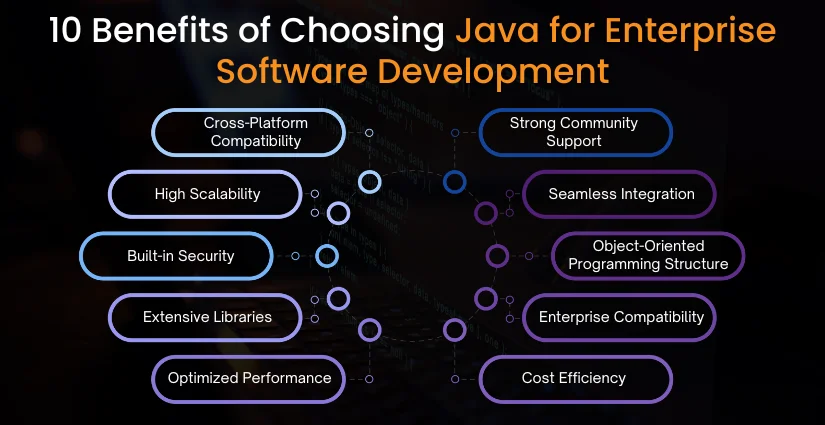
The following is a more thorough look at the top ten benefits of Java for enterprise software development that show why Java is still the first choice for enterprise software development:
Cross-Platform Compatibility
Among the many features, Java’s platform independence is one of its most cherished attributes. Through the JVM, developers have the advantage of writing code once and deploying it on several operating systems without the need to rewrite or recompile. Decrease time-to-market, lessen compatibility issues, and have an even easier process for updates across different enterprise platforms such as Windows, Linux, and macOS.
High Scalability
Java allows for vertical and horizontal scaling, making it a programming language for applications to grow according to business needs. When scaling the application layer to a larger number of users, alternate services, or a microservices architecture, Java efficiently deals with increased load. In addition to this, with tools like Spring Boot and Apache Kafka, developers can easily scale their applications in distributed environments and cloud-native infrastructures.
Built-in Security
Security is a top priority to build enterprise mobile app. Java provides built-in security features such as runtime restrictions using the Security Manager, code-level access control, cryptographic algorithms via JCE (Java Cryptography Extension), and secure socket communication. These features make Java a trusted choice for industries handling financial transactions, personal data, or proprietary business logic.
Extensive Libraries
This is one of the advantages of Java for enterprise software development, which offers a mature ecosystem supported by thousands of libraries and frameworks that streamline development. Frameworks like Spring help developers manage configurations and dependencies, while Hibernate simplifies database interaction.
Additionally, Java is well-supported by build tools (Maven, Gradle), testing frameworks (JUnit, TestNG), and performance monitoring tools (JConsole, VisualVM), ensuring faster development cycles and reduced time-to-market.
Optimized Performance
Java’s built-in multithreading support enables enterprise applications to perform multiple operations concurrently. This is truly important for some resource-heavy applications such as CRM, ERP, and financial systems that must handle thousands of transactions or interactions per second. Java performance aspects, such as Just-In-Time (JIT) compilation and memory management enhance these systems’ efficiency
Strong Community Support
Hire Java developer who continuously helps with updates to the language, to documentation, to tutorials, and open-source tools. Enterprises benefit from a well-maintained technology with long-term support from Oracle and an even greater number of Java User Groups (JUGs), removing difficulties in rapid problem resolution, fostering rapid innovation, and teaching an ever-increasing number of people proficient in working with Java.
Seamless Integration
Java is vibing with integration universely. It supports REST and SOAP APIs, it interacts with databases (SQL/NoSQL), and even talks to messaging systems such as RabbitMQ and Kafka. Plus, it has integration capabilities with new-age technologies, including AI/ML (via TensorFlow, DL4J), blockchain (via web3j), IoT (via MQTT & Java ME), big data (Apache Hadoop & Spark).
Object-Oriented Programming Structure
Due to its object-oriented nature, Java enables programmers to write reusable classes and components approach that greatly reduces code. Better maintainability, improved debugging, and easy scalability are benefits of such modularization. Enterprise teams work with code that is easy to collaborate on, easy to extend, and easy to upgrade with the changes in business needs.
Enterprise Compatibility
Java perfectly fits traditional enterprise architecture and, on the other hand, modern cloud-native designs. It supports monolith, service-oriented, or microservices architectures. Java EE (Jakarta EE) is designed for scalable, transactional, and secure enterprise applications, while Spring Boot and Quarkus provide a fast and lightweight approach for Java development company targeted toward microservices and serverless deployments.
Cost Efficiency
Being open-source, Java has reduced licensing costs, while its extensive talent pool mediates the hiring cost. Enterprises benefit from the reusability of Java components amongst projects, whereas the backward compatibility of Java makes sure that old applications continue working despite system upgrades. These factors help to contribute to the lower total cost of ownership and the high return on investment in the long run.
The Recap and Outline
The technology selection for the core foundations of a solution is very important in the fast-paced environment of enterprise software development. Java continues to boast with its platform-independent nature, speedy performance, and asynchronous ecosystem of development tools and frameworks to serve complex business requirements.
Its adaptability also makes it a strong fit for modern trends like AI in enterprise, enabling organizations to build intelligent, scalable, and future-ready software solutions.
For enterprises to handle large transactional flows, the architecture of microservices, or the maintenance of systems for a long time, Java has stood the test of time as a trusted friend.
In turn, this will keep the companies agile, ensure a fast system lifecycle from scratch to market, and allow easy adaptation to new technologies, all the while keeping stable with definite performance at scale.
How Octal IT Solution Can Help You with Java Enterprise Development?
At Octal IT Solution, we specialize in custom-built, high-performance enterprise Java applications tailored to your unique business needs. We understand Java’s core strength, the benefits of Java for enterprise software development and modern implementation strategies with expertise of over 18 years in enterprise software development.
These are the ways we assist enterprises with Java-based solutions:
- Custom Java Application Development– From ERP and CRM systems through cloud-native platforms to financial software development, solutions that scale as your business grows.
- Expertise in Frameworks- We use Spring Boot, Hibernate, Jakarta EE, and other top Java frameworks to increase development speed and maintain code quality.
- Microservices Architecture– Modernize your monolith systems to a scalable microservices implementation with Java for better performance and maintainability.
- Cloud Integration- We develop and deploy Java applications onto leading cloud platforms such as AWS, Azure, and Google Cloud for better agility and to cut down software development costs.
- Java Migration & Upgrades – We assist in migrating legacy systems to the latest Java versions while preserving business logic and improving security and performance.
- Ongoing Support & Maintenance – Our post-deployment support ensures your enterprise systems remain secure, updated, and aligned with evolving business goals.
Whether you are a startup scaling up or an established enterprise undergoing digital transformation, Octal is your reliable technology partner for full-cycle Java development services.
Read More : android app development companies

 By
By June 16, 2025


 Get in Touch