


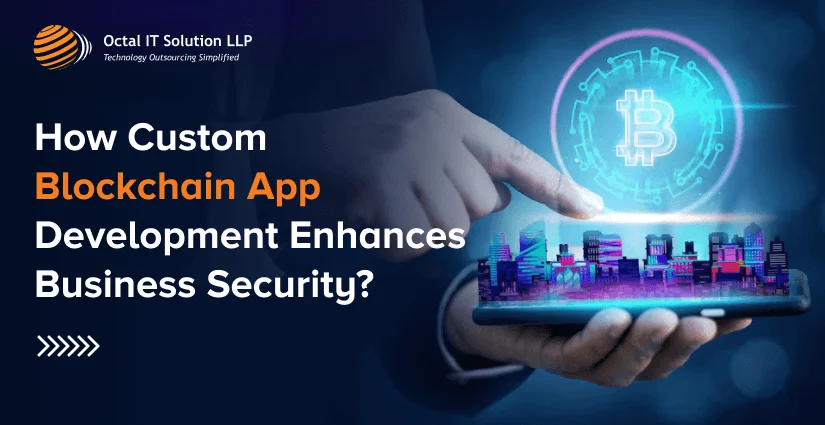
Have you ever thought about the ways in which businesses might be able to maintain their safety and security, really, in a world riddled with relatively sophisticated cyber-threats and data breaches? Security has become an absolutely mandatory aspect of digital business operations, as more and more enterprises digitally transform themselves.
The demand for secure, transparent, and self-executing systems has been the primary driver behind the rapid adoption of blockchain technology over the last few years. The trend of blockchain is set to continue soaring from $33.27 billion global market size in 2025 to $55.08 billion in 2026 and further to $5107.54 billion by 2035 at a CAGR of 65.5% as per Business Research Insights.
That is the reason why tailor-made blockchain programs are gradually becoming a decisive pillar of technologically advanced businesses worldwide. By virtue of sophisticated security features in their blockchain applications, enterprises can work out such blockchain solutions that not only enable data protection but also transaction security and trust creation among stakeholders through an open chain.
What Makes Custom Blockchain Applications More Secure?
Decentralized structure, unbreakable encryption, and automated smart contracts, which are by design immune to data tampering and unauthorized use of information, are the main security features enhanced by Custom blockchain apps that improve business security.
1. Immutable Data Architecture
One of the key features of data storage in a customized blockchain app is continuous record keeping with strong data protection, complete transparency, data integrity, and, very often, providing a reliable means of a chain of data documents, thus ensuring stronger blockchain security.
2. Smart Contract Automation
Smart contract automation dramatically improves blockchain app security as it does not involve any human intervention, thus allowing for trusted workflows auto-execution, fraud reduction, and compliance guarantee, resulting in enterprise blockchain solutions becoming safer and more efficient for businesses.
3. Distributed Ledger Technology (DLT)
Distributed Ledger Technology is a data decentralization technique that stores data in multiple partitions, thus DLT decentralizes data across multiple nodes, making it impossible for a hacker to access any single point of failure and, in the meantime, increasing blockchain app security, thus creating trust among participants of custom blockchain applications for secure enterprise environments.
Key Security Features in Custom Blockchain App Development
Custom tight-coupling blockchain mobile application development includes advanced tech features of security, cryptography, permissioned networks, and consensus algorithms. Not only can they strengthen typical blockchain solutions, but they can also protect sensitive business data from leaking.
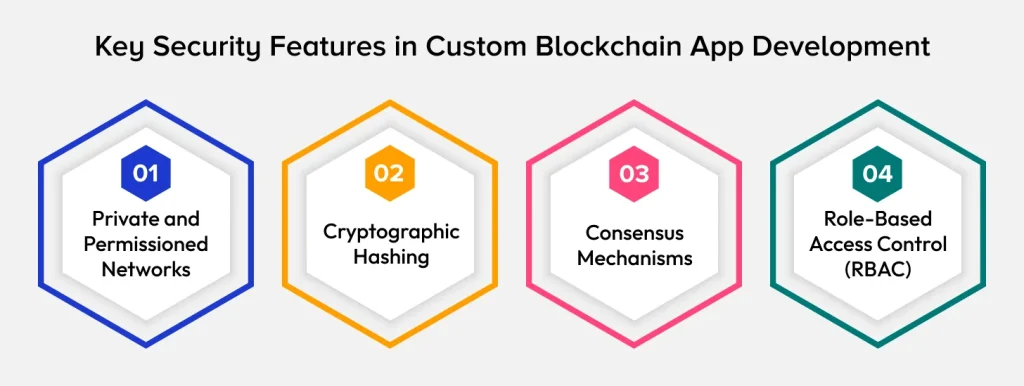
1. Private & Permissioned Blockchain Networks
Private permissioned blockchain networks protect blockchain apps in that they employ access limitation methods, only allow verified participation, and thus preserve the safety of custom blockchain applications in an enterprise setting.
2. Cryptographic Hashing
Cryptographic hashing securing custom blockchain apps is done through the encryption of records, which are thus tamper-proof; therefore, the security of the business blockchain app is also strengthened.
3. Consensus Mechanisms
Consensus mechanisms in general are the means by which secure transaction validation is achieved, so that fraudulent actions are not executed, and trust is kept; thus, they are the primary sources of security in the case of blockchain for enterprises.
4. Role-Based Access Control (RBAC)
RBAC is used for the promotion of blockchain app security by giving permission control a leading role in at the same time cutting down the activities of the unauthorized and helping to comply with custom blockchain applications for enterprises.
Get Services: Stablecoin Development Services
How Custom Blockchain Solutions Reduce Business Vulnerabilities?
By raising blockchain app security, lowering risks to the system, and providing safer enterprise blockchain solutions, mainly because of decentralization and automation, custom blockchain solutions can reduce vulnerabilities that business faces.
1. Eliminating Single Points of Failure
It is through the removal of single points of failure by decentralized blockchain applications that blockchain app security levels are not only raised to a great extent, but also enterprise blockchain solutions are guaranteed to be able to stay up and run without breaks.
2. Fraud Prevention
The foremost goal of security in blockchain-driven apps is the very substantial prevention of fraud. This is achieved through allowing full record transparency, making transactions immutable, and, as a result of the validation of the transactions through automated steps, trust in the blockchain-based environment overall is raised.
3. Secure Data Sharing
Thanks to encryption and permission, custom blockchain applications are engaging in data sharing, which thus makes the blockchain app more secure and also helps enterprise blockchain solutions in coordinating with each other at zero risk.
4. Identity & Access Management
One of the major applications of blockchain technology in the enterprise sector is identity and access management, where it provides security of blockchain applications with verified identities, controlled access, and secure authentication.
Read More: Top Blockchain Consulting Companies in USA
AI in Blockchain Security: A Modern Advantage
The use of AI in blockchain security has the power to make applications more secure through intelligent monitoring, automated analysis, and advanced protection of custom blockchain applications, as well as enterprise blockchain solutions.
1. AI-Driven Threat Detection
The use of AI in the blockchain application security domain allows the application to identify threats by spotting unusual patterns, continuous transaction monitoring, and providing protection for custom blockchain applications against hacks.
2. Predictive Risk Assessment
With the help of AI, risk assessment can be made proactive as it can point out the blockchain trends that are becoming vulnerable, and hence, the decision-making for the enterprise blockchain solutions can be improved with such insights.
3. Automated Smart Contract Audits
The AI that facilitates manual smart contract audits and discovers code defects, checks for compliance, and strengthens the security of blockchain applications for custom blockchain technology is one of the key factors.
Read More: Blockchain Identity Management Guide
Top Use Cases Where Blockchain Boosts Enterprise Security
The development of blockchain applications in the enterprise sector cuts across industries and enhances security by offering transparent, tamper-proof, and automated custom blockchain applications that reduce risks and foster trust. So, here are the blockchain use cases as per the industry.
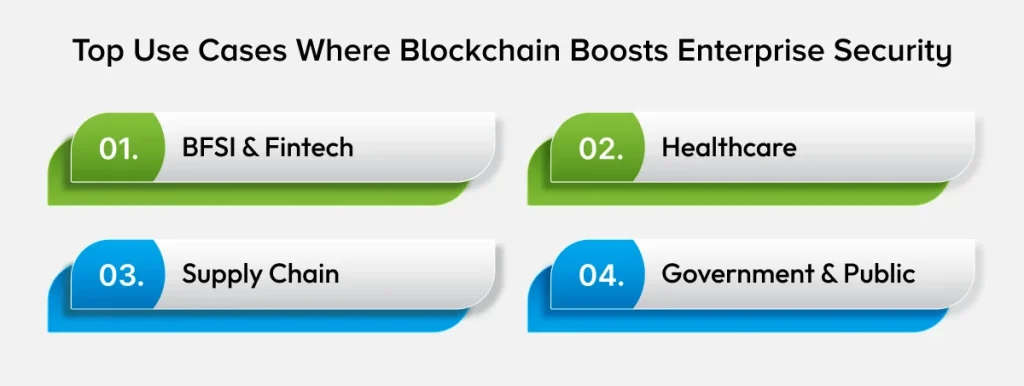
1. BFSI & Fintech
With industry-specific applications of blockchain tech, the financial sector has an easier and faster customer onboarding process through secure KYC data sharing, less risk of fraud, and, in particular, the acceptance of blockchain for payments.
2. Healthcare
The security of medical records by blockchain technology is practical in the healthcare sector, as it associates patient data security and enables compliant sharing through custom blockchain applications for healthcare.
3. Supply Chain
Traceable blockchain applications built on custom enterprise blockchain solutions have transformed the landscape of the supply chain by increasing visibility, facilitating secure transactions, and protecting against counterfeiting.
4. Government & Public Sector
Security associated with blockchain applications guarantees that public data is protected, records are secured, and government sectors operate upon transparent processes throughout the custom blockchain applications.
Enterprise Benefits of Custom Blockchain App Development
The use of custom blockchain applications in the enterprise realm results in strong benefits such as increased transparency, decreased risks, and enhanced security of the blockchain across digital ecosystems.
1. Enhanced Transparency
Besides being immutable and traceable, custom blockchain applications are a great means of making transparency; thus, trust is further strengthened, and the security of the blockchain app is also increased in enterprise blockchain solutions.
2. Reduced Operational Risks
Errors are done away with through automation in custom blockchain applications that also provide operational risk reduction and security enhancement for the blockchain in enterprise solutions.
3. Better Compliance & Auditability
Application of custom blockchain has become indispensable for secure, regulatory-ready enterprise blockchain solutions due to their ability to support better compliance and auditability via immutable ledgers.
Choosing the Right Blockchain App Development Platform
The choice of the blockchain app development platforms has a direct impact on the security, scalability, and thus, the creation of custom blockchain applications as well as the strength of enterprise blockchain solutions.
1. Ethereum
The Ethereum network allows the development of smart contracts and decentralized applications; thus, it is a very stable choice for the security of custom blockchain applications as well as the whole enterprise blockchain solutions.
2. Hyperledger Fabric
Hyperledger Fabric indeed makes permissioned networks available, the very feature that giants in the corporate world will appreciate to a great extent, and the combination of those network features is high privacy, modular architecture, and the strongest security for blockchain apps.
3. Polygon
Polygon allows for blockchain app development that is highly scalable and of low cost, thus letting fast, secure, and custom-made blockchain applications be created for the needs of enterprise blockchain solutions that are growing in number.
4. Solana
Solana comes with high-speed transactions and strong blockchain app security, thus allowing performance-driven custom blockchain applications for modern enterprise blockchain solutions.
How Much Does Blockchain App Development Cost?
A number of factors, including project complexity, selected blockchain app development platform, security level required, and the team’s experience, determine the price of blockchain app development.
Custom blockchain applications are on average between $30,000 and $300,000+, depending on the enterprise’s needs. For the cases of high complexity involving smart contracts, AI integration, and multi-chain functionality, the costs may be even higher.
Team composition, development time, technology used, and security measures required for blockchain apps that can handle large-scale business operations are the main factors influencing the blockchain app development cost.
| Role | Hourly Cost ($) | Estimated Cost Range for Project ($) |
| Blockchain Developer | $50 – $120/hr | $10,000 – $80,000 |
| Smart Contract Developer | $70 – $150/hr | $8,000 – $60,000 |
| Blockchain Architect | $90 – $180/hr | $12,000 – $100,000 |
| UI/UX Designer | $40 – $90/hr | $4,000 – $20,000 |
| Project Manager | $50 – $110/hr | $5,000 – $30,000 |
| QA Tester (Blockchain Testing) | $40 – $80/hr | $3,000 – $15,000 |
| DevOps Engineer | $60 – $120/hr | $4,000 – $25,000 |
| Security Engineer | $80 – $160/hr | $6,000 – $40,000 |
| AI/ML Engineer (If needed) | $90 – $170/hr | $8,000 – $50,000 |
Total Estimated Blockchain App Development Cost: $30,000 – $300,000+
Which Factors Influence Blockchain App Development Cost?
Many factors influence the overall blockchain app development cost. Whenever you develop blockchain applications, you have to consider all these factors in your mind that influence the development cost.
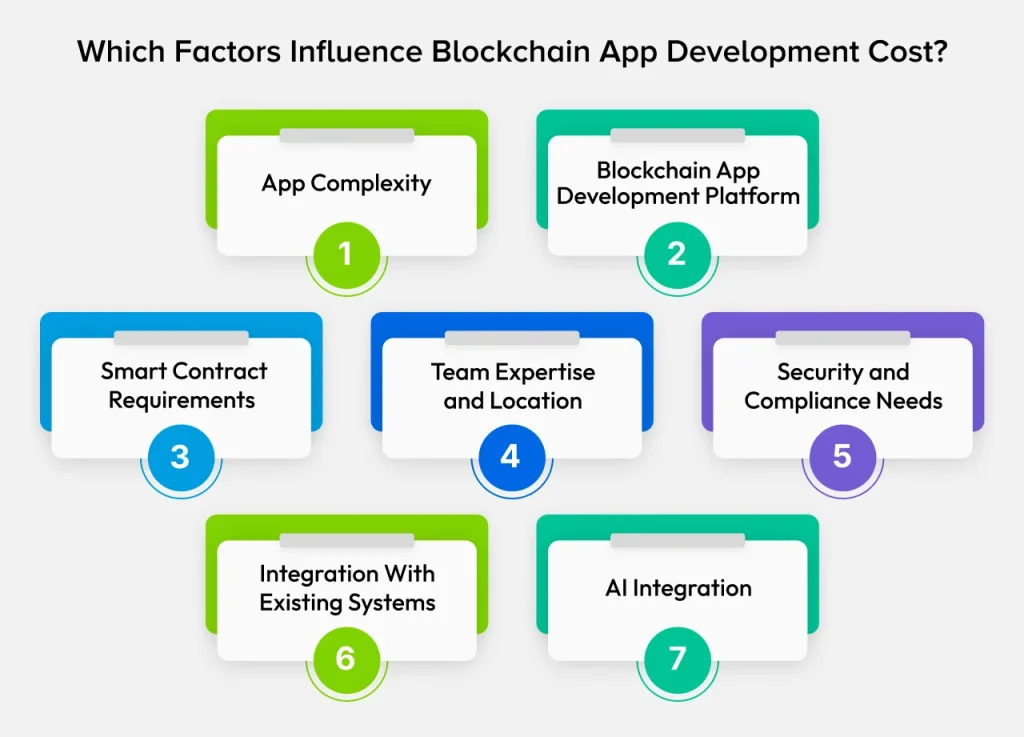
1. App Complexity
The increased complexity in custom blockchain applications drives up the overall cost of blockchain app development considerably, including, to a great extent, the development hours, smart contract logic, and security layers.
2. Blockchain App Development Platform
The choice of Ethereum, Hyperledger, Polygon, or Solana as the platform for blockchain app development will significantly affect the cost because of the contrast in the demand for scalability, tools, and enterprise blockchain solutions.
3. Smart Contract Requirements
Smart contracts that are sophisticated lead to an increase in security requirements for blockchain apps, testing, and architecture, which are all directly impacting the cost of custom blockchain applications.
4. Team Expertise & Location
Going for the best blockchain development firms or hiring senior professionals will definitely cost more, but it will also guarantee that the enterprise blockchain solutions are secure, of high quality, and have very few vulnerabilities.
5. Security & Compliance Needs
The total cost of each project concerning blockchain app development will be higher for enterprise blockchain solutions needing audits, encryption, compliance modules, and robust app security.
6. Integration With Existing Systems
The process of making custom blockchain applications work with on-premise systems, APIs, or enterprise tools is going to be more complex, and that will not only lead to longer development time but also an increase in the overall cost.
7. AI Integration
For the addition of AI in the blockchain to cover areas like threat detection, predictive analysis, and automation, the cost of development will increase because of the complexity of development, and thus, the total blockchain app development cost will increase.
How to Choose a Reliable Blockchain Development Company?
To select a trustworthy blockchain development service provider, one must first examine their technical skills, look through their project base, and take note of the length of time they have been in the business of designing secure custom blockchain applications. It would be more beneficial if you could first determine whether the company deals mainly with enterprise blockchain solutions, smart contracts, and advanced blockchain app security.
Besides, would they not have a good grasp on these blockchain platforms, like Ethereum, Hyperledger, Polygon, and Solana, raise a flag? Their knowledge of blockchain app development for fintech, supply chain, and healthcare industries.
Top dapp blockchain development agencies would be the ones who incur less risk as a result of communicating transparently, having strong QA procedures, and cost structures that are clear to all parties involved in the development of a scalable, future-ready, and successful blockchain app.

Conclusion
Blockchain technologies with features tailored to different user groups have the potential to radically change how enterprises maintain security by decentralizing control, providing unalterable data, and giving rise to more advanced forms of automation.
With the help of more robust blockchain app security, businesses will be in a position to totally wipe out the loopholes that fraudsters operate through, prevent that menace, and guarantee transparency of the operations that take place in any sector of the economy.
In the meantime, the use of AI solutions in blockchain technology is opening up new ways through which enterprises can become safer thanks to intelligent monitoring and predictive risk insights.
The careful selection of a blockchain application development strategy and the decision to collaborate with the top blockchain development companies will assure enterprise blockchain solutions that are not only scalable but also secure and future-ready, thus capable of leading to digital trust in the long run.
Visit More: Best Blockchain Development Companies in mexico


 Get in Touch
 By
By September 8, 2026