


Are you looking for legacy application modernization services but unsure about various aspects? If yes, you have landed on the right page.
In a modern, globalized, and digitalized world, companies that rely on outdated software are increasingly struggling with scalability, security, and customer experience.
Legacy applications, which might have been essential in the past, may turn out to be expensive, sluggish, and rigid. Firms are also spending more on legacy application modernization services to future-proof their IT environments.
We at Octal IT Solution offer full-fledged legacy software modernization services to enable enterprises to upgrade their inefficient legacy systems to modern cloud platforms.
This guide is deep into the advantages, problems, and costs of legacy application modernization, strategies and tools.
- Why Legacy Application Modernization is Important?
- Benefits of Legacy Application Modernization
- Challenges of Legacy Application Modernization
- Cost of Legacy Application Modernization
- Legacy Application Modernization Strategies
- Top Approaches for Legacy Application Modernization
- Why Octal IT Solution for Legacy Modernization?
- Conclusion
Why Legacy Application Modernization is Important?
Legacy application modernization is significant to eliminate security risks, reduce high maintenance costs, and improve operational efficiency. Experts have predicted that the application modernization services market will reach USD 51.45 billion by 2031, growing at a CAGR of 14.6% between 2024-2031.
Upgrading the outdated apps definitely enhances the scalability, helps in adopting trending technologies like AI, boosts user experience, and helps businesses to remain competitive in the market.
Benefits of Legacy Application Modernization
There are several benefits of modernization of legacy systems. Companies investing in legacy modernization solutions have the ability to enhance their operational efficiency, cut costs, and increase their competitiveness through digital transformation services.
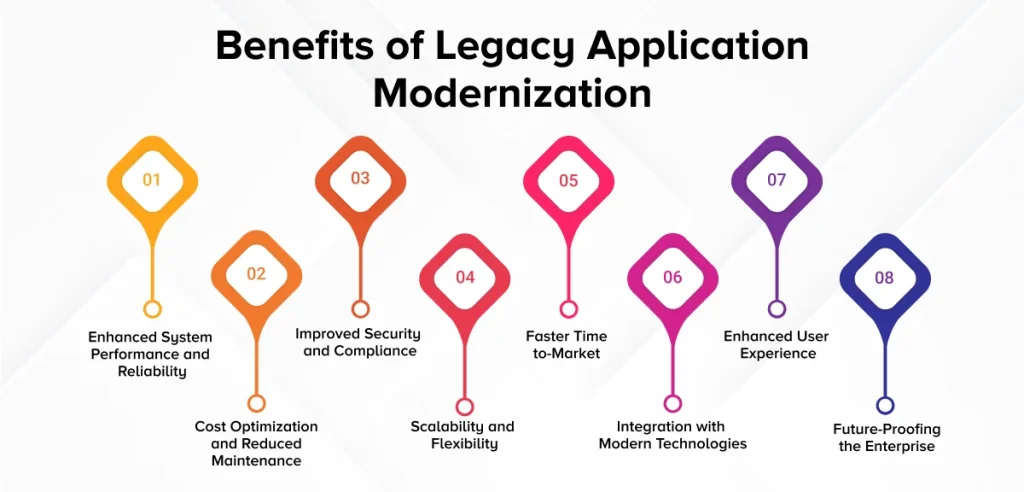
1. Enhanced System Performance and Reliability
The old systems usually fail to perform to the current standards. On renewal of legacy applications, the code is optimized, the obsolete infrastructure is eliminated, and scalable architectures are introduced. Businesses enjoy quicker processing of transactions, the lowest possible downtimes, and dependable business operations, which assure business continuity and consumer satisfaction.
2. Cost Optimization and Reduced Maintenance
The legacy application maintenance services are costly because of the expensive infrastructure and expert workers. By increasing efficiency and cutting costs of the operations, the organizations cut down the expenses of operation through the legacy software modernization development solutions. Therefore, Recurrent maintenance costs are also reduced with the help of automation and cloud migration.
3. Improved Security and Compliance
The systems are outdated and are susceptible to cyber threats. Legacy systems renovation presents new encryption, secure authentication, and compliance readiness structures. This safeguards confidential information, regulatory provisions, and risks of using obsolete technology.
4. Scalability and Flexibility
Businesses are able to expand resources dynamically by cloud application modernization services from legacy to cloud. Cloud-native systems will enable the capacity to be adjusted in a flexible way to provide the best performance when the demand is at its highest point.
5. Faster Time-to-Market
The agile development and DevOps pipelines are supported with renewal applications. The legacy app modernization services are allowing the organizations to launch new services more quickly, quickness in responding to changes in the market, as well as ensuring a competitive edge.
6. Integration with Modern Technologies
Legacy systems tend to be closed systems, which prevent innovation. Modernizing legacy applications will allow connecting with AI, the Internet of Things, analytics, and third-party APIs. Businesses obtain operational intelligence, live reporting,g and actionable insights.
7. Enhanced User Experience
The old interfaces confuse the users and lower productivity. Software product modernization can enable organizations to redefine workflows, increase usability, and increase availability. Upgraded systems are efficient for employees andlead to better customer satisfaction.
8. Future-Proofing the Enterprise
Legacy IT modernization is an investment that will make the enterprise agile enough, competitive enough, and up to date with technology in future innovations. Modernization of the legacy minimizes the technical debt and provides a strong basis to grow with the current market trends, such as AI development.
Let us have a clearer understanding of the key legacy modernization benefits through the table below.
| Benefit Area | Legacy Systems Status | After Modernization | Business Impact |
| Performance | Slow, limited capacity | Optimized, high-speed | Reduced downtime, improved efficiency |
| Cost | High maintenance and infrastructure | Lower operational costs | Significant savings over time |
| Security | Vulnerable, non-compliant | Up-to-date security standards | Regulatory compliance and reduced cyber risk |
| Scalability | Rigid, manual upgrades | Elastic, cloud-ready | Supports growth without heavy investment |
| Time-to-Market | Slow release cycles | Agile, DevOps-enabled | Faster deployment of features |
| Integration | Siloed systems | Fully integrated with modern tech | Real-time data insights and automation |
| User Experience | Outdated interface | Modern UX/UI | Increased productivity and customer satisfaction |
| Future-Proofing | Technical debt | Cloud-native and agile | Long-term sustainability and competitive advantage |
Challenges of Legacy Application Modernization
While renewal offers significant benefits, enterprises face application modernization challenges that require careful planning and execution.
| Challenge | Risk if Unaddressed | Mitigation Strategy |
| Complex code | Project delays | Phased refactoring and code audits |
| Operational disruption | Downtime, revenue loss | Parallel deployment, rollback plans |
| Data migration | Data loss or corruption | Automated validation and incremental migration |
| Skill shortage | Project dependency | Engage expert legacy software modernization developers |
| Integration issues | System failure | API-based modernization and testing |
| Resistance to change | Low adoption | Training, stakeholder engagement |
| Budget overruns | Financial strain | Realistic estimates, phased approach |
| Regulatory compliance | Legal penalties | Compliance assessment and audits |
1. Complex and Unstructured Legacy Code
Most legacy systems were built several decades ago and are poorly documented. Legacy modernization of software can be time-consuming and complex, often including reverse engineering the code, knowing the dependencies, and refactoring complex modules.
2. Risk of Operational Disruption
The migrating legacy applications can potentially cause a temporary impact on the business processes. Businesses should use gradual methodologies, tests, and roll-backs in order to reduce the amount of time they are down to ensure that operations do not stall.
3. Data Migration Complexity
The process of data migration from legacy systems to modern databases entails the transfer of huge amounts of data in a safe manner. Unless migration processes are handled carefully, the risks of data inconsistency, format changes, and corruption may occur.
4. Limited Availability of Skilled Professionals
It is hard to find qualified legacy software modernization developers or legacy iOS modernization developers. Obsolete systems demand specific skills, which means greater reliance on established IT consulting services providers.
5. Integration Challenges
The legacy systems are usually tightly integrate with other applications. Modernization can also cause integrations to break as long as the legacy modernization tools are not configured appropriately, and hence, a careful dependency analysis and testing are necessary.
6. Resistance to Change
The modernization can be opposed by employees and stakeholders who are used to the old systems. IT legacy modernization is one of the aspects that needs a systematic change management, training, and communication strategies in place in order to be adopted.
7. Budget and Timeline Uncertainty
The legacy app modernization services may increase the costs and schedule unless proper planning. Selecting the appropriate legacy modernization approach is critical to foreseeable results.
8. Compliance and Regulatory Concerns
Some spheres of life, like banking or healthcare, are strict. The process of modernizing legacy systems should not go against regulations, which should require specialized knowledge and extra testing.
Cost of Legacy Application Modernization
One of the most important matters of the legacy application modernization services is cost. The legacy software development cost is dependent on the size of the enterprise, the complexity of the system, the level of modernization, and the level of cloud adoption.
1. Cost by Modernization Strategy
Different legacy system modernization approaches involve varying levels of investment.
| Modernization Approach | Typical Effort | Estimated Cost (USD) | Benefits |
| Rehosting (Lift & Shift) | Low | $50,000 – $150,000 | Quick migration with minimal disruption |
| Refactoring | Medium | $100,000 – $250,000 | Optimized code, better performance |
| Re-architecting | High | $200,000 – $400,000 | Scalability, microservices adoption |
| Rebuilding | Very High | $300,000 – $600,000 | Complete system overhaul |
| Replacing with SaaS | Medium | $100,000 – $300,000 | Reduced maintenance overhead, faster deployment |
Enterprises often combine approaches (e.g., rehosting + refactoring) for cost efficiency and reduced risk.
2. Cost by Enterprise Size
The cost of modernization also depends on business scale and system complexity.
| Enterprise Size | System Complexity | Estimated Cost (USD) |
| Small | Single application, minimal integrations | $50,000 – $120,000 |
| Medium | Multiple modules, several integrations | $150,000 – $350,000 |
| Large | Enterprise-wide systems, multi-department integrations | $400,000 – $800,000 |
| Global | Multi-region systems with regulatory compliance | $800,000 – $1,500,000 |
Large-scale enterprises often require phased modernization to manage costs and operational continuity.
3. Detailed Cost Breakdown
A granular view of cost components highlights where investments are allocated.
| Cost Component | Estimated Range (USD) | Description |
| Assessment & Planning | $10,000 – $30,000 | System audit, dependency mapping, strategy development |
| Development & Refactoring | $50,000 – $300,000 | Code optimization, feature enhancement, UI/UX redesign |
| Cloud Migration | $20,000 – $150,000 | Infrastructure setup, cloud configuration, security |
| Data Migration | $20,000 – $100,000 | Secure transfer to modern databases, validation |
| Testing & QA | $15,000 – $50,000 | Performance, security, and integration testing |
| Training & Change Management | $5,000 – $25,000 | Employee onboarding, stakeholder engagement |
| Ongoing Support | Variable | Maintenance, monitoring, and continuous improvements |
The estimated cost for legacy application modernization services for a medium-sized enterprise will require about $250,000 -600,000 USD in total cost, which depends on the complexity and the approach of choice. Big-scale projects may be more than $1,000,000 USD.
4. Cost Comparison: Legacy Maintenance vs Modernization
| Cost Type | Annual Legacy Maintenance (USD) | Modernization Investment (USD) | ROI Timeline |
| Small Business | $30,000 – $50,000 | $50,000 – $120,000 | 1–2 years |
| Medium Business | $100,000 – $200,000 | $250,000 – $600,000 | 2–3 years |
| Large Enterprise | $300,000 – $500,000 | $800,000 – $1,500,000 | 3–5 years |
Mobile app development or modernization offers higher ROI within 2–5 years, reducing ongoing maintenance and enabling faster growth.
Legacy Application Modernization Strategies
There are several legacy application modernization strategies, so let us have a look at the table for the legacy modernization strategies.
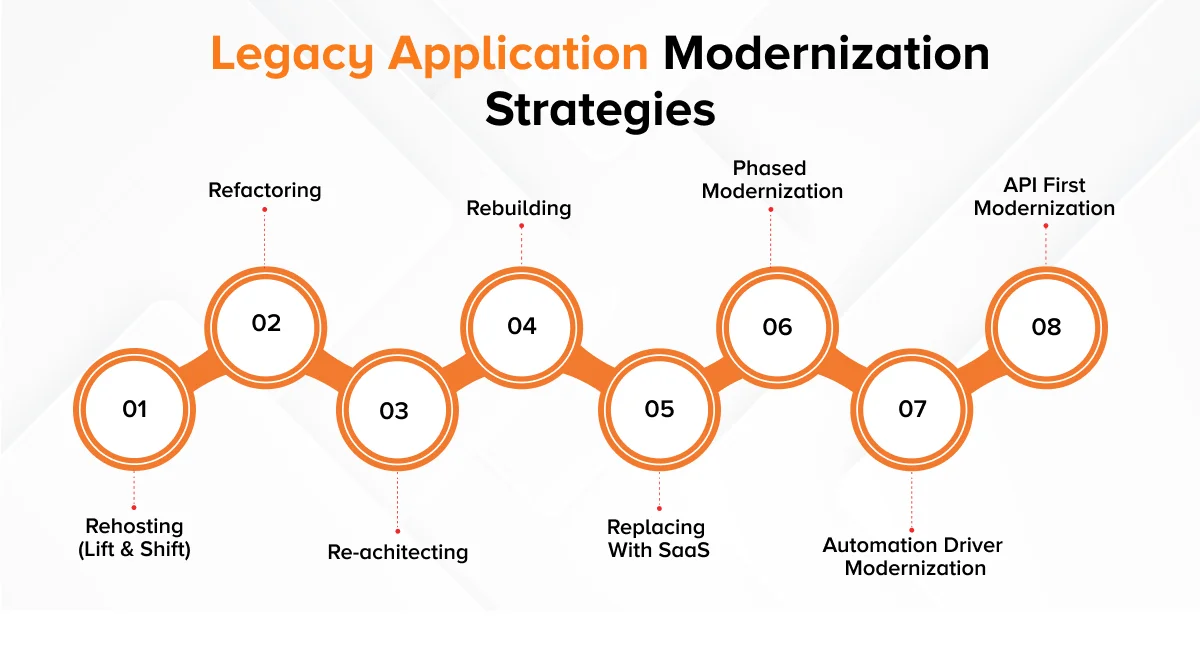
| Strategy | Key Features | Best Use Case | Benefits |
| Rehosting | Lift & Shift | Quick cloud migration | Fast deployment, low risk |
| Refactoring | Code optimization | Moderate updates | Improved performance |
| Re-architecting | Redesign | Scalability & microservices | Long-term agility |
| Rebuilding | Complete rewrite | Obsolete systems | Modern functionality |
| Replacing SaaS | SaaS adoption | Standard processes | Reduced maintenance |
| Phased | Incremental update | Large systems | Low risk, continuous operation |
| Automation | CI/CD integration | Agile teams | Faster delivery, fewer errors |
| API-First | API design & integration | Complex ecosystems | Seamless interoperability |
1. Rehosting (Lift & Shift)
Migration of old applications to new infrastructure is done at a very fast pace and with minimal changes, which minimizes disruption and takes advantage of cloud computing solutions.
2. Refactoring
Performs code optimization to enhance the performance and support the code without modifying its functionality, which is helpful in modernizing legacy applications.
3. Re-architecting
Scalability and adoption of microservices. Redesigns architecture necessary for scalability and use by enterprise-wide systems.
4. Rebuilding
Modernize applications with new technology stacks, which are suitable for outdated systems.
5. Replacing with SaaS
Transforms old programs into new software as a service, saves on maintenance, and expedites implementation.
6. Phased Modernization
All updates are performed on a component-by-component basis, reducing the risk and ensuring continuity in the process of legacy application migration services.
7. Automation-Driven Modernization
Eliminates manual work and errors through legacy modernization tools included in DevOps pipelines.
8. API-First Modernization
Provides a seamless interface with other contemporary systems and platforms, which makes it more interoperable.
Top Approaches for Legacy Application Modernization
We have a clear and tested process of legacy application modernization services at Octal IT Solution, which guarantees the minimum impact, predictable cost, and quantifiable business value with real legacy modernization examples.
Our methodology will include technical skills, quick delivery, and top legacy modernization tools to make old systems scalable, secure, and performance-driven.
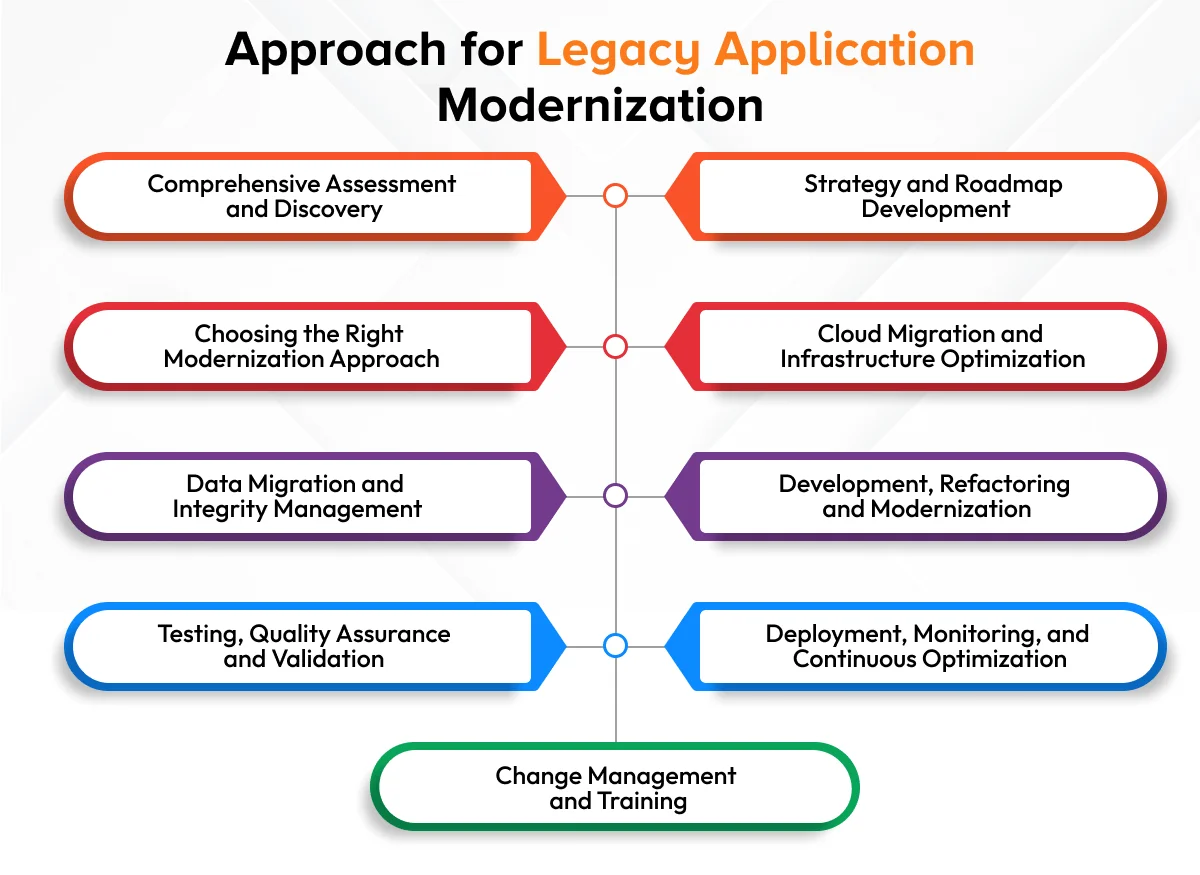
1. Comprehensive Assessment and Discovery
We begin with a comprehensive audit of your current systems, pain points, dependencies, and technical debt. This encompasses infrastructure assessment, quality of code, integrations, and data structures.
Through an in-depth evaluation, we work out the best legacy modernization approach, that is, rehosting, refactoring, re-architecturing, or rebuilding, based on your business requirements.
2. Strategy and Roadmap Development
On the basis of assessment findings, we develop a comprehensive roadmap of modernization. This identifies gradual migration schemes, milestones, and schedules of legacy application modernization companies as the least amount of disturbance to the current operations happens.
High-impact modules are also put on our roadmap centre in order to see our highest ROI and incremental performance.
3. Choosing the Right Modernization Approach
Each of the legacy systems is individual. Our group suggests the best legacy application modernization strategies, rehosting to the cloud, refactoring to achieve better performance, re-architecting to microservices, or rebuilding. Another aspect we determine is the possibility of software product modernization or SaaS replacement based on business goals.
4. Cloud Migration and Infrastructure Optimization
Our focus remains on application modernization services from legacy to cloud that will help enterprises to use cloud infrastructure that is resilient, scalable, and cost-effective. Our cloud migration cycle comprises secure data transfer, environment configuration, performance optimization, and after-migration monitoring to ensure smooth operations.
5. Data Migration and Integrity Management
Migration of the data in legacy systems to up-to-date database platforms is one of the main concerns of our strategy. We apply automated systems and validation frameworks to guarantee compliance, accuracy, and consistency of data. This action will remove the risks of migration, and keep business-critical information secure and available.
6. Development, Refactoring, and Modernization
Code refactoring, addition of new features, and modernization of old modules are features that our legacy software modernization developers apply. We also make your user interface more modern, make it perform better, and add modern technologies, like APIs, analytics, and AI, to future-proof your apps.
7. Testing, Quality Assurance, and Validation
The assurance of quality is establish in all stages. We carry out strict functional, performance, and security tests to ensure modernized applications meet enterprise standards. Continuous integration and automated testing aid in the detection of problems at an earlier stage and minimize risks of operation during the deployment.
8. Deployment, Monitoring, and Continuous Optimization
Modernized systems are introduced gradually and without much downtime, so that there is a smooth transition. We constantly track the performance, security, and scalability after deployment. Modernizing legacy applications is a long-term investment as it is sustainable and optimized through continuous support.
9. Change Management and Training
In order to achieve successful adoption, we offer training programs, workshops, and change management support. New workflows, interfaces,s and tools are used to guide employees and stakeholders in the process of ensuring maximum productivity and a seamless changeover of old systems.
Why Octal IT Solution for Legacy Modernization?
The first question after this discussion that must be coming to your mind will be Why are modernizing legacy systems services being taken from Octal IT Solution. Our team provides full services of legacy application modernization and legacy system modernization. We are a combination of talented legacy software modernization developers, legacy iOS modernization developers, cloud architects, and agile software experts to provide custom, enterprise-scale solutions to legacy modernization.
Our end-to-end solution involves minimal disruption, optimum cost, and ROI, which ensures proper support from assessment to post-deployment.
Conclusion
Legacy application modernization is no longer a choice; it is a strategic necessity. Modernized businesses have quicker performance, lower cost, greater security, and systems that will not be outmoded in the future.
By collaborating with the team of Octal IT Solution, the transition to the old system and the adoption of dynamic and cloud-based systems will be a smooth process, which will open the gates to successfully operating the organization, innovation, and sustainable growth.
Modernization cost is normally between 250,000 and 600,000 USD to medium enterprises and above 1,000,000 USD to large enterprises, and ROI is notice in 2 to 5 years.
So, are you ready to modernize your outdated apps? Contact us now and get the best consulting service for legacy system updates.
FAQs

 By
By September 10, 2026



 Latest Stories
 Get in Touch