


Key Highlights
| – AI is transforming every phase of web development- from planning and design to deployment and optimization. – Businesses are leveraging AI for personalization, chatbots, automated testing, and performance optimization. – AI-powered tools enable faster delivery, lower costs, improved code quality, and better user experiences. – The future of web development lies in autonomous workflows, hyper-personalization, and AI-first frameworks. |
- Key Highlights
- Breaking it Down
- Quick Market Overview of AI in Web Development
- How AI is Used in Web Development: Key Applications
- Top AI Tools for Web Development in 2026
- Benefits of AI in Web Development
- AI-Driven Web Development Lifecycle Process
- Future Trends: What's Next for AI in Web Development
- How to Get Started with AI in Your Web Projects?
- Closing Thoughts
- FAQs
Breaking it Down
Businesses nowadays are finding ways to grow digitally, and one of the most common and cost-effective solutions is Web Development. This allows businesses immediate, platform-independent access via browser and serves as the primary entry point for user acquisition. But as the market is undergoing fundamental changes, it is equally important for businesses to know what can help them improve.
Right now, the answer is Artificial Intelligence. AI in web development is no longer a fantasy; it is changing how websites and applications are designed, built, and maintained. Works that previously required weeks to be done now take less time and cost.
Intelligent coding tools and real-time personalization are just a few of the ways AI is helping companies make digital business products smarter and more competitive. As a developer, business owner, or product leader, it is now important to know how AI can be used in web development.
This blog explores its key applications, benefits, and future trends shaping the next generation of web development.
Quick Market Overview of AI in Web Development
The adoption of AI in web development is growing rapidly due to increasing digital transformation across industries.
- In 2026, the global web development market is estimated at around $87.75 billion, with steady growth expected.
- Global AI spending is projected to surpass $2 trillion in 2026, reflecting strong investment in AI-driven technologies.
- The market is growing very fast and is expected to cross 8.87% CAGR in the period 2026-2031.
- AI-powered website builders are also expanding fast, with the market expected to reach $25 billion by 2035.
AI will continue to drive faster development, lower costs, and more personalized user experiences in the coming years.
| Key figure to note: AI-driven tools reduce development times by up to 35% through automated coding and design generation, a direct productivity multiplier for every team using them. |
How AI is Used in Web Development: Key Applications
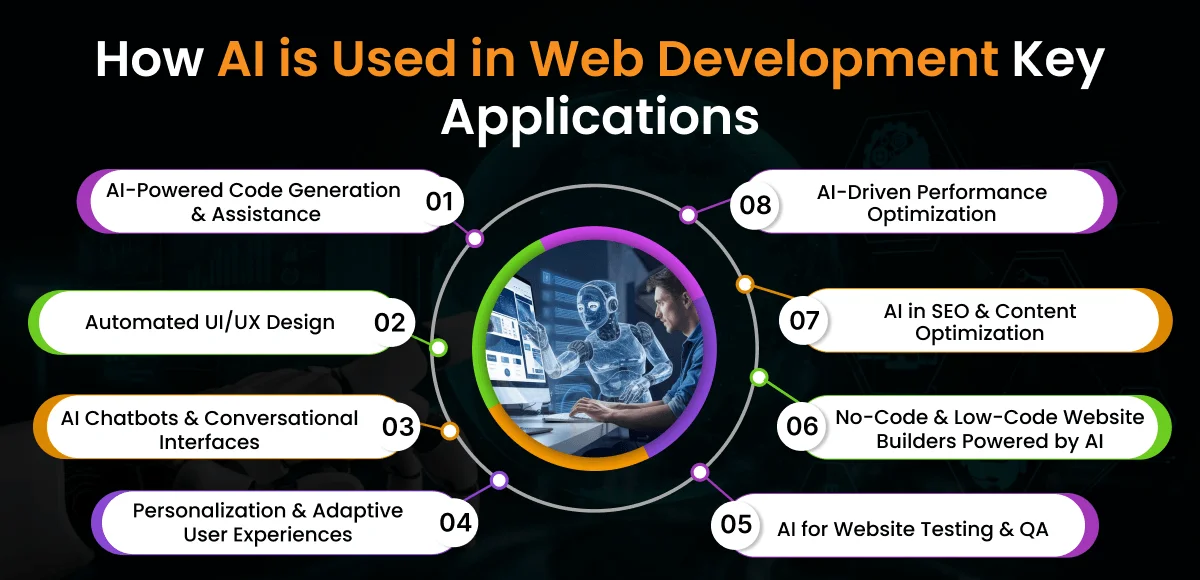
The use of AI in website development spans the entire product lifecycle. Below are the most impactful application areas that are redefining how web products are built in 2026.
1. AI-Powered Code Generation & Assistance
Intelligent code generation is one of the most widely adopted innovations in AI-driven web development services. Tools like GitHub Copilot, Cursor, and Claude Code act as always-on partners in code creation. They suggest the next line of code, complete functions, detect bugs, and generate tests and documentation. These tools also understand project environments, APIs, and coding styles. This helps reduce time spent on repetitive boilerplate and improves overall development efficiency.
As per the reports, 35–50% faster development, making AI a strong productivity booster.
2. Automated UI/UX Design
AI is changing design from a manual process that is time-consuming to an iterative and quick shortcut. The ability to transform a plain-text prompt into an entire responsive web layout can happen in seconds on platforms such as Framer AI. The AI capabilities of Figma propose the optimization of the layout, the automatic creation of design tokens, and the detection of accessibility problems, all in the design process. More tools, such as v0 by Vercel, go even further and generate working React components based on natural language descriptions.
Around 58% of designers use AI, with nearly 40% relying on it daily.
3. AI Chatbots & Conversational Interfaces
Modern AI chatbots developed by the experts from a leading ai chatbot development company understands context, handle conversations, and deliver personalized responses with smooth human handoff when needed. They are widely used across industries to reduce response time, lower support costs, and improve user engagement. They are now a standard feature in modern web applications.
Around 80% of businesses use AI chatbots that understand context, handle conversations, and personalize responses.
4. Personalization & Adaptive User Experiences
AI transforms websites from static experiences to dynamic, personalized journeys by analyzing user behavior and preferences in real time. With modern AI based web development tools, businesses can deliver tailored content, recommendations, and user experiences at scale.
Can increase user engagement by up to 70%, making it a high-ROI feature.
5. AI for Website Testing & QA
Testing is one of the most time-consuming phases in web development, but AI-powered tools automate test creation, detect visual issues, simulate user behavior, and identify performance problems. Tools like Testim, Mabl, and Playwright AI offer self-healing tests, reducing maintenance efforts. AI also strengthens security by scanning code for vulnerabilities, compliance issues, and threats before deployment.
With cyberattacks rising by 25% annually, AI-driven security testing is now essential for modern web projects.
6. No-Code & Low-Code Website Builders Powered by AI
The emergence of no-code and low-code AI builders is also among the most democratizing impacts of AI on web development. Such tools as Bubble, Webflow AI, and Wix ADI are now open to non-technical users, marketers, product managers, and entrepreneurs to create functional, responsive web experiences without typing a single line of code.
Around 70% of applications are built using low-code/no-code technologies.
7. AI in SEO & Content Optimization
AI has revolutionized search engine optimization. Automated keyword clustering and content gap analysis, as well as on-page suggestions in real-time and the creation of meta-descriptions with AI tools such as Surfer SEO, Clearscope, and the AI capabilities of Semrush, help development and content teams to create pages that rank. This is often the intersection between web development and AI, where developers are directly embedding AI-driven SEO audits into CMS workflows and deployment pipelines.
Websites using AI for SEO have seen up to 45% increase in organic traffic and 40% higher CTR, proving its impact on rankings and engagement.
8. AI-Driven Performance Optimization
Page speed and Core Web Vitals serve as essential ranking elements, which AI enhances through its capabilities in image compression, resource prefetching, and CDN optimization powered by advanced machine learning solutions. This also enable the system to identify performance problems at an early stage while maintaining a consistent user experience across various devices,
AI-powered optimization and personalization can improve user engagement by up to 20–25%, directly impacting performance and conversions.
Also Read: Low-Code vs. No-Code Development: Key Differences and Benefits
Top AI Tools for Web Development in 2026
The AI powered web development tools have reached a high level of maturity. The following is a dissection of the best tools of type currently in active use by development teams.
| Category | Tools |
| AI Coding Assistants | GitHub Copilot, Cursor, Claude Code, JetBrains AI |
| AI Design Tools | Framer AI, Figma AI, v0 by Vercel, Canva AI |
| AI Testing & Debugging Tools | Mabl, Testim, Sentry AI, Snyk AI |
| No-Code & Low-Code AI Builders | Webflow AI, Bubble, Wix ADI, Durable |
When choosing among these AI tools in web development, the key is matching the tool’s capabilities to your specific use case, whether that’s accelerating code review, automating QA, or enabling non-technical stakeholders to build faster.
Benefits of AI in Web Development
Understanding what are the benefits of artificial intelligence web development requires looking at both quantitative outcomes and strategic advantages. The case is compelling across every dimension.
1. Dramatically Faster Development Cycles
The single most cited benefit is speed. The developers said that AI-based design tools had reduced the average time of development by 35 percent, and AI-based programming and code-generation can reduce development time by up to 50 percent. This is transformative to teams that release features on a tight release date.
Using AI in web development effectively means your team spends less time on scaffolding, boilerplate, and repetitive debugging. This allows them to focus more on architecture, product thinking, and creative problem-solving.
2. Significant Cost Reduction
The reduction of development cycles will result in decreased costs. Smaller teams are able to provide what would have needed larger headcounts, with the help of AI. No-code and low-code AI platforms enable the marketing and product teams to create and test web experiences without queuing in the engineering line. In the case of early-stage companies and enterprises, the overall development costs can be cut down to 30% – 40% by the use of AI web development strategies that leverage these tools.
3. Improved Code Quality & Fewer Bugs
It is not just AI coding assistants that write code, but they also look at it. The checks are incorporated within the code, and when it is written, the checks indicate possible bugs, security weaknesses, and anti-patterns before it reaches a pull request. This moves the quality control to the left of the development lifecycle, which makes the downstream correction of the errors cheaper and less complex.
4. Enhanced User Experience & Personalization
Web applications can be personalized to an extent that it was wielded only by the biggest tech giants due to the use of artificial intelligence. User interactions can be enhanced by up to 70 percent using AI-based recommendation engines, dynamic content layouts, and search prediction. In the case of e-commerce, media, and SaaS platforms, it directly reflects in the increased conversion rate, the increased session time, and retention.
5. Stronger Website Security
The role of AI in web development extends to cybersecurity. The AI-based tools can scan vulnerabilities, analyze traffic to identify anomalies constantly, and can automatically fix or identify problems in real-time. The increasing prevalence of web cyberattacks by 25 percent per year makes the adoption of AI-guided security into the development cycle no longer a luxury for any web product with any integrity.
6. Accessibility at Scale
AI is helping make websites more accessible by automatically checking accessibility standards, adding image descriptions, improving screen reader support, and fixing color contrast issues. Websites following accessibility guidelines have grown by 18% in two years, with AI playing a big role. Businesses using AI development services can reduce legal risks and reach a wider audience.
AI-Driven Web Development Lifecycle Process
Perhaps one of the most notable changes modern software engineering has seen is the integration of artificial intelligence in web development into all development lifecycle stages of the development process, not just the code. The knowledge of the AI-based development lifecycle assists the teams in determining where they can leverage the most of all.
Phase 1: Planning & Requirements
Product teams can use AI tools to review user data to identify feature gaps, understand user sentiment, and prioritize the product backlog based on usage and sentiment data. The unstructured user interviews and support tickets may be converted into development requirements through natural language processing.
Phase 2: Design
AI design tools create wireframes, component libraries, and complete page designs based on prompts of text or existing brand guidelines. They propose color schemes, accessibility enhancements, and breakpoint responsiveness – radically decreasing the design-to-handoff timeline.
Phase 3: Development
Here, the most evident effect is achieved by AI-powered web development tools. AI code assistants produce boilerplate, autocomplete features, and write unit tests and recommend refactors. The effects of AI on web development at this stage are fairly established: the teams record time savings on development work ranging between 30 and 50 percent most of the time.
Phase 4: Testing & QA
AI is automated to generate test cases, visual regression testing, and performance benchmarking. Self-healing test frameworks automatically adjust to changes in UI elements and also incur smaller overheads in test maintenance. This significantly improves testing efficiency, reduces manual effort, and ensures faster, more reliable software releases.
Phase 5: Deployment & Monitoring
AI is included in CI/CD pipelines to indicate high-risk code changes, deployments are optimized, and rollback decisions are automated. After deployment, AI surveillance software identifies anomalies in real time, be it a drop in performance, an increase in the error rate, or a security breach.
Phase 6: Optimization & Personalization
The AI is continually analyzing user behavior after launch in personalizing content, optimizing conversion funnels, and suggesting UX improvements. This completes the feedback loop and allows an endless process of AI-powered enhancement – such that web development and AI become not only a build-phase tool but also a business intelligence layer that is constantly being enhanced by its own processes.
Read More: AI in Digital Transformation: Strategy, Use Cases & ROI
Future Trends: What’s Next for AI in Web Development
The future of AI in web development is defined by greater autonomy, deeper personalization, and the convergence of AI with a new generation of web technologies. Here are the trends shaping the next five years.
1. Agentic AI & Autonomous Development Workflows
The agentic AI allows systems to plan, implement, and finalize the development processes on their own, such as writing the code, testing, and deployment, and instead of implementing the code manually, developers should act as observers, strategists, and decision-makers.
2. AI-First Frontend Frameworks
AIs are being integrated into the core of new frontend frameworks that can automatically generate components, create and maintain personalized user interfaces in real-time, and inherently A/B test how developers create and optimize future user interfaces. This development is one of the most significant emerging technologies to frontend engineers.
3. Hyper-Personalization at Scale
AI can also be used to provide extremely personalized experiences, through dynamically presenting content, layouts, and user journeys in real time, and with artificial intelligence web development services, businesses can speak to users individually at scale, without manually configuring or maintaining.
4. Voice & Conversational Interfaces
AI is giving rise to voice-first and conversational web experiences, which allow natural language interactions, voice navigation, and more intelligent user interactions, making a website more accessible and meeting changing search behavior.
5. AI + AR/VR for Immersive Web Experiences
The intersection of WebXR, 3D assets created by AI, and spatial computing is creating a new edge in web development. Artificial intelligence is starting to create immersive product demos, AR overlays that people can use in stores, and 3D configurators, and it can be accessed directly on the Web, without the need to install a native application.
6. Edge AI & Real-Time Intelligence
The ability to perform AI inference at the edge, closer to users on CDN nodes instead of centralized servers, enables real-time capabilities by drastically reducing latency. This is especially valuable for personalization, fraud detection, and content moderation, where milliseconds matter. Edge AI is one of the most exciting advancements in AI and ML in web development.
7. AI in Web3 & Decentralized Applications
Web3 AI is driving smarter decentralized apps with smart contract audit, DAO optimization, and Frontend generation that assist programmers in developing intelligent systems within decentralized ecosystems that are changing.
How to Get Started with AI in Your Web Projects?
Knowing how to integrate AI in web development effectively requires a structured approach. Here is a practical roadmap for teams at any stage of AI adoption.
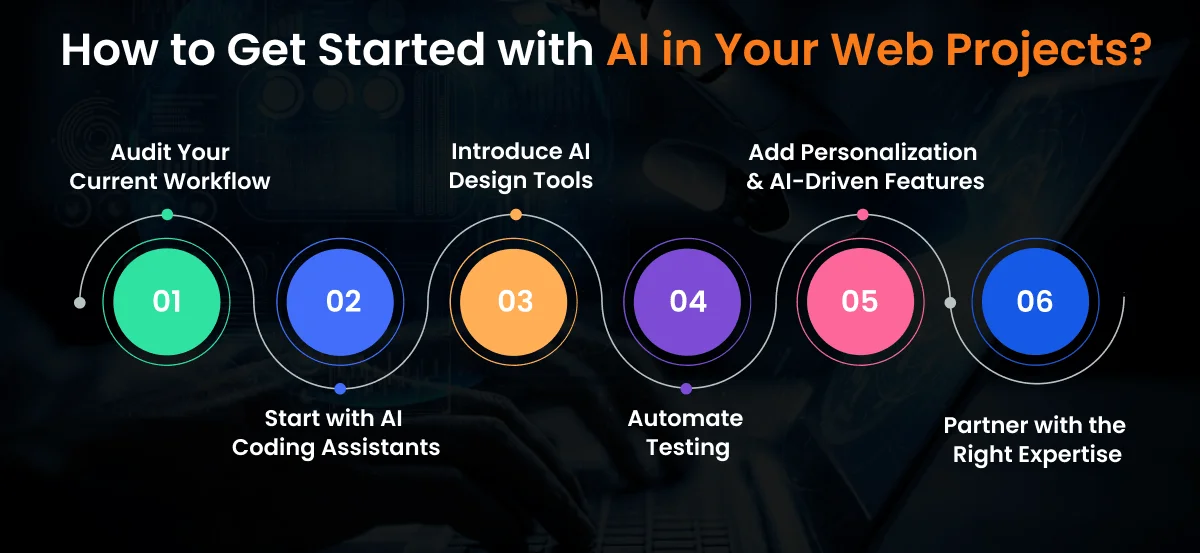
Step 1: Audit Your Current Workflow
Prior to the implementation of AI tools, visualize your existing development lifecycle and determine the largest source of time drain. Is it code review? Testing? Design iteration? Content creation? The least strategic phases that take the most time are typically the entry points that have the highest ROI.
Step 2: Start with AI Coding Assistants
The easiest method for a development team to feel the concrete advantages of how to utilize AI in web development is to add an AI coding assistant, such as GitHub Copilot or Cursor. The benefits in terms of productivity realized are immediate and quantifiable, and the learning curve is minimal. This helps the team to get used to AI-assisted workflows and then proceed to more complex integrations.
Step 3: Introduce AI Design Tools
Given the intensive design projects, incorporate Framer AI or v0 in the prototyping stage. Enable designers and product managers to produce variants of layout within a short period of time, followed by engineering feedback. This squashes the design-to-development handoff significantly.
Step 4: Automate Testing
Adopt an AI-based testing tool to cope with regression tests and test generation. This liberates QA engineers to do exploratory and edge-case testing on the work that needs human judgment, and still has a baseline coverage that is automatically maintained.
Step 5: Add Personalization & AI-Driven Features
After the main development process undergoes AI enhancements, spread AI to the customer- facing product. Include a recommendation system, launch a chatbot interface, or adaptive personalization of content. These characteristics become cumulative with time as the AI models adapt to the actions of users.
Step 6: Partner with the Right Expertise
In the case of organizations that lack profound in-house AI, outsourcing the services of an AI development firm that focuses on web applications can help the process go a lot faster. The appropriate partner offers technical skills to deploy AI powered web development tools as well as the strategic background to make those tools consistent with business aims. Look for partners with proven experience in trending technologies and a portfolio that spans AI integration across the full development lifecycle.
Closing Thoughts
AI in web development has rapidly progressed from being a niche feature to being an elementary feature. Through automation and personalization, teams that use AI are faster, less expensive, of high quality, and deliver superior user experiences.
The most effective approach is not just adding AI, but integrating it across the entire development lifecycle with the right tools and strategies. At Octal, we have a full suite of web development services powered by AI and other next-gen technologies. So if you want to stay ahead of the competitive market, integrating AI will drive greater automation, smarter personalization, and seamless development processes in your business. So, without waiting long, connect with the team of experts and get your project started today.
 By
By June 22, 2026


 Latest Stories
 Get in Touch