


Key Highlights
- The research-full guide of react native and flutter which examines their performance, architectural design, cost estimation methods, and ability to handle increasing system demands.
- This blog provides clear insights that shows the performance differences between React Native vs Flutter when applied to actual mobile applications.
- The cost analysis provides details about expenses while showing how Flutter vs React Native development cost to help budget planning.
- This provides guidance for startup businesses, corporate organizations and software development projects.
- Flutter vs React Native Pros and Cons evaluation help users make their selection process easier.
- The guide provides three methods that assist users in selecting their ideal development partner and framework solution.
The blog helps users determine which technology suits their needs based on business objectives, financial resources and future expansion plans.
Confused between Flutter and React Native for your upcoming 2026 application project creates uncertainty for you. According to Market Research, the cross-platform market currently projects to achieve a value of $418.2 billion by 2030, which requires proper framework selection more than any other time before.
More than 68% of developers now prefer using cross-platform solutions for their work that makes this choice more significant than before, according to research findings. The guide presents a React Native vs Flutter comparison that helps you select the best cross platform app development company for your project needs.
- Key Highlights
- What Are Flutter and React Native?
- Flutter and React Native Performance Compared
- Flutter and React Native: Cost Breakdown
- Hidden Costs of Flutter and React Native Projects
- Flutter and React Native for Startups and MVPs
- Flutter and React Native by Industry: Real Examples
- Flutter and React Native: Scalability Compared
- Flutter, React Native, and the Rise of AI Tools
- Flutter and React Native: Pros and Cons
- How to Choose Between Flutter and React Native?
- Why Hire Octal IT Solution for Mobile App Development?
- Final Verdict
- FAQs
Choosing a framework to build your app is not a trivial choice. It influences your budget, your time frame, and your app’s user experience. If you are wondering which one to choose between these two names, you’re not the only one. This is a question that we get from nearly all business owners.
After reading countless blogs, it’s easy to get confused with Flutter vs React Native. This blog is unique and a straight-forward. At the end, you will have a clear idea of which framework you will use to develop your app.
What Are Flutter and React Native?
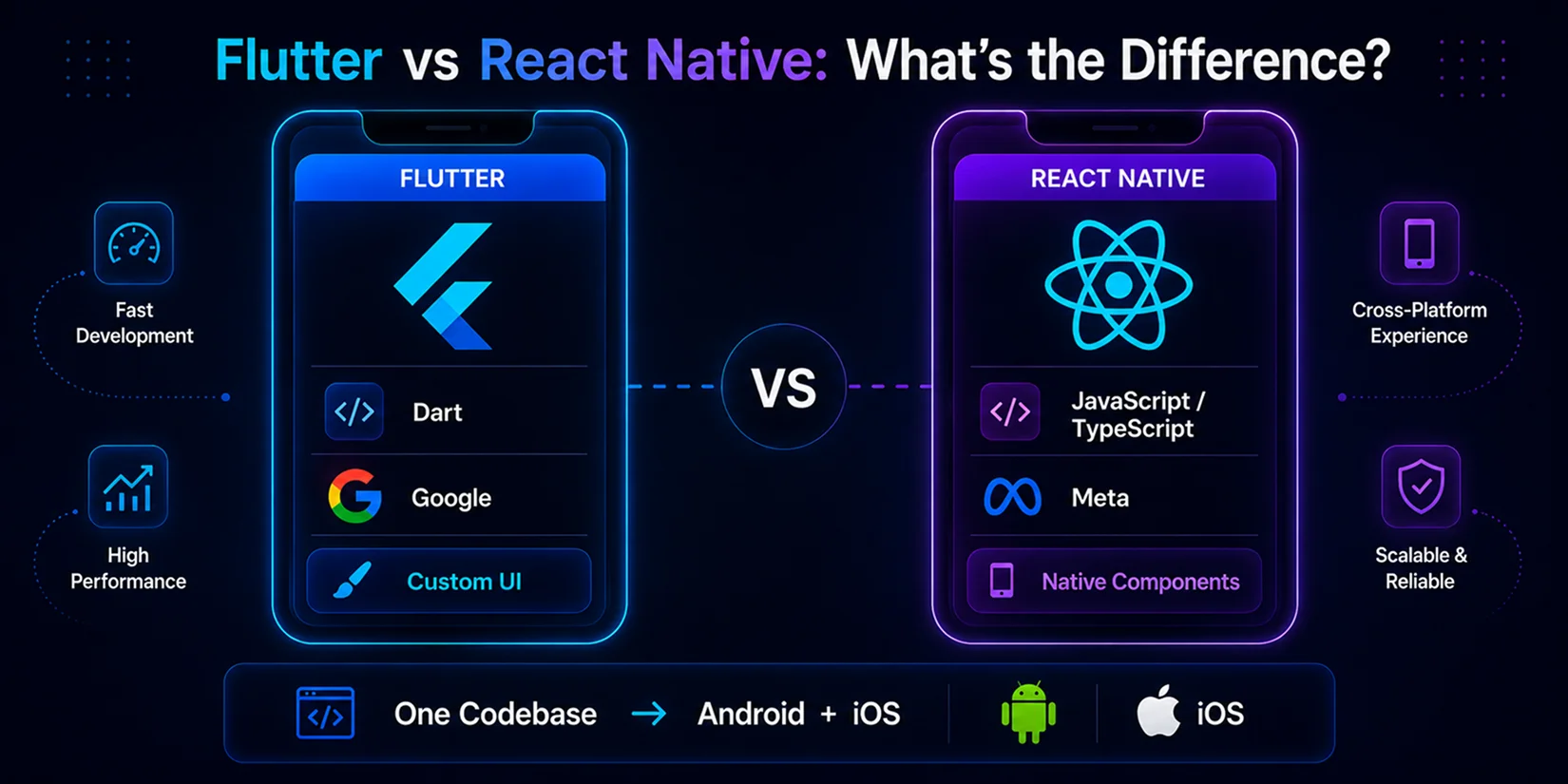
Google developed Flutter using the programming language Dart. Uses its own engine to draw each pixel on the screen. This allows a developer to have strong control of the appearance of the app.
React Native has been developed by Meta and is written in JavaScript, which is widely used by web developers. It enables connection with real native components on each cellphone. The link to that makes the app feel closer to native.
Both are great options for cross-platform app development in 2026. There is no definitive advantage to one over the other. It depends on your goals, team, and budget.
| Feature | Flutter | React Native |
| Language | Dart | JavaScript/TypeScript |
| Creator | Meta | |
| UI Rendering | Own engine (Skia/Impeller) | Native components |
| Learning Curve | Moderate | Easier for web developers |
| Community | Large and growing fast | Large and mature |
Flutter vs React Native seems to be a catch-caught situation when comparing both of them. The actual difference is reflected when you begin construction.
Flutter and React Native Performance Compared
Flutter apps often start up a bit faster. This is because Flutter avoids the bridge that communicates with the native code. All the elements are closer to the device.
React Native has really come along since then, thanks to its new architecture. It now communicates with native modules much more quickly than before. There should not be any significant difference to most users.
| Metric | Flutter | React Native |
| App Size | Slightly larger | Slightly smaller |
| Startup Speed | Very fast | Fast |
| Animation Smoothness | Excellent | Good to excellent |
| Native Module Access | Good | Excellent |
When your app has a lot of animation or games, Flutter generally outperforms React Native. In case you require deep native integrations, React Native is the better option. This is where the real difference between React Native vs Flutter performance comes in.
Flutter and React Native: Cost Breakdown
For many business owners, cost is a critical component. Either one will allow you to build once and ship twice. That just reduces your budget by avoiding the need to develop two separate native apps.
| Project Type | Timeline | Flutter | React Native |
| MVP | 2–4 months | $15,000–$40,000 | $12,000–$35,000 |
| Mid-size App | 4–7 months | $40,000–$80,000 | $35,000–$75,000 |
| Enterprise App | 7–12+ months | $80,000–$150,000+ | $75,000–$140,000+ |
More readily available for hire are React Native developers, due to the ubiquity of JavaScript. This can cut down your React Native vs Flutter app development cost early. While Flutter might be more expensive initially, it can provide better returns in the long term.
The cost difference between the two technologies, React Native and Flutter, narrows over time. Maintenance and team availability are as important as the first invoice. When you budget, do so more than just for launch day!
Also Read: React Native App Development Cost- The Complete Guide
Hidden Costs of Flutter and React Native Projects
Here is something most blogs skip entirely. Framework upgrades can quietly drain your budget over time. Flutter’s SDK updates sometimes break older plugins without warning.
- However, the newer architecture change with React Native has wreaked havoc on older apps as well. The effort required to move old code to new standards is a lot of developer time. Time is money, even if it’s not clearly marked.
- Third-party libraries can be abandoned at any time, without notice. You take that risk if your app relies on a plugin that doesn’t continue to update. A good app development partner is able to identify these problems early on before they become costly.
- Many of these surprises can be avoided by having good practices in app development using Flutter, like not using too many third-party plugins.
That’s why maintenance is an essential part of the React Native vs Flutter development cost discussion. The early cutting of corners is usually the more expensive choice.
Flutter and React Native for Startups and MVPs
When testing, speed is everything, especially for a new idea. Both frameworks allow for hot reload: changes are reflected immediately when coding. This cuts down on your development cycle quite a bit.
When it comes to building an app, React Native app development is faster to start. Most web developers can just say, “Oh god, I’ve never worked in a foreign language before!” Once you’ve adopted Dart in your team, Flutter can run at the same speed.
For almost every startup, there is a question: React Native vs. Flutter. When it comes to MVP timelines, the first thing you should consider is your team’s skill. One is there to get you to market quickly in the right hands.
In the end, it all comes down to who is part of your team.
Flutter and React Native by Industry: Real Examples
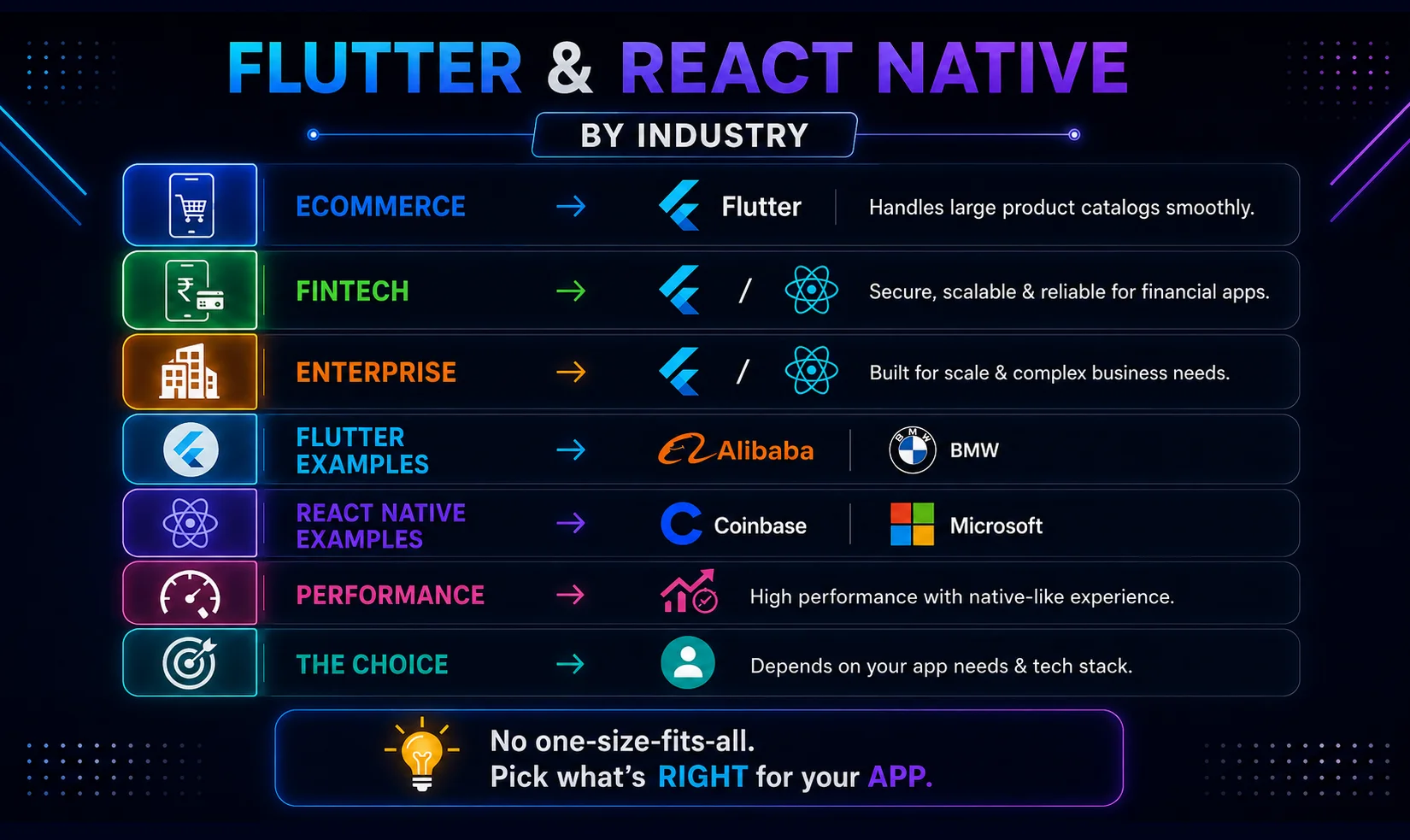
Not all apps are the same, and not all of them are given the same priorities. An eCommerce app is mindful of the catalog process and the checkout. Security is almost the most important concern of a fintech app.
For eCommerce Apps
Alibaba was able to rebuild part of its app using Flutter, and it was able to achieve smoother performance. That demonstrates the ability to manage extensive product catalogs. In the case of eCommerce app development, the number of products in the catalog may be a decisive factor in choosing between React Native and Flutter.
For Fintech Apps
Google Pay is built on Flutter and uses sensitive data scaled to vast numbers. On the other hand, Coinbase created a portion of its chat application with React Native. Coinbase, however, used part of its app as a React Native solution. When it comes to choosing between React Native vs Flutter for fintech app development, there’s a strong possibility that your existing tech stack will influence the choice.
For Enterprise Apps
BMW has developed its My BMW app in multiple regions using Flutter. BMW has developed its My BMW app in numerous regions with Flutter. Microsoft, on the other hand, has implemented React Native within portions of its Office applications. Both are able to work with a capable team for enterprise apps.
| Industry | Often Recommended | Real Example |
| eCommerce | Flutter | Alibaba |
| Fintech | Either, based on stack | Google Pay, Coinbase |
| Enterprise | Either, based on team | BMW, Microsoft |
| Startups | Either, based on speed | Various |
This table is provided as a guideline only; each business is unique. Teams are already using JavaScript stacks, and often prefer React Native when building enterprise apps. Discuss with a team that has shipped first. Then choose React Native vs Flutter for business needs.
When deciding between React Native or Flutter for enterprise projects, support becomes the deciding factor, rather than speed. When your real customers rely on your app every day, it’s important that you’re reliable in the long term.
Flutter and React Native: Scalability Compared
When you scale an app, there are more screens, more users, more code over time. As apps scale, Flutter’s widget structure ensures organization. A consistent codebase is a common feature that teams go on about.
React Native scales as well, particularly if the project structure is laid out right from the beginning. They have used React Native at large scale for years, for example, Instagram. Consistent design across devices is another factor why many growing brands hire Flutter developers.
| Scalability Factor | Flutter | React Native |
| Codebase Structure | Widget-based, highly predictable | Component-based, flexible but less strict |
| Team Onboarding | Easier once Dart is learned | Faster for existing JavaScript teams |
| State Management | Provider, Riverpod, Bloc | Redux, MobX, Zustand |
| Performance at Scale | Very stable, fewer bridge issues | Strong, especially with New Architecture |
| Modular Architecture | Clean separation via packages | Common via monorepos and modules |
| Known at Scale | Google Pay, BMW, Alibaba | Instagram, Facebook Ads Manager, Shopify (early years) |
When it comes to the scalability of React Native vs Flutter, things would depend on the team’s discipline. After a certain point, any framework can be negatively affected by poor planning.
Flutter, React Native, and the Rise of AI Tools
Here is an angle most comparisons completely ignore. AI coding assistants now support both Dart and JavaScript quite well. This changes how fast either framework can be built.
Partnering with the right AI development services can speed up your build significantly. Many companies now integrate Flutter or React Native with smart features such as chatbots. Recommendation engines and predictive search fit smoothly into either ecosystem today.
If you are still torn between Flutter vs React Native, AI tooling narrows that gap. Your roadmap can include AI features later without major rework.
Flutter and React Native: Pros and Cons
| Framework | Pros | Cons |
| Flutter | Fast performance, consistent UI, strong for animations | Larger app size, Dart is less common |
| React Native | Huge developer pool, mature ecosystem, native feel | More bridge dependency, some style variance across platforms |
Both frameworks solve real problems well. Your decision should match your project, not general opinions found online.
How to Choose Between Flutter and React Native?
Start with your team’s existing skills, since that saves training time. Then look at your budget and how fast you need to launch. If speed and animation matter most, React Native vs Flutter performance should guide your call.
This React Native vs Flutter breakdown should make your next step much clearer. Most business owners feel stuck at this stage, and that is normal. Talking it through with experienced developers usually clears things up fast.
The best mobile app development always starts with your goals, not the latest trend.
Why Hire Octal IT Solution for Mobile App Development?
Octal IT Solution has been building mobile apps since 2007. Our team has delivered hundreds of projects across many industries worldwide. We hold a 4.6 rating on Clutch from real client reviews. We are also CMMI Level 3 certified for consistent process quality. Our ISO certification reflects strict standards across every project we handle.
Hire mobile app developers who work across Flutter, React Native, native iOS, and native Android. We also build backend systems, APIs, and cloud integrations when needed. Looking to hire mobile app developers who deliver on time? We fit that need.
Our team studies your business goals before recommending any technology. That approach has helped us build long-term partnerships with clients globally.
Final Verdict
There is no single winner in the Flutter vs React Native debate. Both frameworks are mature, well supported, and capable of great apps. The right choice depends entirely on your project’s unique needs.
At Octal IT Solution, we have built apps using both frameworks for years. Our team studies your goals first, then recommends the smarter technical path. If you want to hire React Native developers who ship fast, we can help.
We also help founders who simply want to hire mobile app developers without picking sides. Our team handles that framework debate for you, quietly and confidently. That is how real product decisions get made.
Still unsure about Flutter vs React Native for your specific idea? Reach out to Octal IT Solution for a free consultation today. Let us help you build something users genuinely love.


 Get in Touch
 By
By March 30, 2026