


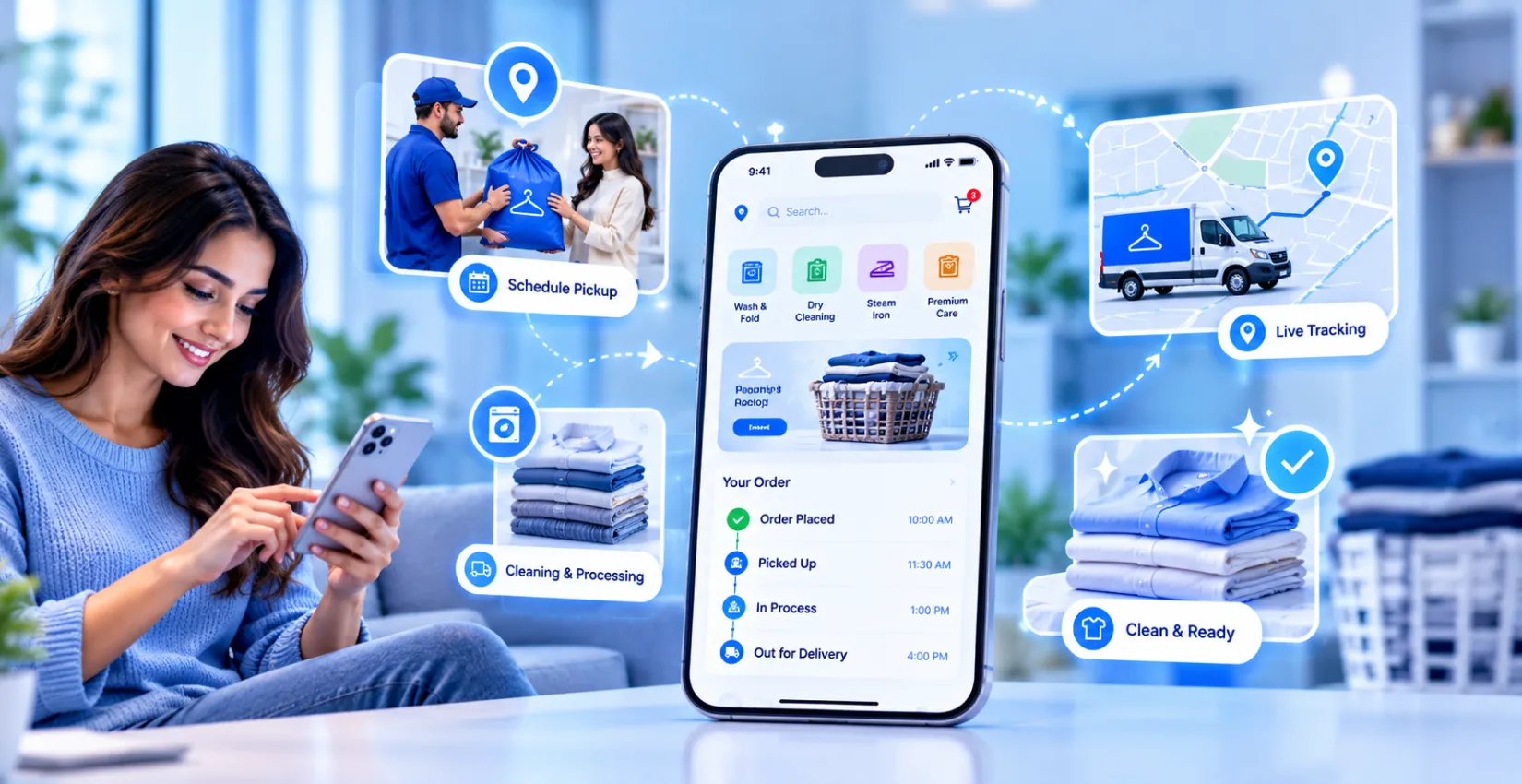
Imagine it is 9 p.m., you just got home, and the laundry basket is overflowing. Tomorrow’s shirt is still dirty? Plenty of people know this scene well.
Now flip it around. Someone taps their phone, picks a time slot, and a driver shows up within the hour. Clean, folded clothes come back the next day. Nobody leaves the couch.
That small moment is why founders keep building laundry apps. The demand is real, and it is growing. But the first question is always the same: what will this cost, and which features do I actually need?
This guide answers all your questions. You will see the on-demand laundry app development cost in clear numbers, the features each panel needs, the tech behind them, and the ways to earn from day one. So, let’s start our discussion and take a step ahead in making your business more tech-friendly.
Why Laundry App Development Is a Growing Business Opportunity?
Laundry is a chore most people would happily hand off. Long work hours, small apartments, and packed weekends push more households toward pickup-and-delivery services.
As per the report published by Grand View Research, the online laundry market is expected to expand from USD 58.9 billion in 2026 to USD 221 billion by 2030, registering a CAGR of 37.3% during the 2025–2030 period.
Real brands already prove the model of home delivery app development for laundry purposes. Rinse in the US and Laundryheap in the UK built their businesses on app-based pickup and delivery. Hotels, clinics, gyms, and offices now outsource laundry the same way.
Let’s take an illustration to better understand the shift. Picture a small laundromat owner in Pune with 40 walk-in customers a day. Once she lists her shop on an app, she can serve people across the whole neighborhood, not just those who walk past her door.
That is the shift apps create. Laundry is also just one category inside on-demand app development, so the same skills carry over to cleaning, salon, and repair services.
Key Features of an On-Demand Laundry App
The right laundry app features decide whether people order once or order every week. A laundry platform usually has four panels, and each one needs its own set of tools.
Customer App Features
The customer app is where trust is won or lost. If booking takes more than a minute, users leave. These features keep the experience quick and clear.
- Easy registration
Users register via cell phone, email or Google account. OTP verification ensures genuine profiles. A shorter sign up process results in lower drop-off before the first order.
- Service selection
Customers select wash/fold, dry cleaning, ironing or shoe cleaning. All items have prices listed. Clear menus eliminate disagreement over what was ordered and how much it cost.
- Scheduling
Users select a collection time and delivery time that are appropriate for their day. Recurring schedules are suitable for weekly loads. A busy parent can make a one-off booking and forget.
- Live tracking
Customers watch the driver on a map and see each cleaning stage. Push notifications announce pickup, processing, and delivery. Fewer “where is my order?” calls reach your support team.
- Multiple payment options
The majority of preferences are covered by cards, UPI, wallets, and cash on delivery. Repeat orders are facilitated by saved cards. Promotional codes and tip options can be located next to the checkout.
- Order history
All previous orders are just a tap away. Customers are able to rebook, download invoices, and review their charges. It only takes seconds to reorder.
- Ratings and reviews
Once it’s delivered, the user rates the vendor and the driver. Admins are notified of low scores early. Positive reviews enable new customers to make their choices with confidence.
Delivery Partner App Features
Drivers decide how fast and how safely clothes move. Their app must work well on a busy street, in bad weather, and on a weak network.
- Order alerts
Drivers receive real-time notifications about pickups in the immediate vicinity. They respond to a yes or no within seconds. Smart assignment will route each job to the nearest partner that is available.
- Route navigation
Embedded maps display the fastest route to the customer and to the vendor. Drivers don’t change apps. This is a waste of fuel, time, and missed turns.
- Earnings dashboard
Partners can monitor daily trips, tips, and payouts from a single screen. When drivers can see their earnings, it keeps them happy. Your hiring costs will be reduced by happy drivers who stay around longer.
Laundry Vendor Panel Features
Laundries and dry cleaners need a panel that fits their daily workflow. If it feels like extra work, they will stop using it.
- Order management
Fulfill incoming orders, check item count, and schedule jobs to employees. Paper slips and phone calls are replaced with one digital queue. There’s no wasting of time from one shift to another.
- Pricing control
Rates per item, per kg or per service are fixed and set by each vendor. Seasonal offers and charges can be added to the expressions. Admins can impose restrictions to ensure fair prices.
- Status updates
Orders are marked when received and staff wash, dry, iron, and make ready. The customer is updated as the tap updates. There’s no need to make a single additional phone call for transparency.
Admin Panel Features
The admin panel is your control room. It shows what is working, what is stuck, and where the money is flowing.
- User management
Approve vendors, check drivers, and manage customer accounts all from one central location. To stop imposter profiles, block them right away. Role-based access ensures that sensitive information stays in the hands of those who need it.
- Analytics
Dashboards include daily orders, peak hours, top vendors, and repeat customer rates. You don’t have to guess how much to market or how many staff to hire based on these numbers.
- Commission control
Define a percentage for each vendor and/or per category. Change it when you run promotions. Automatic settlement reports ensure payouts are transparent and minimise accounting mistakes.
- Promotions
Design coupons, initial order discounts and referral bonuses. Schedule campaigns based on area or customer group. For illustration, the right offer at the right time can make a fun-filled Tuesday.
AI Features That Set Your Laundry App Apart
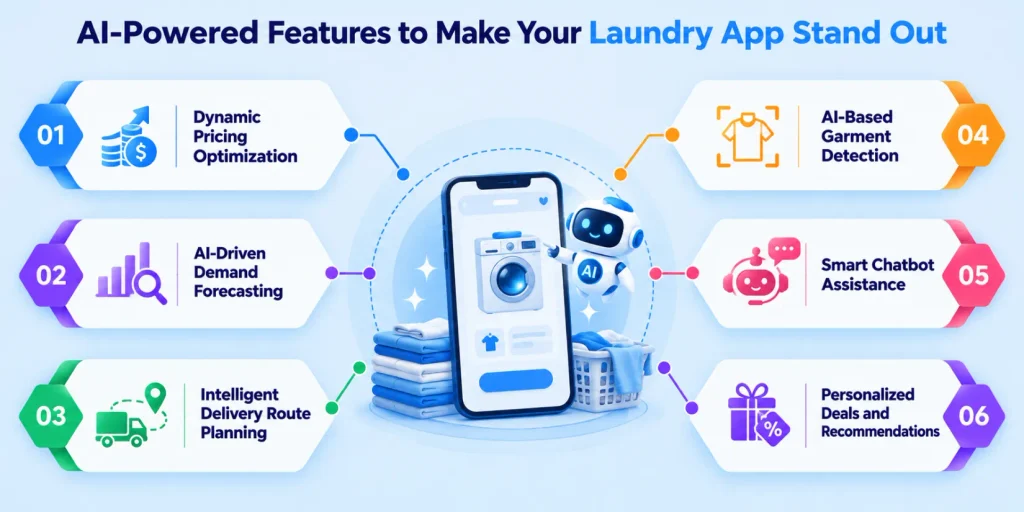
AI turns a basic laundry app into a smarter business. The features below cut costs, speed up deliveries, and help customers feel understood. Teams offering AI-powered app development can add them in stages.
- Smart pricing
Algorithms change prices according to the type of item, time of day, and demand. Express orders during rush hours are more expensive, and slow hours are discounted. This keeps vendors active and ensures that you do not have to manually change the rates, thus avoiding all the hassles.
- Demand prediction
Machine Learning will analyze historic orders to predict busy days. Rain will only extend weekend bookings if it does, and it will be known early. Vendors will be able to hire additional workers, and you’ll be able to book additional drivers in advance of the peak.
- Route optimization
AI groups nearby pickups and plans the shortest multi-stop route with AI groups. A driver could pick up from 6 houses on one drive rather than 3. Fuel costs are reduced, and delivery windows are much more predictable.
- Garment recognition
A customer takes a picture of a smudged shirt or a fragile saree. A customer takes a picture of a smudged shirt or a fragile saree. Images are recognized, fabric type is suggested, and appropriate treatment is recommended. Care Notes are read by the vendors before handling the garment.
- AI chatbot support
A chatbot responds to frequently asked questions such as pricing, order status, and time slots 24/7. If it’s a tricky issue, it’s sent to a human agent. Support costs are reduced, and customers never wait in a line.
- Personalized offers
The app gets to know each user’s habits. Those who send shirts each Friday can receive a slight discount on Thursday evening. Timely, individualized offers are more effective at boosting repeat orders than generic ones.
Laundry App Development Cost: How Much Does It Really Cost?
A laundry mobile app development cost can be anywhere between $15,000 and $120,000. Your final laundry app cost depends on features, platforms, and who builds it. The tables below use typical market estimates, so treat them as ranges, not quotes.
Laundry App Cost Breakdown by Complexity
| Complexity | What You Get | Estimated Cost (USD) | Timeline |
| Basic (MVP) | Customer app, driver app, simple admin panel, one payment gateway | $15,000 to $30,000 | 3 to 4 months |
| Medium | Vendor panel, live tracking, multiple payments, promotions, analytics | $30,000 to $60,000 | 4 to 6 months |
| Advanced | AI features, subscriptions, multi-city support, chat, advanced reporting | $60,000 to $120,000+ | 6 to 9 months |
Laundry App Cost Breakdown by Region
The same medium-complexity app costs very different amounts depending on where your development team sits.
| Region | Estimated Cost (USD) |
| USA and Canada | $80,000 to $150,000 |
| UK and Western Europe | $60,000 to $120,000 |
| Eastern Europe | $40,000 to $80,000 |
| India | $25,000 to $60,000 |
Key Factors That Affect Laundry App Development Cost
- Features: Every extra module, such as in-app chat or subscriptions, adds development hours.
- Platforms: Android, iOS, or both. Cross-platform frameworks can reduce the bill.
- Design: Custom animations and brand-specific UI take longer than standard templates.
- Tech stack: Complex backends and real-time systems cost more to build and maintain.
- Team location: Hourly rates vary widely across regions, as the table above shows.
- Third-party integrations: Maps, payment gateways, SMS, and AI services often carry their own fees.
On-demand app development cost is affected by the above factors, as the actual price can fluctuate according to the needs of the client.
Hidden Costs to Consider
Many founders budget for the build and forget what comes next.
- Maintenance: A common rule of thumb is 15% to 20% of the build cost every year.
- Server and hosting: Cloud bills grow with your order volume.
- Marketing: Getting your first 1,000 users usually costs more than founders expect.
- Updates: New iOS and Android versions need regular compatibility fixes.
Custom Laundry App Development vs. Ready-Made Solutions
Both paths work. The right one depends on your budget, timeline, and long-term plans. Plenty of laundry app development services exist off the shelf, but they come with limits.
| Factor | Custom Build | Ready-Made Solution |
| Upfront cost | Higher | Lower |
| Time to launch | 4 to 8 months | 2 to 6 weeks |
| Flexibility | Full control over features and design | Limited to what the script offers |
| Scalability | Built for growth | Often hits limits as orders increase |
| Code ownership | Complete | Depends on the license |
| Best for | Funded startups with a unique model | Testing an idea on a tight budget |
If you want to stand out, custom laundry app development is the safer bet. If you only want to test demand in one neighborhood, a ready-made base can get you live fast. Many founders start there and move to a custom build once revenue proves the idea.
Laundry App Development Process: Step by Step
A clear process keeps cost and timeline under control. Here is how a typical project moves from idea to launch. First-time founders can also read our notes on app development for startups to plan each phase.
- Discovery and planning
We research your business model, target city, and your competition. We brainstorm together, prioritize, and establish a budget. This way, you won’t have to pay for significant changes in the future, and you’ll have a roadmap to follow.
- UI/UX design
All four panels are designed by producing wireframes and clickable prototypes. You test the flow before you start writing code. Simple screens for quicker booking.
- Development
In sprints, the front end, back end, and APIs are developed. You will be shown working demos on a biweekly basis. Surprises are not allowed at the end, as the next sprint will be shaped by feedback.
- Testing
QA engineers test on real devices, slow networks, and different versions of the OS. They review payments, notifications, and tracking for accuracy. Bugs are addressed prior to customers seeing them.
- Launch
The application will be released to the Google Play Store and Apple App Store. A significant number of companies begin in one city. The 50 to 100 user soft launch exposes the holes, and the risk is low.
- Support and updates
Once it’s online, the work is still ongoing. Teams track crashes, debug and publish updates according to user feedback. Keeping the app updated with regular maintenance ensures its security and compatibility with new phone updates.
Recommended Tech Stack for a Laundry Mobile App
Custom mobile app development services for laundry needs a stack that is fast, scalable, and easy to maintain. Here is a practical combination many teams use. Your developers may suggest alternatives.
| Category | Technologies |
| Frontend | Flutter, React Native, Swift (iOS), Kotlin (Android), React.js (admin panel) |
| Backend | Node.js, Laravel, Python (Django), Express.js, REST APIs |
| Database | MySQL, PostgreSQL, MongoDB, Redis, Firebase |
| Maps | Google Maps SDK, Google Directions API, Geocoding API, Places API, Mapbox |
| Payment Gateways | Stripe, Razorpay, PayPal, Braintree, Apple Pay and Google Pay |
| Cloud | AWS, Google Cloud, Microsoft Azure, Docker, Firebase Cloud Messaging |
How to Hire Laundry App Developers and Choose the Right Company?
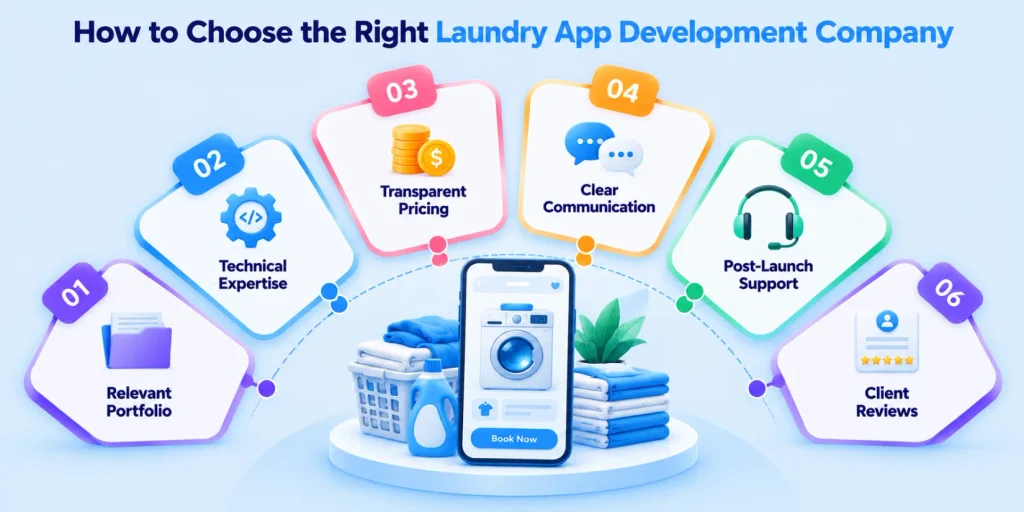
Your developer choice affects cost, quality, and launch speed. A weak partner can burn six months and your budget. Use these six checks before you sign any contract.
- Relevant portfolio
Use a shortlist of on-demand app developers that will be able to demonstrate to you live delivery or service apps rather than mere screenshots. Download them yourself. See how quickly and accurately the check can be booked, and how simple the payment process is before you buy the pitch.
- Technical depth
A smart laundry app development company will be able to describe their stack in easy-to-understand terms question about why they chose Flutter over native or Node.js over Laravel. Clear answers reveal true experience and not rehearsed sales lines.
- Transparent pricing
Experienced on-demand laundry app developers break down the estimates by modules and hours. Most budget arguments are over hidden charges for revisions, hosting, or third-party APIs. Clear change rules to protect both sides with fixed scopes.
- Communication
See how quickly they respond, who they are in touch with, and how frequently they give demonstrations. Projects are kept on track with week-to-week updates via Slack or Jira. No talk before the contract is a red flag.
- Post-launch support
Apps crash when OS updates are applied. Inquire about maintenance plans, bug-fix windows, response times. When looking to hire mobile app developers on a dedicated team, you must verify that the team can grow fast.
- Client references
Speak to two or three past clients. Ask about missed deadlines, surprise costs, and how problems were handled. Honest feedback tells you more than awards do. A reliable mobile app development company will happily share contacts.
How Laundry Apps Make Money: Monetization Models
A laundry app can earn from several streams at once. Most successful platforms combine two or three. On-demand laundry app development pays off faster when revenue is planned before launch, not after.
- Commission Based
Make a 10% to 25% commission on every sale. It grows with the volume and doesn’t require any initial payment from the partners. This is the beginning of the majority of market-style best laundry apps.
- Delivery fees
Option to add a flat or distance-based fee for pickup and drop. Offer free delivery above a minimum order value to encourage bigger baskets. When tracking works out, customers pay small sums.
- Subscriptions
Customers who opt for weekly or monthly plans will receive a fixed number of pickups at a reduced fee. It’s a win-win scenario for everyone. Switching is perceived as a loss of a benefit, which leads to better retention.
- Featured vendor listings
Vendors pay to be featured at the top of search results, or on the home screen. This will be useful when you have a good amount of traffic. Limit the number of slots to maintain the trustworthiness of the app.
- In-app advertising
Local companies like appliance stores, fashion shops, and detergent manufacturers could pay for a banner or coupons. Do not allow irrelevant and excessive advertising, as this will cause the booking flow to become cluttered.
- Express and premium services
Offer an additional charge for same-day cleaning, high-quality services for garments, shoes, or bags. People don’t like shopping for the lowest prices. These are also usually the highest margin types of add-ons.
Why Choose Octal IT Solution as Your Laundry App Development Company?
Octal IT Solution has been developing delivery and service platforms since 2007. We manage the strategy, design, development, and launch of your product in one place. We are an on-demand laundry app development company, and we begin with the business model and not a template.
For laundry app development, we offer customer, driver, vendor, and admin panels, payment gateway integration, and AI integration. Our delivery app development solutions can be customized to achieve minimal rework.
Individual founders can also take advantage of our custom Home service development solutions if they have a unique idea. Our support team takes care of any updates, bug fixes, and scaling after launch. From the 1st sketch to the thousandth, you get one team from each sketch.
Conclusion
The on-demand laundry app development cost depends on your features, platforms, and team. Start with a lean MVP, prove demand in one city, and then add AI and subscriptions. The market is growing, and customers already expect convenience.
The right on-demand app development company makes that journey faster and cheaper. Ready to build yours? Talk to Octal IT Solution for a free consultation and a detailed estimate.


 Get in Touch
 By
 November 4, 2026