



In 2026, digital payments continue to accelerate, making eWallet applications a critical component of modern fintech ecosystems. Businesses across retail, banking, mobility, and on-demand services are investing heavily in eWallet app development to deliver faster, secure, and user-friendly payment experiences.
However, understanding the actual cost of building an eWallet app goes beyond basic development estimates. Factors such as feature complexity, security compliance, technology architecture, regional development rates, and integration requirements play a major role in determining overall investment.
The world is going cardless and cashless, and ewallet app development companies are leaving no stone unturned in delivering out-of-the-box, unique solutions. Here, you can understand the term e-wallet, how to make ewallet app, and its entire development process from scratch to end, its challenges, ewallet app features, and the ewallet app development cost.
- Why eWallet App Development is Gaining Importance in 2026?
- How Does an eWallet Work?
- Core Features of Ewallet App Development in 2026
- How Much Does it Cost to Develop an eWallet App in 2026?
- Factors Impacting Cost to Develop Ewallet in 2026
- Growing Use Cases With the Rise of Mobile Wallet Applications
- Different Payment Methodologies to Consider in eWallet App Development
- Types of e-Wallet Revenue Models
- Types of Mobile e-Wallet Applications
- Monetization Models for eWallet Applications in 2026
- Top Challenges in Ewallet App Development
- Top 5 Popular eWallet Mobile Apps
- Conclusion
Why eWallet App Development is Gaining Importance in 2026?
The global eWallet market is projected to grow by $169.86 billion between 2024 and 2029 at a 21.9% CAGR, meaning the market will nearly DOUBLE in 4 years. For entrepreneurs, this translates to: – 500M+ new digital wallet users in 2026 alone – $8-12 billion in annual payment processing revenue opportunity – 3-5 year payback periods for launched wallets (vs. 5-7 years in 2023) This explosive growth is driven by three shifts:
(1) 70% of millennials prefer wallets to cash,
(2) mobile-first payment infrastructure now mature across 70+ countries, and
(3) AI/blockchain security removing adoption friction.
These innovations are accelerating consumer trust and business adoption. Despite this momentum, the market continues to face challenges, particularly related to high infrastructure and implementation costs.
At the same time, blockchain-based wallets and cryptocurrency payments are opening new transaction models, creating fresh opportunities for innovation and expansion within the evolving digital payments ecosystem.
How Does an eWallet Work?
A lot of people who are interested in entering the market with digital wallet apps aren’t sure how to make money from digital payments. We’ll discuss the monetization of digital wallet applications in further sections. Let’s have a look at how ewallet apps work.
The basic functioning of digital wallets is:
- Create your profile by registering on the application with your contact details (email id and phone number) registered with the bank account.
- Once registered, set up a payment pin of 4 or 6 digits. Once you have a payment pin, the registration process is complete,e and you can make the payments now.
- Search for the payee with their contact number.
- Select the Pay or Request option in the application.
- If you are a business that wants to demand money from the customer, go for the request option, and if you want to pay someone,e simply select a payment option.
- Pay the amount with the payment pi, n, and whoosh! You are done.
Transferring money or making payments has never been this easy. Along with this simple transaction, you can pay bills, recharge phone numbers, book tickets, make investments, and do a lot more in modern money transfer applications.
Core Features of Ewallet App Development in 2026
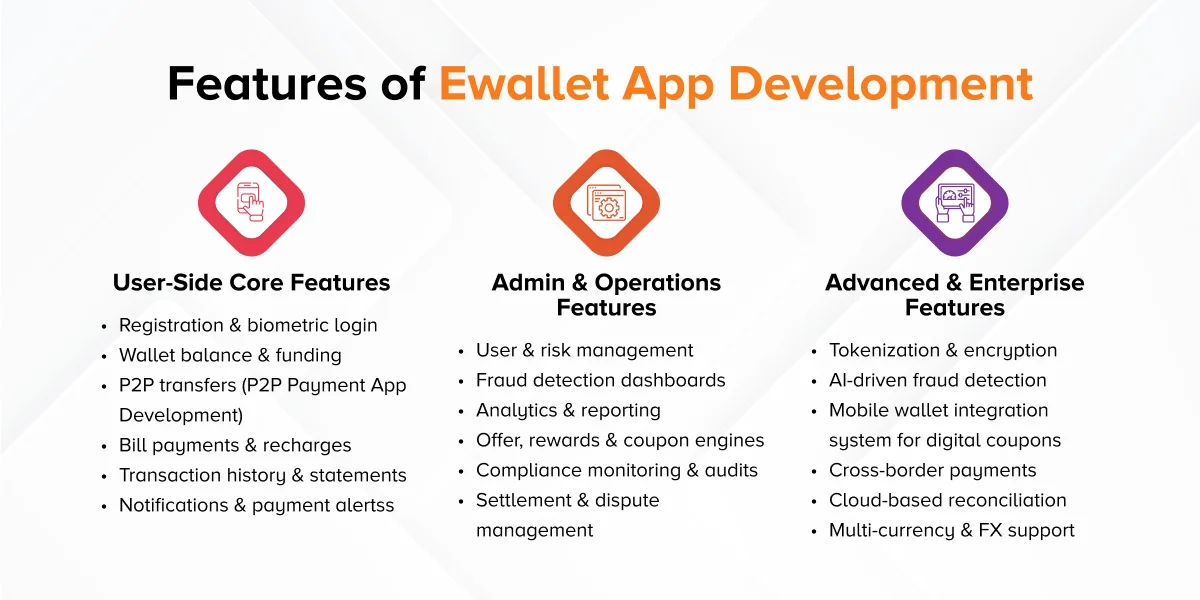
| User-Side Core Features | Admin & Operations Features | Advanced & Enterprise Features |
| Registration & biometric login | User & risk management | Tokenization & encryption |
| Wallet balance & funding | Fraud detection dashboards | AI-driven fraud detection |
| P2P transfers (P2P Payment App Development) | Analytics & reporting | Mobile wallet integration system for digital coupons |
| Bill payments & recharges | Offer, rewards & coupon engines | Cross-border payments |
| Transaction history & statements | Compliance monitoring & audits | Cloud-based reconciliation |
| Notifications & payment alerts | Settlement & dispute management | Multi-currency & FX support |
After taking the brief overview, let us now understand the features under each panel in a detailed manner.
User-Side Core Features
- Registration & Biometric Login
This feature enables secure onboarding through email, mobile number, and KYC verification. Biometric authentication, such as fingerprint or facial recognition, improves security, reduces login friction, and ensures fast yet protected access to wallet functionalities.
- Wallet Balance & Funding
Users can view wallet balances in real time and add funds using cards, UPI, bank transfers, or net banking. Secure funding mechanisms ensure instant balance updates, transaction transparency, and smooth money management within the eWallet ecosystem.
- P2P Transfers (P2P Payment App Development)
Peer-to-peer transfers allow users to send or receive money instantly using phone numbers, QR codes, or wallet IDs. This feature is central to P2P payment app development and drives daily engagement and transaction frequency.
- Bill Payments & Recharges
This feature enables users to pay utility bills, mobile recharges, subscriptions, and broadband payments directly from the wallet. Automated reminders and recurring payments improve convenience and position the wallet as a daily-use financial tool.
- Transaction History & Statements
Users can access detailed transaction histories, downloadable statements, and spending summaries. This improves financial transparency, helps users track expenses, and supports dispute resolution by providing accurate, timestamped payment records.
Admin & Operations Features
- User & Risk Management
Admins can monitor user activity, set transaction limits, and flag suspicious behavior. Risk profiling tools help enforce compliance policies, manage KYC status, and reduce exposure to fraudulent or high-risk transactions.
- Fraud Detection Dashboards
Centralized dashboards provide real-time visibility into suspicious transactions, anomalies, and alerts. Fraud detection tools enable operations teams to take immediate action, block accounts, and minimize financial losses caused by fraud attempts.
- Analytics & Reporting
Advanced analytics track transaction volumes, user behavior, revenue metrics, and system performance. Data-driven insights help businesses optimize features, improve user retention, and make informed strategic decisions.
- Offer, Rewards & Coupon Engines
This feature allows admins to launch cashback offers, loyalty rewards, and digital coupons. Personalized promotions increase transaction frequency, improve user retention, and create additional monetization opportunities for wallet platforms.
Advanced & Enterprise Features
- Tokenization & Encryption
Sensitive payment data is protected using asset tokenization solutions and end-to-end encryption. This ensures that card details and credentials are never exposed, significantly reducing fraud risks and ensuring compliance with global security standards.
- AI-Driven Fraud Detection
Machine learning algorithms analyze transaction patterns in real time to identify suspicious behavior. AI-driven systems continuously learn from data, improving fraud detection accuracy while minimizing false positives and operational overhead.
- Mobile Wallet Integration System for Digital Coupons
This system enables seamless storage, redemption, and tracking of digital coupons within the wallet. It supports merchant integrations, improves user engagement, and enhances the overall value proposition of mobile wallet applications.
- Cross-Border Payments
Cross-border payment capabilities allow users to send and receive money internationally with currency conversion and compliance checks. This feature supports global expansion while ensuring secure, fast, and transparent international transactions.
- Cloud-Based Reconciliation
Cloud-based reconciliation automates transaction matching across banks, gateways, and internal ledgers. It improves accuracy, reduces manual errors, and ensures real-time financial reporting for enterprise-scale wallet operations.
How Much Does it Cost to Develop an eWallet App in 2026?
Let us discuss the ewallet app development cost in different circumstances.
Cost by Wallet Complexity
| Wallet Type | Architecture | Cost Range (USD) |
| Basic Wallet | Monolithic | $25,000 – $40,000 |
| Mid-Level Wallet | Modular | $40,000 – $80,000 |
| Enterprise Wallet | Microservices | $80,000 – $150,000+ |
| Open Wallet (Bank-Integrated) | Service-Oriented | $90,000 – $170,000 |
| BNPL Wallet | Event-Driven Architecture | $70,000 – $140,000 |
| Crypto-Enabled Wallet | Hybrid (Web2 + Web3) | $100,000 – $180,000 |
Each wallet type varies in cost due to differences in architecture, scalability requirements, compliance complexity, and third-party integrations. Enterprise and crypto-enabled wallets demand higher investment because of security, performance, and regulatory considerations.
Cost by Region
| Region | Hourly Rate | Best For |
| Asia (India, China) | $25 – $80 | Cost-efficient builds |
| Eastern Europe | $60 – $100 | Balanced cost & quality |
| Western Europe | $120 – $150 | Compliance-heavy solutions |
| North America | $150 – $200 | Enterprise fintech |
| Middle East | $80 – $120 | Rapid fintech adoption |
| Southeast Asia | $40 – $90 | Startup-friendly MVPs |
The development region significantly impacts the overall project cost. While India and Southeast Asia offer affordability, Europe and North America are preferred for regulation-intensive and enterprise-grade wallet platforms.
Cost by Technology Stack
| Technology | Description | Cost Impact |
| Blockchain Wallet App Development | Decentralized ledger | High |
| Crypto Wallet Development | Multi-chain support | High |
| Web3 Development Cost | Smart contracts | Very High |
| Legacy Application Modernization | Refactoring & migration | Medium–High |
| AI-Powered Fraud Detection | Real-time risk scoring | Medium |
| Cloud-Native Infrastructure | Auto-scaling & resilience | Medium |
Advanced technologies increase development cost due to specialized skill requirements, extended testing cycles, and higher security standards. However, they significantly enhance scalability, security, and long-term ROI.
eWallet vs Crypto Wallet Cost Comparison
Ewallet app development prices can differ from the cost to develop a crypto payment gateway, as shown in the table.
| Product | Development Cost |
| eWallet App Development Cost | $30k – $150k |
| Crypto Wallet Development Cost | $40k – $180k |
| Create a Cryptocurrency Wallet | $35k – $120k |
| Custodial Crypto Wallet | $50k – $140k |
| Non-Custodial Wallet | $60k – $170k |
| DeFi Wallet development Platform | $80k – $200k+ |
Crypto wallets generally cost more than traditional eWallets due to blockchain integrations, private key management, and smart contract audits. DeFi and non-custodial wallets further increase costs because of enhanced security and decentralization requirements.
Factors Impacting Cost to Develop Ewallet in 2026
Various factors impact the ewallet app development cost. Let’s look at those factors before we discuss the approximate cost.
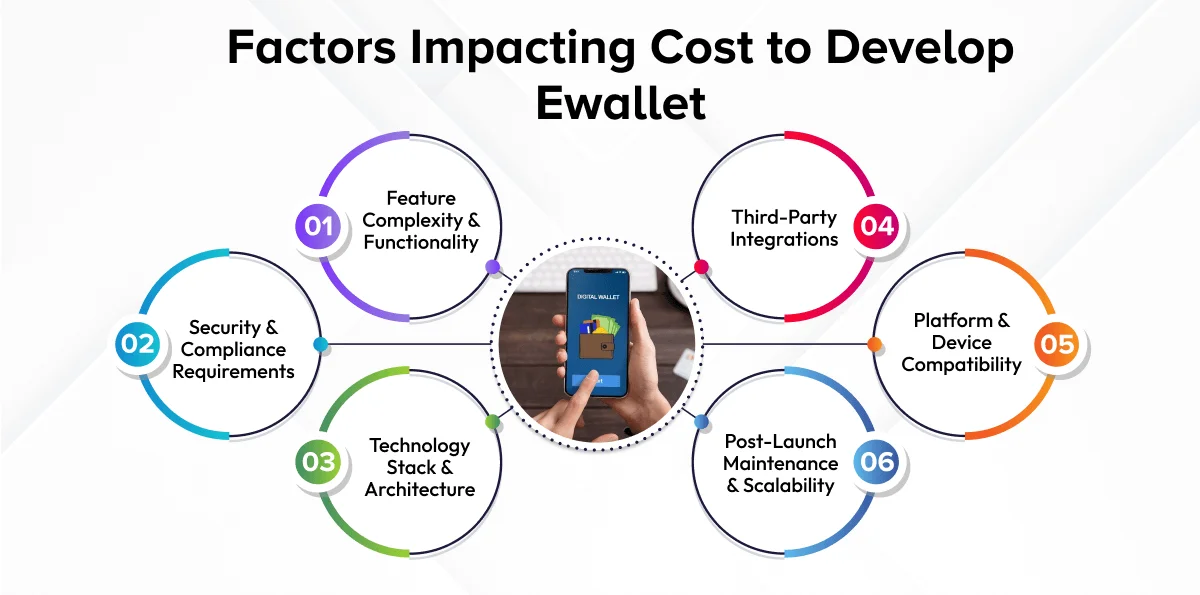
- Feature Complexity & Functionality
The number and complexity of features such as P2P transfers, QR payments, bill payments, BNPL, and multi-currency support directly affect development time, testing efforts, and overall eWallet app development cost.
- Security & Compliance Requirements
Implementing encryption, tokenization, biometric authentication, PCI-DSS compliance, and regional regulations like KYC/AML increases development complexity. Higher security standards require advanced architecture, audits, and ongoing compliance management, raising overall costs.
- Technology Stack & Architecture
Choosing between monolithic, modular, or microservice architectures affects scalability and maintenance. Advanced stacks involving blockchain, Web3, or cloud-native infrastructure require specialized developers, increasing initial ewallet app development investment.
- Third-Party Integrations
Integration with payment gateways, banks, APIs, identity verification services, analytics tools, and fraud detection systems adds development and testing overhead, significantly influencing the total cost of building a secure eWallet application.
- Platform & Device Compatibility
Developing native iOS and Android apps or cross-platform solutions affects cost. Supporting multiple devices, OS versions, and screen sizes increases development effort and quality assurance requirements.
- Post-Launch Maintenance & Scalability
Ongoing support, feature upgrades, performance optimization, and infrastructure scaling contribute to long-term costs. Wallet apps must handle increasing transaction volumes while maintaining speed, security, and compliance over time.
Growing Use Cases With the Rise of Mobile Wallet Applications
The ewallet app development use cases are increasing in different business industries. Let us discuss some of the major areas where mobile wallet usage is increasing.
eCommerce Industry
Smartphones are a part of our day-to-day lives in the present era. When ordering food, home décor items, apparel, medicines, anything, and everything is delivered with a click. In recent years, the eCommerce industry has seen great popularity and has bridged the gap between sellers and buyers.
With a rise in Digital Wallet App Development, small companies and start-ups have boosted their performance. Because of trends in mobile wallet applications, eCommerce has become easier and payments safer.
On-Demand Food and Grocery Delivery
No one is blinded to the rising trends of the on-demand food and grocery delivery industry. With the ease of getting household items delivered to the comforts of drawing rooms, making payments online has seen a rising trend.
Integrating ewallet features with your grocery delivery app development and food delivery app development would make it easier for customers to make payments and earn better profits.
Taxi Booking Applications
Want to book a cab but don’t have enough cash? Well, no worries. Book your cab and enjoy your ride, as almost all taxi booking app developments have features ofan e-wallet integrated. Thus, even if you do not carry enough cash, the payment could easily be made,e and you would reach your destination as and when needed.
Pay Your Bills Online
This is one of the best mobile wallet features that customers love. Most organizations accept bill payments online and often send reminders too. This makes it easier for the customers to remember their schedules and not miss bill payment dates.
Ticket Booking Apps
When you work to create a wallet like PayTM or Google Pay, you must integrate a ticket booking application with your mobile wallet that would make travel simpler. So, if you want to reach the heights of success, you are just a few steps away.
Now that you have a clear idea of the prospects of digital wallet app development, reach the right service provider and get ready to enter the market with a highly engaging, feature-laden app. Before you look further for the ewallet app features and ewallet app development cost, let’s understand how the payments are made.
Different Payment Methodologies to Consider in eWallet App Development
As you build your own e-wallet application, things become quite complicated for you. You need to find the right money transfer method that would make your app more popular.
Some of the most popular ways of mobile wallet transactions are:
NFC
According to Top ewallet app development Companies, one of the best technologies used for sharing information and transferring funds with a convenient approach is Near Field Communication. Nowadays, most eWallets use NFC channels for making contactless payments.
Bluetooth and iBeacon
With Bluetooth and iBeacon technology, you can make secure and fast payment transfers. Today’s user community embraces these evolving technologies. Digital Wallet App Development teams can efficiently work on apps using Bluetooth and iBeacon technology.
QR Codes
These payment methods in eWallet Mobile apps are primarily used for making payments. Simply scan the QR code, enter the amount, and be done!
Blockchain
An eWallet mobile app powered by blockchain is one of the evolving payment trends. It is highly secure and immutable. Generally, government organizations and financial institutions use these applications to maintain the secrecy of the payments and amounts transferred.
Payment Apps
Such eWallet Mobile Solutions best suit the business requirements. Businesses can partner with other companies and the local merchant sections and effectively transfer the cash. With the help of personalized mobile apps, moving massive amounts becomes very safe and ensures no third party is involved while making the payments.
POS Payment App
Point-Of-Sale payment applications let vendors receive compensation when the sale is made. Our payment gateway app development team brings a solution that makes transactions easy and clear.
These are the significant ways in which one can make payments online. If you want to create an app like Google Pay, you need to ensure that your app supports all these payment methodologies easily. We build mobile POS systems that make transactions easier for the vendors.
Monty Transfer App
It is not just the payment type that matters, but also the kind of mobile wallet that determines the ewallet app development cost breakdown. When you hire mobile app developers, they share different types of mobile e-wallet applications you can choose from for your business model.
With clear instructions and a well-curated application, it becomes easier for the end user to connect with your ewallet application. Another important factor that defines the reflection of your application is the mobile wallet revenue model.
Types of e-Wallet Revenue Models
Experts at our ewallet app development agency believe there could never be a fixed way to generate revenue from your business. The more opportunities you explore, the more revenue-generating opportunities for any e-wallet business model. Yet, the most popular ones are:
Micro Payments
Applications that are focused on making payments of small amounts fall under this category. This transaction method can either be explored with an independent payment application or an in-app payment methodology. Mostly, it works as an in-app payment method, where the merchant demands the amount of the purchase.
Pay Per Use
This is an interesting ewallet business model. Here, the usage of the product is metered. The customers would be asked to make payments only when they use the product. This is more like your TV recharges, where you pay only for the channels that you want to watch and not everything. Another significant reference is when industry research firms offer pay-per-click or usage offers.
Membership Models
A lot of people often ask us how e-wallets make money. Well, along with these business models, there are a lot more ways in which the business can make money. In the membership model, the user pays a subscription fee to use the specific service or product unrestricted. This is quite an interesting way to make sure your clients keep coming back to you.
Freemium Version
This is another important and interesting way to engage with customers. Here, the owner offers a few services to the users for free, and charges for the rest of the features. In this case, if the user is fine with the basic functionalities, they would rarely ask for more, and if there is something missing, they have a clear alternative of going for the paid alternative.
Crowdfunding
Crowdfunding is another important topic that you need to take care of. This business model works in a simple way of raising funds from the public. Here, individuals and organizations who like the product’s idea contribute to give it strong financial support and back it with advanced technology.
These are the basic wallet business models that you can consider for revenue generation. Once you reach us, our ewallet app development team communicates with you regarding all the points and helps you decide on the right business model with a strong feature set.
Before we talk about the feature set that helps us build a strong solution, let’s see the functions of a digital wallet. It is way beyond simply making transactions.
Types of Mobile e-Wallet Applications
Deciding on ewallet app features would majorly depend on the type of mobile e-wallet application you want to develop. Each of these has its own limitations and advantages. When you struggle with how to start an e-wallet business, a quick read here can surely help you through.
| e-Wallet Type | Description | Common Use Cases |
| Closed e-Wallets | Wallets usable only within a single brand or platform, mainly for refunds, loyalty points, and cashback. | Starbucks, Amazon, Myntra |
| Semi-Closed e-Wallets | Wallets accepted by partnered merchants but restricted from cash withdrawals or universal usage. | Paytm, PhonePe (merchant payments) |
| Open e-Wallets | Fully interoperable wallets supporting bank transfers, bill payments, and multiple payment methods. | Google Pay, Apple Pay |
| Cryptocurrency eWallets | Wallets are designed to store, send, and receive cryptocurrencies securely across global networks. | Crypto payments, exchanges |
| NFT-Based eWallets | Wallets that store, trade, and manage NFTs and digital assets in Web3 ecosystems. | NFT marketplaces |
| IoT eWallet Apps | Wallets integrated with IoT devices and wearables for seamless, device-based payments. | Smartwatches, smart devices |
| Mobile-Only eWallet Apps | Wallets developed specifically for mobile platforms using QR codes, UPI, or account transfers. | Mobile payment apps |
| BNPL eWallet Apps | Wallets enabling deferred payments or installment-based purchases with flexible terms. | Retail, eCommerce |
| Hybrid eWallet Apps | A combination of multiple wallet types offering diverse payment options in one platform. | Super apps, fintech platforms |
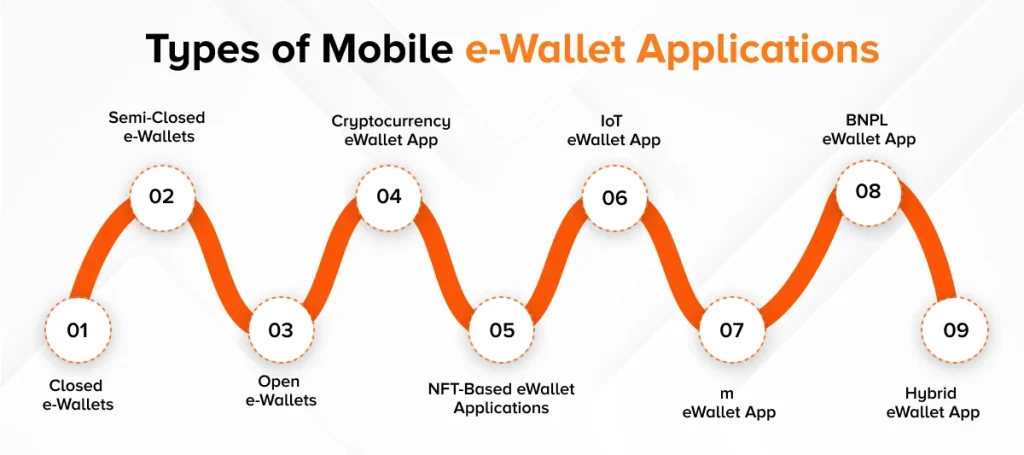
Closed e-Wallets
Well, some apps have built-in payment features, and transactions through these apps cannot be made universally. These organizations have been in the business for a long time and often share loyalty points, rewards, and cash back in the app wallet.
For example, you have a Starbucks wallet where most of the refunds and loyalty points from Starbucks are added. The same goes for other apps like Amazon, Myntra, etc.
Semi-Closed e-Wallets
A step ahead of the closed e-wallet types lie the semi-closed e-wallets. Paytm is quite similar to such apps. These apps are often used to make payments at stores. Their scope is limited and cannot be used at various steps, thus, half-closed or semi-closed e-wallets. These applications can also be used to make payments on the same network and other networks.
Open e-Wallets
These are simple and the most popular e-wallet applications that make things easier for people to use. They can be installed over any platform and are compatible with all networks. These have an extensive scope of payment and can handle all types of expenses easily. Ewallet app development cost highly depends on the market we explore and the ewallet app features we include.
Cryptocurrency eWallet App
Get an eWallet application that deals in cryptocurrency. Our cryptocurrency wallet development team brings solutions that can be used to make crypto payments globally. We have been offering solutions that make crypto exchanges without much hassle.
NFT-Based eWallet Applications
We work on solutions that are easy to publish and can help you build a strong presence in the virtual marketplace. With crypto punks, NFT monkeys, and other digital assets gaining popularity, the need for NFT-based eWallet applications has increased.
>>> Recommended Read: A Guide to Types of Digital Wallets: Cost and Features <<<
IoT eWallet App
The applications that leverage the power of the Internet of Things to make seamless payments come under this category. It is generally integrated with wearables and transaction devices.
m eWallet App
These applications are designed and developed only for mobile phones. They let users pay via various methodologies like QR code scanning, Account Transfer, etc. Our ewallet app development team can build solutions with advanced technology and help you be on top of your business.
BNPL eWallet App
The applications that give users a little time frame to make payments or split payments into installments are Buy Now Pay Later ewallet applications. These applications are gaining popularity because of their flexible payment terms and interest-free installments.
>>> Recommended Read: Buy Now Pay Later App Development: Step-by-Step Guide <<<
Hybrid eWallet App
As the name suggests, these eWallet applications are the ones that are a mix of various eWallet applications that we have discussed above. These applications allow users to get multiple payment options, giving them the ease and convenience of working on the solutions.
These are the significant kinds of e-wallet apps that one can consider for their business.
Monetization Models for eWallet Applications in 2026
In a market of tremendous inflation, success can not be a sure bet for businesses. It must be a sparkling app idea that will elevate your brand value. Mobile service providers across the world use highly adoptable monetization methods for the development of the app. Let’s discuss here some of the models.
Commission-Based
Keeping the business working is a necessity for businesses. In the commission-derived model, the authority owner surcharges a fixed charge to the bank transfers and the user. For example, a user performs a transaction on the platform and pays a small charge to the bank.
Earn by Advertising
In such a model, a similar bank service provider allows them to place their ads in the display area of the platform. This allows a large customer base on that platform. This is one of the kinds of sources of income to drive the businesses.
E-commerce Enabled
This model welcomes new companies to run their services over the already-pitched platform mutually. E-commerce has multiple options for giving back to the marketplace. Due to the more significant presence of overcrowded traffic, it preserves more scope for e-wallet transactions and businesses.
Freemium Solutions
Why not enter the market with a solution that lets users make essential payments for free but charges for using extended features?
This can help you build a strong presence in the market. Your users would be excited to explore the new advanced ewallet app features and willing to pay a little.
Choose any of these monetization models and connect with our experts to get an app that aligns with your business objectives and helps you make profits.
Top Challenges in Ewallet App Development
No custom mobile software development agency can deny dealing with security, safety, and confidentiality concerns. When we talk about fintech, the situation gets a little serious. Fintech deals with information about your finances, like bank accounts, debit cards, credit cards, and other information. The mobile app development team faces many challenges when developing a highly safe and reliable solution.
Our e-wallet app development team has seen each challenge as an opportunity to develop stronger, better, and more reliable solutions over time.
Let’s talk about some of the most common challenges, their solutions, and the opportunities they bring with them.
| Challenge | Solution | Opportunity |
| Choosing the Right Technology | Use scalable, future-ready technologies like AI, ML, blockchain, and cloud-native architecture. | Build advanced, high-performance wallets with long-term scalability and innovation potential. |
| Regulatory & Compliance Requirements | Ensure early compliance with KYC, AML, PCI-DSS, GDPR, and regional regulations. | Establish credibility, faster market entry, and stronger trust among users and regulators. |
| Fraud & Security Risks | Implement encryption, tokenization, blockchain, and AI-driven fraud detection systems. | Develop highly secure and reliable wallets that improve adoption and brand reputation. |
| Customer Trust & Adoption Mindset | Educate users, simplify UI/UX, and highlight security features clearly. | Expand the user base beyond early adopters and increase transaction frequency. |
| Lack of Trust in Digital Wallets | Use biometric authentication, device-level security, and strong marketing communication. | Position the wallet as a safe alternative to cash and traditional banking methods. |
Challenge 1: The Right Technology for the Perfect Delivery
It is complicated to identify and use the right technology to deliver the right solutions. We make sure to deliver solutions that are scalable and future-ready. For such solutions, our team needs to be updated with the technology and use the ones that have a better scope in the future.
Solution: Use Futuristic Technology
Artificial Intelligence and Machine Learning solutions are making it easier for developers around the world to build e-wallet applications that are reliable and technologically advanced. Augmented Reality is another technology that is molding the fintech industry only for the better.
Opportunities
The e-wallet development opportunities here are pretty extensive. When you think of any financial institution and the services it provides, we can bring it all within a click. One can always use advanced AI and ML solutions for security, blockchain for data modulation, AR/VR for verifications, etc.
Challenge 2: The Need for Regulatory Compliance
Mobile wallets and online payment platforms need to have some permission from government jurisdictions before coming into the real picture. This entails customer and financial institution regulations that define their functioning. If there is some major drift in compliance, then the owner must deal with judicial issues.
Solution: Before You Hire a Development Team, Get a Clean Chit
Clear the regulation compliances and understand the terms and conditions before you reach the development team. Although the ewallet application development team at Octal IT Solution is aware of the complaints in most countries around the world, a clear set of instructions would be better.
Opportunities
Regulations and compliance define the ewallet app solutions we work on. One can start with a strong mwallet app development trend where the compliance and regulations are adhered to, and help you make a strong presence in the market.
Challenge 3: The Risk of Frauds
It is essential to take care of the fraud and the risks that come with digital wallet app development. There is a general mindset about digital transactions where people assume there is a high risk of fraud, data theft, data leak, hacking, malware attack, etc. Over the years, technology has advanced so much that these things seem no wonder.
Solution: Use Advanced Technology and Stick to Compliance
When discussing secure and safe solutions, most digital payment apps these days are GDPR compliant. Not just this, these solutions go through a strict verification process and make use of technologies like Blockchain and Encrypted messaging to ensure things are reliable and easy to proceed with.
Opportunities
When talking about the risks associated with mobile payment applications, there is a better scope for development. E-wallet app development opportunities are mostly around making the application credible and reliable. With various development considerations, using advanced encrypted methods for transactions would offer a better future.
Challenge 4: The Mindset of the Customers
This is another reason why money transfer applications and digital payment platforms seem to have a limited scope. The target group, instead of being universal, is the youth. Many people still don’t trust online payment methods, as they do not rely on the fact that these are safe. Also, they doubt that if the transaction is unsuccessful, they may lose their money.
Solution: Spread Awareness and Guide People
To expand the horizon of the audience group, it is important that you tell people about the safety features and the understanding of the application. They need to be aware of the credibility and reliability of the solutions. Also, it should be easier to navigate for better and faster transactions.
Opportunities
Although till we talk about finances, security would be an issue. Your ewallet app development agency with advanced technology can come up with more reliable and credible solutions. Also, a technologically advanced User Interface would make it easier for the technotards to make payments easily, thus expanding the domain of ewallet applications.
Challenge 5: The Lack of Trust
When we talk about the challenges related to ewallet development, the lack of trust in the team is one of them. Deal with ewallet development challenges with immense care to ensure that the solution reflects well. If people cannot trust their devices, they aren’t going to keep money in them. They are often scared that if the device is lost, they may lose all their money too.
Solution: Bust the Myths
It is important to deliver an app with advanced security features. Your marketing team must take care of busting the myths around the ewallet app development and its usage. Over the years, we have been working toward delivering better solutions that would make things easier for all.
Every doubt comes with an exciting opportunity. The risks that ordinary people think are associated with the ewallet application can be reduced if developed solutions use some technology where the biometric locking and verification system is used.
With AI and ML solutions, one can develop products that use biometric identification to make transactions. Thus, no two people would be able to access the same account.
These are some of the most common challenges and solutions that our team takes care of. With various opportunities and solutions, it is important that the product that gets into the market is interesting and unique.
Top 5 Popular eWallet Mobile Apps
Some of the top ewallet mobile apps in the market are PayPal, Google Pay, Samsung Pay, Stripe, Amazon Pay, WhatsApp Pay, Phonepe, and many others. Our experts study and research these before they begin ewallet app development for your project.
Google Pay
Google Pay is one of the most popular solutions that lets users add money to their wallets for instant payments. The ease and 2FA make the application a credible place to count money and use it as required without carrying a traditional wallet.
Many businesses that connect with the best fintech app development company or another service provider often ask if they can integrate Gpay payments with their applications, making it one of the most popular online payment platforms.
Amazon Pay
One of the best examples of semi-closed wallets, AmazonPay offers users unique perks. They can get discounts on the total order value, pay bills, and make payments to other AmazonPay users.
Paypal
It is a global cross-border payment solution for costs in a secure way. 51% of businesses trust PayPal for their payments. More than 27M traders’ preferred choice worldwide is PayPal.
Most e-commerce app development companies integrate it into their solutions. Paypal offers secure payment methods for transactions. It also occasionally provides a wallet, debit card attachments, and bank accounts with discounts and rewards.
Venmo
Another online payment application that is gaining popularity in recent days is Venmo. It has a fantastic interface and lets users make payments without any disruptions. We consider Venmo’s look and feel one of the simplest yet most effective in terms of user engagement and adaptability.
PhonePe
Phonepe has one of the largest transaction ecosystem with a user base of 340M+ worldwide. Stakeholders from worldwide trust this platform for its safe and fast payment solutions. Using the application is convenient. Simply enter the 4-digit mpin and Ting! Payment done.
For most ewallet app development agencies, PhonePe is the best inspiration considering its ease and user-interface.
So finding the right e-wallet application development partner to help you through the journey, starting with an innovative concept, unique ideation, passion, and tech stack, will drop the e-wallet app development cost and time framework for developing a virtual wallet app by up to 40%.
Conclusion
If you embark on the virtual wallet app development journey, this guide surely can be your manual. Another challenge is choosing the right company to help you with a feature-laden solution. You can hire Octal IT Solution for ewallet app development services. We have a team of highly experienced developers who can assist you in ensuring your business growth and revenue.
Therefore, before embarking on the journey, choose an ewallet app development agency that can understand your business objectives, ewallet app features, ewallet app development costs that help you to achieve your business goals and reach your audience with an interactive and intuitive solution.
Frequently Asked Questions
 By
By July 10, 2026


 Latest Stories
 Get in Touch