


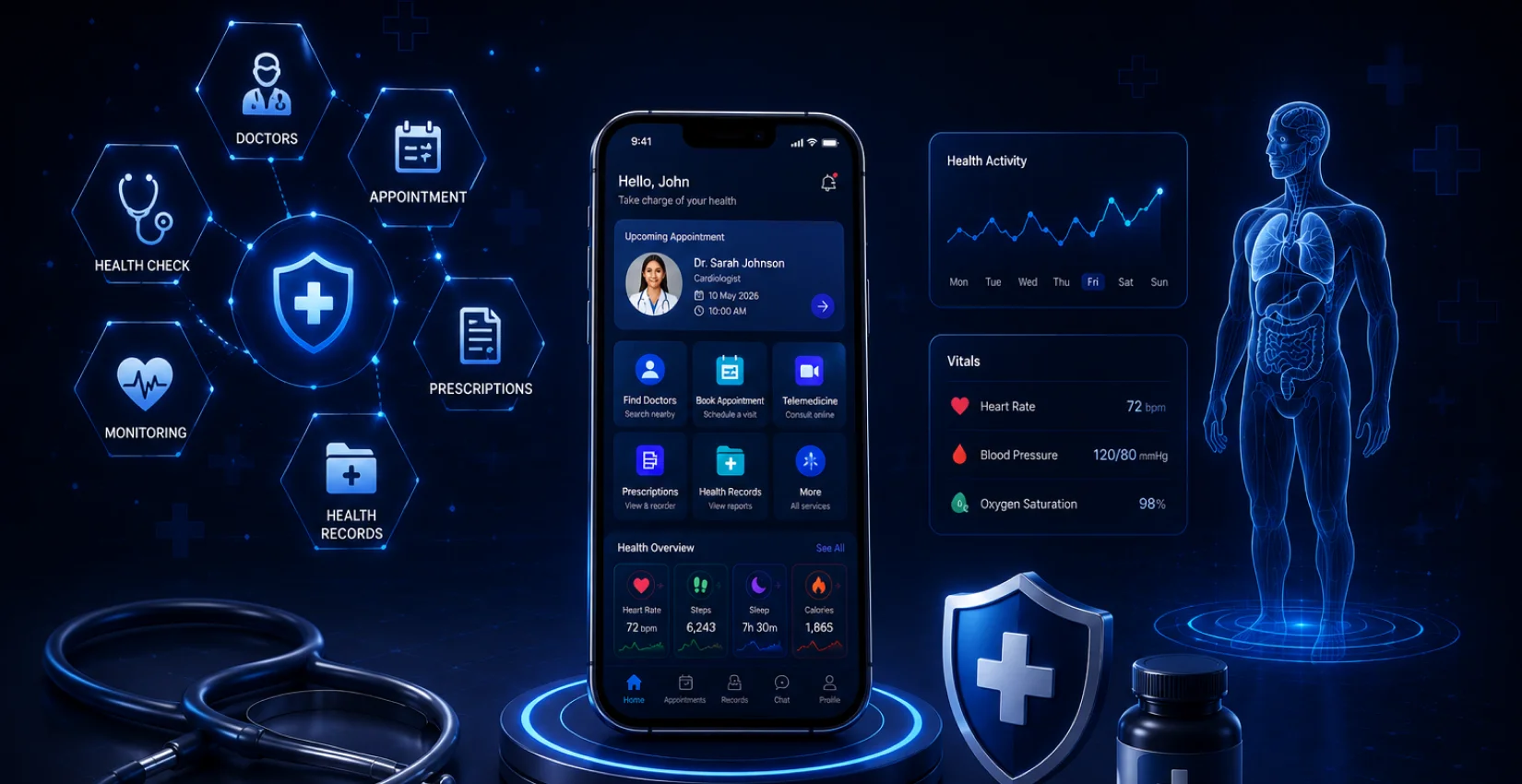
Still relying on outdated healthcare systems while patients want digital care experiences? Well, that’s the area where medical app development will revolutionize the healthcare sector with advanced and faster technologies powered by AI.
According to Precedence Research, the global size of the digital health market is forecasted at USD 420.08 billion in 2025, while it will increase from USD 483.07 billion in 2026 to reach USD 1,171.24 billion by 2035, which reflects a CAGR of 10.8% between 2026 and 2035.
Here in this blog post, we will go through all aspects of medical app development, including its types, features, development process, cost, benefits, artificial intelligence in medical applications, and security standards. Additionally, businesses will get some valuable tips on how to select the best medical app development company.
- What is Medical Application Development?
- Why Should Businesses Invest in Medical App Development?
- Types of Medical Applications in Healthcare
- Top Features of a Medical Mobile Application
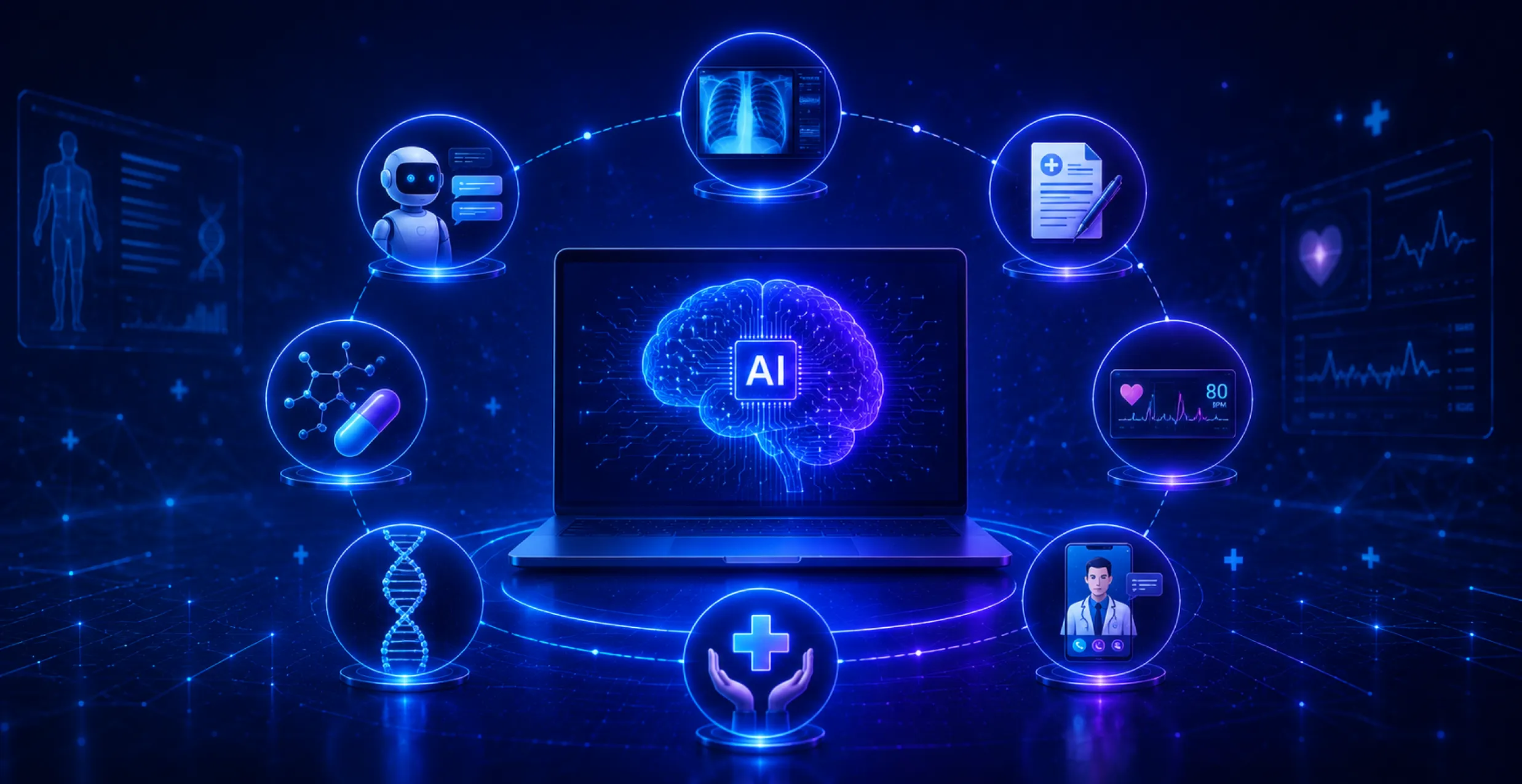
- AI in Medical Application Development
- Step-By-Step Process of Custom Medical Mobile App Development
- Tech Stack Used for Medical Mobile App Development
- Compliance & Security Standards in Medical App Development
- How Much Does Medical App Development Cost?
- Cost Breakdown by Medical App Type
- Benefits of Custom Medical Application Development
- Challenges in Medical Application Development
- Latest Trends in Medical App Development
- Why Choose Octal for Medical Application Development Services?
- Final Words
What is Medical Application Development?
Medical application development involves developing innovative software products aimed at increasing patient benefits, making hospital processes smoother, and enhancing the process of clinical communication app development. At present, medical mobile app development involves the use of AI technologies, cloud services, and IoT devices in order to ensure that patients get a more secure healthcare experience.
As a matter of fact, nowadays most organizations opt for hiring medical app development companies because they need their assistance not only in terms of telemedicine implementation but also in remote monitoring and AI-based healthcare innovations.
Why Should Businesses Invest in Medical App Development?
Today, many organizations have already realized the importance of implementing IT solutions for healthcare in order to increase patient experience, optimize internal processes, and cut down on operational expenses. By investing in medical application development, companies will be able to compete with others and enhance healthcare provision, including custom mobile applications that are scalable and fully functional.
1. Improved Patient Engagement
Health apps let patients book appointments, get reminders, and join virtual consultations so providers can offer more tailored experiences. With advanced medical application development solutions, teams can improve patient interaction in a more seamless way.
2. Faster Healthcare Access
Digital health platforms facilitate remote consultation and allow for medical assistance at any time. Thus, medical services become accessible anytime throughout the day. Many companies choose to cooperate with a custom medical application development company in order to increase coverage.
3. Better Operational Efficiency
Healthcare facilities leverage mobile applications in order to automate operations related to billing, scheduling, medical record management, etc. Such automation leads to higher efficiency and productivity among many medical departments.
4. Higher ROI for Healthcare Businesses
With custom healthcare apps, one can expect reduced costs, increased patient loyalty, and long-term income opportunities for new companies, clinics, and healthcare organizations.
5. Competitive Advantage Through Innovation
Incorporation of AI-powered healthcare solutions allows for fast diagnostics, remote care, and customized medical approaches. It gives companies a competitive edge among many players in the healthcare sector.
Types of Medical Applications in Healthcare
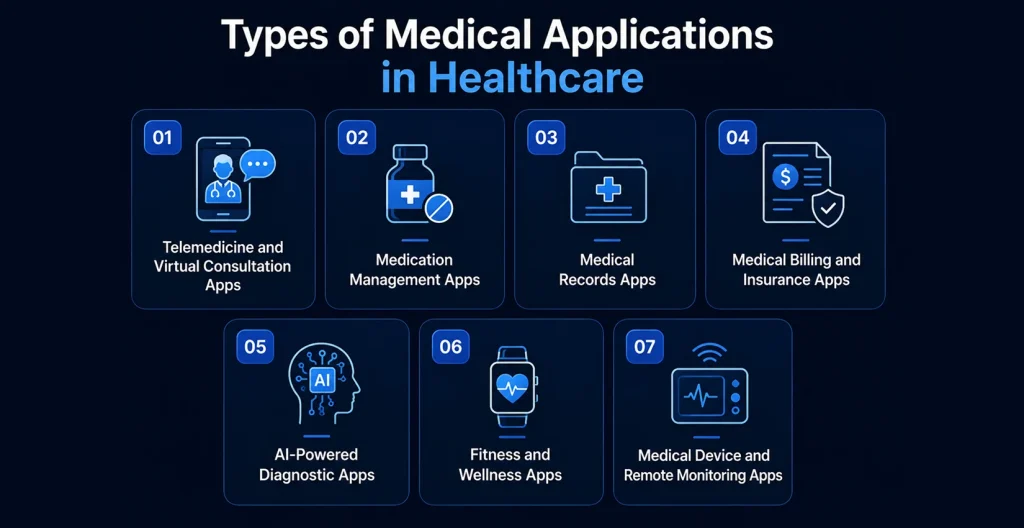
Health care companies are adopting various medical apps to make patient care more efficient, bring order to hospitals, and deliver faster digital health care services. Today the development of modern medical mobile applications is moving in the direction of secure, AI-powered, and still user-friendly healthcare solutions for hospitals, clinics, startups, and other healthcare providers.
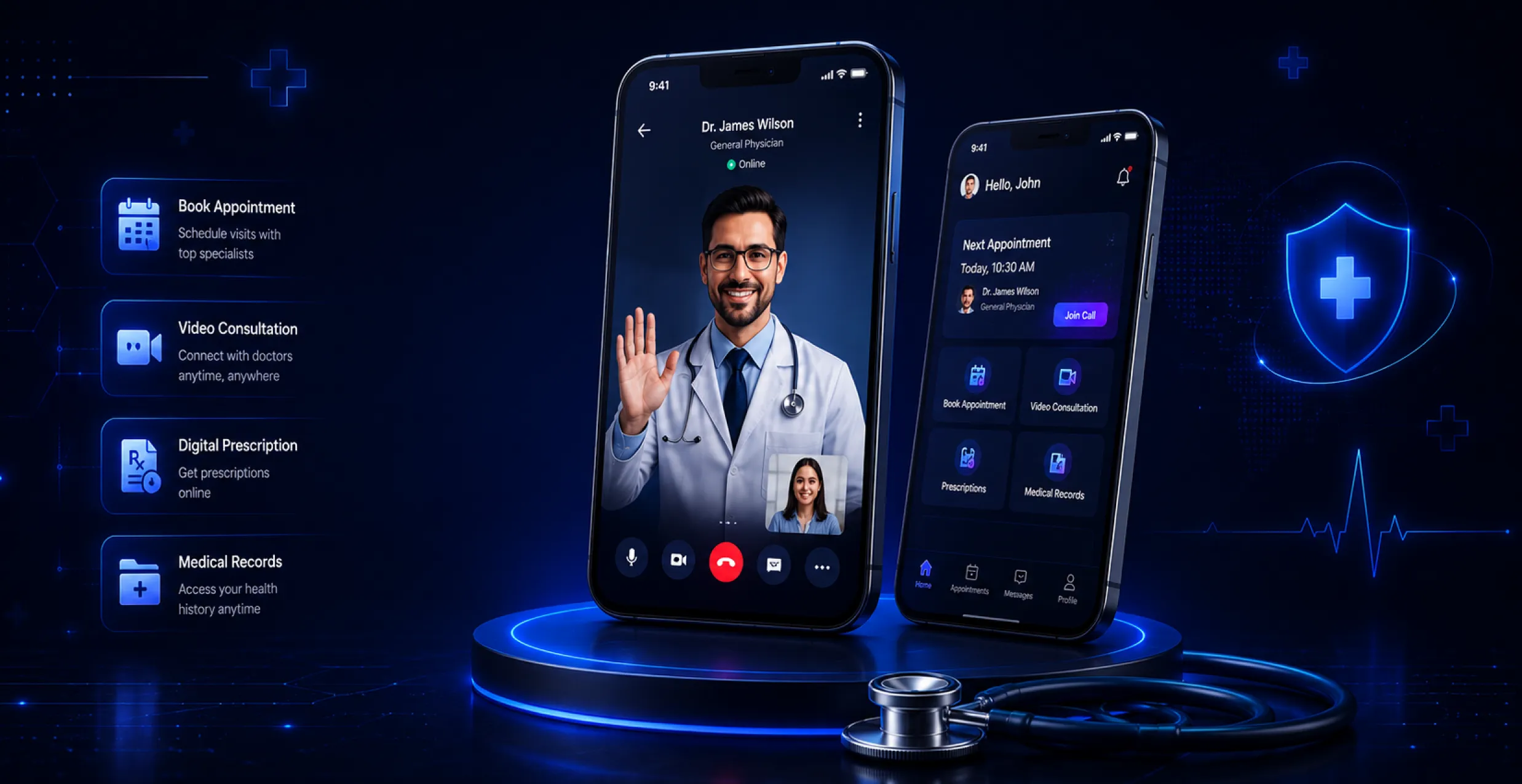
1. Telemedicine and Virtual Consultation Apps
Such apps allow patients to get in touch with doctors via video communication, chatting, and even making online prescriptions. These telemedicine mobile apps are broadly utilized in combination with telemedicine software development services.
2. Medication Management Apps
These applications aid the process of taking medications by reminding about dosage and helping with refilling prescriptions. Moreover, medication apps help to follow the treatment plan.
3. Medical Records Apps
This kind of application helps to store patients’ records, reports, prescriptions, and details of treatments. In this case, healthcare providers can easily gain access to the necessary information instantly.
4. Medical Billing and Insurance Apps
Billing and insurance apps facilitate the processes of accounting, claims processing, and payments. Such applications are popular among hospitals, clinics, and insurance agencies.
5. AI-Powered Diagnostic Apps
AI healthcare apps are designed to diagnose symptoms, medical records, and other information provided by patients. Treatment options are also suggested using artificial intelligence medical application development solutions.
6. Fitness and Wellness Apps
These types of health-related mobile apps monitor physical exercise activities, sleeping patterns, and eating practices. They even monitor mental well-being and try to encourage good healthcare practice compliance.
7. Medical Device and Remote Monitoring Apps
Wearable technologies and medical equipment devices are synchronized using connected healthcare application development solutions to offer continuous patient monitoring and management of chronic illnesses.
Top Features of a Medical Mobile Application
Modern mobile applications require secure integration, convenient user interfaces, and practical features to maintain a pleasant experience for patients during healthcare management. The services provided by medical app development companies center around convenient interaction, automation, and accessibility.
A. Patient Panel Features
1. Appointment Scheduling
Patients can schedule appointments, cancel bookings, or reschedule their appointments using digital calendars, thus making their lives easier and reducing wait times at medical establishments.
2. e-Prescription Management
ePrescription features allow doctors to send digital prescriptions safely, and patients can review medication details right inside the healthcare application.
3. Video Consultation
With the video calling facility, patients can take consultations with doctors virtually by utilizing advanced medical mobile apps.
4. Health Tracking Dashboard
With the health tracking dashboard facility, users can keep track of health statistics, fitness information, medication records, and treatment history.
5. Payment Integration
With the integration of secure payment gateways, the process of paying consultation fees and processing insurance becomes easier.
6. Push Notifications
Doctors can send reminders to their patients about their appointments, medication, tests, and other healthcare notifications.
B. Doctor Panel Features
7. Patient Record Access
Doctors can access all sorts of data related to patients, including patient history, medical prescriptions, reports, etc.
8. ePrescription Tools
Using the e-prescription facility, doctors can prescribe medicines to patients instantly without wasting time in writing down prescriptions on papers.
9. Appointment Management
Doctors can manage appointments and schedule consultations through a healthcare management dashboard.
10. AI-Assisted Diagnosis Support
With the help of AI-powered health apps, medical professionals are capable of identifying disease signs and diagnosing diseases through complex healthcare analytics.
11. Secure Communication
For securing communications, it uses encryption technologies as well as video communication between patients and healthcare providers online.
C. Admin Panel Features
12. User Management
The admin panel uses management features of the healthcare application to control and monitor various users, including doctors, patients, and employees.
13. Analytics Dashboard
With the help of online healthcare analytics, the health business can monitor user behavior, financial performance, and productivity.
14. Compliance Management
Healthcare administration ensures regulatory compliance, data management, and patient privacy in all digital healthcare systems.
15. Billing and Reporting
Some other features, like automated billing and reporting, ensure that the health business monitors its financial status through IT healthcare solutions.
AI in Medical Application Development
Nowadays, AI is taking up a significant place in the healthcare industry, offering various advantages through diagnostics, automation, and healthcare services to patients. The adoption of AI medical app development services helps businesses develop an intelligent healthcare app, which provides healthcare solutions through predictive analytics and personalized treatment.
1. AI Medical App Development Use Cases
AI medical apps include telemedicine consultation, symptom checking, medical imaging, patient monitoring, and automation in the healthcare industry.
2. Predictive Healthcare Analytics
Through AI predictive healthcare analytics, organizations can use medical data to predict various health issues and medical risks.
3. AI Chatbots and Virtual Assistants
The use of AI technology in chatbots and virtual health assistants allows businesses to provide quick and useful health advice to their customers.
4. AI-Powered Symptom Checker Apps
Through the use of AI, intelligent healthcare apps determine health issues and symptoms of patients based on their medical history.
5. Personalized Treatment Recommendations
AI algorithms help businesses develop personalized treatment plans for patients according to their medical history and behavior.
6. Benefits of AI Medical App Development Company Solutions
AI in the healthcare industry helps companies achieve automation and efficient diagnostics along with cost savings and patient satisfaction.
Step-By-Step Process of Custom Medical Mobile App Development
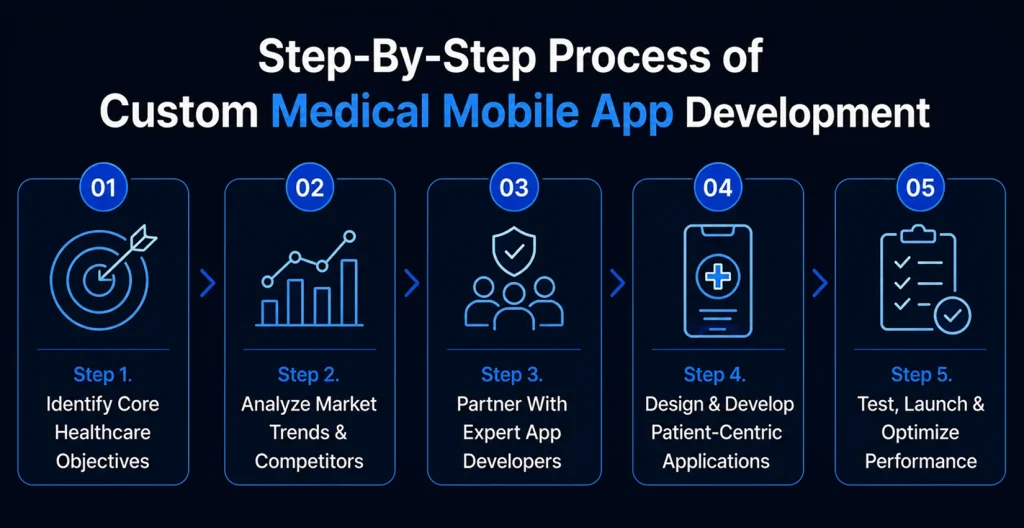
The development of the healthcare application requires preparation, regulation, the creation of a secure architecture, and the use of scalability technologies. Enterprises collaborate with a healthcare application development company focusing on creating an effective application.
Step 1. Define Healthcare App Requirements
It is important to define the audience, problems, goals, and functions, as well as other requirements for the healthcare application, prior to its development.
Step 2. Conduct Market & Competitor Research
Such information as competitors, market trends, and patient needs is required to create an effective, competitive, and efficient healthcare solution.
Step 3. Choose the Right Medical App Development Company
An enterprise should find professional specialists with the skills related to HIPAA, AI, and healthcare app architecture.
Step 4. UI/UX Design & App Development
The developers will design appealing interfaces and incorporate cloud platforms, APIs, and communication solutions to deliver the best user experience.
Step 5. Testing, Launch & Maintenance
Tests, deployment, security checks, and updates will be needed to ensure that the healthcare solution operates flawlessly.
Tech Stack Used for Medical Mobile App Development
It is important to focus on the correct selection of technologies while developing healthcare apps. Contemporary healthcare mobile apps need efficient front-end and backend, cloud, and AI technologies to support seamless healthcare operations and patient engagement.
| Technology Area | Technologies Used |
| Frontend Development | React Native, Flutter, Swift, Kotlin |
| Backend Development | Node.js, Python, Django, .NET, Laravel |
| Database | PostgreSQL, MongoDB, MySQL, Firebase |
| Cloud Infrastructure | AWS, Microsoft Azure, Google Cloud |
| AI & ML Technologies | TensorFlow, OpenAI APIs, IBM Watson |
| Healthcare APIs | HL7, FHIR APIs, Apple HealthKit |
| Video Consultation | Twilio, Agora, WebRTC |
| Payment Integration | Stripe, PayPal, Razorpay |
| Security Tools | OAuth 2.0, JWT, SSL Encryption |
| DevOps & CI/CD | Docker, Kubernetes, Jenkins |
| Analytics Tools | Google Analytics, Mixpanel |
| Notification Services | Firebase Cloud Messaging, OneSignal |
Similarly, medical businesses work together with medical translation app development specialists in order to improve multilingual healthcare access through the use of global health platforms.
Compliance & Security Standards in Medical App Development
Standards for security and compliance are key components to securing the data for healthcare applications. Reliable medical application development focuses on developing compliance and security architecture for healthcare.
1. HIPAA Compliance
HIPAA compliance is the standard that enables the handling of patient health records and other information by the application securely.
2. GDPR Regulations
GDPR makes sure that user privacy and their data security and management are protected in all applications that aim to target European healthcare users.
3. HL7 & FHIR Standards
HL7 & FHIR standards ensure smooth data sharing between healthcare applications, hospitals, clinics, and insurance services.
4. Data Encryption & Cybersecurity
Cybersecurity and data encryption protect healthcare applications from cyber threats and any potential attacks.
5. Secure Cloud Storage
Patients’ data is stored in the cloud healthcare system using UAE healthcare application development technology.
How Much Does Medical App Development Cost?
The medical app development cost can range between $20,000 to $200,000+, depends on a number of aspects, including the complexity of the app, the functionalities that it will perform, the platforms selected for its deployment, compliance considerations, and the development location.
For companies contemplating custom solutions to medical app development costs, they need to consider several issues, including phases of the app development process, developer teams required, and maintenance costs.
Cost As Per Project Phase
| Development Phase | Estimated Cost |
| Research & Planning | $5,000 – $10,000 |
| UI/UX Design | $8,000 – $15,000 |
| App Development | $25,000 – $100,000 |
| API Integration | $5,000 – $20,000 |
| Testing & QA | $7,000 – $15,000 |
| Deployment & Maintenance | $5,000 – $12,000/year |
Cost According to Development Roles
| Team Role | Hourly Rate |
| Project Manager | $25 – $60 |
| UI/UX Designer | $20 – $50 |
| Frontend Developer | $25 – $70 |
| Backend Developer | $30 – $80 |
| AI/ML Engineer | $40 – $120 |
| QA Engineer | $20 – $45 |
App Complexity Cost Breakdown
| App Complexity | Estimated Cost |
| Basic Medical App | $20,000 – $40,000 |
| Medium Complexity App | $40,000 – $80,000 |
| Advanced AI Healthcare App | $80,000 – $200,000+ |
Cost Based on Region
| Region | Average Hourly Rate |
| North America | $80 – $200 |
| Europe | $60 – $150 |
| UAE | $40 – $100 |
| India | $25 – $70 |
1. Average Medical App Development Cost
Healthcare mobile app development cost varies from $20,000 up to over $200,000, depending on the functionality that it is designed to deliver as well as other issues, including compliance and artificial intelligence.
2. Factors Affecting Medical App Development Costs
Among the key factors that influence healthcare application development costs are the complexity of the application, healthcare APIs, cloud computing environment, artificial intelligence integration, and security considerations, among others.
3. Cost Based on Platform Selection
Depending on the platforms chosen for developing healthcare applications, the cost will vary significantly in terms of development and maintenance cost.
4. Hidden Costs in Medical Mobile App Development
The hidden costs associated with health application development include maintenance, cloud hosting, and security management costs.
Cost Breakdown by Medical App Type
Different healthcare applications involve unique technologies, policies, and integrations, having considerable influence on the overall cost of development. The general costs of development of the medical application vary depending on each individual project’s requirements.
1. Telemedicine App Development Cost
Development of telemedicine applications implies video call and appointment scheduling, etc., which costs approximately $40,000 – $120,000.
2. Medication Management App Development Cost
The creation of applications for reminders and prescription delivery requires investments in a range between $25,000 and $70,000.
3. Medical Records App Development Cost
Applications that include electronic health records, HIPAA compliance, cloud storage, and many others start from $50,000 and go up to $150,000.
4. Medical Device App Development Cost
Apps related to connected healthcare and devices cost much more money compared to traditional software development.
5. Healthcare Mobile App Development Cost
Main factors influencing the cost of development includes what type of features you involved, such as AI, analytics, and remote monitoring.
Benefits of Custom Medical Application Development
Customized healthcare applications enable medical businesses to offer a better experience, automated workflow, and healthcare services tailored to individual needs. Organizations that choose custom medical application development will receive future-proof healthcare application development solutions.
1. Improved Patient Engagement
Medical applications facilitate engagement and interactions with patients through reminders, consultations, and personalized information related to their health conditions.
2. Better Healthcare Accessibility
With the help of remote healthcare applications, patients will be able to have consultations, prescriptions, and medical assistance at all times from wherever they are.
3. Operational Efficiency
Healthcare organizations are enabled to streamline and automate operations by leveraging medical application development software.
4. Real-Time Data Access
Doctors and healthcare specialists are able to get instant access to records, reports, and analyses related to the patient’s condition.
5. Reduced Administrative Workload
Healthcare providers are relieved from paperwork through medical billing software development for improved patient care and services.
Challenges in Medical Application Development
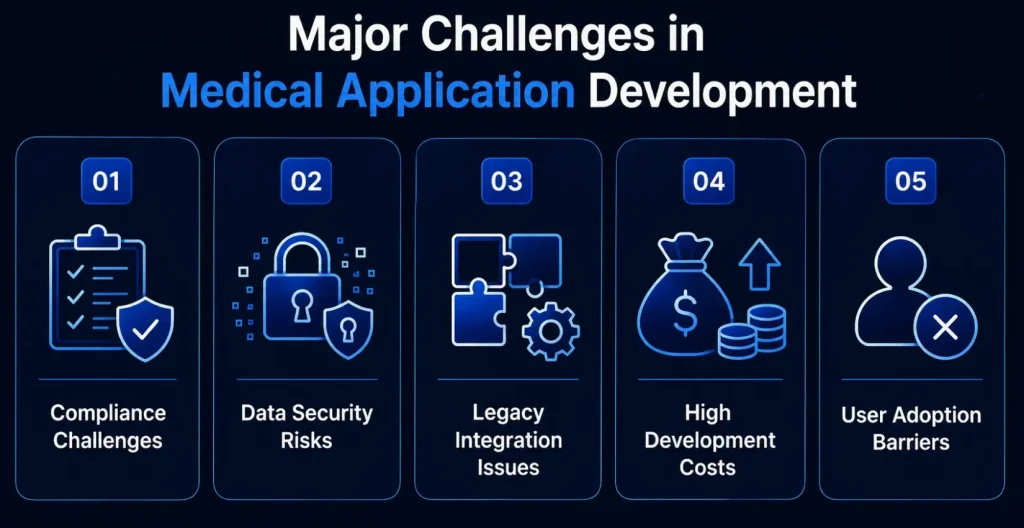
Healthcare app development faces many technical, legal, and organizational challenges that need to be overcome by companies. The successful medical mobile application development is only possible with an emphasis on such aspects as security, regulation, and health system integration.
1. Regulatory Compliance Issues
For the safe transfer of data, healthcare applications need to comply with HIPAA, GDPR, and local healthcare regulations.
2. Data Privacy Concerns
The protection of medical information from cyberattacks will become possible through encryption, secure APIs, and the implementation of reliable identity authentication systems.
3. Integration with Legacy Systems
Healthcare institutions use obsolete systems that create significant technical problems for the integration of healthcare applications.
4. High Development Costs
Due to numbers of complexities, healthcare applications become expensive because of the implementation of artificial intelligence technology.
5. User Adoption Challenges
It will be hard to implement medical app ideas into practice when healthcare organizations are resistant to using new digital technologies.
Latest Trends in Medical App Development
There are many significant trends that shape the future of digital health experience. Currently, the modern healthcare app development companies use AI, IoT, blockchain, and cloud technologies to implement innovations in healthcare solutions.
1. AI-Powered Healthcare Apps
These applications use AI technology to deliver more efficient and productive diagnostics, virtual assistance, patient monitoring, and analytics to provide efficient and high-quality healthcare.
2. Blockchain in Healthcare
This technology provides security to information in different healthcare organizations and information exchange for patients’ medical records and information.
3. IoT Healthcare Ecosystem
With the help of IoT technology, healthcare apps can connect different devices and provide healthcare services integration in the system.
4. AR/VR in Medical Training
AR and VR technologies can be used for the creation of virtual reality, in which a person will train different skills.
5. Voice-Enabled Healthcare Apps
With the voice technology, patients can get additional features in healthcare apps, such as appointment booking.
6. Cloud-Based Healthcare Systems
Using cloud infrastructure allows implementing scalability in the healthcare application and providing remote access to its features.
Also Read: Medical Software Development Guide for 2026
Why Choose Octal for Medical Application Development Services?
Healthcare businesses need reliable technology partners to build scalable and future-proof healthcare applications. In this regard, Octal is among the best medical application development companies providing efficient healthcare software solutions.
- Our skilled medical app developers are creating robust medical software with our experience in AI programming and other technical elements.
- We also offer AI-based healthcare software solutions like AI analytics, AI chatbots, prediction of disease diagnoses, and remote patient monitoring.
- Our medical app developers emphasize HIPAA compliance, cybersecurity, scalability, and performance in the healthcare application development process.
- Octal is one of the healthcare mobility solutions providers, with our services ranging from strategy and design to deployment and maintenance.
Final Words
The healthcare sector is undergoing a major transformation in terms of becoming more digitized, and the development of medical applications plays a crucial role for businesses in this area. Not only does using healthcare apps help improve access to care, but it also makes it more efficient and easier for patients to interact with the healthcare system in general.
By focusing on the development of safe and scalable healthcare solutions, companies can get many opportunities to grow in the long run. Selecting an experienced medical mobile app development company will help organizations create healthcare apps that meet all of their needs in the best possible way.
 By
By September 14, 2026



 Latest Stories
 Get in Touch