

What if the developer you hire today writes half their code using an AI copilot? But then can’t explain why the model failed the moment it hit production? This is the whole gap businesses stumble into when they rush to hire AI developers.
The global AI market is projected to climb from $539.5 billion in 2026 to $3,497.3 billion by 2033, roughly a 30.6% CAGR (Grand View Research). And this growth is pulling demand for skilled AI talent ahead of supply.
This guide goes through the exact workflow and real 2026 costs. Among the key things to watch when hiring AI developers who can deliver production-ready systems.
- The Growing Demand for AI Developers & Why Custom AI Projects Need the Right Team
- Different Types of AI Developers You Can Hire
- Signs You Need to Hire AI Developers for Your Business
- Step-by-Step Process to Hire AI Developers for Custom Projects
- Illustrative Project Scenarios: How the Right Hire Solves Real Business Problems
- Where to Find and Hire Dedicated AI Developers?
- Cost to Hire Generative AI Developers in 2026
- Key Skills to Look for When You Hire AI Engineers
- Red Flags to Watch for Before You Hire an AI Developer or Team
- AI Development Services vs. Building In-House: Which Should You Choose?
- How to Evaluate an AI Development Company Before You Commit
- Common Mistakes to Avoid When You Hire AI Developers
- Final Words
- FAQs
The Growing Demand for AI Developers & Why Custom AI Projects Need the Right Team
AI adoption is moving faster than hiring pipelines can keep up, like faster. Businesses that want to hire generative AI developers right now are running into more competition and higher rates. Along with a smaller pool of proven talent.
1. Enterprise AI Adoption Has Outpaced Talent Supply
Enterprise AI hit the mainstream threshold years ago. But the training pipelines for specialized engineers still haven’t caught up. In practice, the companies that bring in artificial intelligence developers early often get a true head start over everyone who moves a bit slower.
2. Off-the-Shelf Tools Can’t Handle Unique Workflows
Most generic AI tools handle generic problems well enough. But custom work needs people who can craft tailored AI automation solutions around your specific data and your compliance constraints. As well as the software stack, not a one-size-fits-all plugin.
3. Agentic and Generative AI Have Raised the Skill Bar
A lot of projects now involve agentic workflows plus generative models, working together in the same system. That means developers need orchestration skills and prompt engineering. Furthermore, safe deployment know-how, not just basic scripting or simple API integration work.
4. Competitive Pressure Is Forcing Faster AI Rollouts
Competitors keep shipping AI-powered features every quarter. So waiting around to build internal expertise from scratch can put you behind. That’s why many businesses end up complementing in-house teams with specialized outside talent.
5. Custom Projects Carry Higher Stakes Than Pilots
A failed pilot costs little. But a failed production system tied to real customers costs revenue, trust, and time. Well, exactly why custom AI projects ask for developers with proven delivery experience in the real world.
Different Types of AI Developers You Can Hire
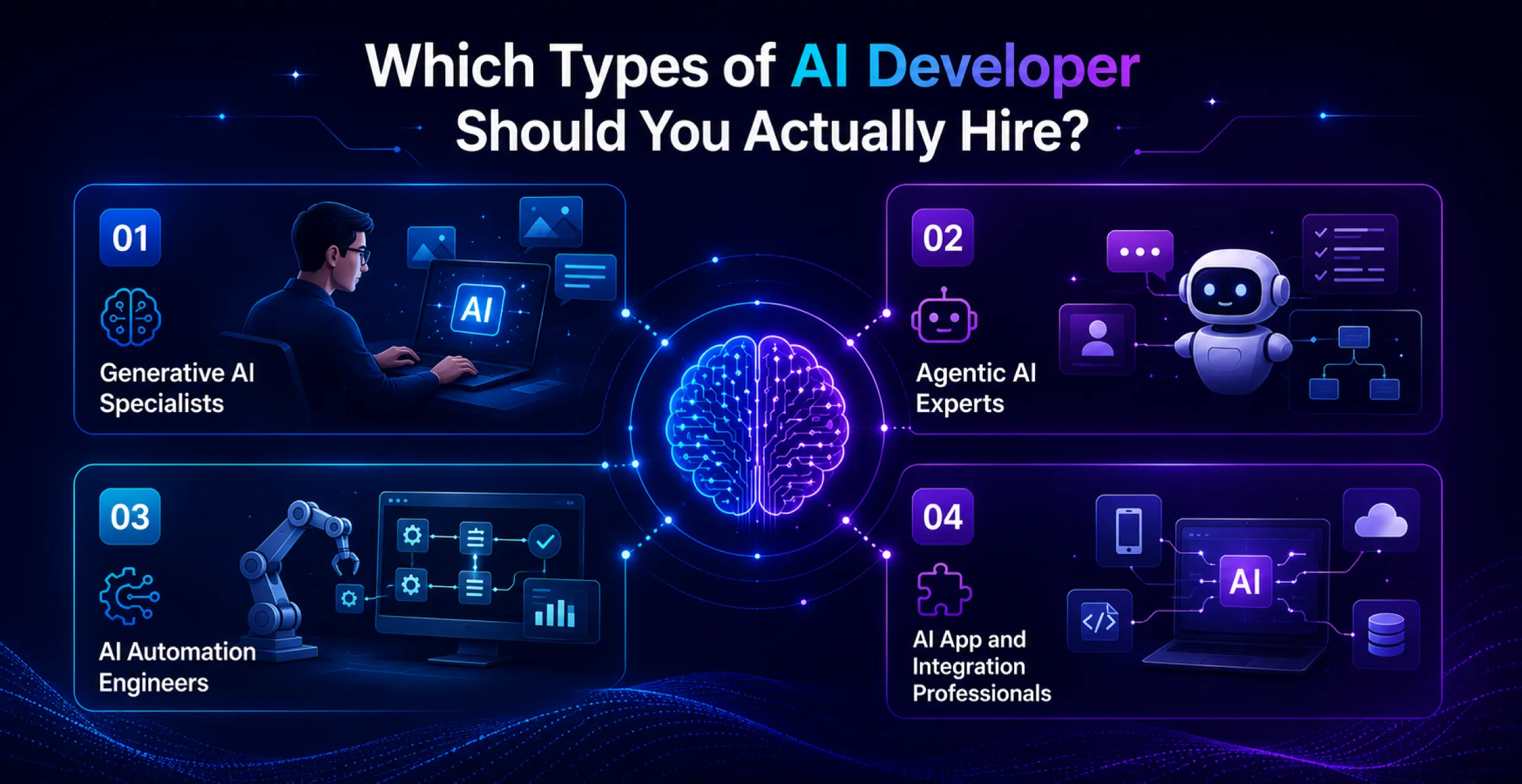
Not all AI developers do the same thing. Picking the right specialist, generative, agentic, automation, or integration-focused, for your project scope. This helps you save time and budget and avoid those mismatched expectations.
1. Generative AI Developers
Generative AI developers build systems that produce text, images, or code using large language models. When a business hires generative AI developers, they want content engines and coding copilots. Or full conversational products built from scratch.
2. AI App Developers & AI Integration Specialists
AI app developers focus on the user-facing product. While integration specialists connect the model bits into your existing software. A lot of companies end up hiring an AI app developer. While also bringing in a separate group for dedicated AI integration services.
3. Agentic AI Developers
Agentic AI developers create systems that plan and carry out multi-step tasks, more or less by themselves. As workflows drift from simple chatbots into self-directed agents. More companies now hire agentic AI developers to automate entire processes, from beginning to completion.
4. AI Automation Engineers
AI automation engineers link machine learning models to real business workflows. They deal with data pipelines, monitoring, and later retraining too. This is the right hire when you want efficiency at scale, not just one customer-facing feature.
Signs You Need to Hire AI Developers for Your Business
We can say some signs are obvious, but others show slowly. If you notice manual effort rising, accuracy slips. Or growth that suddenly stalls, then it often points to an AI gap. Catch it early and hire artificial intelligence developers’ talent before the issues compound.
1. Repetitive Manual Work Is Eating Staff Hours
If people spend hours doing data entry, ticket triage, or manual reporting, that’s a significant signal. You should hire AI engineer talent who can automate those workflows with dependable AI automation solutions instead.
2. Off-the-Shelf Tools Have Hit a Ceiling
Generic SaaS AI features often reach a ceiling once your data or workflows get complex. That’s when a dedicated AI platform development effort starts. Built by developers who understand your systems, it starts paying off.
3. Customer Experience Is Falling Behind Competitors
If competitors answer faster, personalize better, or just solve the problem instantly, your customers definitely notice. Custom AI systems help close that gap in a way that generic chat widgets and template automations can’t match.
4. Data Sits Unused Across Departments
Most businesses gather huge amounts of data, but they rarely use it for predictions or automation. Skilled AI developers can turn scattered data into working models that forecast demand, highlight risk, or personalize offers.
5. Your Team Lacks AI-Specific Technical Depth
General software engineers can hook up APIs. But they don’t have the deeper experience for fine-tuning models or handling vector databases. In addition, troubleshooting production AI failures. Those gaps are exactly why hiring specialists becomes non-optional.
Step-by-Step Process to Hire AI Developers for Custom Projects
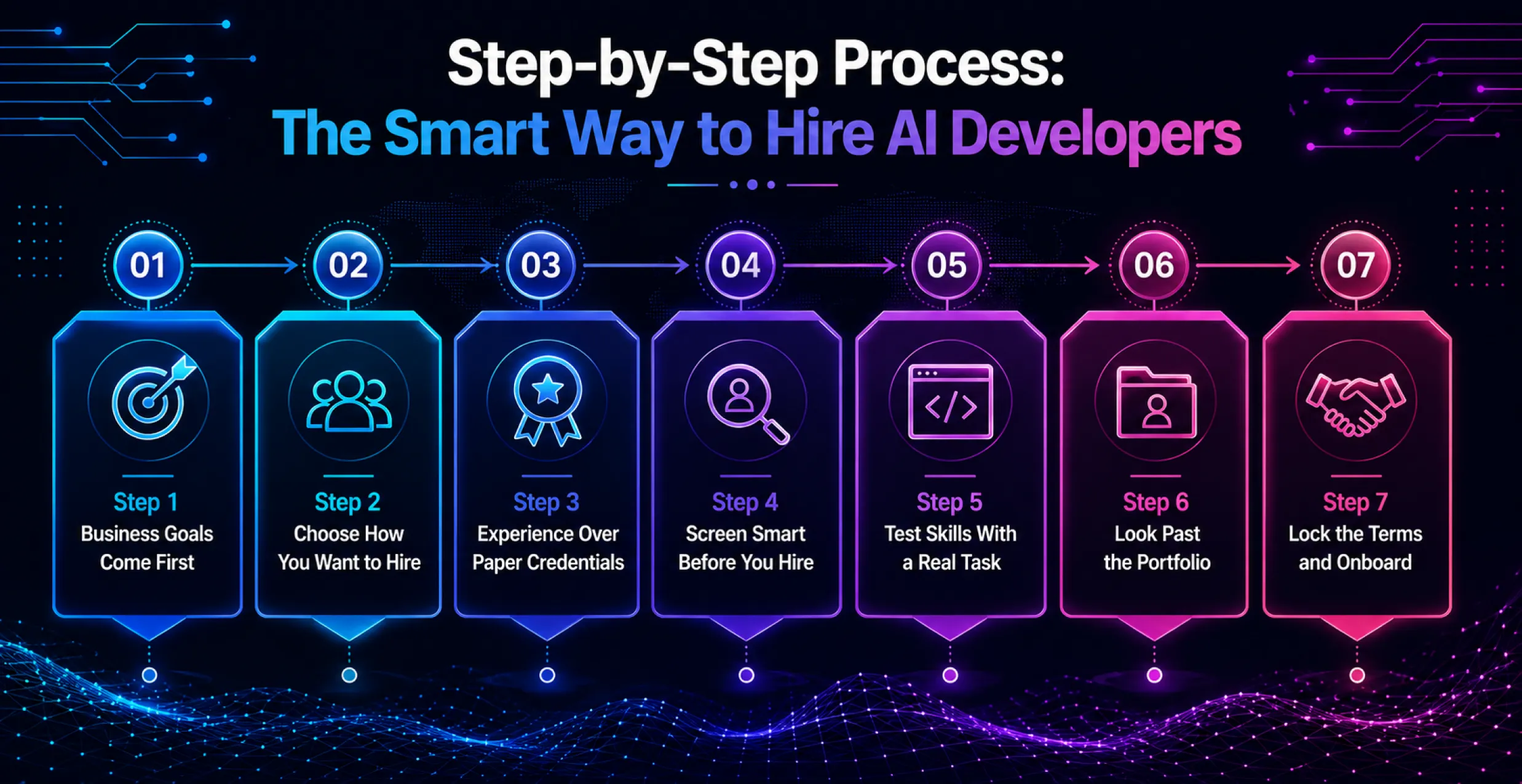
Hiring the wrong AI developer costs more than a bad resume; it costs you months of rework. This seven-step process is here to help you hire AI developers who deliver working systems, not just demos.
Step 1 – Define the Business Problem Before the Tech Stack
Start with the result you need, not the tech you want. Get clear on what success looks like in measurable terms. Such as timelines, accuracy, cost per outcome, or uptime expectations before you even draft a job description. Or reach out to some AI development company.
Step 2 – Decide: In-House, Freelance, or Dedicated AI Development Team
Pick an engagement model early. If you’re hiring dedicated AI developers via an agency, you tend to get full team coverage. While freelancers are better when the work is small, tight, and well scoped, with limited ongoing support needs.
Step 3 – Shortlist Based on Real Project Experience
Certificates prove effort, but not outcomes. Go for people who can talk you through a real project end-to-end, from data collection through deployment. Additionally, they also say what broke along the way and exactly how they fixed it.
Step 4 – Technical Screening: Questions to Ask Before You Hire an AI Developer
Ask about model evaluation, failure handling, and monitoring. Don’t stop at what frameworks they used. A suitable hire app AI developer candidate, should be able to explain trade-offs in plain language to non-technical stakeholders too.
Step 5 – Assign a Paid, Time-Boxed Practical Task
Use a short paid exercise that matches your real use case. This reveals more than any interview ever will. Also pay candidates for the time; it reads as professionalism and it filters out novice generalists.
Step 6 – Check Production Track Record, Not Just Portfolios
Ask directly if their previous models actually arrive in production. Whether they performed like expected. Talk to past clients or employers straight, rather than trusting a portfolio or a client logo list.
Step 7 – Finalize Engagement Model and Onboard
After selection, agree on documentation standards, communication cadence, and who owns the code and models. Clear onboarding at this stage helps avoid the lack of clarity that derails most custom AI software development efforts.
Illustrative Project Scenarios: How the Right Hire Solves Real Business Problems
Every engagement model plays out differently in practice. These representative scenarios show how the right hiring approach solves common business problems. In many different AI use cases and different team setups too.
1. Retail Personalization Engine
A mid-size retailer needed personalized product suggestions at scale. A dedicated AI development team built a recommendation engine integrated with existing inventory systems. Replacing a static rules-based approach within one quarter.
2. Customer Support Automation
A SaaS company wanted to shrink its support ticket backlog. Hiring generative AI developers for a context-aware support assistant cut first response time. While routing the trickier tickets to human agents.
3. Fraud Detection for Fintech
A fintech business needed near real-time fraud flagging beyond simple rule sets. An AI engineer for hire built a monitoring model trained on historical transaction behaviors. This significantly reduced false positives compared to the legacy system.
4. Agentic Workflow Automation
A logistics company wanted to automate those multi-step scheduling choices. Agentic AI developers build a system that thinks through routes and checks constraints. Moreover, it then adjusts on its own, which reduces the need for hand coordination across the dispatch team.
5. Healthcare Documentation Assistant
A healthcare provider needed a quicker clinical note summary. A custom AI integration project linked a fine-tuned language model to existing systems, cutting documentation time. While still keeping a human reviewer in the loop.
Where to Find and Hire Dedicated AI Developers?
Where you look shapes who you find. Depending on what you need, freelance platforms and remote talent networks. Furthermore, dedicated agencies can fit a project in different ways. Like project sizes, budgets, and even your timeline when you want to hire artificial intelligence developers.
1. How to Hire Remote AI Developers Without Losing Project Control
Hire remote AI developers; it goes smoother if you keep documentation crisp. Overlap in working hours, and you run structured check-ins. Also, lean on project management tools and written specs so that distance turns into just a location detail, not a reason for missed deadlines.
2. Hiring Dedicated AI Developers vs. Freelance AI Engineers for Hire
Dedicated AI developers go all in on your effort and plug into your team over time. Freelance AI engineers for hire are better when the work is short. But you may get less consistency across multi-phase builds.
3. Working with AI Development Companies vs. AI Consulting Companies
AI development companies build and then ship the actual product. AI consulting companies mostly focus on guidance for strategy and architecture, rather than producing code for production. Lots of businesses end up using both, especially when the deployment is complex and high-stakes.
Cost to Hire Generative AI Developers in 2026
The cost to hire AI developers varies a lot by region, seniority, and how you engage with the team. Here’s a realistic 2026 breakdown so you can budget before you start interviewing candidates or sign any contract.
| Region | Hourly Rate (USD) | Best For |
| United States / Canada | $80 – $200/hr | Complex, high-stakes builds needing close, on-shore collaboration |
| Eastern Europe | $40 – $80/hr | Strong technical depth with solid timezone overlap |
| India / South Asia | $20 – $70/hr | Cost-efficient scaling, a common source for dedicated ai developers |
| Latin America | $35 – $75/hr | Timezone-aligned option for US-based teams |
| Engagement Model | Typical Structure | Good For |
| Hourly / Freelance | Pay per hour, flexible scope | Small tasks, proof-of-concept, one-off fixes |
| Fixed-Price Project | Set cost for a defined scope | Well-documented projects with a clear final deliverable |
| Dedicated Team | Monthly retainer, full-time allocation | Long-term, multi-phase custom AI development work |
Hidden Costs Most Businesses Miss (Retraining, Monitoring, MLOps)
Beyond the hourly rates, the budget for model monitoring, periodic retraining, cloud compute, and MLOps tooling. These ongoing expenses end up costing more than the initial AI development cost once the system is in production within the first year.
Key Skills to Look for When You Hire AI Engineers
Technical depth matters, but it’s not the whole picture. The strongest candidates you hire artificial intelligence engineers, combining practical model know-how with real communication. Along with the ability to explain tradeoffs without making everything feel magical.
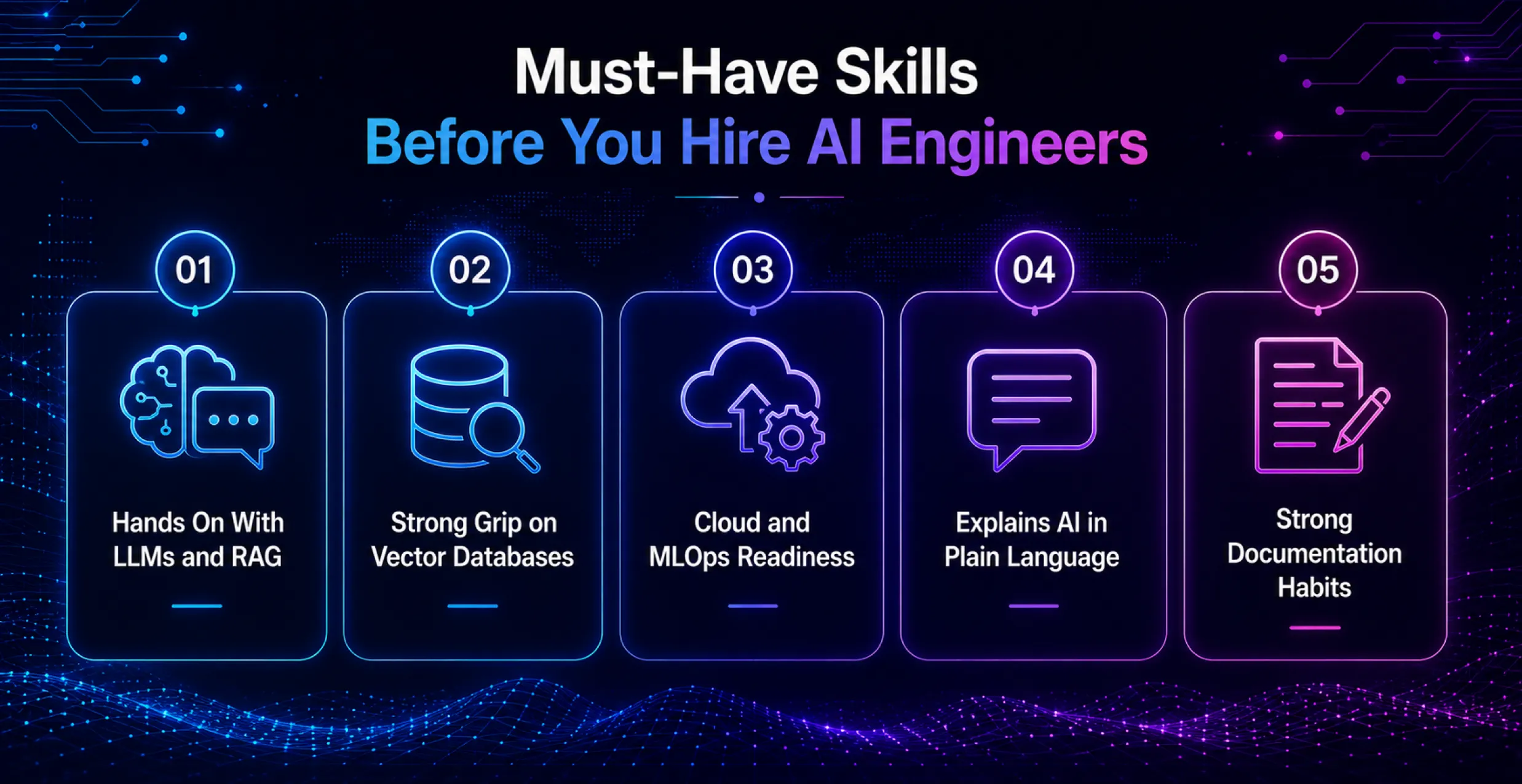
A. Core Technical Skills
1. LLM and RAG Experience
Candidates should understand prompt design, retrieval-augmented generation, and context management. Which is essential for any project that has generative AI development services, chatbots, or knowledge-based search features.
2. Vector Database Proficiency
A working knowledge of tools like Pinecone, Weaviate, or pgvector matters for any project involving semantic search, embeddings, or retrieval-based systems. Especially when the system needs quick and accurate similarity lookups.
3. Cloud Deployment and MLOps
Developers should be comfortable deploying models on AWS, Azure, or GCP and handling versioning, monitoring, and retraining pipelines. The point is systems stay solid after launch, not just at demo time.
B. Soft Skills That Predict Project Success
4. Clear Communication with Non-Technical Stakeholders
The best hires can describe model limitations and trade-offs in plain language. That matters more than most businesses expect when they’re reporting progress to leadership.
5. Documentation Discipline
AI systems evolve constantly. Developers who document decisions, data sources, and model versions make it easier for future engineers. Whether internal teams or an AI consulting company’s partner, to pick up the work.
Red Flags to Watch for Before You Hire an AI Developer or Team
Not every confident pitch holds up once people look closely at it. These red flags can help you avoid a pricey mismatch before you hire an AI developer. Or just commit a budget to that longer, multi-month engagement.
1. Can’t Explain Their Own Code
When a candidate can’t walk you through why they picked a particular architecture. Or what tradeoffs they were accepting; treat it like a warning. This matters a lot when you’re hiring an AI developer for a serious build.
2. No Clear Answer on Model Monitoring
Ask what happens after deployment. If they can’t describe how they would track drift, accuracy declines. In the case of outright failures, they’ve probably shipped prototypes and demos, not production systems.
3. Overpromising Timelines Without Scoping
Be careful with anyone who gives you a final price or timeline. Before they fully understand your data, integrations, and edge cases. Fast estimates often point to fast thinking, and fast thinking tends to mean unproven delivery.
4. No Verifiable Production Experience
A portfolio full of screenshots means little without proof the system ever reached real users. Ask for client references or metrics tied to systems that are running in production right now.
AI Development Services vs. Building In-House: Which Should You Choose?
Building in-house gives you full control, but it takes months to ramp up and get everyone aligned. In-house teams require ongoing internal oversight to balance workloads, whereas dedicated staff augmentation models require formal tracking systems to manage engineers’ work hours, billable time, and sprint capacities. On the other hand, partnering with AI development services helps you move faster. Especially if you’re after agentic AI development services, where you need rare, specialized know-how.
| Factor | In-House Team | AI Development Services Partner |
| Time to Launch | 3–6 months to hire and onboard | Days to weeks with an existing team |
| Cost Structure | Fixed salaries, benefits, recruiting fees | Flexible, scoped to project or retainer |
| Specialized Skills | Limited to locally available talent | Broad bench across generative, agentic, and MLOps roles |
| Long-Term Ownership | Full control over roadmap and IP | Shared, defined contractually upfront |
| Best Fit | AI is a permanent, core capability | Project-based needs or fast-evolving AI strategy |
1. When AI Platform Development Needs a Specialized Partner
If you’re building a full AI platform, not just one feature, then you’re talking architecture experience. Most internal teams haven’t done that work before. So a specialized AI platform development partner can shorten the learning curve considerably.
2. When Agentic AI Development Services Make More Sense Than Hiring Solo Developers
Agentic systems demand coordinated skills across orchestration, safety, and integration. One person, even a strong hire, rarely covers the whole set. That’s where agentic AI development services make sense. Because you’re getting a whole group that’s prepared for this exact kind of complexity.
How to Evaluate an AI Development Company Before You Commit
Not every AI development company delivers what their sales pitch says. These quick questions and checks help you confirm real capability before you commit or share a project brief.
Note: Reviewing Case Studies, Clutch Ratings, and Client References
Questions to Ask About Past AI Software Development Projects
1. Did Previous Models Actually Reach Production?
Ask directly whether past projects went live and stayed live. A lot of agencies will show impressive demos, but they don’t hold up once real users display and real production traffic starts.
2. How Do They Handle Underperforming Models?
A credible AI software development partner should be able to point to a specific situation where a model underperformed. Furthermore, then explain how they diagnosed it and fixed it, not just claim effortless success.
3. Can They Provide Verifiable Client References?
Request direct contact with a past client, not only a glowing quote or that logo wall thing. One short call with the person tells you more than any polished case study page.
4. What Do Clutch or Independent Reviews Show?
Look at third-party review platforms for recurring patterns across several projects. Don’t focus on a single cheerful review. Consistent themes, positive or negative, tell you more than a single data point.
5. Do They Offer Post-Launch Support?
Ask what happens after deployment. A dependable partner should offer monitoring and support terms that are clearly stated in the contract, not those vague promises.
Common Mistakes to Avoid When You Hire AI Developers
Even well-funded AI efforts can stall out because of hiring errors that you could have avoided. If you already know the usual traps, hire artificial intelligence developers who deliver results, not expensive, unfinished experiments.
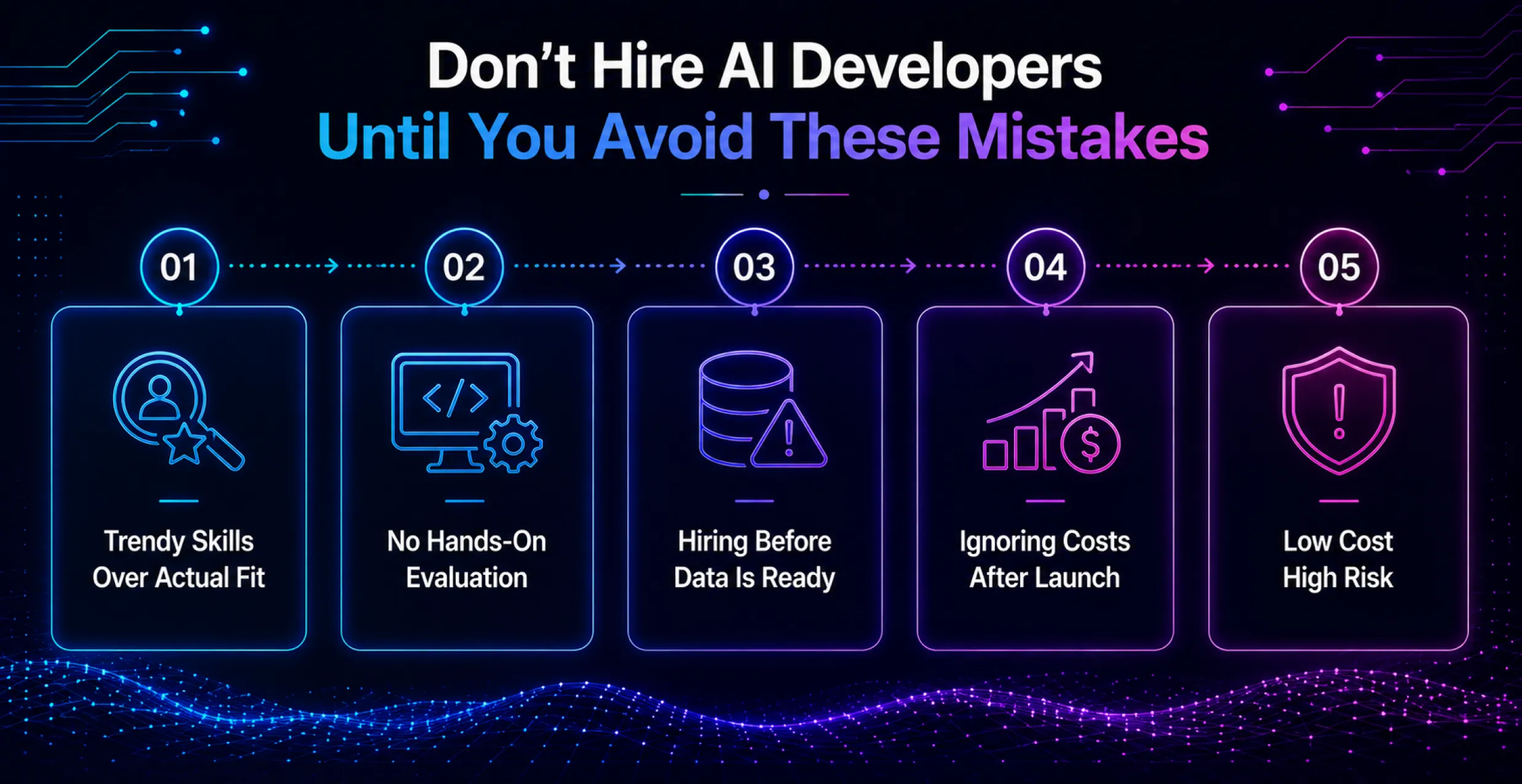
1. Hiring for Buzzwords Instead of Fit
Chasing candidates who list every trending framework often backfires. Instead, look for developers whose background matches your real situation, like generative AI, process automation, or agentic workflows.
2. Skipping the Practical Evaluation Step
Interviews alone seldom show the whole picture. If you skip a paid, scoped practical assignment, you end up hiring based on how someone explains their past work, not how well they actually do it.
3. Ignoring Data Readiness Before Hiring
If you hire before your data is cleaned up, reachable, and documented, you just burn time and money. Developers lose momentum, and your budget takes the hit. Prepare the dataset first, before recruitment, not after the agreement is signed.
4. Underestimating Post-Launch Costs
A lot of companies plan for the build but forget the ongoing costs. Monitoring, retraining, and infrastructure that keeps running long after release. In a year it can easily outweigh the initial development effort, even when the launch looked great.
5. Choosing Price Over Verified Track Record
The “cheapest” option often becomes the most expensive because of rework, scheduling delays, and missed milestones. Compare the cost to hire dedicated AI developers with verified, real-world delivery experience.
Final Words
Choosing to hire AI developers is one of those high-leverage decisions a business can make when it is building custom AI projects. But like, the right process, clear scoping, real technical screening, and transparent cost expectations matter more. Simply hunting for the lowest AI development cost or getting dazzled by some flashy pitch.
No matter if you are seeking generative models, agentic workflows, or a full GenAI development services package. The underlying goal stays steady: find developers who actually ship reliable systems, rather than only nice demos. At Octal IT Solution, we help companies sort out the scope, then hire AI engineers as per your project requirements. Then build custom AI projects that stay dependable in production, not just something that looks good in a proposal.

 By
By September 10, 2026



 Latest Stories
 Get in Touch