


What kills most startups: bad code, poor funding, or a product that is annoying to use? A lot of the time, it’s the last one.
Here’s a number that should really stop you: every $1 you invest in UX can bring back as much as $100. That’s a 9,900% ROI, per Forrester. But still, founders often treat design like it’s optional, like something you only “polish” after the whole thing is built. That approach is expensive.
Mordor Intelligence says the UI/UX market size is expected to hit USD 1.98 billion in 2025, then USD 2.91 billion in 2026, and reach USD 11.66 billion by 2031. That’s a CAGR of 32% from 2026 to 2031. Also, even a decent interface can lift conversions by 200%, while a smoother user experience can take it up to 400%.
So if you’re trying to hire professional UI UX developers, or you want the right UX design service for business, or you just want to figure out what designer your startup actually needs, this guide is for you. Just a straight, honest breakdown of how to make the right call.
Understanding the Difference Between UI and UX Design
Before you post a job listing, you should understand what you are really hiring for. Most founders use UI and UX interchangeably, and that confusion leads to mismatched hires.
UI (User Interface) is what people see: colors, buttons, fonts, layouts, and spacing. It’s the visual layer, the surface. UX (User Experience) is how the product feels to use, the flow, the logic, and the journey from “I just opened the app” to “I actually finished my goal.”
So think of UI as the interior design of a house. And UX is the floor plan, less flashy maybe, but it decides where everything goes. Both matter, but one without the other creates weird problems, delays, and frustration.
Here’s a quick side-by-side to make it concrete:
| Dimension | UI Design | UX Design |
| Primary Focus | Visual aesthetics | User flows & usability |
| Key Deliverables | Style guides, mockups | Wireframes, prototypes, user testing |
| Tools | Figma, Adobe XD, Sketch | Figma, Maze, Miro, UserTesting |
| Works With | Marketing, brand, devs | Product managers, researchers, devs |
| Startup Priority | High — especially at launch | Critical — before development starts |
For most early-stage startups, hiring a UI & UX designer & developer hybrid, someone who does both, is usually the most practical and cost-efficient move you can make. Then, when you start scaling, it gets a bit more real, and separating the roles makes more sense.
Why Startups Need a Dedicated UX Design Service?
There’s a common startup myth: “We’ll fix the UX after we validate the product,” which sounds fine until you remember that by the time you’re actually fixing anything, you’ve already lost users who didn’t stick around long enough to give you a second chance.
So here’s why investing money in a UX design service this early is one of the smartest decisions you can make:
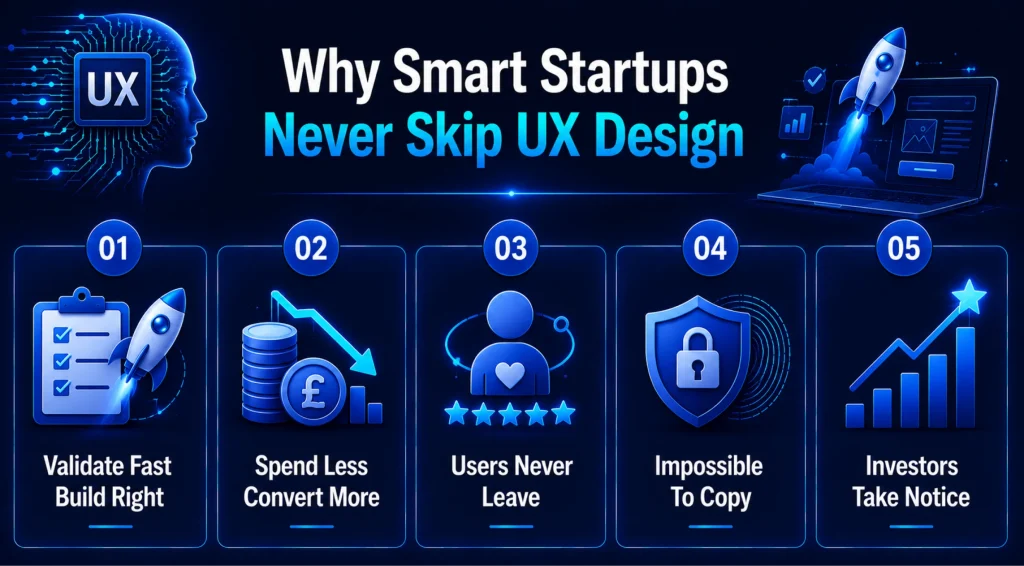
1. Faster Product-market Fit
User research helps you confirm the path before you write a single line of production code. You end up building what users actually need, not whatever you guess they need.
2. Lower Customer Acquisition Costs
When onboarding converts well, you don’t have to spend as much cash on ads to grow. Better UX leads to stronger activation, which means lower CAC.
3. Stronger Retention
Some research indicates that teams that invest in continuous UX testing can improve revenue retention by as much as 10.8% over three years. For subscription companies, improve compounds quickly.
4. Competitive Edge That’s Hard to Copy
Features are easy to replicate in a few weeks. But a product that genuinely feels right to users is closer to a moat. If you hire user-centered designers, you’re building something that people want to keep using.
5. Investor Confidence
When your UX looks polished and intentional, it signals your team understands the customer. Design-led companies, it’s been reported, grow revenue 32% faster and can deliver 56% higher shareholder returns.
Freelancer, Agency, or In-House: Which One Is Right for You?
This is one of the most important early decisions you’ll end up making. The right model depends on where your startup is right now, not where you’re trying to land later on.
1. Freelance UI UX Developer for Hire
Great choice for well-scoped, short-term work like a landing page redesign, a UX audit, or a rapid prototype. The back and forth is direct and usually fast. The tradeoff is that one person rarely covers research, UI, prototyping, and developer handoff at the same depth. Mostly best for pre-seed startups with tight budgets.
2. UI UX Design and Development Company/Agency
You get a bundled team, with project management built in, and more total know-how. Ideal when you need to hire UI/UX developers for a full MVP build or a major redesign. Upfront costs are higher, but there’s usually less execution risk.
3. In-house Hire
Usually, the move is after product-market fit, when you need continuous design iteration. A senior in-house designer in the U.S. runs about $130k–$150k fully loaded. It’s a real number, but it makes sense when you’re scaling.
| Factor | Freelancer | Agency | In-House |
| Best For | Defined short tasks | Full builds & redesigns | Post-PMF iteration |
| Cost | $45–$150/hr | $15k–$150k/project | $130k–$150k/year |
| Speed to Start | Days | Weeks | Months (hiring) |
| Scalability | Low | High | Moderate |
| Brand Consistency | Variable | Agency-managed | Best — daily embedded |
Key Skills to Look for When Hiring a UI/UX Designer
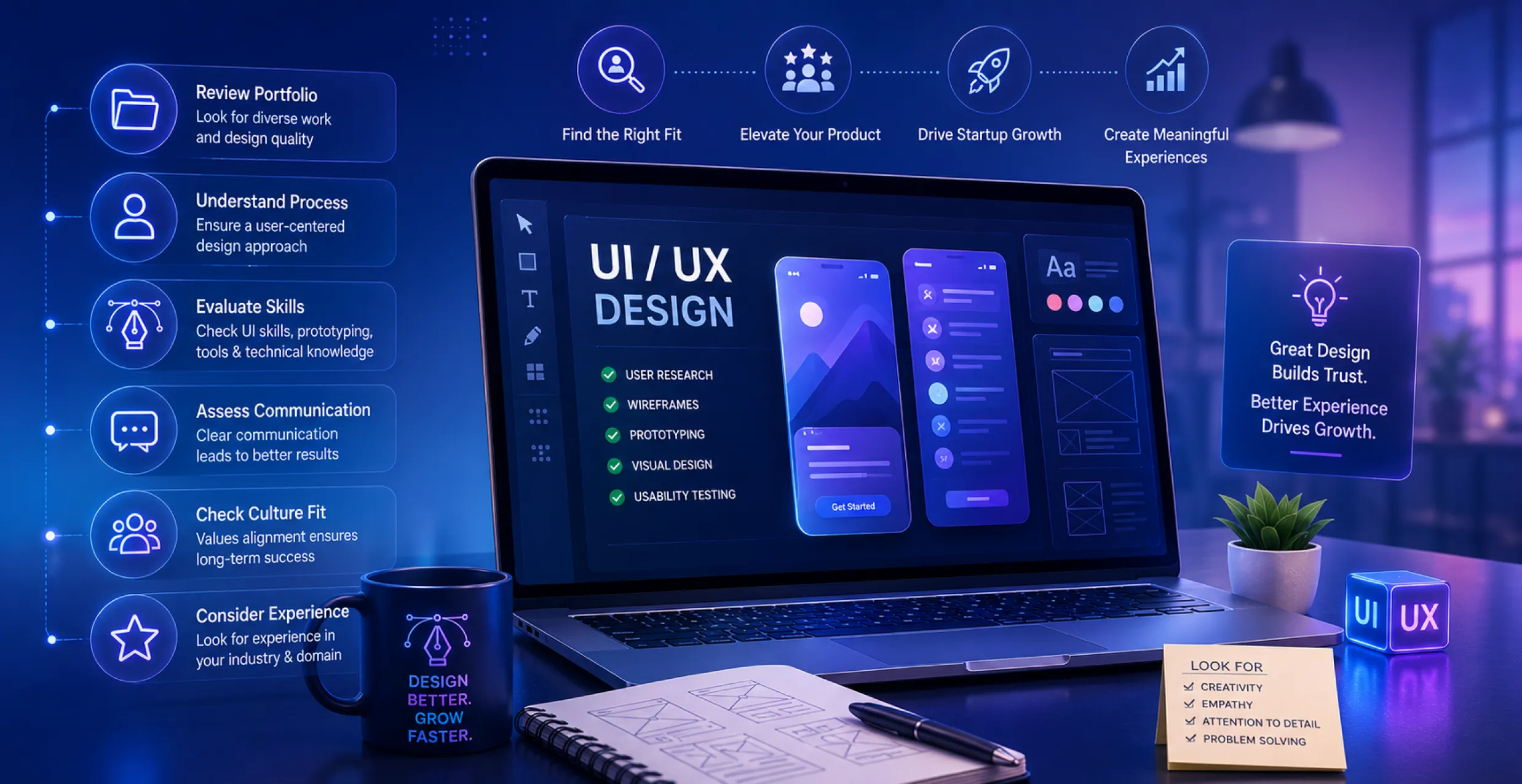
A visually appealing portfolio doesn’t really mean you found the right person. What actually counts when you’re evaluating talent:
1. User Research Ability
The best designers don’t jump straight into wireframes. They start with questions, and then they refine. So you want candidates who can talk through user interviews and usability tests and also show how those findings bent (or redirected) their design decisions.
2. Interaction Design and Prototyping
Figma knows how it is basically expected. But the real deal is whether they can say why they picked a specific interaction and then tie that reasoning back to usable design principles to back it up.
3. Systems Thinking
Do they understand how to arrange a product’s structure in a way that mirrors how people actually think? Great information architecture is almost invisible when done right and painful when done wrong.
4. Developer Collaboration
A UX designer and front-end developer collaborate well only when the designer gets implementation. Look for designers who annotate clearly, use component-based file structures, and actually participate in the dev reviews.
5. Data Literacy
The strongest UI/UX developers can read product analytics such as funnel metrics, heatmaps, A/B results, and all of that. A design specialist who can connect a change in the interface to measurable outcomes is more valuable than someone who only delivers screens.
How to Read a Designer’s Portfolio the Right Way
Most founders review portfolios, mostly for their previous work on screens. Here’s what you should actually be evaluating:
- Does the portfolio actually explain the problem they’re solving, or is it just showing the final result and nothing more?
- Is there any process documentation? Sketches, wireframes, research notes, and iteration cycles; those are little signs of real UX thinking.
- Also, does the designer show what changed after user testing? Like what got revised, what got cut, what improved. That iteration part is the strongest signal that they’re research-driven.
- Then check for component libraries or design systems. If they’re thinking in terms of systems, that usually means they can scale with your product.
- Finally, are there outcome metrics? Something like “reduced onboarding drop-off by 30%” tells you more than a polished Dribbble shot.
How UI/UX Design Impacts Startup Growth and User Retention
Good design isn’t only about how it looks; it affects how people feel, how long they stay, and if your startup either grows or sort of stalls right from day one.
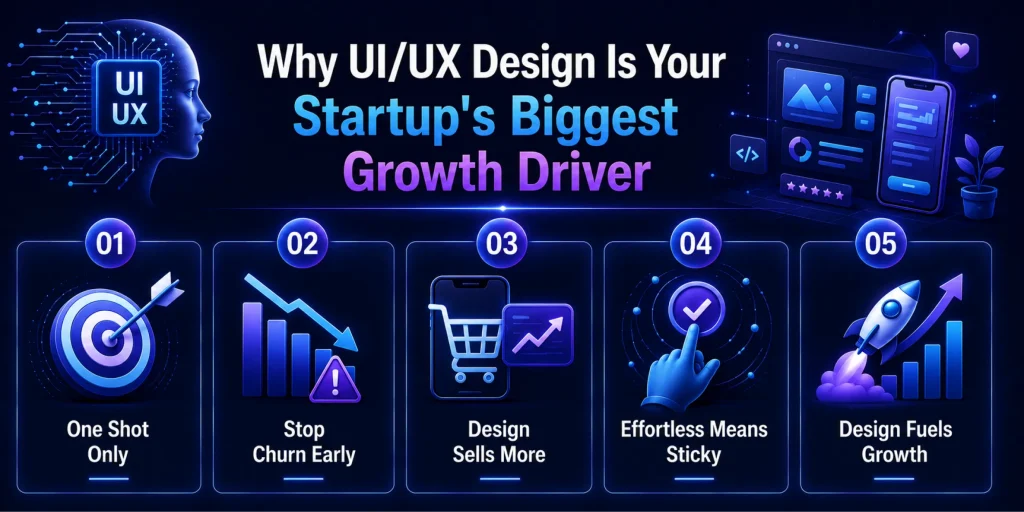
1. First Impressions Decide Everything
People make up their mind about your product in like under 50 milliseconds. A clean, easy interface builds quick confidence and keeps them from leaving before they even really get to check what you offer.
2. Great UX Reduces Churn Before It Starts
When users can find what they need without any mental gymnastics, they stay. A friction-light experience removes the small annoyances that push folks away quietly and often before you even notice it happening in your metrics.
3. Design Directly Drives Conversion
A well-planned journey leads users toward the important moments, signups, purchases, and upgrades. Startups that team up with a user experience design expert tend to get higher conversion rates because each screen is made with one clear user intent in mind.
4. Retention Grows When the Product Feels Effortless
People come back when it feels smooth and easy. If you put money into a solid UX design service for a business , you’re creating the kind of experience users return to out of habit, not the one they just endure because there isn’t another alternative.
5. Design-Led Startups Scale Faster
When teams hire best UI UX developers early, they can set up scalable design systems and consistent interfaces from the beginning. That groundwork makes it cheaper and faster to deliver new features without accidentally breaking what already works.
Where to Find and Hire Top UI UX Developers in 2026
Figuring out what you want in a designer is only half the battle. The other half is knowing where to look, and then actually finding the right one.
1. Dribbble and Behance
Best for visual discovery. Dribbble tends to lean into UI talent; Behance usually gives more holistic case studies. Use them for a first pass, then do a proper follow-up with a portfolio walkthrough; no shortcuts.
2. LinkedIn
One of the better channels to hire UX UI designers USA for mid-to-senior roles. Be very specific in searches; “UX designer + SaaS + Figma + usability testing” beats generic title searches every single time.
3. Toptal and Arc.dev
These are curated freelance platforms with real screening. Toptal takes something like 3% of applicants. That lowers hiring risk and usually means a faster start. It’s also great if you’re a startup and you want to hire professional UI UX developers without running a months-long recruitment.
4. Design communities (ADPList, Designer Hangout)
Lots of seasoned designers are passive candidates. Not spending time out on job boards, but showing up in communities. Warm referrals from these networks are repeatedly the strongest quality signal.
5. Referrals from your engineering and product network
Your front-end developers have probably already worked with genuinely good designers. Ask them, straight up. If cultural fit matters as much as skills, referrals beat cold sourcing every time.
Interview Questions That Reveal the Right Designer
Go beyond the “tell me about yourself” kind of thing. These questions surface what really matters:
1. Walk me through a design decision and trace it back to user research
That shows you it’s actually user-centered or just aesthetically driven.
2. Tell me about your worst project
This is about self-awareness and also whether they can look at a mess without hand-waving. The strongest candidates give you a clear, honest answer.
3. How do you handle it when a developer says your design is too complex to build on time?
You learn about their technical fluency, yes, but also how they partner and keep things moving when the timeline gets tight.
4. How do you know when a design is good enough to ship?
This reveals whether they understand the difference between craft and pragmatism, a critical balance in a startup context.
5. What questions do you have for us?
Strong candidates ask about your users, your design system, how design and engineering interplay, and what “success” means in the first 90 days. Generic questions about benefits are a mild red flag.
Red Flags You Should Never Ignore
Hiring the wrong UI/UX designer can cost you time, money, and users, and it adds up fast. If you catch the early warning signs before you commit, you can avoid a rough, expensive mistake that sticks around longer than it should.
1. Portfolios With Only Final Screens
If they have zero process, no wireframes, no discovery, and no rounds of tweaking, you basically only get the shiny end result. It doesn’t tell you how they actually reason or how they solve messy problems in the first place.
2. “I Design by Feel” Is Not a Process
Intuition is fine as a piece of the puzzle, but it can’t replace user research and validation. When you’re trying to hire professional UI UX developers, this way of thinking becomes a big red flag, because solid design needs proof, not just instinct.
3. No Knowledge of Developer Handoff Tools
If they’re not familiar with Figma Dev Mode, Zeplin, or design tokens, your engineering team is creating real friction. Smooth collaboration between UX designer and front-end developer relies on proper handoff, so this is one of those “ask early” items.
4. Zero Outcome Metrics in Their Work History
If they can’t name anything measurable, retention went up , drop-offs went down, and conversions improved, then their contribution may never have been tied to real business value.
5. Gets Defensive When You Critique Their Work
Good design grows through feedback and revision. A designer who reacts to every note with pushback, instead of digging in and responding, usually won’t last in a quick-moving startup environment. They might still be talented, but it’s the wrong collaboration.
What Does Hiring UI/UX Design Really Cost?
Most startups either end up overspending on design or underspend and then pay for it later. When you understand the real cost of hiring UI/UX talent, you can make a smarter, stage-appropriate decision from the very start.
| Hiring Model | Cost Range | Best For |
| Freelancer (U.S.) | $45–$150/hour | MVP screens, landing pages, UX audits |
| Freelancer (India/LATAM) | $15–$50/hour | Budget-constrained, well-defined tasks |
| Mid-Level In-House (U.S.) | $85k–$110k/year | Post-PMF continuous iteration |
| Senior In-House (U.S.) | $120k–$160k/year | Scale-up phase, design leadership |
| Agency (Project-Based) | $15k–$150k/project | Full product build, MVP, rebrand |
| Agency (Retainer) | $10k–$30k/month | Funded startups needing design velocity |
Also, one more thing people don’t say enough: fixing a usability problem in production costs 100x more than catching it during the design phase. With that context, every number in the table above feels a lot smaller
How to Onboard Your Designer for Quick Impact
Hiring the right person, then tossing them a Figma file and a Slack invite on day one, is a waste. Instead, set them up so they can contribute fast without flailing. Here’s what to do:
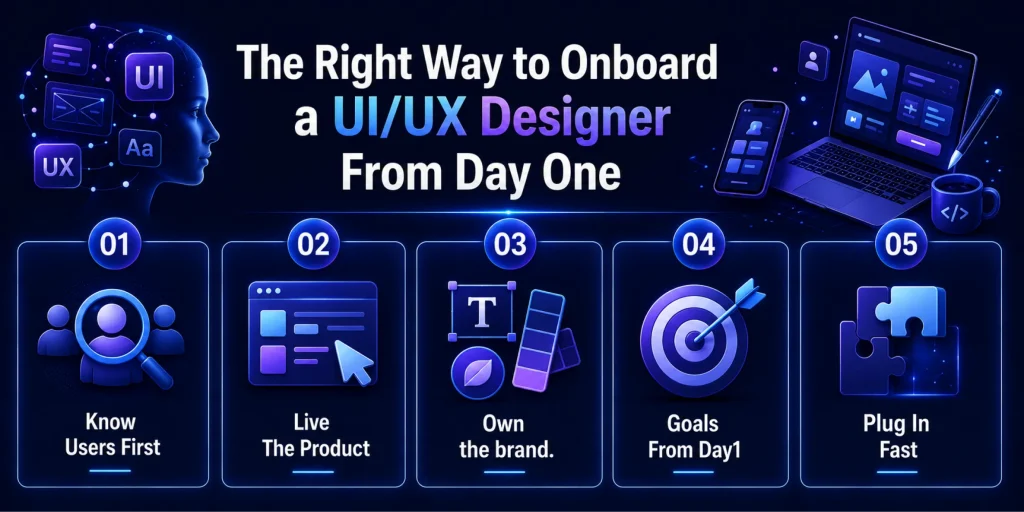
1. User Research Immersion First
Before touching any wireframe, they should talk with 5–8 real users. Give them session recordings, support tickets, and NPS verbatims. That kind of background keeps what they build tied to real user reality.
2. Full Product Walkthrough
Walk them through every flow, every known issue, plus the edge cases people keep bumping into. Also have an engineer show them the component architecture. For a UI designer UX designer and hybrid developer, that technical context makes them credible with the team fast.
3. Brand and Design Principles Alignment
Share every existing guideline, every brand asset, plus all the design files. If you don’t have a design system yet, make designing a working one the main 90-day goal.
4. Clear 90-day Success Metrics
Set goals that are measurable and specific, not some vague “make it better” expectations. When the targets are fuzzy, it’s usually the core reason new design hires end up underperforming, even if they seem promising at first.
5. Integrate into Cross-functional Rhythms Immediately
Sprint planning, product reviews, customer calls; your designer should be sitting in on those from day one. Design doesn’t run in a vacuum, and it can’t really “appear later” like a plugin.
Mistakes Startups Make (And How to Avoid Them)
Even teams with good intentions still trip on these. If you spot them early, you can steer around them:
1. Hiring for Aesthetics Instead of Problem-solving
A decent portfolio is not the same as solving your actual product problems. Put more weight on their process and their reasoning over raw surface-level polish.
2. Treating UI and UX as the Same Role
Be crystal clear in the job description about which abilities matter most for your current stage. If you mix up expectations, you create costly gaps later on.
3. Skipping a Practical Design Challenge
Interviews alone can’t fully show how they think on the fly. Even a 2-3 hour exercise will tell you more than three rounds of behavioral questions.
4. Underinvesting in Onboarding
All that hiring effort shouldn’t just stop with a messy first week. The quickest route to real impact is a structured onboarding that starts with user research.
5. Not Giving Design a Seat at the Product Table
If you hire best UI UX developers or designers who only work downstream, you end up leaving the most valuable design thinking off the roadmap. It’s like you’re only asking for what it looks like, instead of helping decide what actually gets built.
Final Checklist Before You Hire UI/UX Designer
Hiring the wrong UI/UX designer is one of those expensive errors most startups only learn once. So, go through every point on this checklist before you lock in your final hiring decision.
1. Skills
Can they connect a design decision back to user research? Do they know Figma and at least one prototyping tool? Have they built or meaningfully contributed to a design system?
2. Portfolio
Does it show the work process, not only the final screens? Is there at least one measurable outcome? Do you see iteration after testing, not just smooth handoffs?
3. Collaboration
Did they ask careful questions about your users, and not just the feature set? Can they explain how they handle design engineering conflicts? Are they comfortable with your team’s tooling and workflows?
4. Cultural Fit
Do they truly get startup conditions, speed, pivots, and resource limitations? Are they driven by your problem, not just by the design craft? Have you verified two direct references?
Final Words
Choosing the right UI UX designer for your startup isn’t only a hiring call; it’s more like a product strategy call. The person you bring in will end up shaping how your users experience your product, right from that very first click, or maybe even before.
And whether you decide to hire professional UI UX developers for a full MVP build, or grab a freelance UI UX developer for hire to tackle one focused sprint, or team up with a UI UX design and development company so you can scale, the core rules stay steady. You hire for real thinking, you judge for workflow, and you put resources into onboarding.
The best startups right now aren’t merely stacking better features. They’re building products that feel smooth, almost effortless to use, and that comes from people who get it: every screen, every pathway, every small interaction is basically a direct connection to growth. Okay, now you have the whole frame to find yours.
FAQs
Q1. What is the difference between hiring a freelance UI UX developer for hire versus a full-time designer?
A freelance UI UX developer for hire usually jumps in for specific, short-term deliverables. A full-time designer tends to stay with your team, like fully embedded, doing ongoing long-term product work.
Q2. How early should a startup invest in a UX design service for business?
Ideally, before development even starts. A UX design service for business helps you check the product direction early on, which means less painful rework later. It also makes sure the thing you build fits what users actually want to use.
Q3. Can a single UI & UX designer & developer handle both design and frontend development for a startup?
Yes, particularly in the early days. A UI & UX designer & developer hybrid covers both UX thinking and basic frontend work, so you save some budget, and the design-to-development handoff stays quick and consistent.
Q4. How do I know if I need to hire user-centered designers versus just a visual UI designer?
If your product includes complicated journeys, onboarding steps, or retention problems, then you hire user-centered designers. Visual UI designers mostly focus on appearance, colors, and layout style. They typically don’t go deep into behavior, research, or user psychology, and that’s the point.
Q5. Is it worth working with a UI UX design and development company instead of building an in-house team?
For early-stage startups, usually yes. A UI UX design and development company gives you an available team, faster delivery, and less overhead than recruiting, hiring, and managing an internal design team.


 Get in Touch
 By
By July 25, 2025