




Key Takeaways
- Real estate tokenization development cost ranges from $15,000 for MVPs to $150,000+ for enterprise platforms.
- Blockchain requirements, smart contract complexity, and compliance needs drive most cost differences.
- White label platforms usually have lower upfront costs. Custom builds cost more. However, they provide better scalability in the long-run.
- Compliance and legal work can be estimated between $12,000 and $30,000 depending on your target areas.
- Annual maintenance typically costs between $10,000 and $40,000, depending on size.
- The global market space is estimated to grow at a CAGR of 21% by 2035.
- Key Takeaways
- What is Real Estate Tokenization Platform Development?
- Real Estate Tokenization Development Cost in 2026
- Key Factors That Affect Real Estate Tokenization Development Cost
- Blockchain & Smart Contract Cost Factors in Tokenization Platforms
- Real Estate Tokenization Cost by Development Approach
- Real Estate Tokenization Cost by Property Type
- Development Team Cost: In-House vs. Outsourcing vs. Freelancers
- Compliance & Security Costs by Region
- Development Timeline and Its Impact on Cost
- Hidden Costs Businesses Should Consider
- Post-Launch Maintenance & Support Cost
- How to Reduce Real Estate Tokenization Development Cost Without Losing Quality
- Why Choose Octal IT Solution for Real Estate Tokenization Development
- Conclusion
- FAQs
What is Real Estate Tokenization Platform Development?
Before discussing pricing, it helps to understand how these platforms work.
Imagine owning a single floor of Dubai Tower. Not the whole building. Just one floor’s worth of value, tradable out of your mobile phone. That is what makes real estate tokenization development possible today. It transforms ownership into digital tokens on the blockchain. Each token represents a small portion that investors can purchase, maintain, and exchange as a digital asset.
Several factors are speeding up adoption in 2026.
- Global Market Value: around US$3.14 billion in 2025, with a growth rate of about 21% per year until 2035.
- Broader Market View: Deloitte’s estimates tokenized fixed assets could grow from less than $0.3 trillion in 2024 to more than $4 trillion by 2035.
- Regulations have become clearer across the major markets like the US, EU, UAE, and Singapore.
- Institutional money is coming in, not just retail traders anymore.
- North America is leading adoption today, with Europe and Asia Pacific quickly finalizing the space.
A platform built for 2023 regulations may not meet 2026 compliance requirements. Understanding the cost to develop a real estate tokenization platform is more important than ever this year. Your target market affects the cost even before development begins.
Real Estate Tokenization Development Cost in 2026
Real estate tokenization platform development cost depends on the scope, features, and your development team’s location.
| Platform Type | Estimated Cost (USD) | Timeline |
| MVP (basic features) | $15,000 – $30,000 | 6–10 weeks |
| Mid-tier platform | $30,000 – $70,000 | 3–5 months |
| Enterprise-grade platform | $70,000 – $150,000+ | 6–9 months |
| White label solution | $25,000 – $50,000 | 4–8 weeks |
Each estimate breaks down into 3 pillars: development, compliance, and maintenance. Most providers only quote you the first one. Ask about all 3; otherwise, your actual real estate tokenization development charge may not reflect the complete cost.
Your monetization model also shapes long-term ROI, even though it won’t replace a bunch of upfront value. Common models include per-trade transaction fees and membership plans for premium investor tools. They also include white-label licenses for various real estate companies. Some structures additionally charge listing fees from asset owners who wish to tokenize their assets.
Starting with a clear roadmap helps the development team build smart contracts correctly from the beginning. It avoids the need to make changes after the launch.
Key Factors That Affect Real Estate Tokenization Development Cost
Several technical and business factors influence the total development cost.
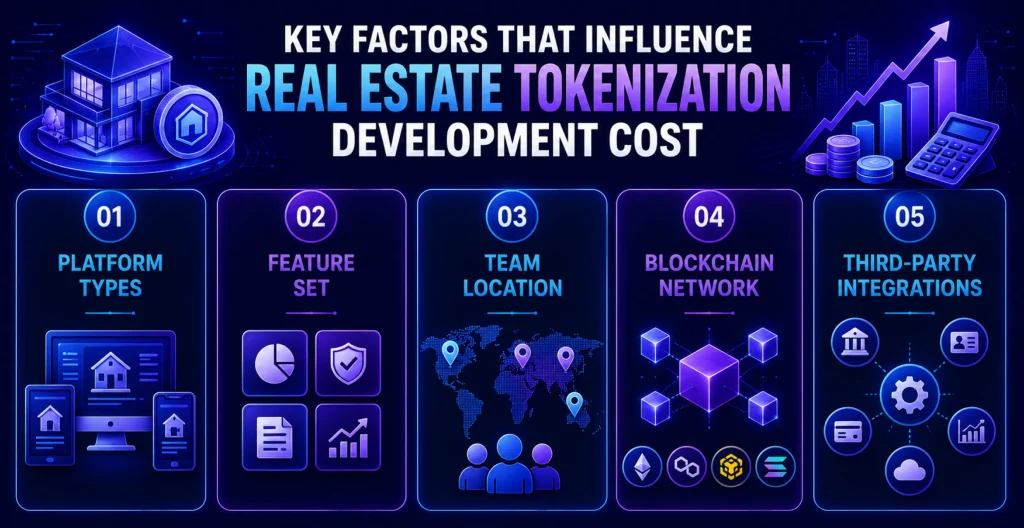
Your final cost depends on several decisions made early in the planning process.
| Factor | Cost Impact (USD) |
| Feature set | $10,000 – $50,000+ |
| Team location | $40/hr (offshore) – $150/hr (US/EU) |
| Blockchain choice | $8,000 – $18,000 |
| Integrations | $10,000 – $18,000 |
- Feature Complexity: Dashboards, dividend automation, reporting tools, and all add hours.
- Platform Type: The simplest online prices are much lower than for native iOS and Android apps.
- Team location: Offshore teams cost less per hour than teams based in the US and Europe.
- Blockchain Networks: Ethereum main network gas costs are higher than on layer 2 chains.
- Third-Party Integration: KYC, payment gateways, and valuation oracles carry setup costs.
A property tokenization development cost estimate without these variables is just a bet.
Blockchain & Smart Contract Cost Factors in Tokenization Platforms
Blockchain architecture has a major impact on the overall development cost.
Your smart contract placement is the engine behind every token, trade, and payout. Poor architecture decisions can increase maintenance and upgrade costs later.
- Token Standard: In 2026, ERC-1400 and ERC-3643 are the dependent standards for security tokens.
- Layer 2 Adoption: Networks like Polygon significantly cut transaction fees against the Ethereum mainnet.
- Modular Design: It separates issuance, KYC, and dividend distribution into independent modules.
- Audit Requirements: A third-party security firm must audit each contract before launch.
Building on Polygon or using secondary markets instead of the Ethereum mainnet can reduce costs by 15 to 20%.
| Smart Contract Approach | Cost Range (USD) |
| Layer 2 / cross-chain setup | $8,000 – $18,000 |
| Modular architecture | $15,000 – $30,000 |
| Standard monolithic contract | $10,000 – $20,000 |
Audited open-source libraries help maintain predictable smart contract development cost. This reduces the need to build everything from scratch.
Real Estate Tokenization Cost by Development Approach
Choosing between custom development and white-label solutions has a major impact on your budget.
- A white label system can be launched within weeks, using pre-built templates.
- Custom builds take months but provide full control with features and branding.
- Hybrid mode: start white label, and move to custom once it has gained traction.
| Approach | Cost (USD) | Timeline |
| White label | $25,000 – $50,000 | 4–8 weeks |
| Custom development | $50,000 – $120,000+ | 4–9 months |
| Hybrid migration | $60,000 – $100,000+ | Phased |
White label solutions usually have lower post-launch maintenance costs. A custom build is ideal for businesses that need unique platform features. However, a custom tokenized real estate platform costs more. It gives you greater flexibility as your platform grows.
If you are comparing this project with other investments, review typical blockchain application development cost benchmarks. This helps you set a realistic budget for your fintech or web3 projects.
Real Estate Tokenization Cost by Property Type
Different property types require different features, which affects development costs.
Commercial properties often require advanced oracle integrations for real-time valuation. It increases real estate tokenization app development cost compared with a simple residential model.
| Property Type | Cost Range (USD) | Why It Differs |
| Residential | $20,000 – $50,000 | Simpler ownership structures |
| Commercial | $40,000 – $90,000 | Complex lease and revenue logic |
| Industrial | $45,000 – $100,000 | Specialized valuation needs |
| Mixed-use portfolios | $60,000 – $130,000+ | Multiple asset types in one system |
Residential platforms are often the fastest way to enter the market. Property transactions are simpler and more appealing to investors. Commercial business projects take longer because lease clauses, sales allocation rules, and valuation strategies vary across products.
If your business plans to tokenize multiple asset types in the future, plan it from the beginning. Design your smart contract architecture to support that flexibility. Developing a commercial real estate tokenization platform costs more upfront. Ongoing maintenance is usually less expensive than the initial development.
Development Team Cost: In-House vs. Outsourcing vs. Freelancers
Team structure is a major factor in your overall real estate tokenization development pricing. It can change the total project cost by tens of thousands of dollars.
Outsourcing to a team in India or Eastern Europe can reduce development costs by 30 to 50%. This is often more cost-effective than hiring North American teams.
Before you hire blockchain app developer talent, first verify their previous work on security token standards. They should already understand tokenization requirements.
| Team Type | Hourly Rate (USD) | Best For |
| In-house (US/EU) | $100 – $150 | Enterprises with long-term platforms |
| Outsourced agency (India, Eastern Europe) | $40 – $70 | Startups and mid-size businesses |
| Freelancers | $20 – $50 | Small, low-compliance tasks only |
Many businesses now use a hybrid staffing model instead of choosing just one alternative. A small in-house team manages product direction and compliance monitoring. An outsourced company builds the actual smart contracts and platforms, helping reduce overall development cost.
Whatever structure you choose, ask for references specifically from the previous tokenization task. General blockchain experience doesn’t translate to security token compatibility requirements.
Compliance & Security Costs by Region
Ignoring compliance requirements can lead to costly changes later.
- United States: SEC filings under Regulation D or S for tokenized securities.
- European Union: MiCA compliance for reporting, retention, and investor rights.
- UAE and Singapore: Regulatory sandboxes allow experimentation with lighter regulatory requirements.
Blockchain consulting services help identify regulatory requirements before development begins. It helps prevent costly changes later.
| Region | Compliance Cost (USD) |
| United States | $10,000 – $20,000 |
| European Union | $8,000 – $18,000 |
| UAE / Singapore | $6,000 – $15,000 |
| Multi-region setup | $12,000 – $30,000 |
AI-assisted KYC and AML tools will also change this cost picture in 2026. Real-time document verification and automated risk scoring systems can reduce manual compliance efforts. This allows faster investor onboarding without needing a large compliance team. It also reduces costs as your investor base grows across different sectors.
Development Timeline and Its Impact on Cost
Development time directly affects your total project cost.
- Short timelines will require larger batches to run in parallel, improving hourly costs.
- Longer timelines reduce the weekly burn, but do stretch the overall load.
- Phased distributions release mid-range features first, with advanced modules later.
| Timeline | Cost Impact |
| 6–10 weeks (MVP) | Lower total cost, limited features |
| 3–5 months (mid-tier) | Balanced cost and depth |
| 6–9 months (enterprise) | Higher total cost, full features |
In most projects, it’s worth setting aside extra real estate tokenization development budget and time for audits. Skipping audit time often leads to delays and unexpected costs later.
Hidden Costs Businesses Should Consider
Some costs are easy to overlook during the initial planning stage.
| Hidden Cost | Estimated Impact (USD) |
| Protocol upgrade | $3,000 – $7,000 per update |
| Governance and legal contingencies | $2,000 – $5,000 annually |
| Traffic scaling spikes | $1,500 – $5,000 per event |
| API licensing growth | $2,000 – $6,000 annually |
| Security contingencies | $4,000 – $10,000 annually |
Budget an extra 15-20% on top of your overall development cost. This buffer covers maximum surprises without derailing your launch plan.
Two expenses are commonly missed during planning. Cross-chain transfer becomes common when the platform expands beyond its original blockchain network. Moving tokens between different networks is not always free. Insuring tokenized assets is also a trendy exercise, especially for institutional buyers who take out insurance before committing capital.
These expenses don’t always appear in the first estimate, but planning for them early helps you avoid surprises.
Post-Launch Maintenance & Support Cost
A post-launch maintenance process is necessary after deployment.
Annual renewal fees and compliance fees typically range from $10,000 to $40,000, depending on platform size, investor base, and jurisdiction.
| Maintenance Area | Annual Cost (USD) |
| Cloud hosting | $24,000 – $72,000 |
| Smart contract versioning | $4,000 – $8,000 |
| Cybersecurity monitoring | $5,000 – $12,000 |
| Compliance operations | $4,000 – $10,000 |
Treat maintenance as part of the original project budget instead of an optional expense.
A useful rule of thumb: budget 15-20% of your individual development cost for maintenance each year. Alternatively, platforms that ignore this may fall behind the security updates for the first 365 days. This can lead to much higher costs later.
Feature enhancements also fall within this price range. Adding an investor dashboard, value portal, or AI-powered valuation tool typically costs $6,000 to $15,000. The final cost depends on the project scope and requirements.
How to Reduce Real Estate Tokenization Development Cost Without Losing Quality
A clear budget helps reduce unnecessary development expenses.
- Most companies do not add all the features on day one. They usually launch an MVP first and expand once investors start using the platform.
- Choose a Layer 2 blockchain network to reduce transaction fees.
- Use audited open-source contract libraries instead of building from scratch.
- Partner with an offshore team with special experience in tokenization.
- Take a white label template first, then personalize it later.
Using audited contract libraries like OpenZeppelin’s ERC-1400 and ERC-3643 implementation saves development time and reduces audit scope.
None of these cost-saving measures should compromise security or compliance. Reducing your real estate tokenization development investment should never mean lowering your needs.
Why Choose Octal IT Solution for Real Estate Tokenization Development
Why does choosing the right development partner matter? Here’s why.
Octal IT Solution helps businesses plan tokenization platforms with detailed cost estimates before development begins.
- In-depth expertise across blockchain application development, smart contracts, and fintech compliance.
- Transparent pricing shared before work begins, and no hidden line items.
- Proven track record through real estate app development and Web3 projects.
- In-house legal guidance for the US, EU, UAE, and APAC markets.
Our development team has delivered fintech and Web3 projects across multiple industries, including solutions involving a reliable web hosting control panel for efficient hosting management. We understand regulatory requirements before your platform goes live. This experience helps reduce unexpected challenges during development and deployment.
Whether you need a real estate app development solution or a centralized tokenization module, our team will help. We define the project scope before providing your budget estimate.
A reliable process starts with a scope discussion. A detailed proposal then separates development, compliance, and maintenance costs. This helps you understand the full project cost before you sign anything. It prevents unexpected expenses that may appear later.
If you compare real estate tokenization development agencies, ask for a detailed cost breakdown. Do not accept a single combined price.
Conclusion
Real estate tokenization is no longer an experiment. This rapidly developing, regulated market is approaching trillions in fees by the mid-2030s. Your final cost depends on development, compliance, and long-term maintenance requirements.
Budget for all 3 pillars: development, compliance, and maintenance. Work with a team like Octal IT Solution that understands the regulatory requirements and planning involved.
The most successful projects usually aren’t the ones with the biggest budgets. They are the ones planned carefully from the beginning. These projects also treat upgrades as part of the plan, not as a costly fix later.


 Get in Touch
 By
By July 30, 2026