


Imagine losing a million-dollar contract because an important customer detail was buried in an email thread or written on a sticky note that went missing. In 2026, customer data plays a direct role in sales performance, customer retention, and brand credibility. Yet many businesses still rely on scattered spreadsheets or rigid CRM tools that do not align with how their teams actually operate. Instead of simplifying work, these systems often create confusion, delays, and missed opportunities.
This gap is driving growing interest in custom Customer Relationship Management (CRM) systems. The market data supports this shift. According to the Grand View Research report, the global CRM market will cross $130 billion by 2030, with businesses reporting an average return of over $8.70 for every dollar invested. Despite these strong results, decision-makers often hesitate at one critical question: what is the real cost to develop a custom CRM software app?
Off-the-shelf SaaS CRMs promise speed and convenience, but they frequently fall short in practice. Companies pay for unused features while struggling to adapt essential workflows to software limitations. Over time, this leads to inefficiencies and rising subscription costs. A custom CRM offers an alternative by aligning the system with your business processes, data needs, and growth plans.
That said, custom development requires careful budgeting. Factors such as features, integrations, security, and maintenance directly affect costs. This guide breaks down the cost to develop a custom CRM software , helping you understand where your investment goes and how to plan it wisely.
Why Invest in Custom CRM Development?
Before we analyze the numbers, we must understand the value proposition. Why are businesses pivoting away from monthly subscriptions toward custom builds? The answer lies in long-term scalability and total ownership.
When you subscribe to standard software, you are a tenant. You cannot tear down a wall to expand your digital living room. With custom software development, you are the architect and the owner. You build exactly what you need.
- Total Ownership: You eliminate recurring license fees that scale punitively as you add users.
- Scalability: The system evolves as your business expands, preventing the need for costly migrations later.
- Integration: You achieve seamless connectivity with your existing ERP, accounting, or marketing tools.
- Competitive Advantage: You utilize unique features that your competitors using standard software simply cannot access.
Factors Influencing the Cost to Develop a Custom CRM Software
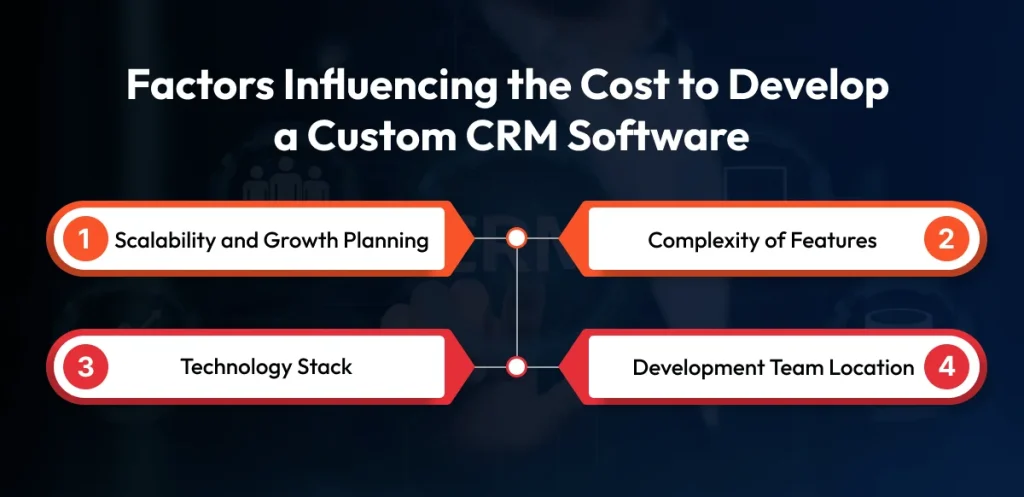
There is no single price tag for a CRM because no two businesses operate identically. The cost to develop a custom CRM software varies significantly based on several critical factors. Engaging CRM consulting services can help understand these variables allows you to budget effectively. Some of the important factors are as follows:
Scalability and Growth Planning
Planning CRM scalability for future growth can increase development costs by $10,000–$40,000, as architectures designed for thousands of users require more robust infrastructure, databases, and performance optimization than small-scale systems.
Complexity of Features
The more features you need, the higher the price. A basic CRM with just a few functions like contact management and task automation will cost much less than a CRM with integrated artificial intelligence, analytics, and workflow automation. Naturally, as logic complexity increases, the cost to develop a custom CRM software rises. For feature complexity, a basic CRM (contacts, tasks, simple automation) typically costs $20,000–$40,000, while a feature-rich CRM with AI, advanced analytics, and workflow automation can cost $60,000–$150,000+ to develop.
Technology Stack
The technologies chosen for CRM web development impact both upfront and maintenance costs. Advanced technologies like machine learning, real-time data processing, or cloud-based integrations add immense value but come with higher development time. A custom CRM software typically costs around $25,000 to $150,000, depending on the chosen technology stack, feature complexity, and development expertise.
Development Team Location
The hourly rate of developers significantly affects the final bill. Partnering with a skilled CRM software development company in a region like India or Eastern Europe can offer the same code quality as Western counterparts but at a fraction of the price.
| Location | Average Hourly Developer Cost (USD) | Estimated CRM Development Cost (Mid-Level CRM) |
| North America (USA & Canada) | $80 – $150 per hour | $80,000 – $180,000 |
| Western Europe (UK, Germany, France) | $60 – $120 per hour | $60,000 – $150,000 |
| Asia (India, Vietnam, Philippines) | $20 – $50 per hour | $25,000 – $70,000 |

Cost Breakdown by Business Size (2026 Estimates)
To provide a realistic picture, we have analyzed the average cost of CRM software development based on business size and requirements. These figures reflect the current market rates for 2026.
- Small Business CRM: Best for startups needing contact management and email automation.
- SMB (Mid-Market) CRM: Best for growing companies needing sales tracking, analytics, and marketing integrations.
- Enterprise CRM: Best for large organizations requiring AI, predictive analytics, and full-scale ERP integration.
Estimated Cost to Develop a Custom CRM Software by Business Size
| Business Size | Estimated Cost Range | Development Timeline | Key Features Included |
| Small Business | $25,000 – $40,000 | Few weeks – 3 months | Contact management, email alerts, scheduling, and basic reporting. |
| SMB (Mid-Market) | $100,000 – $150,000 | 6 months – 1 year | Sales tracking, analytics, marketing integration, and dashboards. |
| Enterprise | $700,000+ | 8 months – 1.5+ years | AI integration, predictive analytics, full-scale ERP integration, and advanced security. |
As you can see, the custom CRM development pricing scale drastically with your ambition. While a startup can launch for under $40,000, an enterprise seeking global dominance must be prepared for a substantial investment to achieve the necessary scale and security.
Regional Development Costs: Where You Build Matters
One of the most effective ways to control the development cost is by carefully selecting where your development team is located. The gap in hourly rates between Western and Eastern markets is significant, despite the convergence in skill levels.
| Region | Hourly Rate | Pros | Cons |
| U.S. / Western Europe | $70 – $100+ | High quality, real-time communication, cultural alignment. | Very expensive, higher overheads. |
| India / Eastern Europe | $35 – $50 / | Highly skilled developers, cost-effective, large talent pool. | Time zone differences (manageable). |
By outsourcing to a reputable partner in a cost-effective region, you can reduce the labor component of the cost to develop a custom CRM software by nearly 50%.
Feature-Wise CRM System Cost Implications
To drill down further into how much does it cost to build a CRM system, we must look at specific feature sets. Features drive the complexity, and complexity drives the cost. Below is a breakdown of what specific functionalities add to your invoice.
Estimated Cost Per Feature Module
| Feature Module | Complexity | Estimated Cost Add-on |
| Basic Contact Management | Low | $2,000 – $5,000 |
| Sales Pipeline & Lead Tracking | Medium | $4,000 – $8,000 |
| Task Management & Scheduling | Medium | $3,000 – $6,000 |
| Reporting & Analytics Dashboard | High | $6,000 – $12,000 |
| Marketing Automation (Email/SMS) | High | $5,000 – $10,000 |
| Mobile Capability (iOS/Android) | High | $10,000 – $25,000 |
| User Access Control & Security | High | $3,000 – $6,000 |
Custom CRM Development Cost of Integration
Your CRM rarely works in isolation. It needs to talk to your accounting software, your website, and your email providers. These integrations affect the cost to develop a custom CRM software.
| Integration Type | Examples | Estimated Cost |
| Simple API Integrations | Google Maps, Social Media Login | $1,000 – $3,000 |
| Complex System Integrations | QuickBooks, SAP, Legacy ERPs | $10,000 – $30,000 |
| E-commerce Integrations | Shopify, Magento, WooCommerce | $5,000 – $15,000 |
Hidden and Ongoing Custom CRM Development Cost
When asking ” what is the average cost of a CRM system?”, many businesses overlook the post-development expenses. To avoid budget shock, you must factor these into your financial planning.
Hidden and Post-Launch Costs
| Cost Category | Description | Estimated Annual Expense |
| Annual Maintenance | Bug fixes, updates, patches. | 15% – 20% of dev cost |
| Cloud Hosting | AWS, Azure, Google Cloud fees. | $1,200 – $6,000+ / year |
| Third-Party API Fees | SMS (Twilio), Email (SendGrid). | Variable based on usage |
| User Training | Teaching staff to use the system. | $2,000 – $5,000 (One-time) |
Analyzing the Cost to Develop a Custom CRM Software by Development Stage
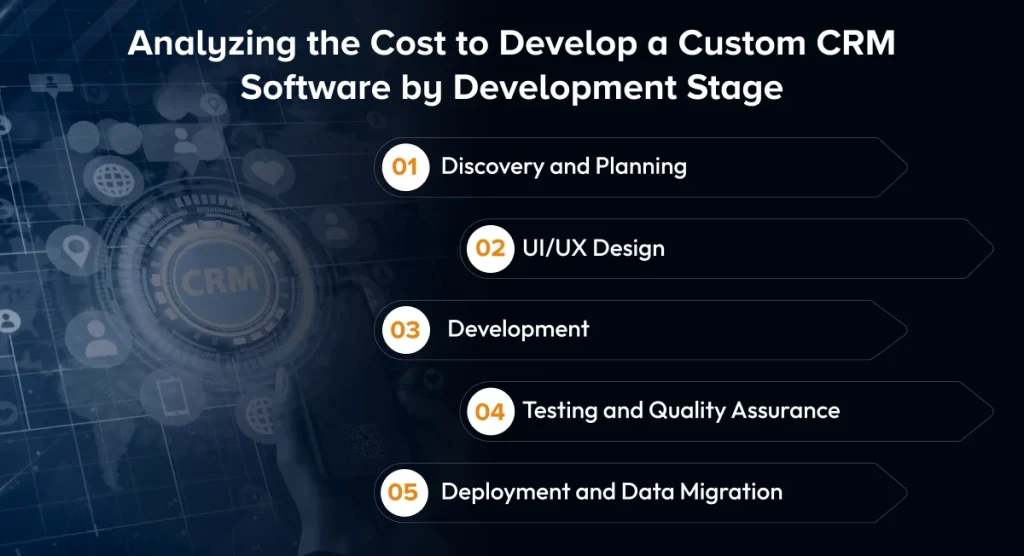
Understanding the cost to develop a custom CRM software requires more than a single price estimate. Each stage of the Software Development Life Cycle contributes differently to the final budget, timeline, and performance of your CRM. Breaking down the development process phase by phase helps you see where your investment goes, identify cost-heavy areas early, and make informed decisions that prevent overruns and wasted effort.
The following breakdown offers a realistic view of how CRM development costs are distributed from planning to deployment.
Discovery and Planning: Business analysts work closely with stakeholders to define objectives, workflows, and technical requirements. Skipping this stage often increases the cost to develop software due to scope creep, unclear expectations, and rework later in the project.
UI/UX Design: Designers create wireframes, user flows, and interactive prototypes that define how users will interact with the CRM. A well-planned design phase helps control the making price of CRM software by reducing usability issues and redesign efforts during development.
Development: Frontend and backend developers build the core features, integrations, automation, and security layers of the CRM system. This phase typically accounts for 5-60% of the total range to make CRM software, making it the most resource-intensive stage.
Testing and Quality Assurance: QA engineers perform functional, performance, and security testing to identify bugs and dataa inconsistencies. Inadequate testing can significantly raise the cost to develop a custom CRM software after launch through fixes and system downtime.
Deployment and Data Migration: The CRM is deployed to production sservers, and existing business data is migrated securely. Proper deployment planning helps avoid operational disruptions and unexpected increases in the cost to develop a custom CRM software .
How to reduce CRM development cost in 2026
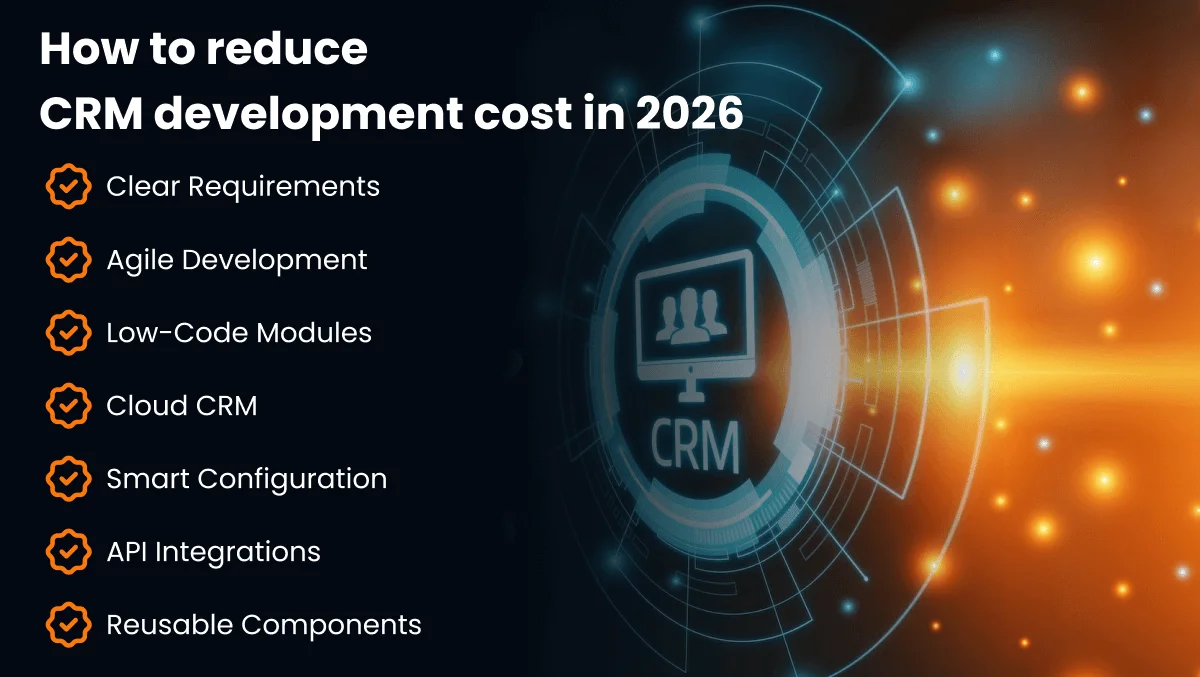
Businesses should take into consideration several significant factors that they should adhere to when developing a business, or rather have their team do so as part of their working process. These best practices are even more important when a SaaS development services provider has to create scalable, secure, and cost-effective solutions. To understand them better, let us examine each of the factors.
Define Clear Business Requirements Early
Begin with clear-cut objectives, procedures, and customer requirements. Clear requirements aid in eradicating scope creep, avoiding rework, and eliminating inessential features that have to be created to save a lot of unnecessary expenses.
Adopt an Agile, Phased Development Approach
When developing CRM, it is better to build it in stages, focusing on the key functionality in the first stage. Agile development facilitates early feedback, quick release, and value control of the budget, as only those features are invested in that bring real value.
Leverage Low-Code and Pre-Built CRM Modules
Custom code is reduced through low-code/no-code platforms and pre-built modules. Automation, reporting, and lead management are pre-developed features that save time and the cost of development.
Choose Cloud-Based CRM Infrastructure
Cloud CRMs remove the initial investment in infrastructure and minimise the cost of maintenance. Cloud deployment is a cost-effective option in 2026 due to subscription pricing, automatic updating, and scalability.
Limit Custom Development and Use Configurations
Use pre-established settings, processes, and automation grounded on rules instead of custom code. The configurations are quick to set up, maintain, and much economical.
Optimize Integrations with Existing Systems
Apply standard APIs and native connectors to join CRM to ERP, marketing tools, and support. This will reduce the complexity of integration and minimize the costs of maintenance in the long run.
Reuse Components and Standardize Processes
Developing reusable user interface components, templates, and workflows can reduce the development costs in making upgrades and additional extensions in the future, making it better in terms of costs in the long run.
Invest in User Training and Adoption
Complete training will guarantee high CRM adoption, so that there will be no unnecessary expenditure on unused features. An optimally embraced CRM provides more ROI without the extra investment in development.

The Final Words
Determining the cost of implementing CRM system is not about finding the cheapest number; it is about aligning your budget with your business goals. While the cost to develop a custom CRM software typically ranges from $25,000 for small businesses to over $500,000 for global enterprises, the investment pays for itself through operational efficiency, data ownership, and the elimination of perpetual licensing fees.
Whether you need a specialized Healthcare CRM software development, or a full-scale development servicesproject, the key is to plan thoroughly and partner with experts who understand your vision. A custom CRM is not just software; it is the engine that will drive your customer relationships, and your revenue forward in 2026 and beyond.


 Get in Touch
 By
By July 13, 2026