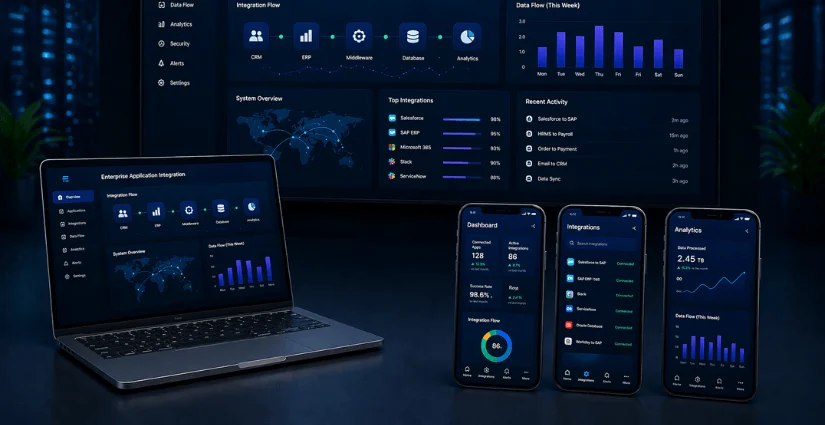




Introduction: The New Era of Mobility
Voice interfaces signify an advancement in the enterprise mobile app development, which greatly enhances user experience through conversational voice-enabled capabilities for hands-free interaction with apps. As organizations are searching for cooperation and productivity-focused smart solutions, voice interfaces will play an increasing role in reinventing users’ interaction with business-critical applications – increasingly done in real-time and seamlessly integrated into enterprise workflows, reports, and everyday mobile moments in our work lives.
Understanding Voice Interfaces in Enterprise Mobile Apps
Voice interfaces allow end-users to execute mobile applications through natural language commands rather than touch or keystrokes. Modern enterprise mobile app development has integrated voice technology to enhance accessibility, innovative engagement, and created platforms that replicate the user experience to address all types of enterprise needs.
- Voice interfaces enable the user to use advanced AI and natural language processing (NLP) to understand their requests, carry out routine tasks, and dynamically access real-time data.
- Large platforms have demonstrated the wide use of voice interfaces in enterprise applications, including Google Assistant, Amazon Alexa, and custom enterprise solutions across multiple industries.
Key Drivers for Voice Integration
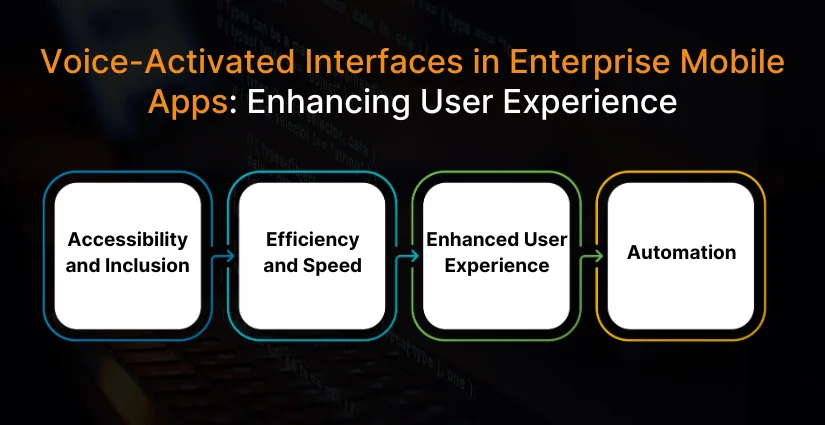
Enterprise mobile applications that are activated by voice commands bestow an array of advantages on both companies and users:
1. Accessibility and Inclusion
The availability of the hands-free feature would make it easier for employees to use the app for users who have difficulty moving or are visually impaired.
2. Efficiency and Speed
The employee can get the information, report, or make a decision much faster if he/she uses the command, which consequently increases productivity to a greater extent.
3. Enhanced User Experience
Engagement and satisfaction of users are among the top characteristics of the mobile applications for enterprises since such a close-to-human interaction is only made possible by the conversational flows in the enterprise mobile app development.
4. Automation
The command of voice for automation takes up the repetitive enterprise processes and thus frees the team for strategic work.

Core Features of Voice-Activated Enterprise Apps
For voice-controlled apps to be a success, their enterprise mobile app development should cover the following core features:
1. Speech Recognition
AI and NLP are used to carry out a process of turning spoken inputs into app responses that can be practically acted upon.
2. Commands Mapping
It is the assignment of certain voice commands to the enterprise’s tasks or its reporting functions.
3. Multi-Mode Interaction
One type of input for more flexibility is the combination of voice input with touch or gestures, as well as other types of input that are also supported.
4. Error Management
Users receive precise feedback and guidance, resulting in the building of trust and the alleviation of irritation caused by incorrect voice command interpretation.
Implementing Voice Interfaces: Best Practices
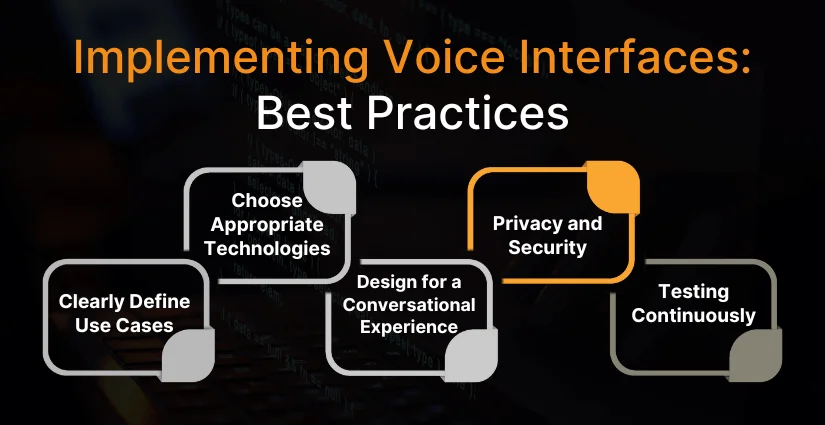
Enterprise mobile app development teams in the enterprise space should take into account these best practices when striving for success:
1. Clearly Define Use Cases
Focus on compelling use cases, including hands-free navigation, data inquiries, and the development of enterprise reporting software.
2. Choose Appropriate Technologies
Use APIs and frameworks that offer reliable voice recognition, secure data handling, and integration with enterprise systems.
3. Design for a Conversational Experience
Keep natural language usage at the forefront of design, along with visible feedback and discoverability to ensure an intuitive user experience.
4. Privacy and Security
Protect voice inputs and reporting data, and ensure compliance and user consent are explicit.
5. Testing Continuously
Factor in improvements regarding retention of context, recovery of errors, and variation in voice commands to strengthen the overall app reliability.
Voice Interfaces Reshaping Enterprise Reporting
Adding voice interfaces within enterprise reporting software development alters the nature of how an organization generates or analyzes data:
- A user can use their natural voice commands to generate, personalize, or validate business reports, making interpretation, research, and insights more transparent and less constricted.
- No longer will a user need to enter data manually or search through case complexity if they know natural language inquiries, e.g., “Show me last month’s sales performance,” “How many AR in each account grouping,” or “Which agents to change from exploratory to focus.” be accurate.
- Both uses of voice democratize data so that non-experts may apply biz intelligence tools, nurturing a data-driven culture through enterprise mobile app development.

Challenges and Solutions in Voice-Activated Enterprise Apps
Implementing voice interfaces in enterprise mobile app development requires addressing several important issues, which include:
1. Limited Discoverability
Most of the time, the users are not aware of the voices that the app can recognize. In order to tackle this problem, the apps can conduct onboarding workshops, supply situational hints, and provide interactive help menus that direct the users to the most effective ways of communicating with the app by voice.
2. Error Recovery
Error Recovery is the most important factor to keep the user’s faith in the system. In the case of voice recognition, the system must respond with very clear and empathetic feedback, for example, “I’m sorry, I didn’t hear you correctly. Would you mind repeating that?” and at the same time provide the user with alternative ways of inputting his/her request in order not to be frustrated.
3. Context Retention
Context Retention is the key factor in multi-step tasks to be done without interruption. Modern voice systems rely on session memory and AI to keep track of the inputs, thus allowing natural, human-like conversations even through complex workflows.
4. Platform Inconsistency
Platform Inconsistency when it comes to the devices and operating systems can be a great user experience killer. Unifying the voice command logic and taking advantage of the cross-platform tools are ways to keep uniformity in the enterprise-wide implementations.
5. Privacy Concerns
Privacy Concerns regarding always-listening microphones require companies to have very clear data policies. They need to use techniques such as the end-to-end encryption of voice data, gaining explicit user consent, and processing as much as possible on-device to protect voice information that is sensitive and, more importantly, to be in line with international regulations.
The Future of Voice Interfaces in Enterprise Mobile App Development
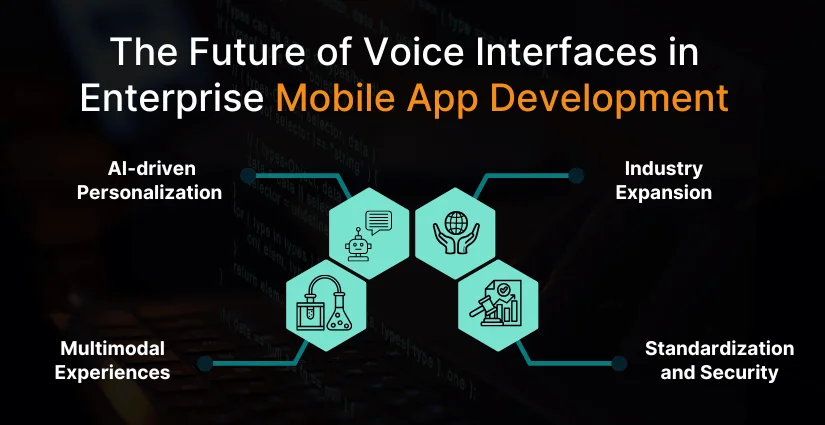
The future of voice interfaces in enterprise mobile app development is bright, with several trends that exhibit how quickly voice is becoming ubiquitous in terms of mobile app development:
1. AI-driven Personalization
AI – Voice interfaces for all users will not simply be a set of commands that respond, reminiscent of many of the digital assistants we deal with in our personal lives. Rather, the application will adapt responses based on learning across not just preferences but in context to the business, all in a way to improve overall user experience.
2. Multimodal Experiences
The combination of voice with smart visuals used to enhance voice and provide haptic feedback to create a richer interaction will offer increased flexibility when a user is working with an app.
3. Industry Expansion
We are already seeing an acceleration of voice interfaces in sectors such as healthcare, manufacturing, logistics, and finance for enterprise reporting software and broader workflow automation.
4. Standardization and Security
As best practices to recommend the use of voice as a user interface continue to broaden, the best practices will promote a good user experience across tools and systems, while supporting secure usage of the user interface as a digital way to address accountability in enterprise applications.
Case Studies and Real-World Applications
- Leading companies are using voice interfaces to change customer service, reduce workflows, and improve internal reporting, all through enterprise mobile app development.
- Available use cases consist of voice-enabled dashboard data interactions, automated entry via spoken commands, and custom reporting based on voice commands in enterprise reporting software development platforms.
- Companies that implement voice features early, on average, will be more competitive in terms of accessibility, efficiency, and employee engagement.
Conclusion
Voice-activated interfaces are legitimately evolving enterprise mobile app development to better engage interactions, improve accessibility, and provide employees with a hands-free tool for quicker reporting and decision making.
As organizations adopt and increasingly engage voice interfaces and mobile enterprise reporting frameworks heavily, the focus on real user experience will shape the future of enterprise mobility- innovation, efficiency, and competitive differentiation from others in a voice-driven world.



 Get in Touch
![Enterprise Mobile App Development – Cost and Key Features [2026]](https://d274cmdd0goq94.cloudfront.net/wp-content/uploads/2025/01/Enterprise-Mobile-App-Development–Cost-and-Key-Features-2026.webp)
 By
By June 12, 2026