


Contemporary businesses are under a lot of pressure in order to remain competitive within an ever-changing and technological environment. The systems of the past, which were sufficient to sustain daily functions, now limit agility, innovation, scalability, and adoption of AI. In order to cope with the digital transformation and increased customer expectations by the year 2026, organizations will have to adopt enterprise app development services that will support customized enterprise app development services. The old infrastructure can not provide the fast, connected, mobile-first, and intelligent experiences that modern users demand.
In this blog, we will cover reasons as to why modernization is important, the dangers of using old systems, and the main technologies that will define modernization in 2026, the ROI advantages, and the acceleration of this process through the professional modernization partners. Modernization, however, is not merely an upgrade anymore, but a strategic reinvention that minimizes the cost of doing business, makes its performance more robust, and equips the enterprises with a more automated and AI-driven future.
What Is Enterprise App Modernization and Why Does It Matter in the Coming Years?
Enterprise app modernization can be defined as a strategic procedure of updating, reorganizing, or re-architecting old business applications to match the latest technologies, performance demands, and changing business objectives. Legacy systems are prone to cause inefficiencies, security risks, and integration issues as organizations grow to a larger scale. The process of modernization can help address these limitations through better operational efficiency, which enhances system performance, reduces maintenance costs in the long term, facilitates smooth adoption of the cloud, and provides smooth, user-friendly user experiences. It is also a ready-to-go AI-based future, serving automation, real-time data processing, and a scalable architecture that can expand with business requirements.
Modernization is done in businesses to:
- Enhance productivity and output.
- Strengthen security
- Reduce maintenance costs
- Enable cloud adoption
- Enhance user experience
- Integrate AI and automation
- Make sure it is scalable in the long term.
The issue of modernization is more important than ever in 2026 because the technology ecosystems within enterprises are growing at an influential pace. The use of cloud-native engineering has become critical to attain speed and resiliency, whereas the application of AI depends largely on modern data pipelines and real-time architecture. Robotic tools are demanding in terms of flexibility (need API compatibility), and the increased risk of cyber threats is leaving old applications highly exposed.
Further, mobile-first workforce and customer expectations impose pressure on the need to respond more quickly and have more efficient digital operations at the same time, as compliance regulations are becoming increasingly stricter. Enterprises that have invested in the modernization of legacy application services also open new possibilities of innovation, productivity, and scalability, and minimize operational risks as well as business continuity.
- The reason why modernization is essential in 2026 is that:
- Operating in a cloud native is becoming the norm in an enterprise.
- The system will need modern data pipelines and real-time systems to implement AI.
- The automation tools require an API-compatible, scalable architecture.
- The threat of cybersecurity is on the increase.
- Mobile-first experiences have to be faster in response.
- The rules of compliance are getting tougher.
The Risk of Not Updating Legacy Apps in the Coming Years
The obsolete systems performed worse than the good ones. Enterprises are subject to long-term business, security, and financial risks by not modernizing.
Security Vulnerabilities and Compliance Gaps
Old applications are seldom maintained, and most use outdated, loosely structured frameworks that lack modern encryption standards and security patches. This increases exposure to:
- Data breaches
- Security exploits
- Malware risks
- Ransomware attacks
- Compliance violations
The environment of industries with tight regulation (GDPR, HIPAA, PCI DSS) may result in the imposition of severe punishment due to the use of outdated systems. Modernization enhances the security of enterprises as well as adhering to the current international regulations.
Security-based modernization is a fundamental service in the enterprise application modernization services.
Declining Performance and User Engagement
The existing applications are not designed to meet the current user expectations. Hacking speed, weak mobile compatibility, old-fashioned user interface, weak integrations, and weak processing capabilities lead to:
- Low employee adoption
- Poor customer experience
- Frequent downtime
- System bottlenecks
- Decreased productivity
The updated systems are real-time, intuitively designed, and can easily integrate with APIs, mobile front-end, and SaaS products.
Rising Maintenance Costs and Technical Debt
Every year, legacy systems are becoming more costly owing to:
- Increasing licensing fees
- Lack of qualified programmers
- Outdated infrastructure
- Frequent bug fixes
- Patchwork integrations
- Aging hardware
Companies spend up to 70 percent of their information technology budget to support old systems- they have not much left to be innovative. Modernization will minimize this technical debt and also bring back resources to growth-driven activities.
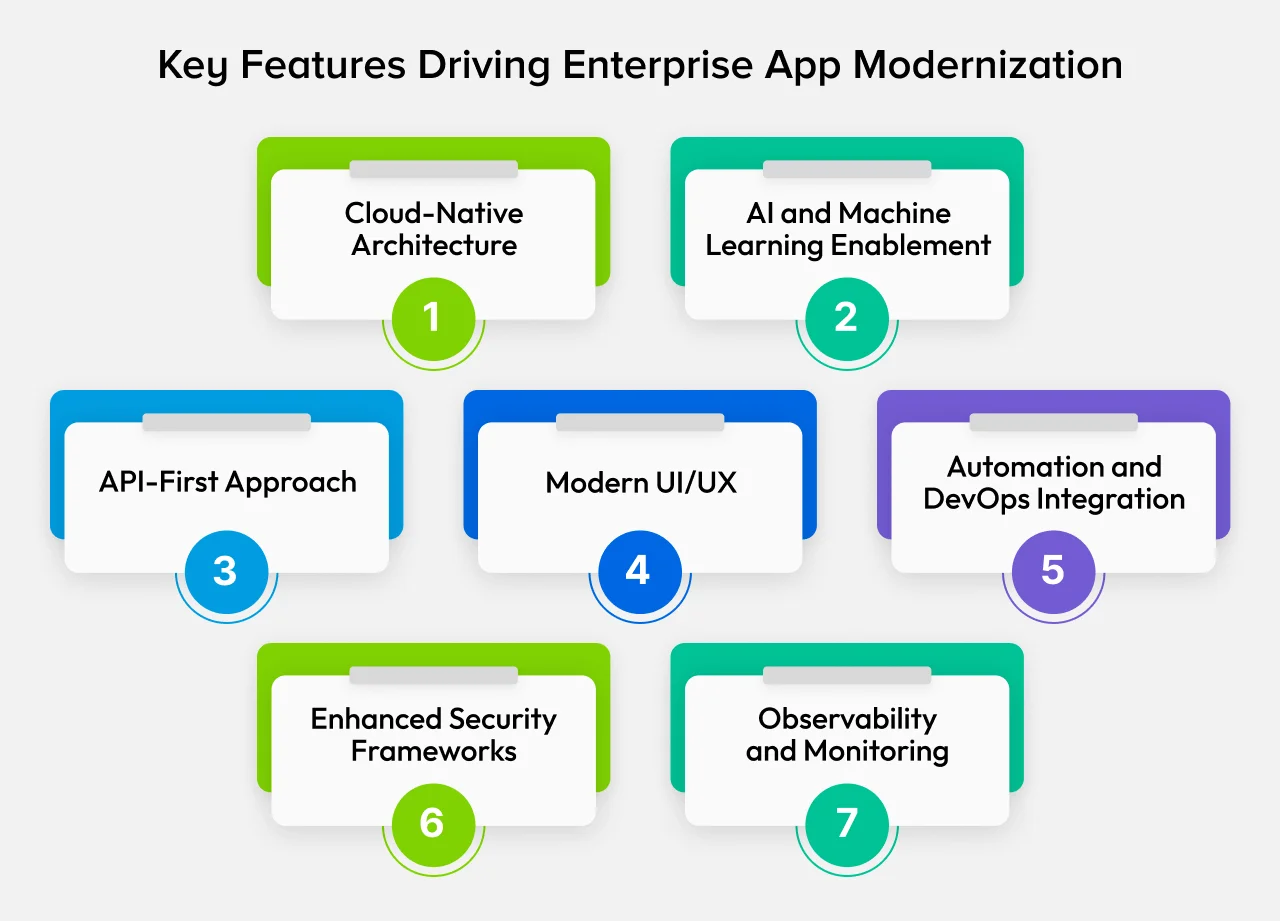
Key Features Driving Enterprise App Modernization
In 2026, modernization of the enterprises will be associated with seven game-changing features:
Cloud-Native Architecture
In the modern world, enterprises demand systems that are dynamically scaled and that are able to work in hybrid and multi-cloud environments. Agility and constant innovation are based on cloud-native engineering.
Switching to microservices, containers, Kubernetes, and serverless computing assists the enterprises to attain:
- Greater scalability
- Easy deployment
- Faster updates
- Flexible integrations
Cloud-native applications make it possible to be continuously innovative and resilient.
AI and Machine Learning Enablement
AI-based businesses should have the latest infrastructure that enables real-time data streams and automation piping, and sophisticated analytics. Modernization also ensures that legacy systems can support the computational and data needs of AI.
AI systems require real-time, clean, structured, and highly available data. Modernization makes applications ready to:
- Intelligent automation
- Predictive analytics
- Computer vision
- Chatbots and virtual assistants.
- Recommendation engines
AI is not a choice anymore; it is what drives the expansion of an enterprise.
API-First Approach
Applications, devices, and platforms must be integrated at a faster rate than ever to ensure businesses stay competitive. A modern digital ecosystem with various integrated components relies on an API-first approach.
APIs enable enterprises to interface their applications with:
- CRMs
- ERPs
- Data warehouses
- IoT systems
- AI services
- Mobile applications
The API-first type of modernization facilitates easy interoperability and expedited implementations.
Modern UI/UX
The expectations of the users are changing to require faster, cleaner, and more personalized digital experiences. Modern UI/UX changes the interaction between employees and customers with the enterprise applications.
Business is focusing on:
- Mobile-first experiences
- Personalized dashboards
- Accessible design
- Reduced friction
- Faster task completion
Enhanced UX will enhance productivity and user satisfaction.
Automation and DevOps Integration
Contemporary business organizations cannot afford to be brought to a halt or to release infrequent software versions; these issues are addressed by the use of automated workflows. Modernization based on DevOps helps in speeding up delivery at the same time, preserving reliability.
DevOps, CI/CD pipelines, and automated testing enable:
- Faster delivery cycles
- Better quality assurance
- Reduced human errors
Maintenance, testing, and deployment are also accelerated by automation.
Enhanced Security Frameworks
As cyber threat intensifies, businesses require new security infrastructures that can respond quickly and secure overall key business processes. Security is built in at the architectural level and not as an add-on in modernization.
Modernization incorporates superior security models such as:
- Zero Trust Architecture
- Multi-Factor Authentication
- Identity and Access Management.
- End-to-end encryption
- AI-based threat detection
Security is proactive, rather than reactive.
Observability and Monitoring
The contemporary systems need total visibility to facilitate the smooth running of the system and prevent failures before they occur. Observability solutions enable teams to gain knowledge in distributed, cloud-native systems.
The present-day applications combine the means of:
- Real-time monitor of performance.
- Anomaly detection using AI.
- Predictive maintenance
This guarantees ease of uptime and early detection of issues.
Technologies Powering Enterprise App Modernization in 2026
Generative AI
Generative AI is a tremendous boost to modernization since it automates the complex engineering processes. It examines old codebases, creates refactoring requirements, provides new documentation, and even creates automated test cases. GenAI reduces modernization cycles, lowers costs, and maintains consistent code quality in large enterprise applications by reducing human effort and eliminating manual errors.
Microservices and Kubernetes
Microservices architecture breaks monolithic applications into modular, independently deployable services, giving teams more flexibility and faster release cycles. Kubernetes acts as the orchestration backbone, managing scaling, deployment, and resilience. Together, they enhance system reliability, enable parallel development, and help enterprises achieve unmatched scalability and operational agility.
Low-Code and No-Code Platforms
Low-code and no-code platforms enable businesses to create interfaces, automate processes, develop ideas, and implement micro-apps without intense coding. These tools will speed up modernization through less reliance on engineering resources, better experimentation, and quicker iteration. LCNC platforms assist companies in being innovative within a short time and, at the same time, make modernization affordable and effective.
Cloud Platforms (AWS, Azure, Google Cloud)
The key element in 2026 modernization strategies is cloud platforms, which facilitate multi-cloud flexibility, hybrid deployments, and serverless architecture. Scalable compute power, high security, worldwide presence, and less infrastructure administration are beneficial to enterprises. The guide to migrate legacy system to cloud is one of the main references of the team, in which the plan for efficient and risk-free cloud adoption is done.
API Gateways and Integration Platforms
The integration platforms, such as MuleSoft, Boomi, and Kafka API gateways, facilitate connectivity in the enterprise. They promote real-time data synchronization, event-driven operations, and smooth third-party integrations. These tools simplify the architecture and allow uniform application performance in the enterprise by providing a safe and scalable communication pathway between the new and old systems.
RPA + AI Automation
RPA with AI processes modernization by automating high-volume tasks and smart workflows. The extraction of data, its decision-making, and optimization of processes are done more accurately thanks to AI-powered bots. This saves time on manual work, speeds up the processes, and enhances the overall efficiency of the business as a whole- making it an excellent instrument to transform the old-fashioned processes of the enterprise in 2026.
Mobile-First Modernization
Mobile-first modernization is the concept of re-engineering enterprise applications to be mobile, so that they are more accessible and operationally nimble. Through the assistance of mobile app modernization consulting, businesses are able to rearchitect interfaces, simplify business workflows, and provide field teams with real-time capabilities. The method will decrease friction, increase productivity, and make enterprise applications compatible with the mobile-driven workforce in 2026.
ROI Analysis: Justifying Enterprise App Modernization Investments
Enterprise system modernization is a high-value, long-term financial, operational, and strategic investment, not merely a technical requirement. Modernization leads to quantifiable benefits in terms of efficiency, agility, customer experience, and risk reduction in organizations. The following are the key areas of ROI in which enterprises are experiencing the greatest effect.
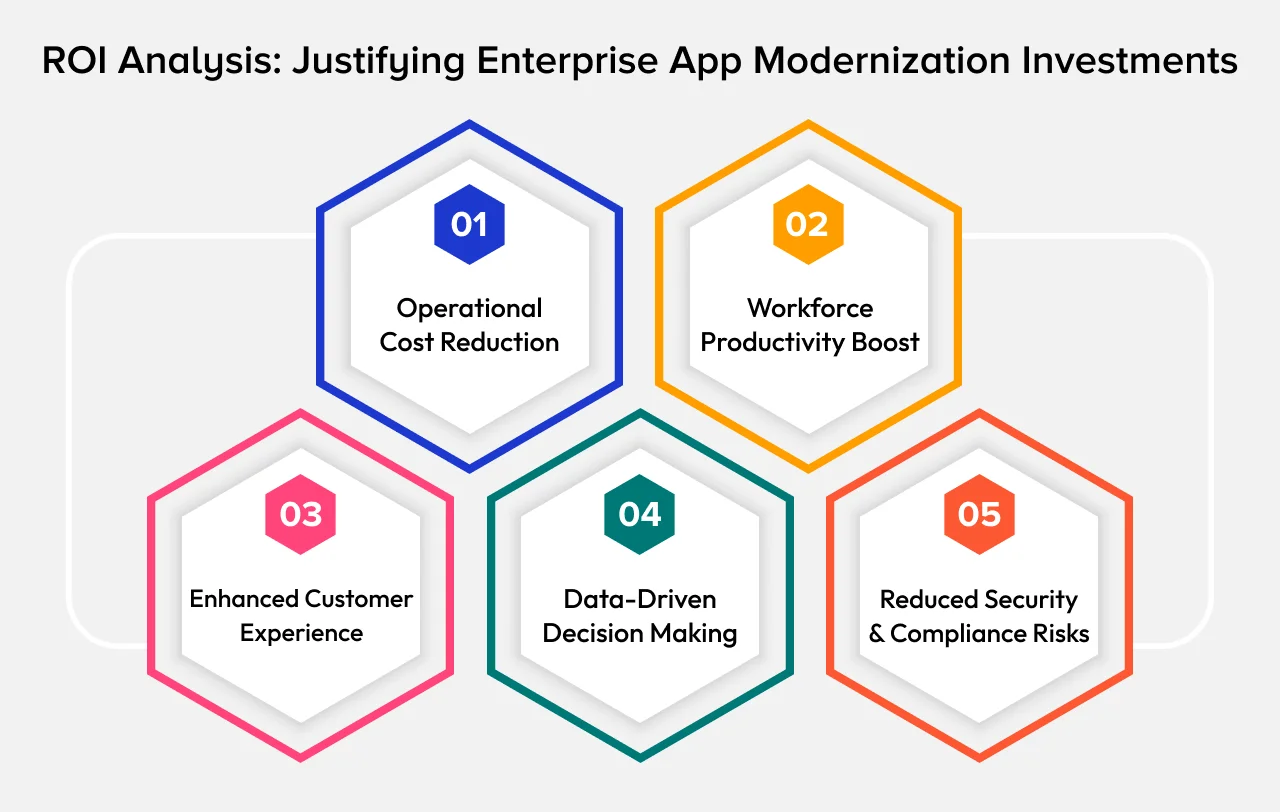
Operational Cost Reduction
The enterprise app development cost is cut down significantly due to the process of modernizing them to cloud-native and scalable applications. Businesses do away with on-premise hardware expenses, reduce downtime waste, reduce maintenance expenses, and eliminate repetitive licensing expenses. Besides, the latest infrastructure enhances the efficiency in the use of resources and decreases wasteful expenditures on the archaic infrastructure. The cloud-based pricing is also predictable to the enterprises, and the reduced physical infrastructure also means that the enterprises use less energy.
Other sources of ROI:
- Less overhead in DevOps through automation.
- Reduced storage expenses through cloud optimization of data.
- Reduced the requirement to support legacy systems with specialized support.
Workforce Productivity Boost
The use of modern applications has drastically enhanced the productivity of the workforce by providing better response time, enhancing the integration of the systems, providing seamless mobile accessibility, and automating repetitive tasks. Employees are able to work more effectively, have real-time data, and finish workflow in a shorter period of time. This increases productivity, hence project turnaround will be quicker, and there will be better communication within, which will improve the performance of the entire business.
Other external ROI sources:
- Ensured employee satisfaction because of the simplified workflows.
- Less time spent in training due to new, easy-to-use interfaces.
- Quickened training of new departments and teams.
Enhanced Customer Experience
The direct effects of modernization on customer experience are the increase in response speed, personalized services, increased access, and better omnichannel performance. Customers are also being provided with quicker, more pertinent engagements, be it on mobile apps, web portals or on in-store systems. This translates to enhanced satisfaction, retention, and revenue prospects.
Other contributors of ROI:
- Increased rates of conversion through better digital touchpoints.
- Less customer service burden because of increased self-service.
- Increased brand perception and competitiveness.
Data-Driven Decision Making
Innovations with modern systems provide enterprises with single analytics and AI-based insights. These features make the correct forecasts, better trend analysis, and business planning possible. Based on high-quality and real-time data, leaders are able to make smarter and faster decisions. There are also modern platforms that destroy data silos, thus making important business data available and implementable at all times.
Other sources of ROI:
- Greater performance tracking between departments.
- Improved resource planning and budgeting.
- Predictive analytics of issues.
Reduced Security and Compliance Risks
Modern systems also have improved security systems that reduce the chances of breaches, legal suits, and compliance breaches to a large extent. Businesses will not incur massive financial losses and reputational harm when the encryption is much stronger, automated monitoring, access controls, and real-time threat detection are in place. New compliance capabilities make the process of audit and exposure to penalties easier.
Other contributors to ROI:
- Reduced Response and remediation costs.
- Constant refreshment of compliance reduces the level of manual control.
- Less susceptibility to outdated third parties.
Through collaborations between businesses and professional service providers for modernizing the application, not only do businesses speed up the digital transformation process, but they also achieve a safer, more cost-effective, and future-proof modernization path that maximizes the ROI.
Octal’s Approach to 2026 Enterprise App Modernization
Step 1: Legacy System Audit & Assessment
Octal starts modernization with a radical review of the current legacy ecosystem. It involves the scrutiny of the existing system architecture, performance gaps, the accumulation of technical debt, and general application preparation to be migrated to the cloud and integrated with AI. This phase makes the process fully visible of what must be fixed, optimized, or re-engineered.
Step 2: Modernization Roadmap Creation
After the evaluation, Octal develops an individual modernization roadmap to structure the process of change. This plan provides the perfect migration strategy, suggests the appropriate cloud architecture, establishes the database modernization plan, and provides a security improvement blueprint. The organized planning is an equivalent of the clarity and prospect that good IT consulting services offer to businesses.
Step 3: Re-Architecting & Development
The execution phase aims at modernizing the legacy system with the application of the most appropriate modernization approaches. Octal can use re-hosting, re-platforming, re-engineering, re-coding, or containerization, depending on the demands of the business. Both approaches are chosen to increase system efficiency, reduce technical debt, improve scalability, and prepare the application to operate in the cloud.
Step 4: AI-First Enablement
Octal is adding AI-first features to modernized apps to make sure that businesses remain competitive in 2026 and beyond. It involves the empowerment of predictive analytics, process automation platforms, and smart data processes that enable businesses to make decisions faster, which are data-driven and minimize human intervention.
Step 5: Integration & API Enablement
Octal brings modernization in the connectivity of the systems by API integration capabilities that help in making communication between apps, databases, and external systems easy. The contemporary APIs guarantee safe, uninterrupted, and scalable cross-system interactions, which allow businesses to conduct themselves within a single digital environment.
Step 6: Testing, Optimization & Deployment
All modernized modules are thoroughly validated through performance testing, security testing, and automated regression testing. CI/CD pipelines make the deployment process smoother and faster, and more dependable. Before the system goes live in the production environment, octal makes sure that the system is at its optimum capacity.
Step 7: Post-Modernization Support
After deployment, Octal proceeds to offer services to enterprises in the form of detailed documentation and user training, system monitoring, and continuous optimization. This stage will be the guarantee of sustainability, improved performance, and constant correspondence with changing trends in technology and business demands.
Industry-Specific Modernization Examples
In industries, businesses are using the effects of modernization to open up efficiency, innovation, and intelligent automation. Here are a few examples:
Banking & Financial Services
Legacy systems are quickly being updated by the banking industry to facilitate real-time payments, AI-enhanced fraud detection, enhanced compliance reporting, and smooth customer journeys through omnichannels. The modern platforms assist the banks in operating quickly, minimizing risks, and providing hyper-personalized experiences, and address the growing regulatory requirements without affecting their security and performance.
Healthcare
Modernization of applications is implemented in healthcare organizations to facilitate competent telemedicine, enhance patient interaction, enhance EHR systems, and facilitate effective sharing of data across departments. Such modernization programs enhance patient care, teamwork, and transparency in administrative operations and adherence to changing health policies, which assist the providers in providing quicker, safer, and more convenient patient-centered medical care.
Retail & eCommerce
Shop operators modernize their online environment to deploy inventory automation solutions, provide customers with personalized products, improve mobile-first shopping, and streamline logistics operations. The upgrades enable the brands to remain competitive, minimize the overheads, and establish frictionless shopping experiences that are motivated by real-time insights and intelligent automation.
Manufacturing
The modernization that manufacturers are adopting in an endeavor to connect IoT devices, track production in real-time, become more visible in their supply chain, and automate quality checks is embraced. Under the guidance of an enterprise app development guide, such changes allow smart operations, fewer downtimes, and manufacturers being able to scale efficiently even as they move to fully data-driven smart factory environments.
Conclusion
Enterprise modernization is no longer an option project; it is a strategic project that prepares organizations to grow, be resilient, and innovative in 2026 and beyond. Modernizing the legacy systems, enterprises lower the risks, enhance the performance, adopt the cloud scaling capabilities, and combine AI-driven opportunities that transform the future of business.
Enterprises have the freedom to choose between microservices and automation, cloud usage, and AI-powered enterprise app development, among other tools. That being said, it all depends on the collaboration with the appropriate experts in partnering in enterprise modernization solutions that could create the scaled, secure, and future-proof systems.
Modernization is not about upgrades alone, but about reinvigorating business activities in the digital-first world.
Read More : Top android application development companies
FAQs
Enterprise app modernization is the act of modernizing, re-architecture, or migrating old systems to current, scalable, and AI-ready architectures. It is necessary in 2026 as companies need faster performance, better security, the capacity to scale to the cloud, and a unified system to keep up with their rivals.
The period is dependent on the complexity of the architecture, the level of its integration, and the way of modernization (re-hosting, re-platforming, or re-architecturing). The average time required to conduct mid-size modernization projects is 3-12 months, and large enterprise transformation can take up to 18 months.
Some of the key technologies are microservices, Kubernetes, cloud infrastructure (AWS, Azure, GCP), AI/ML capabilities, DevOps automation, API gateways, and low-code/no-code tools. These guarantee agility, quicker releases, real-time information processing, and enhanced user experiences.
The businesses implement strong security measures, including Zero Trust Architecture, MFA, IAM, end-to-end encryption, and AI-based threat detection. Further risk reduction is achieved by continuous monitoring and automation of compliance in the process and beyond modernization.


 Get in Touch
![Enterprise Mobile App Development – Cost and Key Features [2026]](https://d274cmdd0goq94.cloudfront.net/wp-content/uploads/2025/01/Enterprise-Mobile-App-Development–Cost-and-Key-Features-2026.webp)
 By
By June 12, 2026