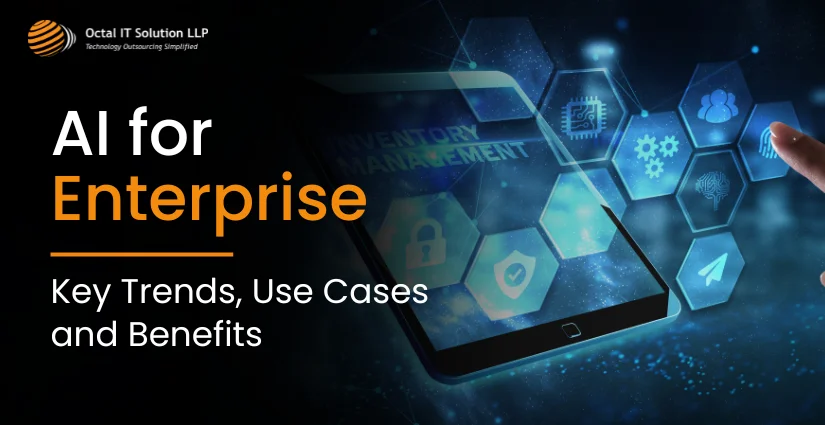



AI is not a luxury for any business; it is vital to enterprises in enhancing efficiency, decision-making, customer satisfaction, and revenue. In customer support, sales enablement, document processing, and Retrieval-Augmented Generation (RAG), companies are using AI. The main advantages are productivity increases of 20-40 percent, shorter decision times, risk reduction, personalization, and shorter time-to-market.
A strong AI-based application architecture includes data, model, inference, and governance layers. Prices range: frontier models can be trained at up to $30191, whereas smaller models can be trained at as low as 10K50K. The range of inference is between 0.002 and 0.12 per 1,000 tokens. Security demands minimization of data, audit recording, RBAC, and equitable scrutiny.
The process of AI-powered mobile enterprise application development includes five steps: use case definition, data collection, design, testing, and maintenance. By planning well, businesses can grow AI in a responsible way that automates business operations, enhances business compliance, and develops intelligent and future-proof systems.
Introduction
Artificial intelligence is not a fashionable term in the future anymore; it is a business requirement. Businesses in all sectors are integrating AI into their systems in order to automate their complex operations, provide real-time insights, and offer personalized user experiences. Customer service AI chatbots, predictive sales analytics, and more AI-based apps are facilitating quicker decision-making, lower operational costs, and the broadening of revenue streams.
The global enterprise AI market was valued at USD 23.95 billion in 2024 and is expected to surge to USD 155.21 billion by 2030, expanding at a CAGR of 37.6% between 2025 and 2030.
But what is the next step between an idea and implementation? Which tools and techniques can you use to select the appropriate use case, architecture, and infrastructure without spending too much and endangering the exposure of data?
As these things involve technical details, you need an experienced development team. Octal IT Solution is a leading enterprise app development company with expert developers and designers who can assist you in building AI-powered enterprise apps.
Here in the blog, we are going to take you through all that you should know about developing AI-driven enterprise applications, the business drivers and reasons, the high-impact use cases, the technical architecture, cost models, security, and a roadmap to implement.
Why Enterprises Are Embedding AI into Their Apps?
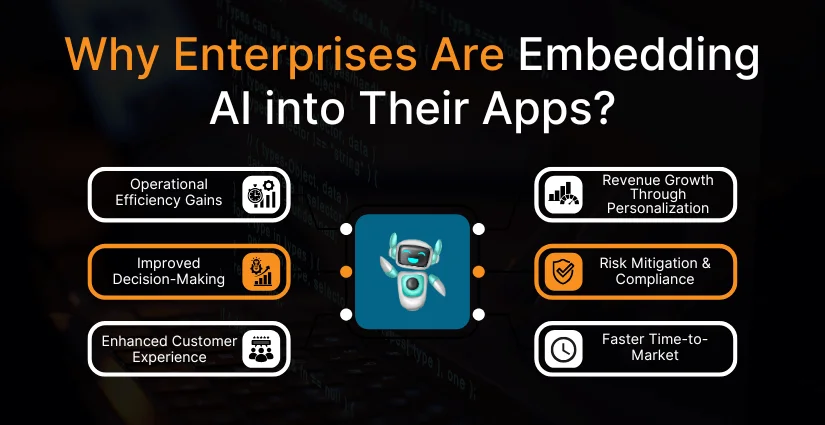
Whenever we talk about AI enterprise apps, some of the common questions that comes to our mind are what is enterprise app and why artificial intelligence should be implemented in such apps. Incorporating AI for enterprise apps offers several business advantages. Let’s take a look at why enterprises are prioritizing AI in their app development.
1. Operational Efficiency Gains
The manual burden on the employees is decreased as AI automates redundant information like data entry, document classification, and email triage. This enables teams to spend more time on more valuable work, usually resulting in productivity improvements of 20-40 percent in essential departments such as HR, finance, and customer support.
2. Improved Decision-Making
AI can process large amounts of data and provide actionable insights quickly than any human being. It could be customer sentiment analysis or supply chain forecasting; AI-powered decision support systems assist leaders in making more confident and faster decisions based on the data.
3. Enhanced Customer Experience
Chatbots and custom content delivery are just a few examples of AI reducing individualized experiences to specific users, in most cases, in real time. The result? Satisfied customers, decreased turnover, increased participation. 24/7 support is also enabled through AI, which helps to increase compliance with SLA and improve the response time.
4. Revenue Growth Through Personalization
Artificial intelligence in the field of sales and marketing is used to customize campaigns and product recommendations based on real-time behavior, purchase history, and even forecasted requirements. This will translate into increased conversion rates, increased basket size, and customer lifetime value (CLV).
5. Risk Mitigation & Compliance
Milliseconds AIs have been shown to be able to flag anomalies, detect fraud, and track compliance violations in thousands of transactions almost instantly. Regulated industries allow enterprises to minimise audit risk and enhance oversight with AI.
6. Faster Time-to-Market
Artificial intelligence can hasten the development process by creating snips of code, writing test cases, and making it possible to generate synthetic data. Development tools assisted by AI teams can reduce their delivery times by up to 30-50 percent.
Common AI Use Cases in Enterprise Applications
Enterprises are incorporating AI into their apps in various ways to improve business outcomes. Here are some common AI-powered enterprise app use cases.
- Customer Support & Ticket Triage
AI Agents for Customer Service can automatically classify and direct support tickets, enabling faster resolutions and reducing the workload on human support teams.
- Sales Enablement
Artificial intelligence can create customer interaction insights in real-time to inform sales representatives so that they can prioritize high-potential leads and predict sales more precisely.
- Intelligent Document Processing (IDP)
AI models can analyze documents, such as contracts and invoices, which helps to cut down the time spent on manual reviews and processing.
- Retrieval-Augmented Generation (RAG)
This brings together the logic capabilities of large language models (LLMs) and company-specific data to assist users with accurate, context-relevant answers to applications such as HR assistance.

Recommended Architecture for AI-Driven Apps
Building a reliable enterprise app architecture is crucial for ensuring that your AI features are scalable and secure. Here’s a high-level overview of what the architecture should include:
- Data Layer
This is the place where your data is gathered through different sources, such as CRMs, ERP, and data lakes. To train AI models, clean and well-governed data is required.
- Model Layer
AI models can be pre-trained (such as GPT-4, LLaMA, or Gemini) or custom-trained to the needs of your enterprise.
- Inference Layer
This provides real-time forecasts, usually via APIs, to provide AI-based decisions with low-latency responses.
- Governance & Orchestration Layer
This also makes sure that your AI models are in line with industry requirements, such as model versioning, monitoring, audit logs, and access controls.
Cost & Infrastructure Considerations of AI-Powered Enterprise Apps
AI for enterprise app is associated with high infrastructure and development expenditures. These costs may be divided into two broad components: Training (one-time or periodical) and Inference (long-term). Training is expensive in terms of computational resources, such as GPU clusters. In contrast, inference is often handled by scaled APIs or edge devices, which are less costly to use in real-time predictions.

Licensing fees of AI models, API usage (which can cost per token), the costs of fine-tuning, storage, and monitoring systems are other factors that dictate costs.
| Component | Typical Cost Range or Statistic | What Drives the Cost / Notes |
| Training large frontier LLMs (Compute only) | US$30-191 million for models like Gemini. | Depends on the number of accelerator chips used, training time, and model size. |
| Training + Staff + Other Overheads | Often doubling or more of the compute cost, might push total cost over US$100 million+. | Includes human labor (engineering, research, data preparation), energy, and hardware depreciation. |
| Growth rate of training costs | 2.4× per year increase since 2016 for frontier AI models. | Rising demand for compute, larger datasets, and more complex architectures. |
| Small model / chat-bot type training | US$10,000 – US$50,000 is typical for smaller or simpler models. | Lower dataset size, fewer parameters, shorter training cycles. |
| API request cost (inference) | US$0.002 – US$0.12 per 1,000 tokens depending on model/provider. | Varies with provider, model size, and speed requirements. |
| Self-hosted inference infrastructure | US$1,000 – US$5,000+ / month for GPU server(s), depending on usage and scale. | Depends on concurrency, latency, number of users, and model size. |
| Enterprise project development (end-to-end) | US$500,000 – US$2,000,000+ over 6-12 months for a large corporation-level app. | Includes model work, infrastructure, interface, integration, security & compliance. |
Security & Data Governance of AI-Powered Enterprise Apps
When building AI-powered enterprise apps, security is critical. Enterprises must implement robust data governance measures, as follows.
Data Minimization
Data minimization is aimed at transmitting the minimal but most necessary information to AI systems and safeguarding the privacy of users and their sensitive data. Such a method minimises risks, compliance, and builds trust as it prevents unnecessary disclosure of personal or sensitive enterprise information.
Audit Logging
Audit logging documents all activity with AI models, including inputs, outputs, and where decisions occurred. These logs also assure transparency, facilitate debugging, compliance audit, a nd accountability through the ability of enterprises to track and investigate AI-based processes.
Role-Based Access Control (RBAC)
RBAC enhances AI’s security, as it limits access control to user roles. Models may only be trained, modified, or deployed by authorized persons, and sensitive operations are confined, insider threats are minimized, and organizational and regulatory security controls are met.
Bias & Fairness Monitoring
Bias and fairness monitoring: This requires constantly comparing the AI outputs to find any instances of discrimination or unfair treatment. Frequent validation makes models fair, precise, and reliable, which is vital to such sensitive uses as hiring, lending, or healthcare decision-making systems.
Guide to Develop an Enterprise Mobile App
In the case of enterprise mobile app development, the demand for AI is on the rise. The application of AI to mobile apps can enhance user experiences and smooth internal operations. The real-time capabilities of AI can be utilized in mobile apps, whether it be an AI-driven chatbot in the context of customer service or predictive analytics in the case of field service.
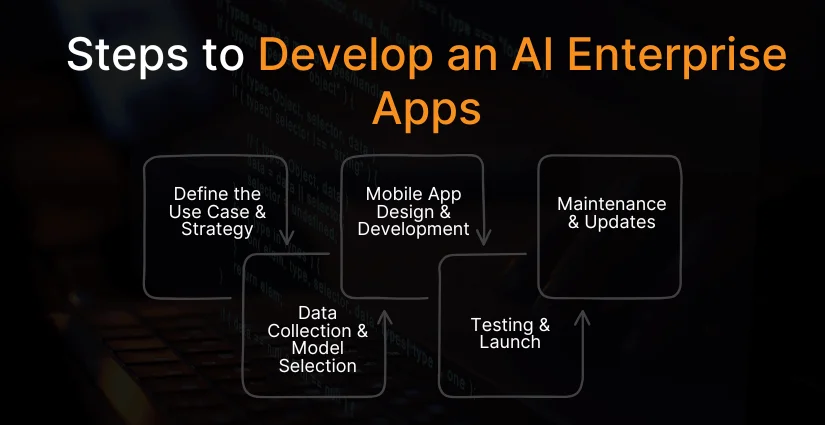
The following is a step-by-step guide to develop an enterprise mobile app list on how to create an AI-driven enterprise mobile application:
Phase 1: Define the Use Case & Strategy
Begin by identifying the precise business issues and opportunities that should be addressed with your app. Identify specific goals and evaluate the ways AI can improve the user experience, increase their engagement, and simplify operations to translate into tangible business results.
Phase 2: Data Collection & Model Selection
Gather quality and relevant information, which captures user behavior, likes, and preferences, as well as the situation. Depending on the objectives, choose available ready-to-use AI models or develop new ones, making sure that they will be accurate, scalable, and adaptable to the functional and business needs of the app.
Phase 3: Mobile App Design & Development
Create a convenient mobile interface where AI-based capabilities are seamlessly integrated with the current functionality. Pay attention to natural navigation, personalization in real time, and the seamless connection of AI functionalities to make the adoption of users comfortable and to provide appealing mobile experiences.
Phase 4: Testing & Launch
Properly ensure AI-driven functions in a controlled setting to identify mistakes, biases, or performance discrepancies. Test and fine-tune models and workflow, and make it reliable so that users can have confidence in the stability and efficiency of the mobile app before it goes to the audience.
Phase 5: Maintenance & Updates
Keep track of the performance of apps through analytics and user feedback. Maintain AI models by updating them to be relevant, improving accuracy, and introduce new features. Constant upgrades will guarantee the success of the apps in the long term, their continued usage, and their suitability to the changing needs of the users.
Conclusion
The future of AI-powered enterprise applications is today, and companies must move swiftly to use AI to achieve efficiency, better decision-making processes, nd customer experiences. The use of AI in enterprise applications should be appropriately planned with a good knowledge of scenarios to guarantee scalability, security, and compliance.

You should take small steps by starting small, building, and scaling in building your next AI-driven enterprise app, and you should create one as you learn. By doing the right thing with the proper assistance of an enterprise app development company, your business will be able to remain ahead of the pack, open new opportunities, and automate workflows into intelligent AI-driven systems.


 Get in Touch
![Enterprise Mobile App Development – Cost and Key Features [2026]](https://d274cmdd0goq94.cloudfront.net/wp-content/uploads/2025/01/Enterprise-Mobile-App-Development–Cost-and-Key-Features-2026.webp)
 By
By June 12, 2026