


The on-demand economy has changed how people shop for their daily needs, and one of the most lucrative digital investments in 2026 is developing a grocery app.
The growth of smartphone use, urbanization, and the popularity of doorstep delivery have both posed a high growth in the cost of the development of grocery apps to both startups and enterprises.
Companies intending to develop a demand-based grocery delivery app must know not only the cost but also the factors that affect the cost of developing the app, scalability, functionality, and ROI in the long run.
Its price is an essential aspect of the grocery mobile app development that can help you make the right choice and choose the appropriate company to develop your grocery delivery app.
Grocery Delivery App: Real-Life Examples in 2026
Grocery delivery services control the rapid-commerce field in 2026. The revenue of grocery delivery apps is anticipated to grow at an annual rate of 8.47% (CAGR 2025-2030), leading to a projected market size of US$514.64 billion by 2030. Meanwhile, the Retail Delivery market is expected to reach a market volume of US$270.33 billion in 2025.
Instacart, Blinkit, Zepto, and Walmart Grocery companies indicate the role of optimized grocery delivery apps development in the generation of recurring revenues.
It is recorded that the apps that promise delivery in 15-30 minutes have 42 percent of users as compared to traditional platforms.
Moreover, companies that invested in state-of-the-art grocery delivery app solution architecture claim to have reduced costs by 30% because of automation and AI-generated inventory solutions.
Alternatively, with the escalating competition, companies are focusing their attention on scalable on demand grocery delivery app development despite the fact that the development cost of grocery delivery app has been escalated owing to AI, cloud infrastructure, and compliance requirements.
Top Business Models Impacting on Grocery App Development Cost
1. Inventory-Based Model
In this model, businesses own and manage inventory directly. This significantly increases grocery app development cost due to warehouse management, inventory software integration, and real-time stock updates.
However, margins are higher. Businesses choosing this model require a robust grocery delivery app solution and advanced analytics, making grocery mobile app development more expensive but profitable in the long term.
2. Marketplace Model
The marketplace model connects vendors with customers. Here, grocery delivery app development cost is moderate because the inventory responsibility lies with sellers.
The grocery app development focuses on vendor onboarding, commission tracking, and logistics integration. This model is widely adopted by startups due to lower upfront grocery delivery app development cost.
3. Hyperlocal Aggregator Model
This model connects nearby stores to customers. On demand app development costs increase due to real-time GPS tracking and local store integrations. However, it reduces logistics expenses.
Businesses often prefer this grocery delivery app solution for faster scalability with controlled grocery app development cost.
How Does Grocery App Work?
A typical grocery delivery app solution operates through a synchronized digital workflow as follows:
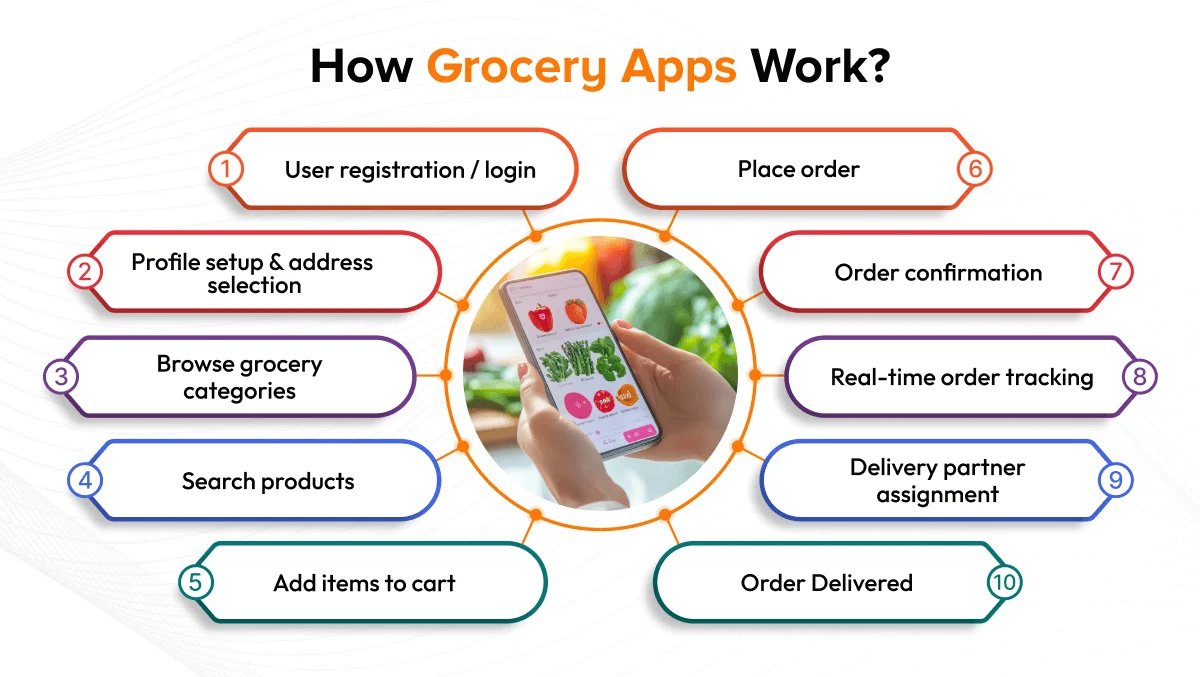
- Users register and browse products via the grocery mobile app development interface
- Stores update real-time inventory through the vendor panel
- Customers place orders and choose delivery slots
- Payment is processed through secure gateways
- Delivery partners receive optimized routes
- Admin monitors performance analytics
This seamless flow directly impacts grocery app development cost because advanced automation reduces operational expenses while improving customer retention.
How Much Does it Cost to Develop a Grocery Delivery App?
The grocery delivery app development cost in 2026 varies based on features, scalability, and technology. Below is a detailed breakdown showing approximate timelines and budgets for different app complexities.
| App Complexity | Timeline | Approximate Budget | Suitable For |
| Simple | 3–4 months | $15,000 – $25,000 | Startups |
| Moderate | 5–6 months | $30,000 – $50,000 | Growing businesses |
| Advanced | 7–9 months | $60,000 – $90,000 | Funded startups |
| Enterprise Grade | 10–12 months | $100,000 – $150,000+ | Enterprises |
Factors Affecting Grocery Delivery App Development Cost
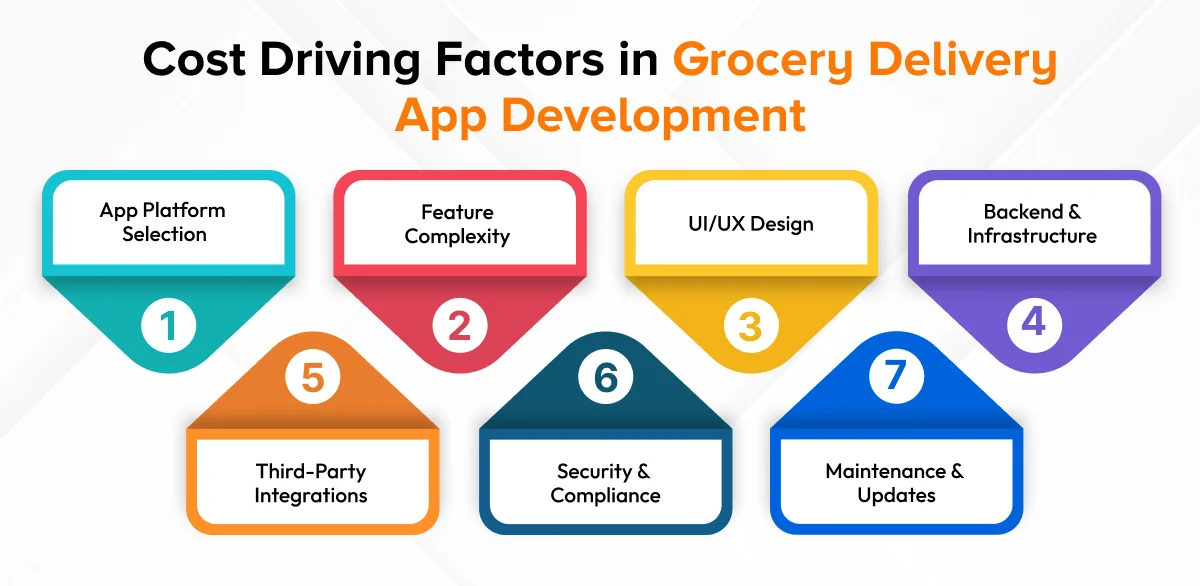
1. App Platform Selection
The platform you choose greatly impacts the overall grocery app development cost. Native Android or iOS development usually costs more than cross-platform solutions.
Cross-platform apps like Flutter or React Native often reduce grocery mobile app development expenses while maintaining near-native performance.
| Platform | Cost Impact | Typical Price Range |
| Android | Medium | $15,000 – $30,000 |
| iOS | Medium | $15,000 – $30,000 |
| Cross-Platform | Lower | $18,000 – $35,000 |
2. Feature Complexity
Features are one of the biggest grocery delivery app development cost drivers. Basic functionality costs less, but adding AI recommendations, multi-language support, or AI chatbot-enabled in-app chat feature raises development complexity and time.
| Feature Level | Cost Impact | Typical Price Range |
| Basic Features | Low | $15,000 – $25,000 |
| Advanced Features | Medium | $30,000 – $50,000 |
| AI-Driven & Predictive | High | $55,000 – $90,000+ |
3. UI/UX Design
Better UI/UX increases app engagement, conversion, and user retention, but also adds to the grocery app development cost. Premium designs, animations, and custom graphics can account for up to 20–30% of total development cost.
| Design Type | Cost Impact | Typical Price Range |
| Standard (Template) | Low | $5,000 – $10,000 |
| Custom UI | Medium | $12,000 – $25,000 |
| Premium UX | High | $25,000 – $40,000+ |
4. Backend & Infrastructure
Backend technology (server setup, cloud integration, microservices) affects scalability and performance. Enterprise-grade backend systems improve reliability but increase grocery delivery app development cost compared to basic servers.
| Backend Type | Cost Impact | Typical Price Range |
| Shared Hosting / Basic | Low | $5,000 – $10,000 |
| Cloud-Based Backend | Medium | $15,000 – $30,000 |
| Microservices / Enterprise | High | $35,000 – $60,000+ |
5. Third-Party Integrations
Payment gateways, location services, CRM tools, and analytics platforms are often essential for modern on demand grocery delivery app development, and each adds to the total price.
| Integration Type | Cost Impact | Typical Add-On Price |
| Payment & Wallet | Medium | $3,000 – $6,000 |
| Maps & GPS | Medium | $2,000 – $5,000 |
| CRM & Analytics | High | $5,000 – $12,000 |
6. Security & Compliance
Securing customer data and meeting regulatory requirements (PCI-DSS, GDPR) is non-negotiable but also impacts grocery delivery app development cost. Prioritizing encryption, multi-factor authentication, and compliance audits ensures long-term trust and avoids penalties.
| Security Level | Cost Impact | Typical Price Range |
| Basic Security | Low | $3,000 – $8,000 |
| Advanced Security | Medium | $10,000 – $20,000 |
| Enterprise-Grade Compliance | High | $25,000 – $45,000+ |
7. Maintenance & Updates
Post-launch support is often underestimated. Regular updates, bug fixes, feature enhancements, and server costs are recurring expenses and a key part of grocery delivery app development cost planning.
| Support Level | Cost Impact | Typical Annual Cost |
| Basic Support | Low | $5,000 – $10,000 |
| Ongoing Support | Medium | $10,000 – $20,000 |
| Dedicated Team | High | $25,000 – $50,000+ |
Key Features to Include in Grocery Delivery Apps
Customer App Features
- User Registration and Profiles
Allows users to sign up quickly, manage personal details, save addresses, set delivery preferences, and enable a personalized shopping experience that improves retention and repeat grocery orders.
- Product Search and Filters
Enables customers to easily find products using categories, keywords, price range, brand, or availability filters, reducing browsing time and improving overall shopping convenience.
- Real-Time Order Tracking
Provides live order status updates from confirmation to delivery, improving transparency, reducing customer anxiety, and increasing trust in the grocery delivery app solution.
- Secure Payments
Supports multiple payment options, including cards, UPI, wallets, and COD with encrypted transactions, ensuring safe, fast, and seamless checkout for customers.
- Order History
Stores past orders, invoices, and reorder options, helping users quickly repeat purchases and track spending patterns, which enhances long-term engagement.
- Push Notifications
Sends real-time alerts for order updates, offers, discounts, and delivery status, keeping users informed and encouraging frequent app usage.
>>>> Read Also:- How to Make Grocery Apps Like Instacart for 2026? <<<<
Admin Panel Features
- Dashboard Analytics
Provides a centralized overview of orders, revenue, user activity, and performance metrics to help admins make data-driven business decisions efficiently.
- Vendor Management
Allows admins to onboard, approve, manage, and monitor multiple vendors, ensuring smooth operations and quality control across the grocery delivery ecosystem.
- Commission Control
Helps admins set and manage commission structures for vendors, ensuring transparent revenue sharing and better profitability management.
- Order Monitoring
Enables real-time tracking of all orders across vendors and delivery partners, helping admins resolve issues quickly and maintain service quality.
- User Management
Allows control over customer and delivery partner accounts, including verification, blocking, or support management for better platform security and governance.
- Report Generation
Generates detailed sales, performance, and financial reports that help evaluate business growth, vendor efficiency, and operational bottlenecks.
Vendor Panel Features
- Inventory Management
Allows vendors to update stock levels in real time, preventing overselling and ensuring customers only order available grocery items.
- Pricing Control
Enables vendors to manage product pricing, discounts, and offers dynamically, helping them stay competitive and maximize sales.
- Order Acceptance
Allows vendors to accept, reject, or prepare orders instantly, ensuring faster order processing and improved delivery timelines.
- Store Analytics
Provides insights into sales performance, popular products, and customer behavior to help vendors optimize inventory and marketing strategies.
- Promotions
Enables vendors to create and manage offers, discounts, and deals to attract more customers and boost order volume.
- Availability Updates
Allows vendors to mark store open or closed and update delivery readiness, ensuring accurate customer expectations and smooth operations.
>>>> Read Also:- How To Develop Apps Like Zepto in 2025: Cost and Features <<<<
Delivery Boy Panel Features
- Order Assignment
Automatically assigns delivery orders based on location, availability, and workload, improving delivery efficiency and reducing delays.
- Route Optimization
Uses GPS-based routing to suggest the fastest delivery paths, saving time, fuel costs, and improving overall delivery performance.
- Earnings Tracking
Displays completed deliveries, incentives, and payouts in real time, helping delivery partners track income transparently.
- Status Updates
Allows delivery personnel to update order status such as picked, on-the-way, or delivered, keeping customers and admins informed.
- Customer Contact
Enables secure in-app calling or messaging between delivery partners and customers for smooth coordination during deliveries.
- Delivery Confirmation
Confirms successful delivery through OTP, signature, or app-based verification, reducing disputes and ensuring order completion accuracy.
Hidden Costs in Grocery Delivery App Development
- Server Scaling and Performance Optimization
As user traffic grows, additional server resources, load balancing, and performance optimization become necessary. These upgrades increase grocery delivery app development cost and are often recurring expenses rather than one-time investments.
- Third-Party API Licensing and Renewals
Payment gateways, map services, analytics tools, and notification services charge recurring fees. These API renewals add hidden grocery delivery app development cost over time, especially as order volume and user base increase.
- Compliance, Security Audits, and Updates
Regular compliance checks for data protection, payment security, and regional regulations require audits and updates. These processes increase on demand grocery delivery app development costs but are critical for avoiding legal penalties.
- Feature Enhancements and App Updates
Customer expectations evolve rapidly, requiring frequent feature upgrades, UI improvements, and bug fixes. These continuous updates add to grocery delivery app development cost long after the initial app launch.
- Customer Support and Operational Tools
Live chat systems, CRM tools, and support staff software subscriptions are essential for handling user queries. These tools contribute ongoing operational expenses often overlooked during initial grocery app budgeting.
Top Ways to Optimize Grocery Delivery App Development
- Cross-Platform Development
Using a single codebase for iOS and Android significantly reduces grocery mobile app development cost by up to 35%, accelerates development timelines, simplifies maintenance, and ensures consistent performance across platforms.
- MVP-Based App Launch
Launching an MVP helps cut grocery app development cost by nearly 40% by focusing on essential features, validating market demand early, and minimizing risks before investing in full-scale development.
- Cloud-Based Infrastructure
Adopting cloud infrastructure lowers operational cost by around 30% by offering scalable resources, reduced server maintenance, better uptime, and flexibility to handle fluctuating user demand efficiently.
- Automation and AI Integration
Automation reduces manpower expenses by up to 45% by streamlining order processing, inventory management, customer support, and delivery assignment, leading to faster operations and improved overall efficiency.
Top Trends in Grocery Delivery Apps in 2026
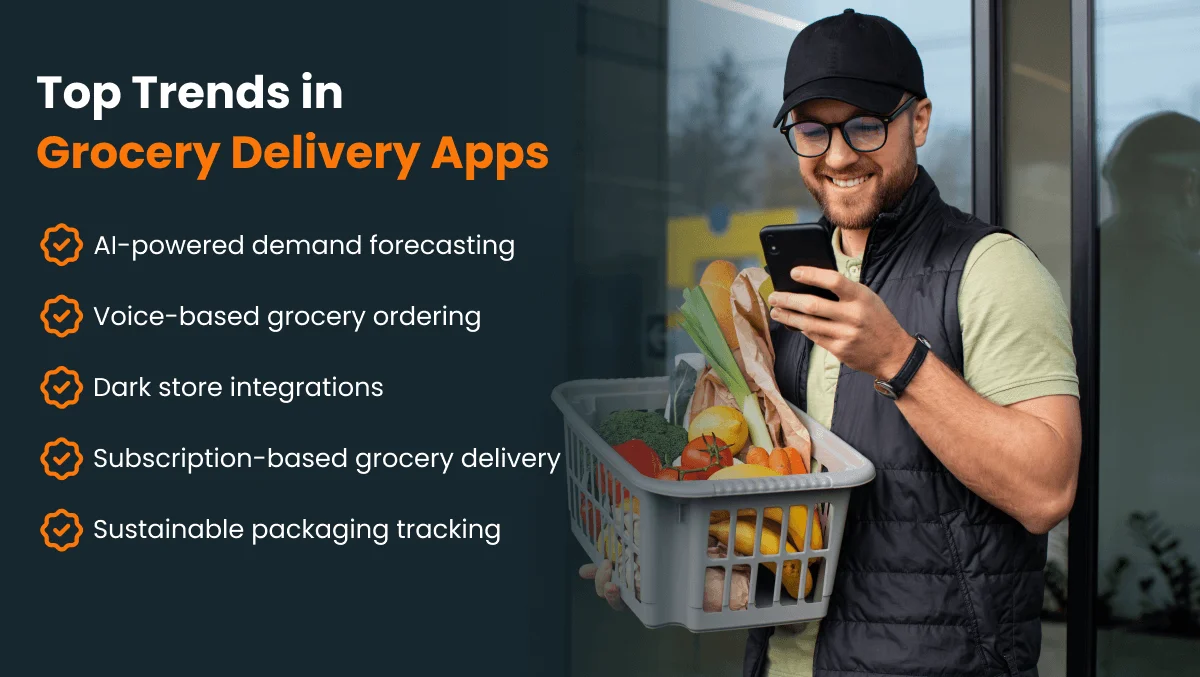
- AI-Powered Demand Forecasting
AI analyzes historical sales, seasonal trends, and customer behavior to predict product demand accurately, helping to start online grocery businesses reduce wastage, optimize inventory levels, and improve order fulfillment efficiency.
- Voice-Based Grocery Ordering
Voice-enabled ordering allows users to add groceries using smart assistants or voice commands, improving accessibility, speeding up shopping, and enhancing convenience for busy, mobile-first customers.
- Dark Store Integrations
Dark stores enable faster order processing by operating fulfillment-only warehouses, helping grocery delivery apps achieve quicker delivery times, better inventory control, and reduced last-mile logistics costs.
- Subscription-Based Grocery Delivery
Subscription models offer scheduled deliveries and exclusive benefits, increasing customer loyalty, predictable revenue, and repeat orders while reducing customer acquisition costs for grocery businesses.
- Sustainable Packaging Tracking
Apps track eco-friendly packaging usage and carbon impact, helping businesses promote sustainability, meet regulatory requirements, and attract environmentally conscious customers.
These trends influence grocery delivery app development cost but boost profitability.
Revenue Models That Generate Sustainable Profits Through Grocery Delivery Apps
- Commission Model
The commission model earns revenue by charging vendors a percentage on every order, making it a popular approach in grocery delivery app solution platforms with consistent transaction-based income.
- Subscription Model
Subscription plans offer premium benefits to customers, generating predictable recurring revenue while helping businesses recover grocery app development cost and improve long-term customer retention.
- Advertisement Model
The advertisement model allows vendors to promote products through sponsored listings and banners, creating high-margin revenue without affecting core grocery delivery operations.
- Delivery Fees
Delivery fees generate income by charging customers based on distance, time, or order value, helping improve profitability while balancing operational and logistics expenses efficiently.
Hire Octal IT Solution For Grocery Delivery App Development Services
Octal IT Solution is a leading grocery delivery app development company with over 18+ years of experience delivering scalable grocery delivery app solution platforms globally. Their expertise in on demand app development ensures optimized performance, security, and ROI.
Why Octal IT Solution?
- 300+ skilled developers
- 98% client satisfaction rate
- 40% faster development cycles
- 30% reduced grocery app development cost
- Delivered 150+ successful grocery mobile app development projects
Conclusion
In 2026, clearly understanding grocery app development cost is crucial for businesses aiming to build scalable, high-performing, and profitable grocery delivery platforms.
As competition in the on-demand grocery market intensifies, companies must carefully evaluate development expenses, feature requirements, and long-term operational investments.
Factors such as platform selection, feature complexity, integrations, security, and scalability directly influence overall grocery delivery app development cost.
Choosing the right development approach and technology stack ensures not only faster time-to-market but also future-ready growth.
Partnering with an experienced grocery delivery app development company plays a vital role in controlling costs, avoiding hidden expenses, and implementing best practices from the start.
With the right strategy, optimized architecture, and a reliable development partner, businesses can effectively minimize grocery delivery app development cost while delivering seamless user experiences, improving customer retention, and maximizing long-term revenue and sustainable business growth.
FAQs
The average grocery app development cost in 2026 typically ranges from $15,000 for basic apps to $150,000+ for enterprise-grade platforms, depending on features, technology stack, and scalability requirements.
Grocery delivery app development usually takes between 3 to 12 months, depending on app complexity, number of features, integrations, testing cycles, and customization needs.
Yes, grocery mobile app development can be easily scaled later using cloud-based and modular architecture, allowing businesses to add features, support more users, and expand operations seamlessly.
On demand grocery delivery app development is highly profitable when combined with strong revenue models like subscriptions, commissions, ads, and delivery fees, along with optimized logistics and customer retention strategies.
Octal IT Solution is a trusted grocery delivery app development company known for delivering secure, scalable, and high-performing grocery app solutions backed by extensive industry experience and global client success.
Essential features include user-friendly navigation, real-time order tracking, secure payments, inventory management, push notifications, and admin analytics to ensure smooth operations and high customer satisfaction.
App complexity directly impacts grocery delivery app development cost, as advanced features, third-party integrations, and custom UI/UX require more development time, resources, and ongoing maintenance.
Yes, cross-platform development is ideal for grocery mobile app development as it reduces development cost, shortens time-to-market, and ensures consistent performance across Android and iOS platforms.
Ongoing maintenance typically costs 15–20% of the initial grocery app development cost annually, covering server hosting, security updates, feature enhancements, and technical support.
Yes, grocery delivery apps can be integrated with POS systems, inventory software, payment gateways, and CRM tools to streamline operations and improve real-time data synchronization.


 Get in Touch
 By
By January 20, 2026
![Grocery List App Development – Cost and Key Features [2026]](https://d274cmdd0goq94.cloudfront.net/wp-content/uploads/2022/04/Grocery-List-App-Development-1.png)