




Key Takeaways: What You’ll Discover in This Guide
The guide will provide detailed information which you need to know before you invest hundreds of thousands into mobile app development for 2026.
- The Real Cost of App Development in 2026 from $20,000 MVPs to $500,000+ enterprise platforms
- The mobile app development cost breakdown shows your budget allocation for design backend testing cloud services and maintenance costs
- The Platform Comparison shows cost differences between iOS Android and Cross-Platform systems
- The Regional Pricing Insights show how development costs differ between North America Europe and Asia and other regions
- The Industry Estimates show expected costs for fintech applications healthcare applications e-commerce applications gaming applications and enterprise applications
- The Hiring Model Comparison shows which hiring option provides better value between freelancers and in-house employees and offshore teams
- The Hidden Costs of app development include app store fees cloud hosting costs API subscription fees and marketing expenses
- The ROI and Break-Even Timeline shows how long it takes to recover your investment
- The Cost Estimation Framework provides you with practical methods to calculate your app budget
- The Cost-Saving Strategies help you reduce development costs while maintaining product quality.
The guide will teach you both the application cost and the reasons behind that cost together with investment strategies for obtaining maximum returns.
Why Does Mobile App Development Cost Matter in 2026?
Mobile application development cost matters in 2026 because apps have become core business assets not optional digital tools. Development requires financial planning because user expectations have increased and advanced technologies such as AI and IoT and data security regulations have become more stringent.
Understanding costs helps businesses:
- Set realistic budgets
- Businesses need to control project scope to prevent additional expenses.
- A app development company should design its system capabilities from the initial stage of development.
- Organizations must develop security measures that meet regulations and security standards.
- The company needs to calculate its return on investment and the time required to reach break-even point.
You can develop a competitive app which meets high standards because you understand the actual development costs.
Top 2026 Mobile App Development Trends and Numbers
The mobile app industry experiences rapid growth throughout 2026 because smartphone usage increases and users spend more money on in-app purchases and companies embrace digital transformation. Businesses choose to invest in app development because these numbers demonstrate its strategic importance to their operations:
- The global mobile app market is projected to reach around $305–$330 billion in 2026, with continued strong growth through 2031.
- Mobile users worldwide are spending more time using applications, which will result in billions of hours being used each year by 2026 according to forecasts.
- Google Play is expected to see over 140 billion app downloads in 2026 while the Apple App Store may reach around 38 billion downloads in the same period.
- The market will see many new applications in 2026 which will use advanced technologies like artificial intelligence and cross-platform frameworks and low-code/no-code tools to enable businesses to develop products more quickly and create innovations at a faster pace.
The Average Cost of Mobile App Development in 2026
The process of determining app development expenses for 2026 requires knowledge that no fixed pricing exists for this service. The total cost depends on multiple factors which include project complexity, selected platforms, backend system needs, required integration work, and design and user experience standards.
The costs of app development divide into four principal categories which range from basic minimum viable products to full enterprise solutions. Below is a clear, detailed mobile app development cost breakdown to help you realistically estimate your budget.
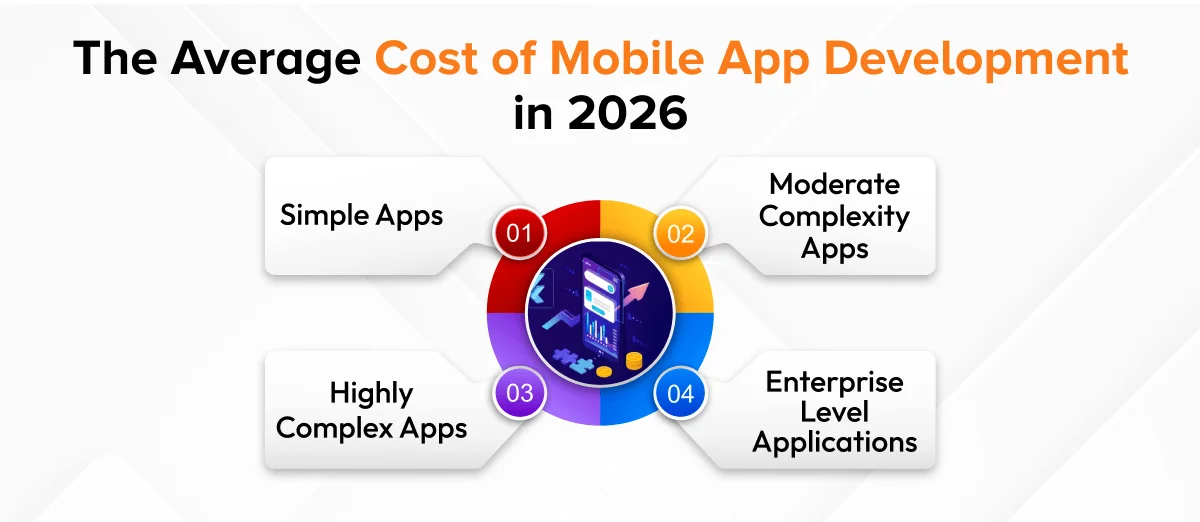
Simple Apps
Cost Range: $20,000 – $50,000
Estimated Timeline: 2–3 months
Simple apps are ideal for businesses testing an idea or launching a basic utility app. These apps operate with a basic design and need only essential backend functions to support their limited features.
Typical Features:
- Few screens
- Basic UI/UX
- Static content
- Login (optional)
- No real-time sync or complex backend
Examples:
- Calculator
- Basic company info app
- Simple to-do list
These apps are usually built as an MVP (Minimum Viable Product) — enough to get the product into the hands of early users quickly and at a low cost.
Moderate Complexity Apps
Cost Range: $50,000 – $150,000
Estimated Timeline: 3–6 months
Most consumer apps fall into this category. These applications need backend services and API integrations, and they usually provide user account support, cloud synchronization, and basic real-time capabilities.
Typical Features:
- User registration & login
- Customer dashboard
- Push notifications
- Admin panel
- Payment integration
- Third-party APIs (Maps, SMS, etc.)
Examples:
- Fitness tracking apps
- E-commerce storefront
- On-demand booking apps
Startups and SMBs who want to create a product that can grow better through moderate apps that provide real business value to their operations.
Highly Complex Apps
Cost Range: $150,000 – $300,000
Estimated Timeline: 6–9 months
The applications demand advanced capabilities which include real-time communication and personalized backend systems and complex user interface design. The applications need to handle multiple users simultaneously because they need to deliver high-speed performance throughout their operations.
Typical Features:
- Real-time chat or GPS tracking
- Gamification elements
- AI / ML integration
- Advanced analytics dashboard
- Data encryption
- Microservices architecture
Examples:
- Ride-sharing apps
- Social networking platforms
- Real-time collaboration tools
The development process for highly complex applications requires both extensive resources and careful strategic planning because their success depends on their ability to perform efficiently at scale.
Enterprise-Level Applications
Cost Range: $250,000 – $500,000+
Estimated Timeline: 9–15 months
Enterprise apps serve as tailored software solutions which organizations use to achieve their operational requirements while maintaining top security standards and system availability and industry-specific compliance.
Typical Features:
- Role-based access control
- SSO (Single Sign-On) and advanced authentication
- Complex workflows
- Data analytics & BI modules
- Integration with legacy systems
- High availability and clustering
Examples:
- ERP mobile apps
- Insurance & healthcare enterprise solutions
- Large-scale fintech platforms
The project demands multiple departments which need project managers who will coordinate efforts between UI/UX designers and frontend and backend architects and QA engineers and DevOps specialists.
App Development Cost By Platform
In 2026 mobile application development cost estimates depend mainly on the choice of platform. Your choice between iOS, Android, cross-platform, and web-based development will determine your financial resources, project execution timeline, and scalability potential. If you plan to hire Android app developers, it can further influence your overall budget depending on expertise level, location, and development approach.
Different platforms provide various development resources and testing procedures and performance standards and ongoing support expenses. The following section provides an extensive cost analysis.
iOS App Development Cost (Swift, Objective-C, Xcode)
Estimated Cost Range (2026):
- Simple App: $40,000–$70,000
- Medium App: $70,000–$180,000
- Complex App: $180,000–$300,000+
iOS apps are built using Swift or Objective-C within the Xcode development environment.
Why iOS Development May Cost More?
- Strict design and performance standards
- Higher-quality UI/UX expectations
- Thorough App Store review process
- Optimized performance for Apple devices
Advantages
- Higher revenue per user
- Strong security standards
- Premium user base
- Lower device fragmentation compared to Android
Cost Considerations
Although iOS development may seem slightly higher initially, testing costs are often lower due to fewer device variations. However, Apple’s approval process may increase launch timelines if revisions are required.
iOS is ideal for:
- Premium consumer apps
- Fintech solutions
- Healthcare apps
- Subscription-based platforms
Android App Development Cost (Kotlin, Java)
Mobile Application Development Cost Estimate Range (2026):
- Simple App: $35,000–$60,000
- Medium App: $60,000–$160,000
- Complex App: $160,000–$280,000+
Android apps are primarily developed using Kotlin or Java.
Why does Android Mobile App Development Cost Vary?
- Large number of device types and screen sizes
- More extensive testing required
- Performance optimization across hardware levels
Advantages
- Global market dominance (~70% share)
- Ideal for emerging markets
- Greater flexibility in deployment
Mobile App Development Cost Considerations
Android development can require more QA testing due to device fragmentation. However, publishing is easier and faster compared to iOS.
Android is ideal for:
- Mass-market consumer apps
- E-commerce platforms
- On-demand services
- Emerging market penetration
Cross-Platform App Development Cost (React Native, Flutter, Xamarin)
Estimated Cost Range (2026):
- Simple App: $30,000–$55,000
- Medium App: $55,000–$150,000
- Complex App: $150,000–$250,000
Cross-platform apps use frameworks like:
- React Native
- Flutter
- Xamarin
These allow developers to write one codebase and deploy it across both iOS and Android.
Why Is Cross-Platform Cost-Effective?
- Shared code reduces development time by 30–40%
- Lower maintenance cost
- Faster time-to-market
Limitations
- May not match native performance for highly complex apps
- Advanced device-specific features may require native modules
Cross-platform development is ideal for:
- Startups launching MVPs
- Budget-conscious businesses
- Apps without heavy graphics or hardware dependency
Progressive Web Apps (PWAs): Are They Cheaper?
Estimated Cost Range (2026): $15,000–$80,000
Progressive Web App development cost are web-based applications that behave like native apps but run through a browser.
Why Are PWAs Cheaper?
- Single web-based codebase
- No app store submission fees
- Faster development cycle
Limitations
- Limited access to device hardware features
- Performance may not match native apps
- Lower user engagement compared to native apps
PWAs are suitable for:
- E-commerce stores
- Content platforms
- Businesses testing digital presence before investing in full app development

Hybrid vs Native App Development: Cost Comparison
Understanding the difference between hybrid and native apps is critical for budgeting.
Native Apps
Built separately for iOS and Android using platform-specific languages.
Pros:
- Best performance
- Superior UX
- Full hardware access
- Better scalability
Cons:
- Higher development cost
- Separate codebases
- Higher maintenance cost
Native is ideal for:
- Gaming apps
- High-performance fintech apps
- AR/VR applications
- Large-scale enterprise solutions
Hybrid Apps
Built using web technologies and wrapped inside a native container.
Pros:
- Lower cost
- Faster development
- Single codebase
Cons:
- Lower performance
- Limited customization
- Not ideal for highly complex apps
Hybrid works best for:
- Internal business apps
- Basic consumer apps
- Budget-constrained projects
How Much Does It Cost to Build an On-Demand or Service App in 2026?
Estimated Cost (2026): $70,000 – $250,000
Timeline: 4–8 months
On-demand apps connect users with service providers in real time. These apps typically require GPS tracking, live updates, payment integration, and multi-role dashboards (admin, user, service provider).
Common Features:
- Real-time location tracking
- Booking & scheduling
- Payment gateway integration
- Push notifications
- Rating & review system
- Admin management panel
Examples: Ride-sharing, food delivery, home services.
Costs increase if the app requires real-time tracking, route optimization, surge pricing logic, or high scalability.
Healthcare & Telemedicine Apps
Estimated Cost (2026): $80,000 – $300,000+
Timeline: 5–10 months
Healthcare apps demand strict compliance with data protection regulations (HIPAA, GDPR, etc.), making security a major on demand app development cost factor.
Common Features:
- Video consultation
- Electronic health records (EHR) integration
- Secure messaging
- Appointment scheduling
- Prescription management
- Data encryption
Advanced security measures, audit logs, and regulatory certifications significantly increase cost.
E-Commerce & Marketplace Apps
Estimated Cost (2026): $60,000 – $200,000
Timeline: 4–7 months
E-commerce apps require robust backend infrastructure to handle transactions, inventory, and large user traffic.
Common Features:
- Product catalog
- Shopping cart
- Secure payments
- Order tracking
- Inventory management
- Multi-vendor support (for marketplaces)
Marketplace models cost more due to vendor dashboards and commission management systems.
Educational & E-Learning Apps
Estimated Cost (2026): $50,000 – $180,000
Timeline: 3–6 months
E-learning apps focus on content delivery, progress tracking, and engagement.
Common Features:
- Video streaming
- Interactive quizzes
- Progress analytics
- Certification modules
- Subscription models
- LMS integration
Costs rise if the app includes live classes, gamification, or AI-based adaptive learning.
Fintech & Banking Apps
Estimated Cost (2026): $100,000 – $400,000+
Timeline: 6–12 months
Fintech apps are among the most expensive due to security, compliance, and transaction infrastructure.
Common Features:
- Secure login & biometric authentication
- Payment processing
- Transaction history
- Fraud detection
- Encryption protocols
- Regulatory compliance
Integration with banking APIs and anti-fraud systems adds complexity and cost.
Social Networking Apps
Estimated Cost (2026): $90,000 – $350,000+
Timeline: 6–10 months
Social platforms require scalable backend systems to handle large user volumes and real-time engagement.
Common Features:
- User profiles
- Content sharing
- Real-time messaging
- Push notifications
- News feeds
- Content moderation tools
Mobile application development costs increase significantly when implementing AI-driven content recommendations and live streaming features.
Travel & Hospitality Apps
Estimated Cost (2026): $60,000 – $200,000
Timeline: 4–7 months
Travel apps integrate with third-party APIs for booking, maps, and pricing data.
Common Features:
- Booking engine
- Real-time availability
- Map integration
- Payment gateway
- Reviews & ratings
Costs increase with dynamic pricing systems and global payment integration.
Gaming Apps
Estimated Cost (2026): $100,000 – $500,000+
Timeline: 6–12 months
Gaming apps are highly resource-intensive due to graphics design, animation, and real-time rendering.
Cost Factors:
- 2D vs 3D graphics
- Multiplayer functionality
- Game engine licensing
- In-app purchases
- Cloud gaming integration
AAA-level games can exceed $1 million in development cost.
IoT-Enabled Apps
Estimated Cost (2026): $120,000 – $400,000
Timeline: 6–9 months
IoT apps connect with smart devices, sensors, or wearables. They require real-time data processing and secure device communication.
Common Features:
- Device pairing
- Data monitoring dashboard
- Cloud storage
- Remote control functionality
- Firmware updates
Hardware compatibility testing significantly increases cost.
Enterprise & B2B Solutions
Estimated Cost (2026): $200,000 – $500,000+
Timeline: 9–15 months
Enterprise apps are large-scale systems built for internal operations or B2B platforms.
Common Features:
- Role-based access control
- Workflow automation
- CRM/ERP integration
- Advanced reporting
- Data encryption
- High-availability architecture
These apps require deep backend customization and integration with legacy systems, making them among the most expensive to build.
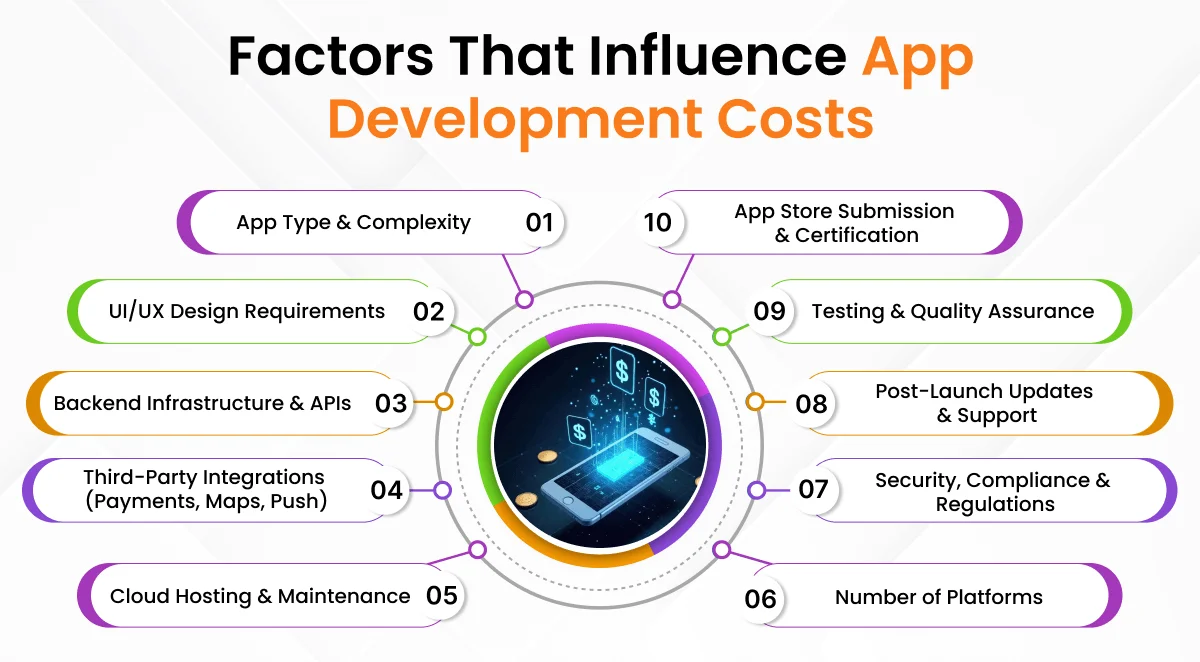
Factors That Influence Mobile Application Development Cost
App development cost in 2026 is not determined by a single factor. It is the result of multiple technical, operational, and strategic decisions. Below are the key elements that directly impact your overall budget.
App Type & Complexity
The type of app you build is the biggest cost determinant.
Simple Apps
Basic apps with limited features such as login, static content, and simple forms cost less because they require minimal backend logic.
Medium-Complexity Apps
Apps with real-time features, payment integration, dashboards, and user roles require more development hours and backend configuration.
Complex Apps
Enterprise platforms, AI-enabled apps, social networks, IoT-connected systems, and fintech solutions demand advanced architecture, scalability planning, and higher security standards.
The more workflows, user roles, and automation logic you add, the more development time and cost increase.
UI/UX Design Requirements
In 2026, users expect polished, intuitive, and interactive design.
Costs increase when:
- Custom animations are required
- Advanced micro-interactions are implemented
- Brand-specific design systems are created
- Accessibility compliance is needed
- Extensive user research and prototyping are conducted
A basic template-based mobile app design cost is affordable. A fully custom, experience-driven interface requires more design hours and usability testing.
Backend Infrastructure & APIs
Backend systems power your app’s performance, scalability, and data management.
Cost factors include:
- Custom server architecture
- Database structure complexity
- Real-time data synchronization
- API development
- Microservices implementation
- Admin dashboard creation
Apps handling large data volumes or real-time operations require stronger infrastructure, increasing cost.
Third-Party Integrations (Payments, Maps, Push)
Modern apps rarely function in isolation. They integrate with external services such as:
- Payment gateways
- Map and geolocation services
- Push notification services
- Analytics tools
- Social login APIs
- CRM or ERP systems
Each integration requires configuration, testing, and sometimes custom development. Licensing or transaction fees may also apply, adding to long-term costs.
Cloud Hosting & Maintenance
Cloud infrastructure supports scalability and uptime.
Mobile App Development Cost depends on:
- Server size and traffic load
- Storage requirements
- Backup systems
- CDN usage
- Auto-scaling configuration
In 2026, most apps use cloud-native environments with DevOps automation, which improves efficiency but adds operational setup costs.
Ongoing maintenance, monitoring, and server optimization also require budget allocation.
Number of Platforms
Developing for multiple platforms increases cost.
- iOS only → Lower cost
- Android only → Similar cost
- Both platforms separately → Higher cost
- Cross-platform → Moderate cost
- Web + Mobile ecosystem → Highest cost
Even with cross-platform frameworks, platform-specific customization and testing add extra development effort.
Security, Compliance & Regulations
Security is no longer optional.
Cost increases when your app requires:
- End-to-end encryption
- Biometric authentication
- Multi-factor authentication
- GDPR compliance
- HIPAA compliance
- Financial regulatory adherence
- Secure cloud architecture
Compliance-heavy industries like healthcare and fintech significantly raise development costs due to legal and security audits.
Post-Launch Updates & Support
App development does not end at launch.
Ongoing costs include:
- Bug fixes
- OS updates compatibility
- Feature enhancements
- Performance optimization
- Security patches
- Customer support
Annual maintenance typically ranges from 15%–25% of the initial development cost.
Testing & Quality Assurance
Comprehensive testing ensures app stability and performance.
Testing includes:
- Functional testing
- Performance testing
- Security testing
- Cross-device testing
- Regression testing
- Automation testing
Apps targeting global audiences or high traffic require extensive QA cycles, increasing total cost.
App Store Submission & Certification
Launching an app involves more than uploading it to the store.
Costs may include:
- Apple Developer Program fee
- Google Play Developer fee
- Compliance documentation
- Privacy policy creation
- App Store Optimization (ASO)
- Certification processes (if required)
Apps in regulated industries may require additional certification, increasing submission-related expenses.
App Development Cost by Region in 2026
Mobile app development cost varies widely by geography due to differences in labor rates, expertise availability, infrastructure support, and economic conditions. Below is a clear regional mobile app development cost breakdown in 2026.
North America (USA & Canada)
Hourly Rates: $100 – $180+
Project Costs: $120,000 – $500,000+
North America remains one of the most expensive regions for app development, with the mobile app development cost in UK being significantly higher due to elevated labor rates and premium technical expertise. However, the region consistently delivers top-tier quality, strong project management, and deep domain knowledge, making it ideal for enterprise-level solutions and mission-critical applications.
Best for:
- Enterprise and B2B applications
- Fintech and healthcare apps
- Complex, scalable solutions
Europe (UK, Germany, France, Eastern Europe)
Hourly Rates: $70 – $150 (Western)
Hourly Rates: $40 – $90 (Eastern)
Project Costs: $80,000 – $350,000+
Europe offers a balance of quality and cost, with Western Europe charging higher rates similar to North America, and Eastern Europe providing cost-effective high-skill developers.
- UK, Germany, France → higher hourly rates, strong standards
- Eastern Europe (Poland, Ukraine, Romania) → more affordable without quality compromise
Best for:
- Mid to large enterprise apps
- Cloud-native solutions
- Cross-platform and native development
Asia Pacific (India, China, Japan, South Korea)
Hourly Rates: $25 – $90
Project Costs: $40,000 – $250,000+
Asia Pacific offers some of the most competitive development rates, particularly in India and parts of Southeast Asia. China, Japan, and South Korea trend higher due to demand and local market sophistication.
- India → lowest regional rates with growing expertise
- China / Japan / South Korea → higher rates but strong technical talent
Best for:
- MVPs and startups
- Cross-platform and hybrid apps
- Offshore dedicated teams
Middle East & Africa
Hourly Rates: $30 – $80
Project Costs: $50,000 – $200,000+
Development markets in the Middle East and Africa are emerging and growing. Costs remain moderate, and local talent pools are expanding rapidly, especially in tech hubs like UAE, Egypt, and South Africa.
Best for:
- Local and regional enterprise apps
- Government digital services
- Mobile initiatives with public sector focus
Latin America
Hourly Rates: $35 – $90
Project Costs: $50,000 – $220,000+
Latin America has become a popular nearshore option for North American clients due to time zone alignment, cultural fit, and competitive pricing. Brazil, Mexico, and Argentina are key tech centers.
Best for:
- Nearshore development
- Mid-complexity solutions
- Cross-platform apps
Cost Comparison by Region: Hourly & Project Rates
| Region | Hourly Rate (USD) | Typical Project Cost |
| North America | $100 – $180+ | $120K – $500K+ |
| Western Europe | $70 – $150 | $90K – $350K |
| Eastern Europe | $40 – $90 | $70K – $250K |
| Asia Pacific | $25 – $90 | $40K – $250K |
| Middle East & Africa | $30 – $80 | $50K – $200K |
| Latin America | $35 – $90 | $50K – $220K |

App Developer Hiring Costs Explained for 2026
Your hiring model significantly impacts app development cost, project control, speed, and quality.
Freelancers vs In-House Developers
Freelancers
- Pros: Lower hourly rates, flexible contracts
- Cons: Less accountability, possible communication gaps, limited collaboration
In-House Developers
- Pros: Full control, deep specialization, better alignment with business goals
- Cons: Higher fixed costs, HR overhead, long-term commitments
Best Use Cases:
- Freelancers → small projects, prototypes, short tasks
- In-House → product teams, long-term product roadmaps, mission-critical systems
Offshore Development Teams
Offshore teams consist of dedicated developers from external regions (Asia, Eastern Europe, LATAM) managed remotely.
Advantages:
- Cost savings (30–60% vs local hires)
- Access to large talent pools
- Flexible scaling
Challenges:
- Time zone coordination
- Cultural communication differences
- Quality oversight (needs strong PM)
Best For: Startup MVPs, product scaling, long-term development pipelines
Dedicated Team vs Fixed-Bid Projects
Dedicated Team
You hire a full team (developers, QA, designers, PM) for as long as needed.
Pros:
- High flexibility
- Adaptive to changing requirements
- Good for long-term products
Cons:
- Monthly fees may add up
- Requires active project management
Fixed-Bid Project
You agree to a fixed price for defined deliverables.
Pros:
- Budget certainty
- Clear scope upfront
Cons:
- Less flexibility for scope changes
- Rigid timelines
- Change requests can cost extra
Some Most Popular Global Apps and Their Estimated Development Cost
Below is a realistic overview of what it would cost in today’s app market standard to build apps similar to some of the world’s most popular mobile products. These are ballpark mobile application development cost estimate based on complexity, infrastructure needs, and typical development effort required for similar features.
Category: Social Networking & Media
Estimated Budget: $100,000 – $300,000+
Estimated Timeline: 9–12 months
Team Size: 6–10 developers + designers + QA + PM
Instagram-like apps require:
- Real-time feed updates
- Stories & Reels
- Photo/video uploads and filters
- Messaging and push notifications
- Scalable backend for millions of users
Cost range reflects strong backend infrastructure and UI/UX sophistication.
Uber
Category: On-Demand Ride-Hailing
Estimated Budget: $100,000 – $250,000+
Estimated Timeline: 9–14 months
Team Size: 7–12 developers + QA + PM
Uber-style platforms have separate user and driver apps, GPS navigation, real-time tracking, fare calculation, payment gateway integration, and admin dashboards — all requiring tight synchronization and strong server scalability.
TikTok
Category: Short-Form Video Platform
Estimated Budget: $150,000 – $300,000+
Estimated Timeline: 10–16 months
Team Size: 8–14 developers + AI/ML engineers + designers
Complexity comes from:
- High-performance video processing
- AI-driven recommendation engine
- Real-time editing tools
- Effects and AR filters
- Live streaming capabilities
Developing a highly engaging TikTok-like app requires advanced video infrastructure and significant engineering investment.
Category: Instant Messaging
Estimated Budget: $100,000 – $250,000+
Estimated Timeline: 8–12 months
Team Size: 6–10 developers + security experts
A WhatsApp-style app needs:
- End-to-end encryption
- Real-time message sync
- Voice & video calls
- Group chats and media sharing
- Reliable backend servers
Security and real-time performance are key cost drivers here.
Netflix
Category: Video Streaming / Entertainment
Estimated Budget: $200,000 – $500,000+
Estimated Timeline: 12–18 months
Team Size: 8–15 developers + CDN & streaming experts
Building a Netflix-like streaming app entails:
- Content delivery network (CDN) integration
- Secure subscription management
- Multi-profile support
- 4K & device-adaptive streaming
- Offline downloads & recommendation engine
Streaming at scale increases backend and licensing costs significantly.
Amazon
Category: E-Commerce Marketplace
Estimated Budget: $300,000 – $500,000+
Estimated Timeline: 10–16 months
Team Size: 10–18 developers + QA + data engineers
Supporting features include:
- Product search & filters
- Large catalog management
- Secure payments & checkout
- Order tracking
- Inventory and seller dashboards
- Recommendation engine
Because of the many user roles and integrations (logistics, payments, analytics), e-commerce marketplaces are among the most complex and expensive apps to build.
How to Accurately Estimate Mobile App Development Cost?
Estimating app development cost accurately in 2026 requires more than guessing a number or comparing competitor budgets. A structured, data-driven approach helps you prevent cost overruns, allocate resources effectively, and build a realistic financial roadmap.
Below is a practical framework you can use to calculate your app budget with confidence.
Using Cost Estimation Formulas
A simple yet effective formula for estimating development cost is:
Total App Cost = Total Development Hours × Hourly Rate
However, to improve accuracy, you should expand the formula:
Total App Cost = (Design Hours + Frontend Hours + Backend Hours + QA Hours + Project Management Hours) × Hourly Rate + Infrastructure Costs + Third-Party Costs
You may also use this expanded formula:
Total Cost = Base Development Cost + Maintenance (15–25%) + Cloud & Licensing + Marketing
For example:
- Total development hours: 1,200
- Average hourly rate: $50
- Development cost = $60,000
- Maintenance (20%) = $12,000
- Cloud & tools = $8,000
Estimated total = $80,000
This structured approach avoids underestimating hidden expenses.
How to Estimate Man-Hours
Accurate cost estimation depends heavily on calculating man-hours correctly.
Step 1: Break the App into Features
List every feature:
- Login & authentication
- Dashboard
- Payment integration
- Chat system
- Admin panel
- Notifications
Step 2: Assign Estimated Hours per Feature
For example:
- Authentication: 40–60 hours
- Payment gateway: 60–80 hours
- Real-time chat: 120–150 hours
- Admin panel: 100–140 hours
Step 3: Add Development Phases
Include:
- UI/UX design
- Frontend development
- Backend development
- API integrations
- QA testing
- Deployment
Step 4: Add Buffer Time (10–20%)
Unexpected changes, revisions, and debugging require extra hours.
If total estimated time is 1,000 hours, add a 15% buffer:
1,000 + 150 = 1,150 total hours
This prevents unrealistic budgeting.
Top App Cost Estimation Tools for Accurate Budgeting
Several tools help streamline cost estimation:
1. Project Management Tools
- Jira
- Trello
- Asana
These help break down features into tasks and assign estimated hours.
2. Time Tracking Tools
- Harvest
- Clockify
These track real development time for better future forecasting.
3. Cost Estimation Calculators
Many development companies provide online mobile app development cost calculator that generate approximate budgets based on:
- Platform selection
- Feature selection
- Industry type
- Complexity level
While these tools provide rough numbers, they should be combined with technical consultation for accuracy.
How to Forecast Maintenance & Support Costs?
Many founders underestimate post-launch expenses.
Typically, annual maintenance costs range between 15% and 25% of the initial development cost.
Maintenance includes:
- Bug fixes
- OS compatibility updates
- Security patches
- Feature enhancements
- Server optimization
- Customer support
Example:
If your app cost $100,000 to build:
- Annual maintenance may range between $15,000 – $25,000.
You should also forecast:
- Cloud hosting fees (monthly recurring)
- Database scaling
- Analytics tools subscription
- Marketing & user acquisition
Planning for at least 2–3 years of operational cost ensures sustainability.
How Can You Reduce App Development Cost Without Compromising Quality?
Reducing mobile app development cost does not mean cutting corners. It means making smart technical and strategic decisions that eliminate waste, optimize resources, and focus only on value-generating features.
In 2026, successful startups and enterprises reduce costs by improving efficiency not by sacrificing quality.
Below are proven strategies that help control your budget while maintaining high standards.
Start with an MVP (Minimum Viable Product)
An MVP focuses only on core functionality required to solve the primary user problem.
Instead of building 25 features at once, you launch with 5–7 essential ones.
Why This Reduces Cost:
- Lower development hours
- Faster time to market
- Reduced initial testing scope
- Early revenue validation
Example:
Instead of launching a full marketplace with analytics, reviews, loyalty programs, and AI recommendations, start with:
- User registration
- Product listing
- Add to cart
- Payment gateway
- Order tracking
Once validated, expand gradually.
MVP strategy can reduce initial cost by 30–50%.
Reuse Open-Source & Ready-Made Templates
Not every component needs to be built from scratch.
Using:
- Open-source libraries
- Pre-built UI kits
- Authentication frameworks
- Payment SDKs
- Backend boilerplates
saves development time significantly.
Cost Advantage:
Custom-built systems take longer and require more testing. Reusing stable frameworks accelerates development while maintaining quality and security (if properly selected).
However, ensure:
- Regular updates
- Active community support
- Security compliance
This strategy reduces engineering hours without compromising performance.
Opt for Cross-Platform Development
Instead of building separate apps for iOS and Android, use cross-platform frameworks like:
- React Native
- Flutter
Why It Reduces Cost:
- Single codebase
- Reduced development duplication
- Unified maintenance
- Faster updates
Cost savings can range between 20–40% compared to native dual-platform development.
Best suited for:
- MVPs
- Startups
- Budget-conscious businesses
- Apps without heavy device-level processing
Prioritize Features With ROI Potential
Not every feature drives revenue.
Before development, categorize features into:
- Must-have (core value)
- Revenue-driving
- Nice-to-have
- Future roadmap
Focus budget on:
- Monetization features
- Conversion optimization
- User retention mechanisms
Avoid early investment in:
- Complex animations
- Rarely used advanced features
- Experimental add-ons
Strategic prioritization ensures the budget is allocated where business returns are highest.
Outsource to Cost-Effective Regions
Development rates vary significantly across regions.
Hiring teams in cost-effective regions can reduce project expenses by 30–60% while maintaining quality.
Benefits include:
- Access to large talent pools
- Flexible engagement models
- Faster scaling
However, success depends on:
- Clear documentation
- Strong project management
- Defined communication processes
Choosing experienced offshore partners ensures cost savings without compromising deliverables.
Focus on Efficient UI/UX
Good design does not always mean expensive design.
Smart UI/UX planning can:
- Reduce user confusion
- Lower support costs
- Improve retention
- Minimize redesign expenses
Avoid:
- Overcomplicated navigation
- Excessive animation layers
- Frequent design revisions
Instead:
- Create wireframes first
- Validate through prototypes
- Conduct small user testing rounds
Efficient UI planning reduces rework, which is one of the biggest hidden cost drivers in app development.
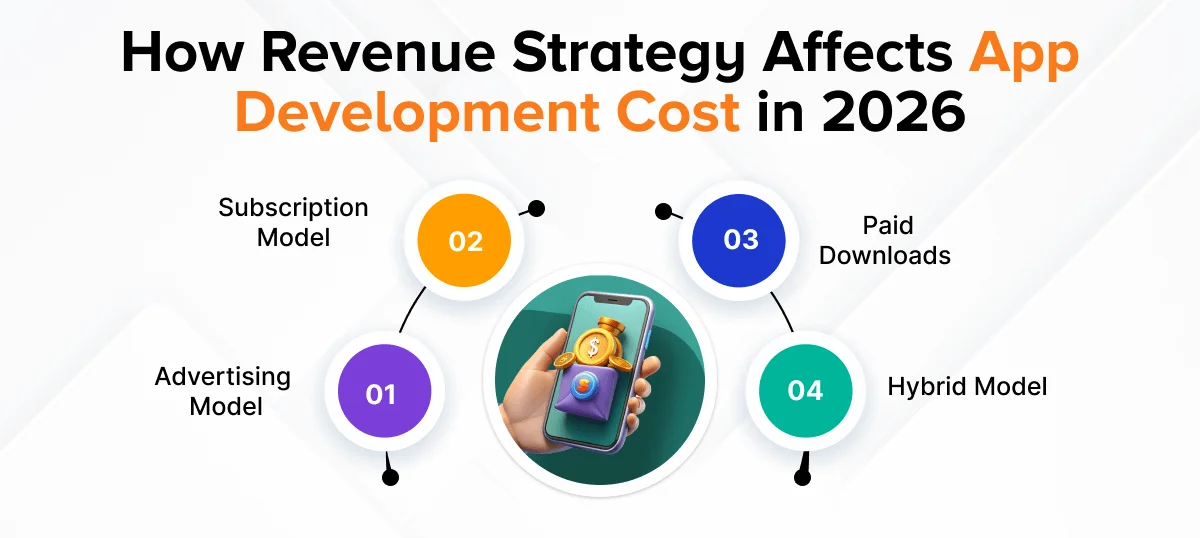
How Revenue Strategy Affects App Development Cost in 2026?
Choosing the right monetization model directly impacts ROI.
1. Subscription Model
Users pay monthly or annually.
Best for:
- SaaS apps
- Fitness apps
- Streaming platforms
- Productivity tools
Advantages:
- Predictable recurring revenue
- High lifetime value
- Strong scalability
In 2026, subscription models dominate due to recurring cash flow benefits.
2. Advertising Model
Revenue is generated through in-app ads.
Best for:
- Free apps
- Social platforms
- Gaming apps
- Content-based apps
Advantages:
- Low barrier to entry for users
- Scales with user growth
However, ad-based models require high active user volume to generate significant revenue.
3. Paid Downloads
Users pay once to download the app.
Best for:
- Niche professional apps
- Utility tools
Advantages:
- Immediate revenue
- No reliance on recurring billing
Limitations:
- Lower scalability
- Users prefer free apps with optional upgrades
4. Hybrid Model
Combination of subscription + ads + in-app purchases.
Most successful apps in 2026 use hybrid monetization for revenue optimization.
Case Study: How Much It Actually Cost to Build an App?
Understanding real-world app budgets helps founders set realistic expectations. Below are practical case-style examples based on typical 2026 market rates. These are representative scenarios built from industry averages and real project structures.
A Simple Utility App
Example Type: Task manager, calculator, reminder app
Platform: Cross-platform (iOS + Android)
Development Model: Small offshore team
Features:
- User registration/login
- Basic dashboard
- Push notifications
- Offline data storage
- Simple admin panel
Team Structure:
- 1 UI/UX Designer
- 2 Mobile Developers
- 1 Backend Developer
- 1 QA Engineer
- 1 Part-time Project Manager
Timeline:
3–4 months
Mobile app development cost breakdown:
- Design: $4,000
- Development: $25,000
- QA & Testing: $6,000
- Project Management: $5,000
- Deployment & Misc: $3,000
Total Estimated Cost: $40,000 – $55,000
Outcome:
Launched quickly as MVP. Revenue generated through in-app ads and premium upgrade. Break-even achieved within 8 months.
A Marketplace App
Example Type: Multi-vendor e-commerce platform
Platform: Native iOS + Android
Development Model: Dedicated offshore team
Features:
- Buyer & seller accounts
- Product listing & search
- Secure payment integration
- Ratings & reviews
- Order tracking
- Admin dashboard
- Inventory management
Team Structure:
- 1 UI/UX Designer
- 3 Mobile Developers
- 2 Backend Developers
- 1 DevOps Engineer
- 2 QA Engineers
- 1 Project Manager
Timeline:
8–10 months
Cost Breakdown:
- Design: $15,000
- Frontend & Backend Development: $110,000
- QA & Testing: $25,000
- DevOps & Infrastructure Setup: $15,000
- Project Management: $20,000
Total Estimated Cost: $160,000 – $220,000
Outcome:
Higher upfront cost due to multi-role functionality and payment integrations. Monetized via commission model (10–20% per transaction). ROI achieved in 14–18 months.
An On-Demand Service App
Example Type: Ride-sharing or home services app
Platform: Dual app (User + Service Provider)
Features:
- Real-time GPS tracking
- Booking & scheduling
- In-app chat
- Dynamic pricing
- Payment gateway
- Ratings & feedback
- Admin panel
Team Structure:
- 1 UI/UX Designer
- 4 Mobile Developers
- 3 Backend Developers
- 1 DevOps Engineer
- 2 QA Engineers
- 1 Project Manager
Timeline:
9–12 months
Cost Breakdown:
- UI/UX Design: $18,000
- Mobile Apps (2 separate apps): $140,000
- Backend & APIs: $90,000
- Testing & QA: $30,000
- DevOps & Cloud Setup: $20,000
Total Estimated Cost: $250,000 – $350,000
Outcome:
Complex architecture due to real-time tracking and two-sided user flow. High scalability cost but strong revenue potential through commission + surge pricing.
A Fintech App
Example Type: Digital wallet or investment platform
Platform: Native + Web dashboard
Features:
- Secure user onboarding (KYC)
- Bank API integrations
- Transaction history
- Biometric authentication
- Encryption
- Real-time notifications
- Fraud detection
- Admin compliance dashboard
Team Structure:
- 1 Senior UI/UX Designer
- 3 Mobile Developers
- 3 Backend Developers
- 1 Security Engineer
- 1 Compliance Consultant
- 2 QA Engineers
- 1 Project Manager
Timeline: 10–14 months
Cost Breakdown:
- Design: $20,000
- Development: $180,000
- Security & Compliance: $50,000
- QA & Penetration Testing: $35,000
- Infrastructure & DevOps: $30,000
Total Estimated Cost: $300,000 – $450,000
Outcome:
High security and regulatory costs significantly increased the budget. However, recurring revenue via transaction fees and subscriptions resulted in strong long-term profitability.
Why Accurate Cost Estimation Is Vital Before You Build an App?
Building an app without a clear cost estimate is like starting construction without a blueprint. In 2026, where competition is high and user expectations are demanding, inaccurate budgeting can derail even the most promising ideas.
Accurate cost estimation is not just a financial exercise it is a strategic foundation for execution, scalability, and long-term sustainability.
Below’s why it matters more than ever.
Preventing Budget Overruns
One of the biggest reasons app projects fail is underestimated costs.
Without detailed forecasting, businesses often face:
- Scope creep (unplanned feature additions)
- Rework due to unclear requirements
- Extended development timelines
- Increased infrastructure expenses
- Unexpected integration costs
When costs are underestimated:
- Funding runs out mid-development
- Product quality is compromised
- Launch gets delayed
- Investor confidence weakens
Accurate estimation helps you:
- Define a realistic budget
- Allocate contingency funds (10–20% buffer)
- Avoid financial strain during development
- Secure investor or stakeholder approval confidently
In short, proper estimation protects your project from financial instability.
Better Resource Planning
Mobile app development cost estimate directly influences how you structure your team and timeline.
With accurate projections, you can:
- Decide between cross-platform or native development
- Choose offshore vs in-house hiring
- Allocate budget for UI/UX, backend, and QA appropriately
- Plan infrastructure and DevOps setup in advance
For example:
If your budget supports only $80,000, you may:
- Start with MVP
- Use cross-platform framework
- Reduce non-essential features
If you skip cost planning, you risk over-hiring, under-hiring, or misallocating talent — all of which increase inefficiency.
Proper estimation ensures:
- Balanced team composition
- Optimized workload distribution
- Controlled development pace
- Efficient milestone tracking
Resource clarity leads to smoother execution.
Reducing Go-To-Market Delays
Time-to-market is critical in 2026. Delays can result in:
- Missed market opportunities
- Increased competition
- Higher marketing costs
- Reduced first-mover advantage
Accurate mobile apps development cost estimation helps you:
- Define realistic development timelines
- Identify critical milestones
- Prioritize core features
- Avoid mid-project pivots due to budget shortages
When budget and timeline are aligned:
- Development progresses without interruptions
- Stakeholders stay aligned
- Launch strategy remains intact
Projects that begin with structured cost planning typically experience fewer disruptions and faster deployment.
Why Octal IT Solution is Your Smartest Choice for Mobile App Development Costs?
The process of estimating app development expenses becomes difficult because multiple factors need assessment which include platform selection and feature development complexity and team organization and costs that occur after the app launch. As a top Mobile app development company we delivers businesses operational assistance which enables them to comprehend complex business situations through transparent and strategic operational support.
The partnership with Octal IT Solution provides you with a financial plan which shows all development phases together with an operational framework that guarantees your application will meet your business objectives and a development model which enables your business to expand in the future.
Octal IT Solution provides an investment solution which enables you to develop everything from a basic MVP for your business idea testing to an extensive enterprise system while ensuring your future requirements at economical costs. Octal IT Solution goes beyond financial metrics by focusing on strategic development while maintaining ongoing visibility of future expenses which enables you to make correct financial choices during the development phase.
With Octal your application development process transforms into a methodical procedure which produces a digital product that grows with your business and creates tangible economic benefits.
The Wrapping Words
The process of creating an application through coding requires companies to make a strategic commitment which needs proper budget management and future expansion planning. The cost of development in mobile application begins at $40,000 for minimum viable products and reaches over $400,000 for advanced enterprise solutions, which businesses can estimate through proper cost estimation methods.
Your entire investment together with your return on investment gets determined through all choices you make including which platform you will use and which features you will develop and how you will build your team and protect your system.
Accurate cost estimation enables organizations to achieve financial transparency while they allocate resources and reduce product development time and create a product that meets both technical and business requirements.
The path to achievement for businesses needs them to create a foundation through planning which they need to follow before they start their construction work.

 By
By March 24, 2026


 Get in Touch