


Your phone buzzed twice while you read that headline. One was a notification. The other might have been an app already deciding something for you.
That is where mobile software stands in 2026. Apps don’t just wait; they plan, decide, and sometimes act before you ask. If you build apps, this shift changes how you plan. This guide covers major mobile app development trends 2026 brings. It also maps out where every trend goes by 2030.
Building only for 2026 is already becoming outdated. Here, you will also find shifts that most guides skip. One changes how your app gets found. The other changes what “app” even means. Let’s start with where mobile stands right now.
The State of Mobile App Development in 2026
Global app revenue is projected to grow 7.48% a year through 2029. That estimate comes from Statista. That consistent climb hides a larger story underneath.
The actual shift is in what powers that growth. Gartner predicts 40% of organization apps will carry AI agents by the end of 2026. That is up from under 5% in 2025. That is at least an eightfold increase in a single year.
Following the latest mobile app development trends is not optional for serious businesses. Users now expect apps to predict what they need. They expect fewer taps, not more screens. Many users also expect an AI agent to handle parts of the app for them. That agent may also act on their behalf, not just chat with them.
This is the backdrop for everything that follows. It’s not one feature update. It’s a full rebuild of how mobile software works. That rebuild runs from the interface right down to how apps get found.
Mobile App Development Trends Shaping the Future (2026-2030)
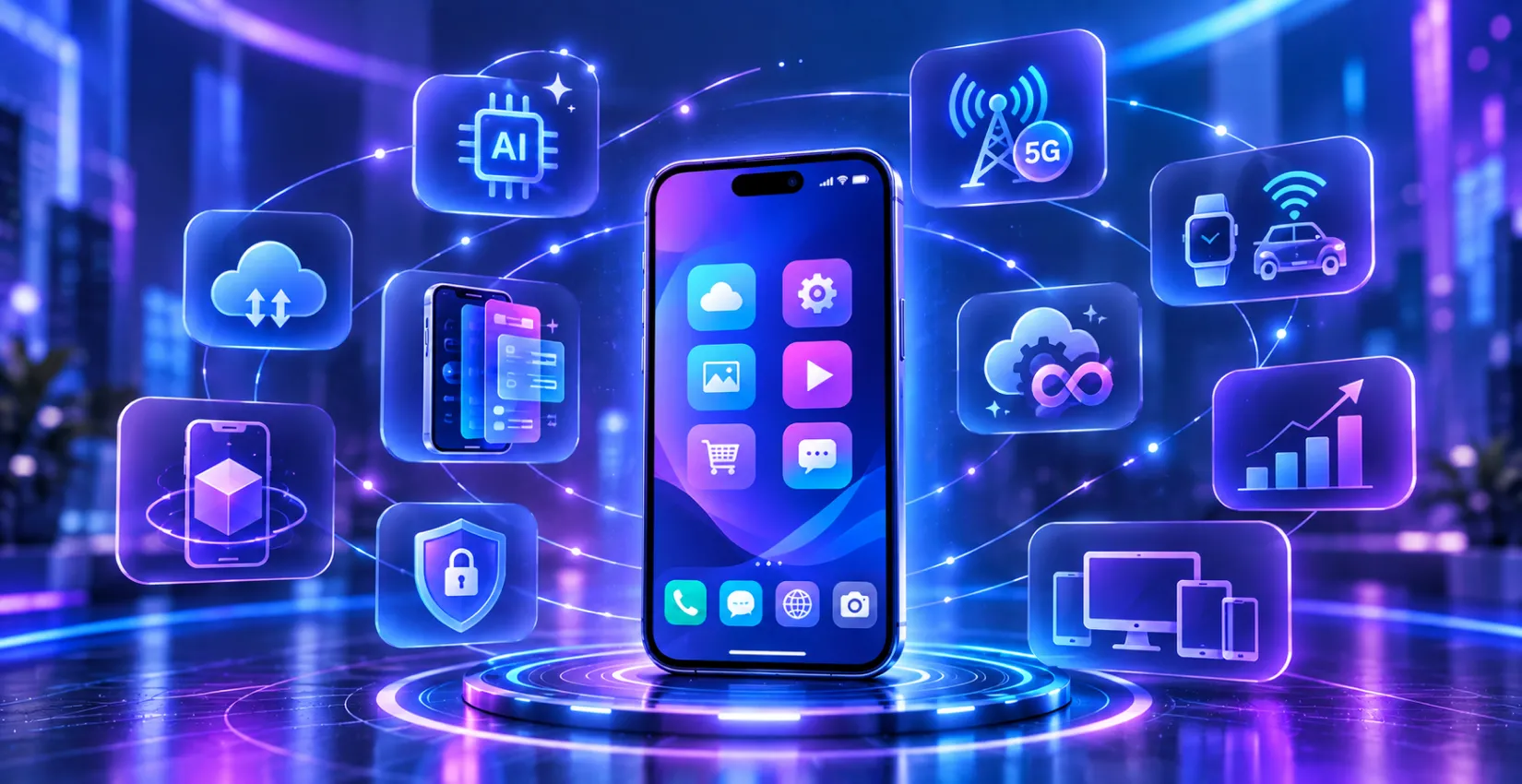
Below are the mobile application development trends really worth tracking today. Each one shows where it stands now and where it heads by 2030.
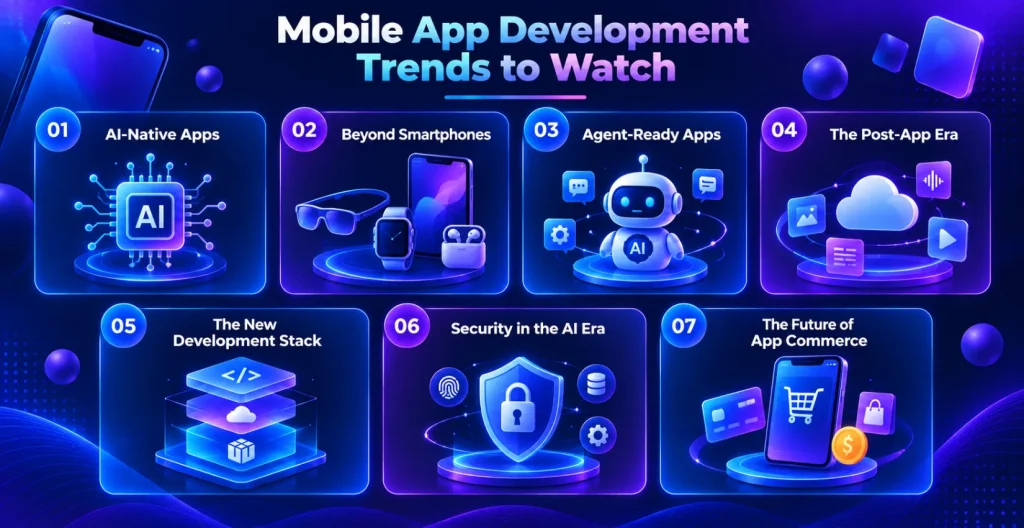
1. AI-Native & Agentic Intelligence
AI stopped being a feature teams bolt on later. Among all emerging mobile app development trends in 2026, this one leads. It sits at the center of every other shift below.
AI Agents That Act, Not Just Assist
Most apps still wait for a tap before doing anything. Agentic AI changes that completely. It plans steps, calls tools, and finishes tasks without intervention. A travel app can now rebook a delayed flight on its own.
On-Device & Edge AI
Smaller AI models now run directly on the phone’s chip. No cloud call is needed for most tasks. This enables quicker responses and stronger privacy by default. Apps also keep operating offline, which matters where connectivity is unreliable.
Hyper-Personalization for Each User
Generic suggestions already seem outdated. Apps now adjust screens, pricing, and content for each user in real time. A fitness app might change today’s workout based on last night’s sleep. This is real personalization, not just broad segmentation.
Multimodal Interfaces
Typing is becoming just one option among several. Apps increasingly accept voice, an image, or a gesture as input. This is one of the clearest emerging trends in mobile application development today. It rewards apps that handle different input types seamlessly.
Predictive, Zero-Tap UX
Sometimes the best interface is no interface at all. Apps are starting to act before you even open them. Think pre-loaded checkout screens or a display that dims at bedtime. Fewer taps mean less friction, and friction is what customers resent.
2. Beyond the Smartphone Screen
The future of mobile app development isn’t always confined to a screen anymore. Screens are spreading to wrists, faces, and thin air.
Smart Glasses as the New App Surface
Meta, Google, Samsung, and Apple are all delivering face-worn devices now. Many rely on a paired phone for data and processing. IDC forecasts 13.6 million smart glasses delivered in 2026. That number grows to 27.3 million by 2030.
Spatial Computing & Extended Reality
Extended reality blends digital and physical worlds into one view. It is moving beyond gaming into training and retail. Property walkthroughs are already using it too. As headsets get lighter, expect this to touch far more apps by 2028.
Wearable-First Health Companion Apps
Watches and rings now collect data that phones never could alone. Apps built around that data, rather than simply displaying it, can offer more useful everyday experiences. Continuous tracking is turning health apps into everyday fitness companions.
Foldable-Optimized Interfaces
Foldable phones stopped being a novelty a while back. They now appear in mainstream device lineups from major manufacturers. Apps that genuinely adapt layouts across a fold stand out. Simply resizing content no longer feels good enough to users.
3. Agent-Ready Apps
Getting found in an app store used to be the whole game. Among the latest trends in mobile app development, this one gets talked about the least. Yet it may be the most consequential of all.
Why Traditional SEO/ASO Isn’t Enough for AI Agents
Search rankings and app store optimization still matter for human users. But AI agents do not browse results or scroll store listings. They call structured data and APIs directly. That means invisible infrastructure now decides real visibility.
MCP, ACP, AP2 & UCP Explained
A handful of protocols now let AI agents talk to apps directly. McKinsey estimates agentic commerce could reach $3 to $5 trillion globally by 2030. Apps without those connections may struggle to reach this growing source of spending.
What an Agent-Ready App Looks Like
An agent-ready app exposes clean, structured data an AI can use. It requires clean product information, stable APIs, and reliable service data. This is now a build requirement, not a marketing afterthought.
Winning Visibility in AI Search
Being cited in a ChatGPT or Gemini answer is its own skill now. It rewards clear, properly structured content over keyword density alone. Both the app and its content need clear structure to get surfaced.
4. The Post-App Era
Some of the sharpest mobile app development trends to watch skip the screen completely. They are about whether users open your app at all.
When Your App Becomes a Headless Service
Increasingly, an AI agent completes a task within your app for users. Your interface becomes optional, even as your backend becomes important. Businesses that rely heavily on traditional app interfaces may feel this shift first.
Future-Proofing Your Business Model
Revenue models built purely on ad impressions face real pressure here. If an agent completes a purchase without rendering your UI, that funnel breaks. Pricing and value now need to work with or without a screen.
5. Engineering & Development Shifts
These mobile app development trends and technologies are changing how teams build. Businesses offering custom mobile application development services are already restructuring their pipelines around them.
Cross-Platform as the Default
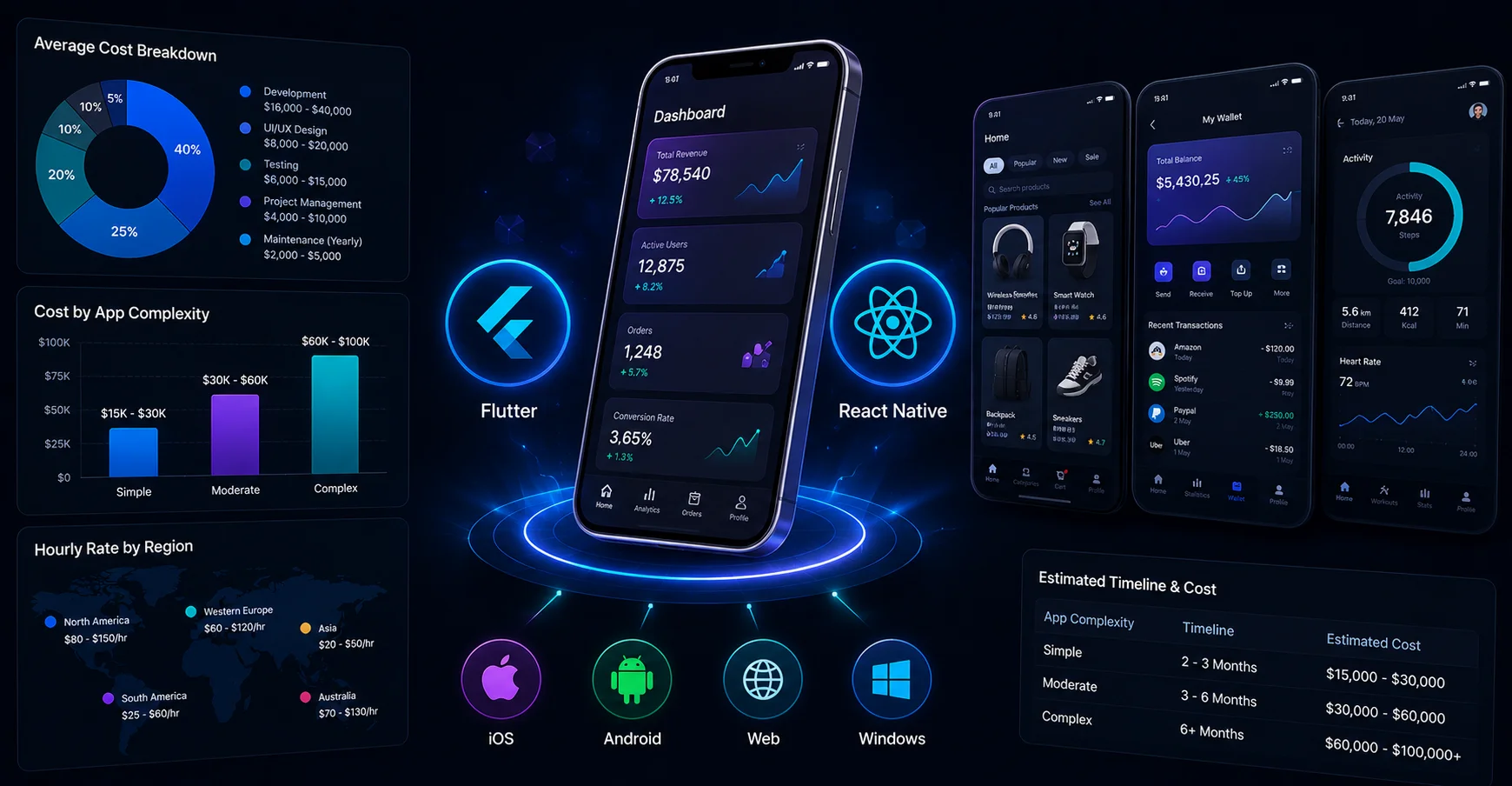
Flutter, React Native, and Kotlin Multiplatform now deliver near-native performance. Fewer teams need separate iOS and Android codebases. This is one of the latest mobile app development technologies cutting costs and time to release.
Vibe Coding & AI Co-Development
AI agents now draft components, fix bugs, and recommend architecture directly. Developers now spend more time evaluating and directing AI-generated code than writing everything from scratch. Teams relying on outdated mobile app development tools fall behind on delivery speed.
Design-to-Code Pipelines
A Figma layout can now become a working component in minutes. This shortens the gap between early wireframes and a working build. Designers and developers now work from the same live source.
AI-Driven Testing & QA
Manual testing cycles are shrinking as AI tools take on more testing work. AI testers now write test cases, run them, and flag regressions. This catches bugs earlier, before they reach a real user’s device.
Edge Computing + 5G/6G
Faster networks combined with edge servers reduce real-time app latency. This unlocks smoother AR overlays and immediate AI responses. Early 6G trials are already shaping how teams plan 2028 releases.
6. Trust, Security & Compliance in the AI Era
Security has quietly become one of the defining mobile app technology trends of this cycle. AI features widen the attack surface, and regulators have noticed.
Privacy-First Engineering by Default
On-device processing can keep sensitive data off external servers for many tasks. Users are also paying more attention to how app handle their information. Privacy is shifting from a settings toggle to a core architecture decision.
Quantum-Resistant & Zero-Trust Security
Financial and healthcare apps are planning for quantum-era encryption risks. Zero-trust models verify every request in place of trusting the network. This is becoming a standard practice rather than an optional security measure.
Regulatory Pressure Is Rising
Rules like the EU’s Digital Markets Act are reshaping app store regulations. Data sovereignty laws now dictate where certain user data must live. Compliance planning belongs in the build phase, not after launch.
Accessibility as a Compliance Requirement
Accessibility used to be handled as a nice-to-have polish item. Laws such as the European Accessibility Act now make accessibility a formal requirement. Building inclusive interfaces early avoids costly retrofits and legal exposure later.
7. Commerce, Monetization & Business Model Trends
Money moves differently when a software program initiates the transaction. These mobile application trends are reshaping how apps earn and retain revenue.
Super Apps & Mini-Apps Ecosystem
One app hosting payments, chat, and shopping together keeps gaining ground globally. Users increasingly choose to switch between mini-apps within one trusted hub.
Agentic Shopping Reshapes Mobile Commerce
Shoppers are letting AI agents compare, negotiate, and check out for them. This changes what “conversion” means for mobile commerce apps. Product data now needs to speak to machines, not just people.
Web3 & Tokenized App Experiences
Loyalty points, ownership records, and identity checks are moving onto blockchain rails. This isn’t limited to crypto apps anymore. Retail and gaming loyalty programs are adopting it directly too.
Subscription Fatigue & New Pricing Models
Users are pushing back against stacking too many monthly subscriptions. Usage-based and outcome-based pricing are gaining traction as fairer alternatives.
Sustainable App Engineering
Leaner code and efficient servers cut both cost and energy use. Sustainable engineering is becoming a real selling point for enterprise buyers evaluating vendors.
Mobile App Trend Roadmap (2026-2030)
Here is where each shift stands today, and where forecasts place it next. This table reflects the top mobile app development trends in 2026 and beyond.
| Trend | 2026 Status | 2028 Outlook | 2030 Outlook |
| Agentic AI in apps | 40% of enterprise apps (Gartner) | Multi-agent collaboration standard | Becoming a default architecture |
| Smart glasses ecosystem | 13.6M units shipped (IDC) | Major platforms compete openly | 27.3M units shipped (IDC) |
| Agentic commerce | Early protocol adoption (MCP, ACP) | Mainstream retail integration | $3–5 trillion in orchestrated sales (McKinsey) |
| On-device AI | Common in flagship devices | Standard across mid-range phones | Default expectation, cloud as backup |
| Spatial computing/XR | Enterprise-led adoption | Consumer retail and training use | Everyday app category, not niche |
| Quantum-resistant security | Early planning stage | Regulated industries begin migration | Broad enterprise adoption |
Why Businesses Must Adapt to These Trends Now
Waiting on any of this carries a real, measurable cost. Teams that track these top mobile app development trends early can prepare their products before user expectations shift further. Competitors adopting later often notice the shift too late.
Retention is the clearest sign here. Apps that adapt quickly to agentic experiences see stronger user retention. These mobile app trends for businesses can help teams prepare for changing user expectations. Static apps may struggle as users become more accustomed to agentic experiences. Early adoption can also give teams more time to build the APIs, security, and agent-readiness these experiences require.
This is not about chasing hype for its own sake. It’s about not getting quietly bypassed by AI agents. It’s also about not losing ground to top mobile app development companies already building for 2030.
How Octal IT Solution Helps You Build for These Trends
Octal IT Solution tracks these mobile app development technology trends closely. We build for where these trends are headed, not just where they stand these days.
AI & Agentic App Development Expertise
Our teams build agentic features directly into new and existing apps. This includes autonomous workflows and on-device AI integration.
Cross-Platform Engineering
We deliver apps with Flutter, React Native, and Kotlin Multiplatform for iOS and Android. This helps teams support multiple platforms without maintaining completely separate codebases.
Security, Compliance & Future-Proof Architecture
The team builds a privacy-first, zero-trust architecture from the ground up. It meets modern policies and anticipates the ones coming next.
Agent-Ready & API-First Infrastructure
Our experts structure your app’s data so AI agents can discover it. This means both human users and AI agents can discover and transact with your app.
Ongoing Support for Emerging Platforms
As smart glasses and wearables mature, we expand your app to them. This lets you extend the app without immediately requiring a costly full rebuild.
Post-Launch Trend Audits & Roadmap Reviews
We revisit your app frequently to address today’s shifts covered here. You get a clear roadmap update, not only a one-time build.
If you’re ready to build for what’s next, our team is a call away. You can also hire mobile app developers directly for any of the trends above.
Check Also: Mobile App Failures: 10 Real-Life Examples
Final Words
Mobile app development in 2026 isn’t always about adding one more AI feature. It’s about rethinking who, or what, actually uses your app.
Businesses that treat these mobile app development trends and predictions as a roadmap can prepare for the changes ahead. Treating them as a five-year plan, not a checklist, matters most. Teams that delay these changes may have more work to do as the market evolves.
Frequently Asked Questions
Agentic AI is one of the biggest mobile app development trends in 2026. Apps are moving from responding to taps to completing tasks on their own.
Not completely, but it’s going to change how many apps get used. Some tasks will shift to AI agents running through your app’s backend.
No, not yet. Smart glasses currently rely on a paired mobile phone app for most data. Teams can create mobile app wireframes for both the phone and glasses experiences to plan how they work together. That makes smart glasses a partner tool, not an alternative.
Start with the highest-impact shifts first. Focus on on-device AI, cross-platform frameworks, and basic agent-readiness before anything else.
It means your app’s data and APIs are structured so an AI agent can discover and use them. A shopping assistant, for example, can then access your services and complete supported tasks.
Usually no. Most 2026 mobile app ideas and features can layer onto a strong existing structure. A full rebuild is rarely necessary unless the current architecture cannot support the required changes.


 Get in Touch
 By
By September 30, 2026