


What if your customers could wrap up a purchase in under two seconds, no card swiping, no PIN typing, and not even unlocking their phone? Contactless payment app development is getting serious attention for banks, retailers, and startup teams who are exploring 2026.
Per 360iresearch, the worldwide contactless payments market will probably climb from USD 21.83 billion in 2026 to USD 43.07 billion by 2032, with a CAGR of 11.73%. Driving that growth is a strong momentum of tap-to-pay wallets and smart wearables. As well as secure NFC payment app development frameworks that are replacing cash and card payments. Here’s exactly how to build one.
- Types of Contactless Payment Apps You Can Build
- Most Popular Contactless Payment Apps
- Must-Have Contactless Payment App Features
- Top Contactless Payment App Use Cases Across Industries
- Tech Stack for NFC Payment App Development Services
- Contactless Payment App Development Process (Step-by-Step)
- How Are AI and ML Transforming Contactless Payment App Development?
- Blockchain and Security Innovations in Contactless Payments
- How Much Does Contactless Payment App Development Cost?
- Common Challenges in Contactless Payment App Development (and How to Solve Them)
- Future of Contactless Payments Beyond 2026
- How to Choose the Best Contactless Payment App Development Company in USA
- Final Words
- FAQs
Types of Contactless Payment Apps You Can Build
There are many types of contactless payment apps. A skilled mobile payment app development company can help you choose the right approach for your target users. How much money moves through the system and what your compliance requirements look like. Before you start building, it’s smart to review a few types.
1. Tap-to-Pay App Development
Users keep card details inside a digital wallet and pay by tapping their phone. Or even a wearable at a POS terminal. This type of contactless payment solution works especially well for retail and daily consumer use.
2. P2P Transfer Apps
Peer-to-peer apps let people send funds straight to friends, family, or even merchants using a phone number or a QR code. If you’re aiming for a dedicated build, P2P payment app development concentrates on instant transfers and bill splitting. Along with more social-style payment features.
3. Crypto-Enabled Wallets
These combine contactless payments with blockchain-based assets, so users can tap to pay using stablecoins or tokens. If you plan ahead and choose crypto wallet app development early. You’re more likely to future-proof your app for Web3-savvy customers and global users.
4. eWallets
An eWallet holds several payment cards, loyalty perks, and a tidy view of transaction history all in one place. Working with an experienced eWallet app development company can help you launch with tokenization and multi-bank linking. Furthermore, safer offline access from the beginning.
Most Popular Contactless Payment Apps
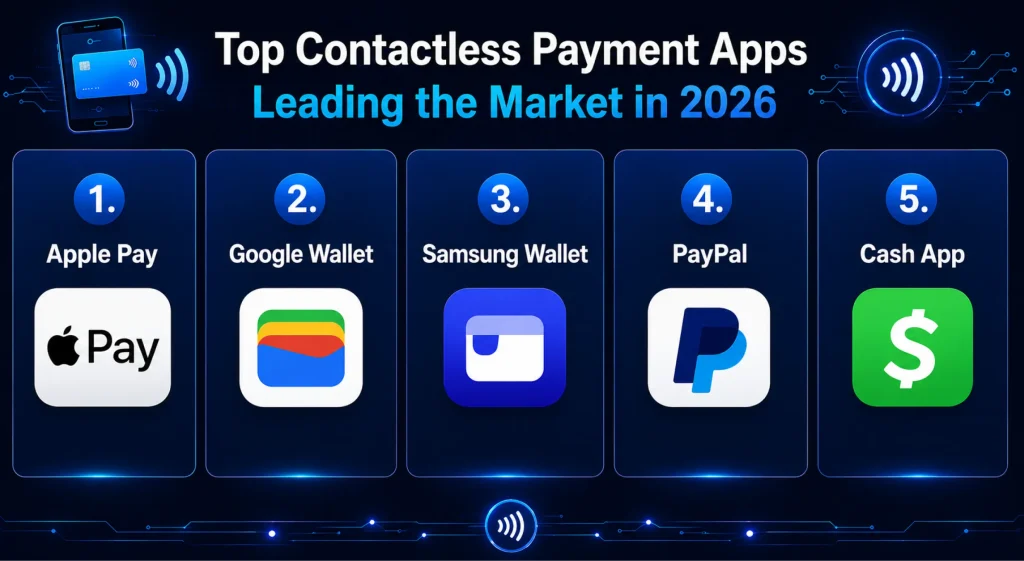
Before you start building your own, it helps to look at what already works and why. These five apps have, for better or worse, shaped user expectations around the globe. Additionally, they bring valuable lessons in design, security, and scale, too.
1. Apple Pay
Apple Pay allows secure-element tokenization on iPhones out in the open. So users can just tap and go to pay in shops, within apps, and on websites. If your plan is to build a contactless payment app like Apple Pay. Then keep your eyes on biometric verification and on-device-level safeguards.
2. Google Wallet
Google Wallet brings contactless payments together with boarding passes and reward cards. As well as even IDs, all in one Android-first experience. To build a contactless payment app like Google Wallet, you should push hard for deeper OS integration and wide merchant acceptance.
3. Samsung Wallet
Samsung Wallet supports both MST and NFC tech, which means it can handle tap payments on contactless readers. As well as the older magnetic-stripe terminals. This “hybrid” style hints that tight software-hardware coupling can widen acceptance, especially in places where devices upgrade more slowly.
4. PayPal
PayPal moved toward in-store tap-to-pay using PayPal Zettle. Furthermore, it links online checkout habits with physical retail workflows. Businesses that develop app like PayPal often do well by blending P2P money movements and merchant management. As well as contactless acceptance inside a single ecosystem.
5. Cash App
Cash App mixes peer-to-peer transfers with a real-world Cash Card. Additionally, a feature that lets users tap to pay at a large number of U.S. retailers. Its focus on simplicity and fast transfers is a big reason it grows steadily in daily active usage at scale.
Must-Have Contactless Payment App Features
Every successful contactless payment app balances security with everyday convenience. Here’s a clear breakdown of the core and the more advanced features you want. In addition to what they generally do to your overall contactless payment app features and cost.
1. NFC Tap Payments
This is the fundamental layer for any contactless app, letting users wrap up a purchase in under two seconds. You need certified NFC chipsets, secure element storage, and solid alignment with EMV contactless specs, not just “close enough,” because the timing and formatting matter.
2. QR Code Fallback
QR fallback makes sure your solution still runs on phones without NFC hardware. This matters a lot in places where those devices are more common. It can cover peer-to-peer transfers too and merchant checkout when the signal is not great or the reader is being picky.
3. Biometric Identification
Fingerprint and face recognition add extra protection beyond PINs, like a better second opinion. It cuts down fraud, especially for higher-value transactions. Most users expect biometric confirmation as the default, not treated like an optional feature you can forget about.
4. Tokenization
Tokenization swaps the sensitive card data with a one-time digital token per transaction. You’ll want a reliable partnership with a payment gateway development service so the whole setup stays correct and audited.
5. Transaction History & Notifications
Up-to-date transaction history and push notifications keep people informed after every tap, transfer, or failed attempt. That transparency tends to build trust, and it often lowers dispute charges along with support tickets.
6. Multi-Currency & Loyalty Integration
Multi-currency support, when paired with loyalty integration, helps your mobile payment app development company serve global users without the usual headaches. It also encourages repeat behavior, which usually improves retention and boosts transaction value over time.
7. Split Payments
Split payment features let groups divide one bill quickly, something people now kind of assume is already there in dining and travel. Planning it early in your contactless payment app development roadmap helps you avoid re-architecture later.
Top Contactless Payment App Use Cases Across Industries
Contactless payments aren’t limited to retail checkout counter life. Even in healthcare and transit, organizations are moving toward tap-to-pay systems to keep things rolling faster. Plus, they cut down that little friction you get at everyday touchpoints.
1. Retail & Grocery
Grocery stores and retailers are using contactless payments to shrink those checkout lines and speed up the high-volume rush. Through NFC payment app development services, retailers can enable tap-to-pay at multiple registers, all at once, without needing to purchase extra devices or additional hardware.
2. Healthcare
Hospitals, clinics, and related providers lean on contactless payments for co-pays, pharmacy items, and even vending machine purchases. This reduces physical contact, which matters in hygiene-sensitive settings. A use case that really got a push from pandemic-era demand and behavior changes.
3. Transportation & Transit
Transit systems now take open-loop contactless cards and mobile wallets for fares. So they cut paper tickets and reduce the lineups as riders are using the tap-to-pay behavior.
4. Hospitality & Travel
In hotels and restaurants, contactless payments show up for room service, table-side checkout, and even tipping. Enterprise contactless payment app development for hotels typically also bundles multi-currency support, which helps international travelers.
5. Enterprise & B2B
Large enterprises adopt contactless systems for internal cafeterias, vending, and paying B2B suppliers. As part of wider digital transformation services, contactless rails help reduce manual invoice work and reconciliation.
Tech Stack for NFC Payment App Development Services
Choosing the right technology stack will decide how safe, adaptable, and quick your app feels in real use. NFC payment app development services depend on a mix of mobile frameworks.
| Layer | Technology Options |
| Frontend (Mobile) | Swift (iOS), Kotlin (Android), React Native |
| Backend | Node.js, Java (Spring Boot), Python (Django) |
| Database | PostgreSQL, MongoDB, Redis (caching) |
| NFC SDKs | Apple PassKit, Android HCE, NFC Forum APIs |
| Payment Gateway | Stripe, Braintree, Adyen, Razorpay |
| Security | AES-256, TLS 1.3, tokenization APIs |
| Cloud Infrastructure | AWS, Google Cloud, Azure |
Since NFC acts a bit differently across platforms, most iOS and Android app development teams end up doing two tracks. One for Apple Secure Element and one for Android Host Card Emulation, and then they merge it all into a shared backend.
Contactless Payment App Development Process (Step-by-Step)
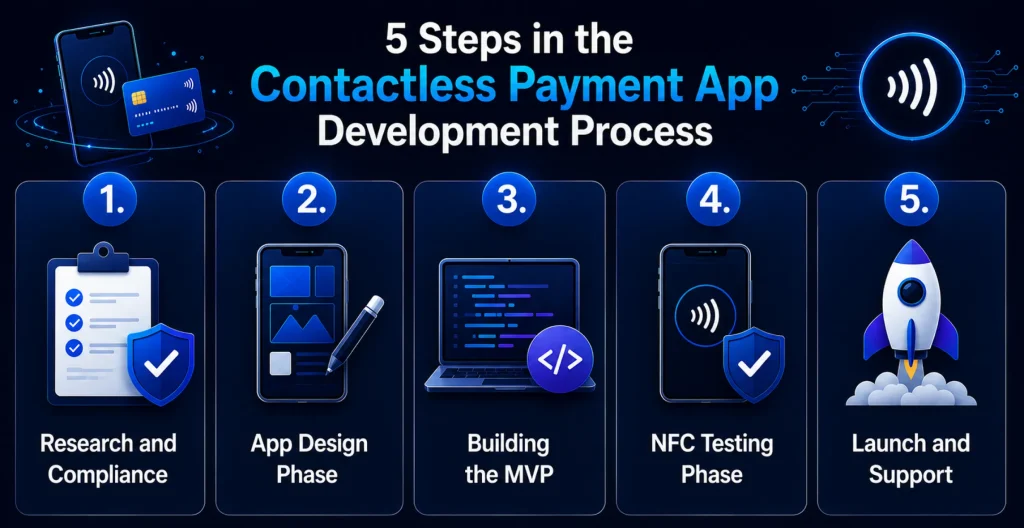
Building a contactless payment app goes through a fairly guided route from the initial idea to the actual launch. Below are the five main steps that experienced teams follow to reduce risk and rework.
1. Discovery & Compliance Mapping
Teams map the target regions, payment rails, and rules, such as PCI DSS or RBI recommendations. A specialized FinTech app development firm does a compliance audit first, before touching any code, just to make sure everything is aligned or not.
2. UI/UX Design
Designers draft wireframes for a nearly one-tap checkout journey, fewer screens overall, and better service uptime. Then at this stage they also run usability testing, because it helps spot awkward or confusing flows earlier rather than later.
3. MVP Development
Teams build an MVP with the basic features like NFC tap, login/sign-in verification, and transaction history. Just to test if the idea actually works before they throw effort and money at fancy, more advanced functionality.
4. NFC Integration & Testing
Developers bring in NFC SDKs to test a lot across different device models, various terminals, and weird network conditions. Also, they run penetration testing to uncover security shortcomings.
5. Deployment & Post-Launch Support
Once the app store approves everything, the teams tend to watch the rate at which transactions come through, then they patch small bugs and roll out new changes. Meanwhile, ongoing contactless payment app development services make it easier to keep the app aligned, as the rules and regulations shift over time.
How Are AI and ML Transforming Contactless Payment App Development?
Artificial intelligence is reshaping the way contactless payment apps can detect fraud. Additionally, figure out who’s behind the screen and also tailor the whole experience. AI and machine learning are doing a lot more, and they’re actively changing how contactless payment apps develop in 2026.
1. Real-Time Fraud Detection
AI models analyze transaction velocity, location context, and device fingerprints in just milliseconds. Moreover, they flag stuff that feels off. This tends to cut down the annoying false declines, but it still catches patterns that older rule-based setups often miss.
2. Risk-Based Identification
Machine learning now changes the verification “strength” depending on the risk of the transaction. So sometimes the app asks for biometrics only when it actually makes sense, not every single tap. That means less friction for low-risk payments and tighter security elsewhere.
3. Predictive Personalization
AI can study spending behaviors and then surface offers that feel more relevant. As well as budgeting insights and reminders right inside the app. A lot of teams also use experienced AI development services to help build those engines without compromising privacy.
4. Chargeback & Dispute Automation
ML models review transaction evidence and can auto-handle the simple chargeback cases. That speeds up refunds, while more unusual or suspicious dispute patterns still get pushed toward human review.
5. Voice & Behavioral Biometrics
Newer AI approaches may analyze things like typing rhythm and tap pressure. Furthermore, even voice is an extra layer of security. In other words, contactless payment solution development is moving toward continuous, sort of passive verification.
Blockchain and Security Innovations in Contactless Payments
Security is still the big concern for contactless payments, and it’s not one single thing either. It’s more like tokenization, encryption, blockchain, and a bunch of regulatory rules working together. So that each transaction inside a modern payment app stays safe and secure.
1. Tokenization Standards
In most modern apps, the system replaces the card number with a one-time token during each transaction. It follows the EMVCo tokenization standards, so someone who intercepts the data. They get nothing that can be used again for fraud.
2. End-to-End Encryption
When it comes to encryption, using AES-256 along with TLS 1.3 keeps information protected while it travels and also when it is being saved. It serves as the backbone for building secure contactless payment app solutions.
3. Blockchain for Transparency
Blockchain works like an immutable ledger, so each transaction gets recorded with no edits. That way, businesses and even regulators get a more legible audit path. A dedicated blockchain development company can layer this on without upsetting existing payment flows, which can be tricky sometimes.
4. Compliance – PCI-DSS & EMVCo
PCI-DSS certification and EMVCo requirements set the rules for card data, including how it is stored and how it is transmitted. If a team skips these steps during contactless payment app development services. It can cause delays in the app approval process.
5. Regional Regulations
And then there are local rules, like RBI guidelines in India and PSD2 across Europe. These bring region-specific checks and verification expectations. So any contactless payment app development company trying to reach multiple markets has to plan for compliance flexibility from the start.
How Much Does Contactless Payment App Development Cost?
Developing a contactless payment app has a cost that really depends on things like how complex it is, which features you want, and where the team is located, plus a bunch of other details. At the same time, it’s not just one single, neat number. What happens in practice is a blend of app tiers and also the development timeline step by step. That’s why it helps to include regional hourly rates so you can plan the budget without surprises.
1. By App Complexity
MVP builds usually suit startups that are trying a lean pathway to validate core functionality first. But enterprise-level apps call for stronger security measures, clear compliance expectations, and a scalable architecture, especially if the transaction volumes end up being high.
| Complexity | Estimated Cost |
| MVP | $25,000 – $45,000 |
| Mid-Range | $45,000 – $90,000 |
| Enterprise-Grade | $90,000 – $200,000+ |
2. By Development Phase
In most situations, the total cost breaks down across five main phases. And security testing plus post-launch support isn’t a one-time line item, it keeps getting revisited, it’s more like a continuing investment.
| Phase | Estimated Cost |
| Discovery & Compliance Mapping | $3,000 – $8,000 |
| UI/UX Design | $5,000 – $15,000 |
| MVP Development | $20,000 – $50,000 |
| Testing & Security Audit | $8,000 – $20,000 |
| Deployment & Support (Annual) | $10,000 – $30,000 |
3. By Region (Hourly Rates)
If you hire contactless payment app developers in USA, you typically see faster delivery and smoother time zone overlap. Meanwhile teams in India can deliver major cost savings while still maintaining a solid quality level.
| Region | Hourly Rate |
| North America | $100 – $180/hr |
| Western Europe | $80 – $150/hr |
| Eastern Europe | $40 – $80/hr |
| India / South Asia | $20 – $45/hr |
Common Challenges in Contactless Payment App Development (and How to Solve Them)
Building a contactless payments app is never “just code”, because there are technical constraints and also regulatory stuff. Below we’ll list five common challenges, the ones people keep running into, and some practical directions to respond to each.
1. Device Fragmentation
Challenge: NFC hardware acts a bit different across Android and iOS models, so the tap response can be inconsistent.
Solution: Test across multiple device tiers, and keep separate native modules for each platform, even if it feels repetitive.
2. Fraud Prevention
Challenge: Contactless is getting a larger fraud target, mainly because the verification friction is lower.
Solution: Deploy AI in FinTech for real-time anomaly detection, and flag suspicious patterns before settlement.
3. Regulatory Shifts
Challenge: Rules for payments change often, and they do it differently by region, from PSD2 updates to entirely new tokenization rules.
Solution: Work with a contactless payment app development company that actually monitors compliance changes.
4. Battery & Performance Optimization
Challenge: NFC and biometric processes may run in the background, most of the time, and they can drain battery quickly.
Solution: Optimize and minimize background tasks so NFC scanning only triggers when you’re actively using the app.
Future of Contactless Payments Beyond 2026
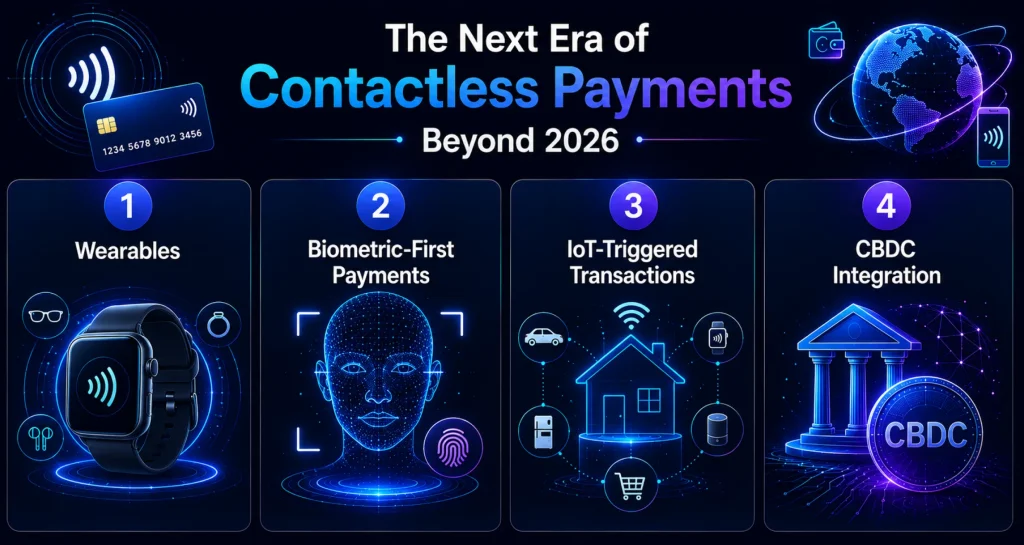
Contactless payments will keep evolving past 2026 as well, and there’s more than one direction it’s going. From wearables to central bank digital currencies, the next wave will reshape how contactless payment app development goes forward.
1. Wearables
Smart rings, watches, and bands are slowly turning into standalone payment devices. So the phone is no longer the main middleman. That push makes tap-to-pay app development lean toward smaller hardware.
2. Biometric-First Payments
Face and palm-based security at checkout is emerging as a replacement for taps in some places. Especially retail and transit. In practice, this means biometric APIs become a must-have core feature.
3. IoT-Triggered Transactions
Connected devices like smart fridges and cars will start triggering payments on their own. For example, for refills, tolls, or subscriptions. Figuring out the eWallet app development cost earlier helps budget for this shift.
4. CBDC Integration
Central bank digital currencies are being test-driven in multiple countries. And most apps will need to handle those payments alongside the current rails. Custom contactless payment apps with flexible architectures adapt more quickly.
How to Choose the Best Contactless Payment App Development Company in USA
Choosing the best contactless payment app development company in USA comes down to three main things. These are the key elements: a proven portfolio, real compliance know-how, and dependable post-launch support.
Before you sign, try to ask each vendor about their experience with PCI-DSS NFC integration. As well as past fintech projects. Octal IT Solution has worked across banking and retail. Along with enterprise fintech products, guiding teams through everything from MVP builds to full-scale compliance reviews.
A lot of eWallet app development companies focus on features. Whereas our experts focus on durable security and long-term post-launch capacity for growth. So you get a partner whether you’re a startup or an established enterprise.
Final Words
In 2026, building a contactless payment app isn’t optional anymore for businesses. They’re looking for faster checkouts, stronger safeguards, and customers who feel more satisfied. From picking the right feature set to planning budgets carefully and choosing the proper partner, every call you make affects how your app behaves when it’s under real load and scale.
Whether you’re working on an enterprise contactless payments app or you’re putting together a simpler tap-to-pay wallet, the core pieces still revolve around safety. If you’re ready to move, then collaborate with a FinTech app development company so you can get a roadmap toward a working product that actually ships.
 By
By April 8, 2026


 Latest Stories
 Get in Touch