



Have you ever wondered what it is like to go to a different place without actually going anywhere? That is exactly the power of the Virtual Reality (VR) system. With the development of more immersive experiences, virtual reality app creation has turned into one of the most thrilling and sought-after fields of technology that can be applied in different sectors of the economy.
It doesn’t matter if the source of the application is gaming, education, real estate, retail, or healthcare; businesses are constantly on the lookout for new ideas to create interactive, life-like, user-friendly minds with which they can engage. How, then, can one go about creating a virtual reality app that will not only engage the user but also be of some use? At this point, the option of designing a bespoke virtual reality app development turns out to be the best.
In this guide, we’re going to point out all the issues that a reader should be familiar with, including the pros and cons of virtual reality, the fields that benefit from it the most, the development process, the most necessary features, the basic tech stack, as well as the approximate cost of customized virtual reality app development. A startup or an enterprise is not important, for if one understands the potential of virtual reality mobile app development, then one can go on to innovate far beyond what was achieved up to that moment.
Also, if you don’t have a clue from where to start, don’t be upset, as we will not just give you the idea of how to develop both Android and cross-platform apps for the virtual world, but also show the steps.
Let us sail in the ocean of deep experiences!
Market Size & Growth Forecast
1. Global VR Market Value
Fortune Business Insight suggests that the total VR market (hardware + software) is expected to soar from US $20.83 billion in 2025 to US $123.06 billion in 2032, with a CAGR of 28.9%.
GlobalData projects a growth from US $11 billion in 2023 to US $57 billion in 2030 (CAGR ≈ 26%).
2. Software-Specific Growth
Statista predicts that VR software will rake in US $4.9 billion in 2025 and US $6.2 billion by 2029 (CAGR ~5.8%).
Only the VR development tools/software sector will be booming from US $6.5 billion in 2022 to US $29.2 billion by 2030 (≈ 20.5% CAGR).
3. Device & Gaming Segment
According to Grand View Research, the VR gaming market is seen to grow from US $32.40 billion in 2024 to US $109.6 billion by 2030 (≈ 21.6% CAGR).
Overall, global VR (hardware + software) is estimated at US $19.44 billion in 2022, with expectations to skyrocket to US $165.91 billion by 2030 (≈ 31% CAGR).
Why Choose Customized Virtual Reality App Development?
Every business is undoubtedly unique; shouldn’t your app be the same? When it comes to implementing highly interactive and functional VR solutions, borrowing a single approach from a family of VR solutions available in the market will not give you results in the long term. That’s where the necessity of customized virtual reality app development is realized.
Instead of riding the same features that everyone uses, tailored VR apps are created to fit specific industry goals, user needs, and brand identities. If you are in the gaming, healthcare, real estate, education, or retail sectors, custom VR apps can increase engagement, improve the user experience, and drive a better ROI.
Here are some of the reasons why it is advisable to invest in a custom-made solution:

1. Tailored to Your Business Needs
Custom VR app development enables you to create and build solutions that are in line with your business objectives, be it product visualization, virtual training, or immersive storytelling.
In retail, a VR app can be targeted at supporting virtual try-ons, whereas in real estate, it can be used for going on 360° property tours, both being applications built to serve distinctly different purposes.
2. Enhanced User Experience
Custom-built VR apps are geared towards easy-to-use controls, immersive environments, and smooth interaction; all of these lead to more engaging experiences.
Developers can predict the needs of the target audience and thus can create app flows and design that is user-friendly, immersive, and give the users a sense of satisfaction.
3. Scalable & Future-Ready
You can adapt and change however you want when you create your own virtual reality application, and you are no longer confined to the frameworks those platforms provide you. You can also grow the functions you currently have, bring in more places, or use the latest technology like AI or blockchain to integrate them.
This adaptability guarantees that your VR application can continue to develop along with your business and industry changes.
4. Cross-Platform Compatibility
Tailor-made VR applications can be created for various platforms such as Android, iOS, or web-based headsets, thus ensuring more extensive reach and better ROI.
For example, choosing Android virtual reality app development gives you the opportunity to reach a huge audience that is using inexpensive VR gear like Google Cardboard or Oculus Quest.
5. Security & Data Privacy
Virtual & Reality applications can be done in a way that a security protocol is implemented. They guarantee a safe user, as well as protected data through an information safety process.
Such a security assurance is an absolute must for those industries where issues like the protection of patients’ personal data cannot be discussed: the healthcare or the education sectors.
6. Competitive Advantage
Next to the unique ones you have, it must create a custom VR app, the customer’s loyal digital differentiator in the market.
Whether you are going to increase your brand awareness, get closer to your customers or improve your operations, the V R development tailor will provide you with a different and unique edge.
Also Read: Augmented Reality App Development: Cost and Features
Key Features of a Virtual Reality App
A winning VR application goes beyond mere visuals; it focuses on fostering engagement, interactivity, and ease of use. Below are some of the features that ensure your VR app stays interesting to the user and hypoallergenic for the user.
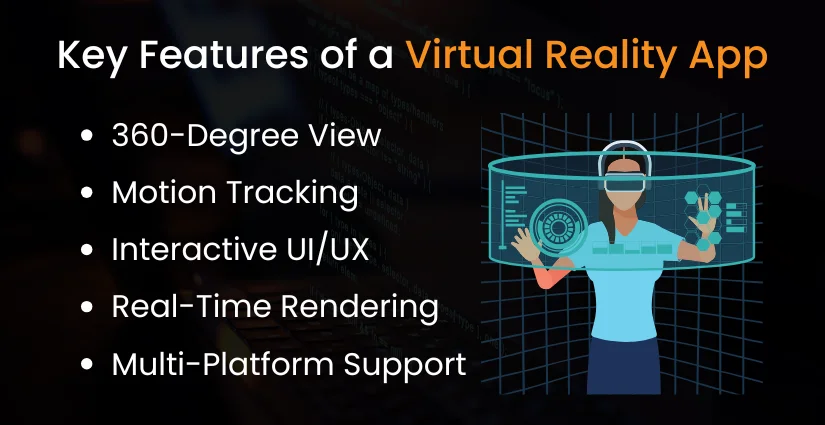
1. 360-Degree View
The feature gives users the freedom to look into the environment from all sides so that the feel of the experience is not only realistic but immersive, too. The feature finds its best use in real estate, tourism, and gaming applications.
2. Motion Tracking
Besides that, motion sensors figure out the user’s head and body movements, therefore making the interaction more natural and smooth. That increases the feeling of being actually there in the virtual scene.
3. Interactive UI/UX
For a VR app, the user interface should definitely be designed such that the user can easily interact with it in three-dimensional space. Such simple tasks as gestures, voice commands, and eyes’ focus-based controls go a long way in making the app more user-friendly.
4. Real-Time Rendering
Amazing, real-time three-dimensional graphics are necessary for no interruption of flow experience. This function guarantees that there will be no jerks or visual problems in the transition or animation.
5. Multi-Platform Support
The capability to extend across various gadgets like Android phones, VR headsets, and desktops increases your app’s potential customer base. It also facilitates Android virtual reality app development and other platforms in a good way.

Virtual Reality Mobile App Development: Key Considerations
Are you thinking of making a VR app for mobile devices? With smartphones becoming more and more used worldwide, plus the low cost of VR headsets, mobile VR app development is leveling up. But in order for your app to provide a smooth and immersive experience on your mobile, you will have to address several important points, ranging from performance to platform compatibility.
Here are six key considerations to keep in mind:
1. Hardware Limitations
Mobile VR applications have to operate efficiently on hardware that has significantly less processing power and memory than desktop VR systems.
Performance optimization is very important, as well as using lightweight visuals, not overloading the processor, and using assets that are suitable for mobile devices.
2. Platform Selection
Decide first if you are going to develop an application for Android, iOS, or both. Android VR app development is more open because there are more devices and headsets that are compatible.
Choosing the right platform guarantees a wider reach and better performance on the devices that you are targeting.
3. User Interaction Design
Mobile VR does not have the same kind of advanced controllers as PC-based VR. Controlling is usually done by looking at something, moving the head, or using simple tap gestures.
Design your UI/UX in such a way that it remains intuitive and user-friendly within the mobile restrictions.
4. Battery & Heat Management
Mobile VR applications can lead to fast battery consumption and also cause the devices to get hot. Hence, efficient coding and asset optimization become crucial.
It is advisable to run the app in the background under real conditions besides simply monitoring performance and avoiding crashes or device warning signals.
5. App Size & Download Speed
Large app sizes may lead to slower downloads, and afterwards, people might uninstall the app. Compress assets and use lazy loading wherever possible.
The lighter an app is, the faster it can be accessed and better retention it will have something very important for mobile users who usually have limited storage and/or slow networks.
6. Offline Accessibility
Mobile users cannot always expect to have access to a strong internet connection. The main part of your app should be available offline or with minimal internet access.
It not only improves users’ emotional experience and still expands market access, but it is also very useful in regions having a weak or unstable internet connection.
Virtual Reality App Development Cost Breakdown
How much does virtual reality app development costs? This is one of the top questions that entrepreneurs usually ask when embarking on a VR app-building journey. The solution lies in many factors, including the app’s complexity, platform, set of features, and the size of the team.
It doesn’t matter if you want to have the simplest VR viewer or a fully interactive 3D world; grasping the price structure is a must. An outline of three types of projects is given below: Basic, Advanced, and Complex. These categories correspond to the overall investment scales in various scopes of virtual reality mobile app development.
Estimated VR App Development Cost by Project Complexity
| Role / Service | Basic VR App ($5K–$15K) | Advanced VR App ($15K–$40K) | Complex VR App ($40K–$100K+) |
| Project Manager | $1,000 – $2,000 | $2,500 – $4,000 | $5,000 – $8,000 |
| UI/UX Designer | $1,000 – $2,500 | $3,000 – $5,000 | $6,000 – $10,000 |
| VR App Developers | $2,000 – $6,000 | $7,000 – $15,000 | $15,000 – $35,000 |
| 3D Artists / Animators | $1,000 – $3,000 | $4,000 – $8,000 | $10,000 – $20,000 |
| QA & Testing | $500 – $1,500 | $2,000 – $4,000 | $5,000 – $10,000 |
| Backend/API Integration | – | $2,000 – $5,000 | $7,000 – $15,000 |
| VR SDK Licensing / Tools | Free – $500 | $500 – $1,500 | $2,000 – $5,000 |
| Total Estimated Cost | $5,000 – $15,000 | $15,000 – $40,000 | $40,000 – $100,000+ |
How to Develop a Virtual Reality App: Step-by-Step Guide
Perhaps you have an idea for a virtual reality application but don’t know the first step. Don’t feel bad; you are not the only one. The need for virtual reality experience is on the upsurge, with more businesses in the game now asking ‘how to develop a virtual reality app that really makes a difference’.
Back in the days when Google Cardboard was all the rage to plan, design and then release VR apps to the market, it was all about a structured process that made sure your app was engaging, functional, and ready to sell.
Here is a concise 5-step manual, which is going to walk you through the main principles of creating an application for virtual reality, be it Android, iOS or cross-platform users.
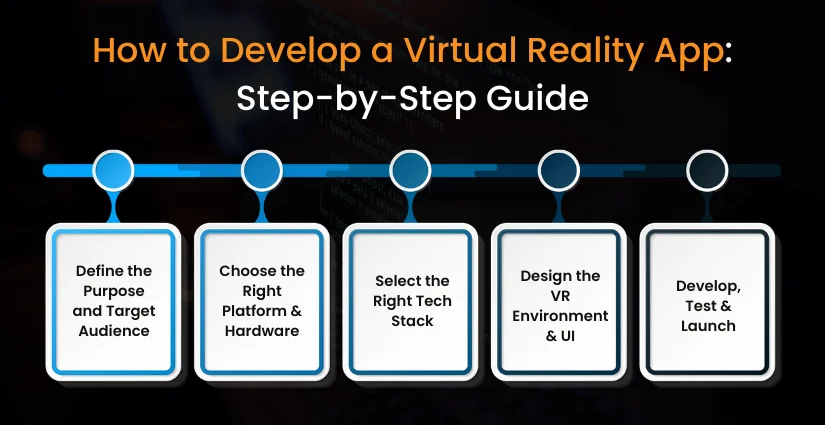
Step 1: Define the Purpose and Target Audience
Don’t just run after the development straight away, it is important to get to know clearly what your application aims at achieving first. Are you going to use it for training, education, games, shopping, or virtual tours? Find out who your potential users are and what problems they set to solve.
The narrowed-down vision enables you to easily select the best features, technology, and user interface.
Step 2: Choose the Right Platform & Hardware
In order to launch your application on Android VR devices, high-performance headsets such as Oculus Rift or HTC Vive, or mobile-based VR platforms like Google Cardboard, you need to decide.
The selection of the platform influences not only the cost of the VR application but also the user experience and time needed for development.
Step 3: Select the Right Tech Stack
Choose VR-compatible development tools and frameworks. The go-to choices are Unity and Unreal Engine for 3D, and SDKs are Oculus SDK or ARCore.
Such tools are the main enablers of the VR experience, which is the gist of VR mobile app development.
Step 4: Design the VR Environment & UI
Along with virtual world creation, introduce interactivity as well. Concentrate on implementing easy navigation, simple controllers, and ensuring user comfort so that the user loses the risk of experiencing motion sickness.
A well-thought-out design can improve app engagement and guarantee a good user experience across various devices.
Step 5: Develop, Test & Launch
After visual and logical aspects have been arranged, implement the app functionalities by writing code. Thoroughly test for program errors, flaws with performance, and user interaction before setting it free in the market.
Once the app is out there, collect users’ opinions and work on the updates. This repetitive process will keep your product looking good.
Read More: Low-Code vs. No-Code Development: Key Differences and Benefits
Challenges in VR App Development
Virtual reality app development is a new field that is full of opportunities, but it also has its own disadvantages. The task of creating a VR environment that is smooth, natural-looking, and highly interactive is a big challenge that requires advanced skills and the proper tools, as well as being very careful with planning. The limitations of hardware and user comfort are just a couple of the many challenges that developers face during the entire development process.
Below are some of the key obstacles in creating VR applications:
1. High Development Cost
The creation of a VR app usually requires complicated design, 3D modelling, and custom programming, which all together can raise the price substantially.
The best mobile game development company is asking themselves about the virtual reality app development cost, and the answer depends on features, platforms, and the level of interactivity. Managing budgets and still meeting quality requirements is a main challenge.
2. Hardware & Device Compatibility
VR apps must be compatible with various devices such as Oculus, HTC Vive, or Android phones that support Google Cardboard.
Making sure that the app performs well on different platforms adds complexity and necessitates extensive testing and optimization, particularly in android customized virtual reality app development.
3. User Comfort & Motion Sickness
Weak design, slow-moving images, or inappropriate movements might lead to the users feeling dizzy or uncomfortable.
Developers need to execute this carefully while designing controls and VR environments so as not to disturb the user’s health and comfort whilst giving the immersive experience.
4. Limited Mobile Performance
Smartphones have limited processing capabilities as compared to desktops or consoles and thus only limited options are available to developers for mobile VR.
Trying to get the best out of both performance and visual quality in virtual reality mobile app development is quite difficult yet an important job.
5. Lack of Skilled Developers
VR, being a skill in a niche area, experienced developers or 3D designers can be extremely rare to find and they are costly to hire.
Working with a mobile app development services provider with the right skills and a good reputation is crucial as it helps shrink the project timelines and ensure that it continues smoothly along the way.
Tips for Successfully Developing Apps for Virtual Reality
Are you looking for a VR app that people will love and remember? Elite virtual reality app development is more than pretty pictures, it is about creating a seamless, interactive, and satisfied experience. No matter if you are a startup or an enterprise, the observance of several essential tactics can assist you in the development of virtual reality apps which are being loved by the users in the market.
Look at these five basic tips to help your development journey:
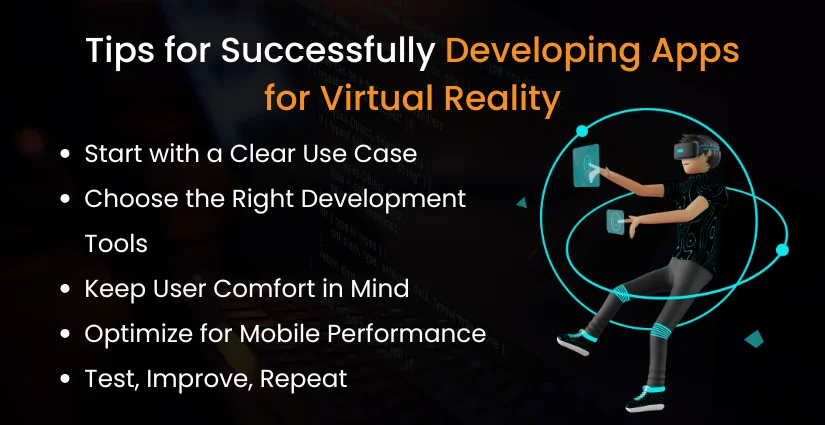
1. Start with a Clear Use Case
Have you ever considered why your VR application should be built before you started designing or programming? What is it intended for: training, gaming, retail, or education?
An application with a single use case will help you to select the appropriate technology, functions, and user experience, which will enable you to have a better development journey.
2. Choose the Right Development Tools
Choosing the right tools (for example, Unity, Unreal Engine, or WebVR) is very important for the performance and scalability of your app.
These platforms are compatible with the major VR device families, thus, among other things, they support cross-device functionality, making it easier to manage virtual reality mobile app development across Android, iOS, and headsets.
3. Keep User Comfort in Mind
Keep in mind that you make everything for the end user. Do not use abrupt motions, complicated navigation, or too many visuals that can be the reason for your client’s motion sickness.
A good and comfortable user experience in carrying out the functions of the app will increase loyalty and reduce the problem of users leaving the app.
4. Optimize for Mobile Performance
If you are creating an app for mobile phones, lower the sizes of files, compress assets, and do tests on many devices.
This statement is very true, particularly in android virtual reality app development, where device capabilities can vary widely.
5. Test, Improve, Repeat
VR apps are constantly at risk of bugs, as they are in good part of their complexity inherent to the user interface, and thus, it is necessary to keep usability testing going.
Ongoing testing gives you a finished product that is of higher quality and also guarantees that your app is evolving with the changes in the users’ needs and technology trends.

Conclusion
Virtual reality has become a game-changer in how businesses interact with their customers, irrespective of whether it is in the gaming, healthcare, education, or retail sectors. By choosing customized virtual reality app development, you can build immersive experiences tailored to your audience and goals. Although issues like cost, performance, and design complexity are present, adhering to adequate steps and strategies can help you accomplish the goal of creating virtual reality apps for Android, iOS, or headsets.
If you are still contemplating the means to create a virtual reality application or the cost of virtual reality application development, collaborating with a proficient team can definitely ease the process considerably. There is no better time than now to launch a virtual reality mobile app and make your ideas come true.
FAQs
The cost varies from $5,000 to $100,000+, completely depending on the app complexity, cards, and platform.
Typically, a standard VR app will take 3 to 6 months, and if it is complex then it will take more.
To name a few, some of the commonly used tools are Unity, Unreal Engine, Blender for 3D, and Oculus SDK, ARCore, or WebVR for platform integration.
Yes, the virtual reality android app development sector has huge support from the participation of different tools such as Unity and Google Cardboard SDK.
Industries such as gaming, health care, education, retail business, and real estate use VR to make their customers more engaged and train the staff better.


 Get in Touch
 By
By September 30, 2026