


Mobile app design is no longer merely of aesthetics; it’s a matter of survival in a world where users spend more than 4 hours a day on their smartphones. If you lose users within a few seconds, your app is poorly designed. A well-designed app will earn your loyalty and help you in creating a sense of brand.
It involves creating the visual design, user experience, and interactive features of a mobile app. From the color palette and typography to the response of a button on being tapped, it connects a potent back-end with a real person using the app day after day.
In 2026, mobile users are more demanding than ever. They want to be able to navigate easily, load quickly, have personalized experiences, and access your site on any device. This is why it is one of the wisest things a business can do to invest in professional mobile app design services from the very beginning and not try to work in design at a later stage in the process.
From trends to process, types to costs to platforms to getting started, this guide covers it all. Whether you are a startup introducing your first product or an enterprise in need of an app modernization this blog is perfect for you.
What Are the Top Mobile App Design Trends to Follow in 2026?
The mobile app development market is rapidly growing. The report published by Grand View Research has anticipated that it will reach 626.39 billion by 2030. The CAGR will remain at 14.3% from 2024-2030.
Mobile app design trends are not simply a luxury; they’re a necessity for staying ahead. User tastes and preferences change rapidly, and out-of-date apps lose trust of users very rapidly. Here are some of the key new mobile app design trends that’ll shape this year’s experiences.
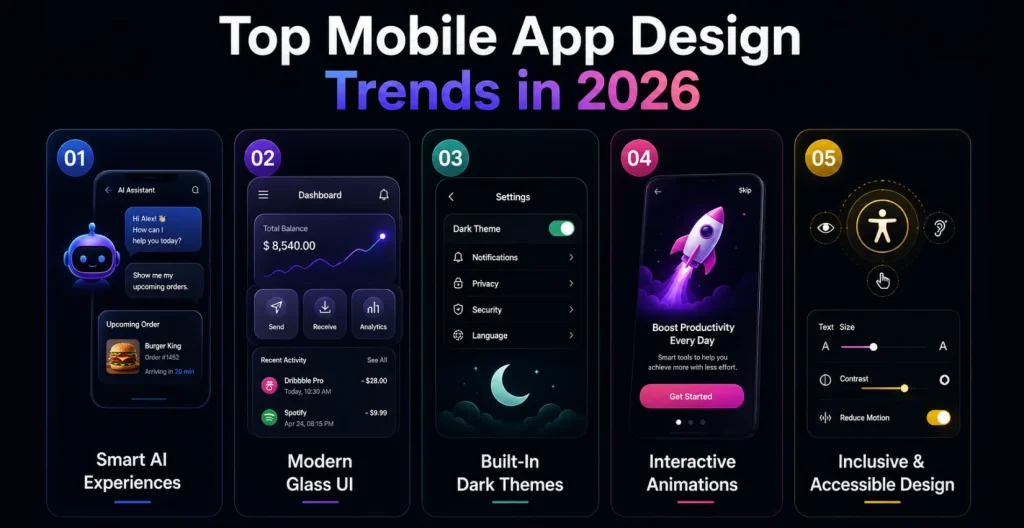
AI-Driven Personalisation
Today, AI has been incorporated into the design layer. Apps are ‘optimizing’ their layout, content and interactions in real time, depending on individual user behavior. AI-driven personalisation, from dynamic home screens to intelligent content suggestions, is boosting the user expectations of the mobile experience.
Glassmorphism and Soft UI
Frosted glass, blurred backgrounds and layered translucent cards are still trending in 2026. These styles, coupled with soft UI (neumorphism), give the feel of premium yet not heavy depth and dimension.
Dark Mode by Default
Dark mode has become a default setting for many of the best apps. It helps alleviate eye strain, extends battery life on OLED screens and is cleaner. Creating designs for dark mode results in much more consistency in the images from the beginning, instead of the end.
Motion and Micro-Interactions
Subtle animations, loading transitions, and button feedback signals create a sense of responsiveness and life in an app. A well-executed micro-interaction can help the user to feel in control and lessen the cognitive friction.
Accessibility-First Design
Inclusive design is no longer just a best practice, it’s a requirement in many markets. From the outset, designers create for screen readers, color-blind users and different motor capabilities. This benefits all users, not just those with disabilities.
Get Our Services: Mobile App Development Services in California
How Does the Mobile App Design Process Work Step by Step?
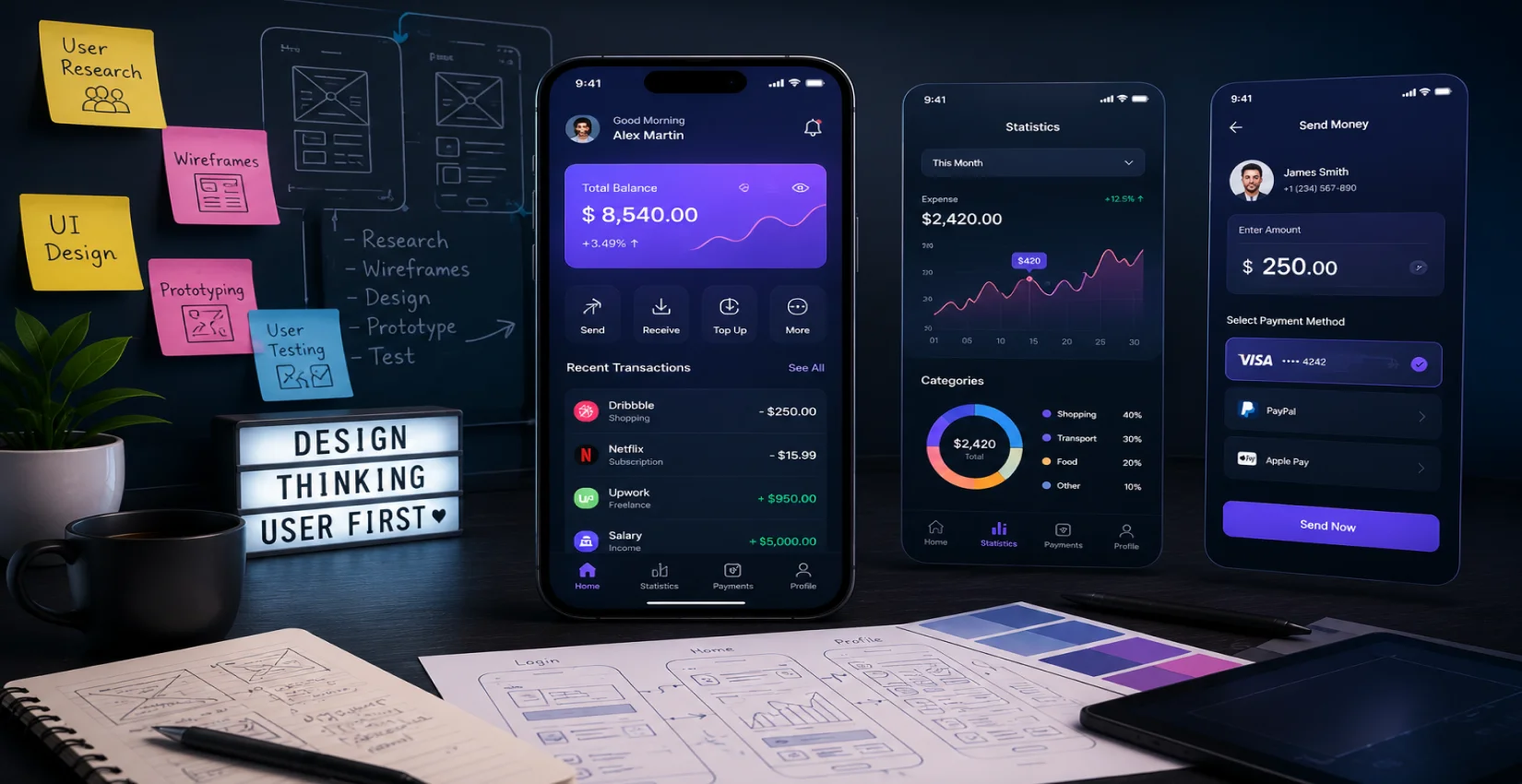
The difference between a quality, successful mobile app and an app that is buggy and confusing is its structured mobile app design process. The mobile app UX design process is generally divided into five steps as follows:
1. Discovery and Research
All good apps begin with certain questions. Who are the users? What issues do they have to solve? What are the strengths of their competitors? What are their weaknesses? This step includes talking to users, conducting a competitive analysis, creating personas, and establishing key success indicators (KSIs). The number one reason apps fail after launch for not doing research.
2. Wireframing
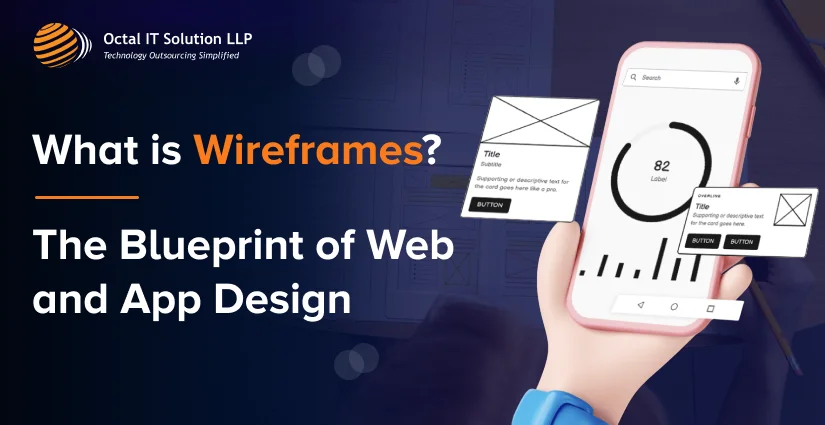
Wireframes are a simple drawing of the screen arrangement of the app. They provide a framework to the internet site with a navigation bar, a place to deliver website content and a place to add calls to action without any color or style. To test logic and user flow at a low cost, and before going all out with design, wireframing can be used.
3. Prototyping
Prototype is a wireframe that can be clicked-on and interacted with. It lets stakeholders and designers explore and experiment with user journeys without writing any code, mimicking the real app experience. Prototyping is fast and can be done together using tools like Figma and InVision.
4. Visual Design
This is where the app identity comes into play. Here are defined typography, color systems, icon sets, spacing and component libraries. For creative prototypes, profile screens, promotional previews, or social-facing app content, designers can use tools like Fontgen to generate copy-ready Unicode text styles for usernames, captions, bios, and other digital elements. At this stage, a robust design system accelerates the development process, ensures uniformity throughout screens and simplifies future modifications.
5. Testing and Iteration
Real usability test with real users using usability sessions, A/B testing and heatmaps. Feedback is collected, pain points are pinpointed and design is improved. This process is repeated until the experience becomes smooth, intuitive and goal-directed for the business.
By working with a reliable Mobile App Development Company in the USA, every step is carried out with the proper proficiency and responsibility.
What Are the Key Types of Mobile App Design You Should Know?
Knowing the various types of mobile app design lets you make an appropriate architectural decision prior to being able to compose a solitary line of code.
Native App Design
Native apps are developed for a particular platform (iOS or Android). They are designed to fit the platform’s design language (Apple’s HIG or Google’s Material Design), are quick and natural, and are fully integrated with the device. Native design generally provides the highest quality user experience, and the best performance.
Cross-Platform Design
The Cross Platform apps will be built with a common code, and will run on both iOS and Android. Both platforms’ design should be taken into account at the same time. Appearance tweaks are possible like a technology like Flutter or React Native. This results in cost reduction, faster time to market and not sacrificing a significant amount of quality.
Progressive Web App (PWA) Design
PWAs behave and look like native apps, while operating in the browser. They can be installed, are offline and load instantly. PWA design principles are about balancing for mobile usability while also taking into account browser limitations and are particularly effective with content-driven or ecommerce products where reach is more critical than device integration.
Hybrid App Design
Hybrid apps are ones that contain web content wrapped in a native shell. They are easily created and easily updated, but they may need careful design so that they don’t seem like a “web-in-a-box,” something that users will immediately recognize.
Hybrid apps can actually look very native and feel very native with a little bit of ingenuity from the designer, using the right components and providing motion.
But when it comes to creating an app that will offer a valuable service to your audience, the design that you choose should be based on user needs and not on your budget.
How Much Does Mobile App Design Cost in 2026?
One of the most frequently asked questions is “how much does it take to design a mobile application?” The answer is, it depends on the level of design and complexity, what platform you are making it for, where your team is, and where your users are.
When it comes to the mobile app UI design cost, there are a few of the most important factors: number of screens, need for custom animation and interactions, number of platforms to be designed for, depth of prototyping and user testing, and the need for a full design system.
Let’s take a realistic look at the various mobile app design cost breakdowns of 2026 based on complexity levels:
| Complexity of the App | Screens | Design Cost Range | Typical Timeline | What’s Included |
| Simple | 10-20 | $5,000- $10,000 | 2-4 weeks | Wireframes, basic UI, 1 platform |
| Mid-Complexity | 20-40 | $10,000-$20,000 | 5-10 weeks | Custom UI, prototyping, 2 platforms |
| Complex/ Enterprise | 40+ | $20,000+ | 10-14 weeks | Design system, animations, accessibility, multi-platform |
The cost of designing a mobile application also varies depending on the professionals that you hire. Freelance is the cheapest option, but does not necessarily have end to end process knowledge. In-house teams provide control, but incur high costs.
Full-service agencies such as Octal IT Solution provide mobile app design services from research to wireframes to the creation of final UI assets and handoff to the developers in a systematic, process-driven fashion that minimizes costly rework.
When you understand how much a mobile app design will cost, there will be no scope creep and you will be able to know how much your product will need.
Based on numerous successful app design projects, investing in UI/UX development can deliver significant value to a product, making it one of the highest-ROI business decisions.
The price to build a mobile app response also varies across platforms, with designing for both platforms (iOS and Android) at the same time being more expensive than a single-platform approach, but cross-platform design frameworks such as Flutter can help keep the price gap to 30–40% of fully separate native designs.
When you research the Best UI UX Design Agencies in detail and cost breakdown, you will have a better idea of what the market rates are for your project scope.
Emerging Technologies and Trends in Mobile App Design
In addition to visual trends, there are a number of new technologies changing the landscape of mobile app design in 2026. These are the driving forces behind the new mobile apps design and development solutions scene.
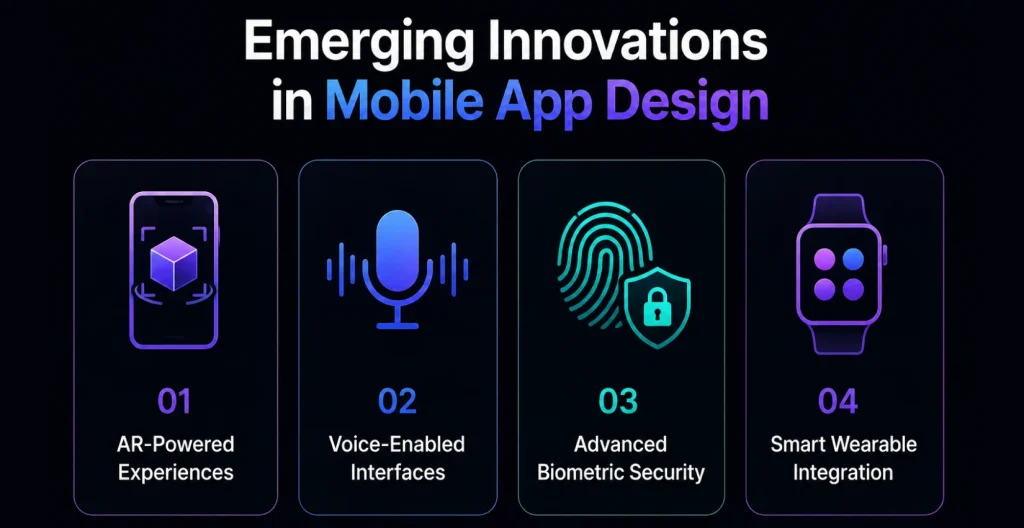
Augmented Reality
In the realm of retail, real estate, and education, augmented reality (AR) is becoming an integral part of their application. Designing for AR is 3D, you’re thinking in terms of overlaying digital on the physical world and that means new UX patterns and interaction models.
Voice Interface
Voice and gesture interfaces are decreasing “touch” dependency. Apps are being built to be used hands-free, requiring good audio feedback, conversational flows and graceful fall backs for noisy environments.
Biometric Authentication
Biometric authentication UX – fingerprint, face unlock, and behavioral biometrics is being integrated effortlessly into app flows. How to make the security invisible, fast, frictionless, trustworthy.
Wearable Technology
The wearables first approach more users wearing smartwatches and health trackers. If you’re creating an interface for a 44mm screen which you are required to glance at, information should be prioritised and only the most essential information should be provided at the right time.
For businesses considering investments in Mobile Web Design Services or native mobile products in 2026, it’s crucial to grasp these changes.
In this context, the mobile app design issues are quite real, such as how to design mobile apps in a consistent manner on a constantly increasing array of form factors and modes of interaction. Another issue is how to provide a coherent brand experience. Other issues in mobile app design are related to customization and privacy as well as adapting UI using AI while making the user feel as if they are not under surveillance.
The ideal platform for teams creating more sophisticated mobile app design and development solutions is one that everyone on the cross-functional team can actually use together without friction designers, developers, and product managers alike.
Refer to the entire mobile app development guide and get an understanding of design tooling’s place in the product development lifecycle.
Conclusion
The design of a mobile application in 2026 is much more than just an artistic endeavor; it’s a strategic way of thinking. It’s an effect that impacts user retention, brand perception, product quality and finally, revenues. From all the latest mobile app UI/UX design trends to the strict mobile app UX design process, each of your mobile app design choices will impact the performance of your mobile app in the marketplace.
Whether you’re thinking about the cost of your mobile app user interface design in a budget or the choice between a native or cross-platform app, or selecting the design software for your team, your decisions up front set the product you ship.
Whether you’re a business seeking to accelerate your mobile application design process without compromising quality, Octal IT Solution has you covered with end-to-end mobile app design services, from discovery to design system creation. Our team of experts are the best and you can Hire UI/UX Developers or take care of the whole UI/UX design engagement from start to finish.
Ready for some great building? Meet the people and get a free design consultation today. If you want to get more technical details, check out our UX/UI Development projects to be one step ahead of the rest.


 Get in Touch
 By
By June 9, 2026