


Key Takeaways
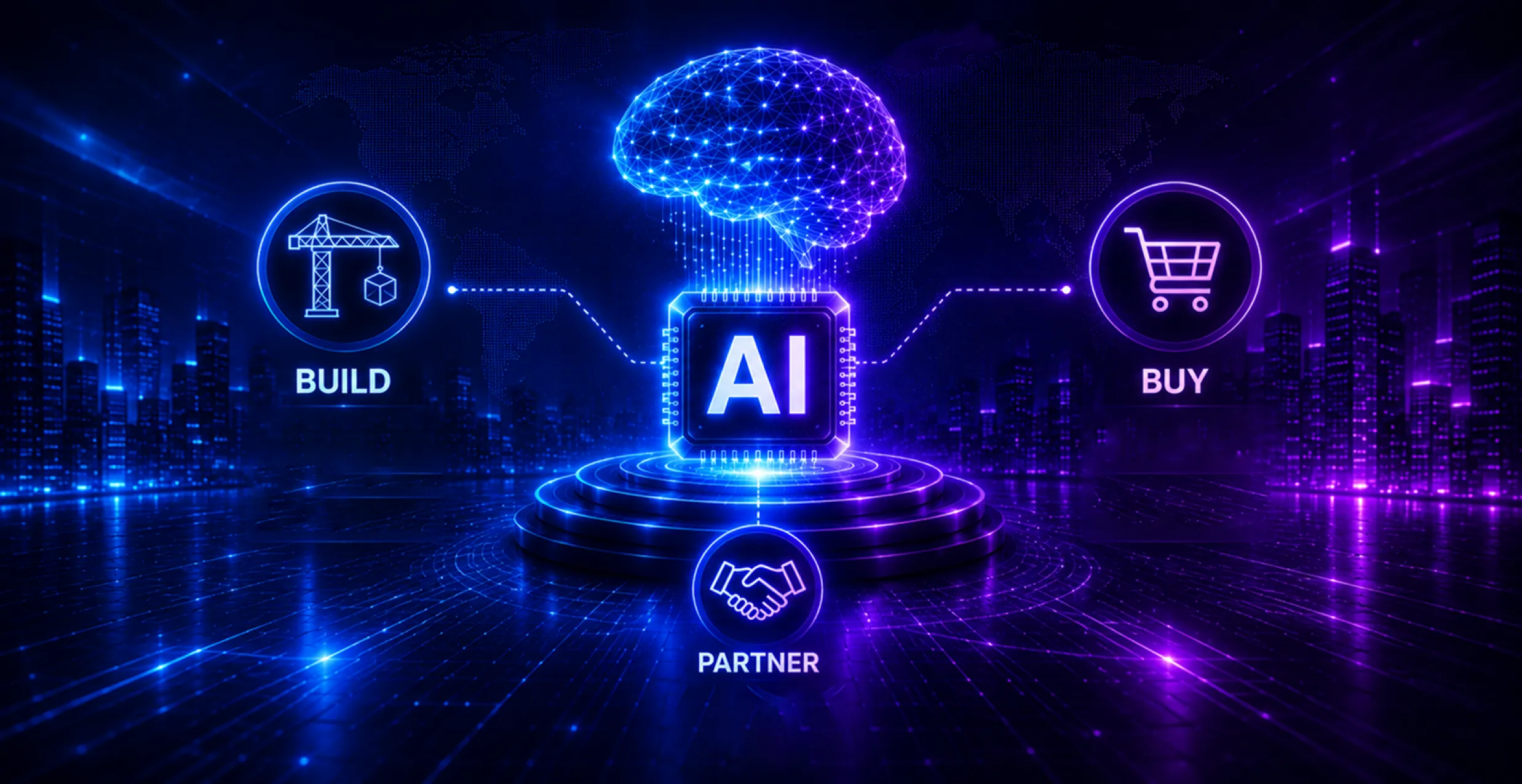
- The enterprise AI market is rapidly expanding, and companies must choose wisely between building, buying, or partnering for AI solutions.
- Building in-house provides control and customization but requires significant investment in talent and infrastructure.
- Buying pre-built AI tools offers quick setup but may not perfectly fit unique workflows and includes vendor management risks.
- Partnering combines the benefits of both building and buying, providing expertise and scalability while mitigating risks.
- Ultimately, enterprises should assess their budget, timeline, internal talent, and data maturity before deciding on their AI adoption strategy.
Should your enterprise build its own AI, grab a ready-made platform, or loop in a partner to get it right the first time, maybe? The enterprise AI market was worth USD 114.87 billion in 2026. Additionally, it’s likely to climb to USD 273.08 billion by 2031, rising at an 18.91% CAGR, per Mordor Intelligence.
Even as adoption grows over the next few years, choosing the wrong entry point can quietly consume time and burn millions of dollars. This is why a clear, no-nonsense comparison of enterprise AI solutions matters. Also, a well-defined AI transformation roadmap helps. Because that’s what separates the organizations that scale AI successfully from those stuck in pilot purgatory.
What Does “Enterprise AI Adoption” Actually Mean Today
Enterprise AI adoption right now isn’t only about dropping in a chatbot. More like a whole shift in how an organization runs day-to-day. What used to be scattered pilot efforts have now matured into a structured approach to enterprise AI development across operations, customer service, finance, and even product design.
In practice, modern enterprise AI implementation lands on the core workflows. It plugs into existing data infrastructure, and it needs governance that spans every department that ends up using it. The companies that treat AI like a long-term strategic capability.
Not just a one-off gadget, it tends to build a long-term competitive advantage. They move from random experiments into something measurable, scalable, and of actual business value.
The Three Paths to Enterprise AI: An Overview
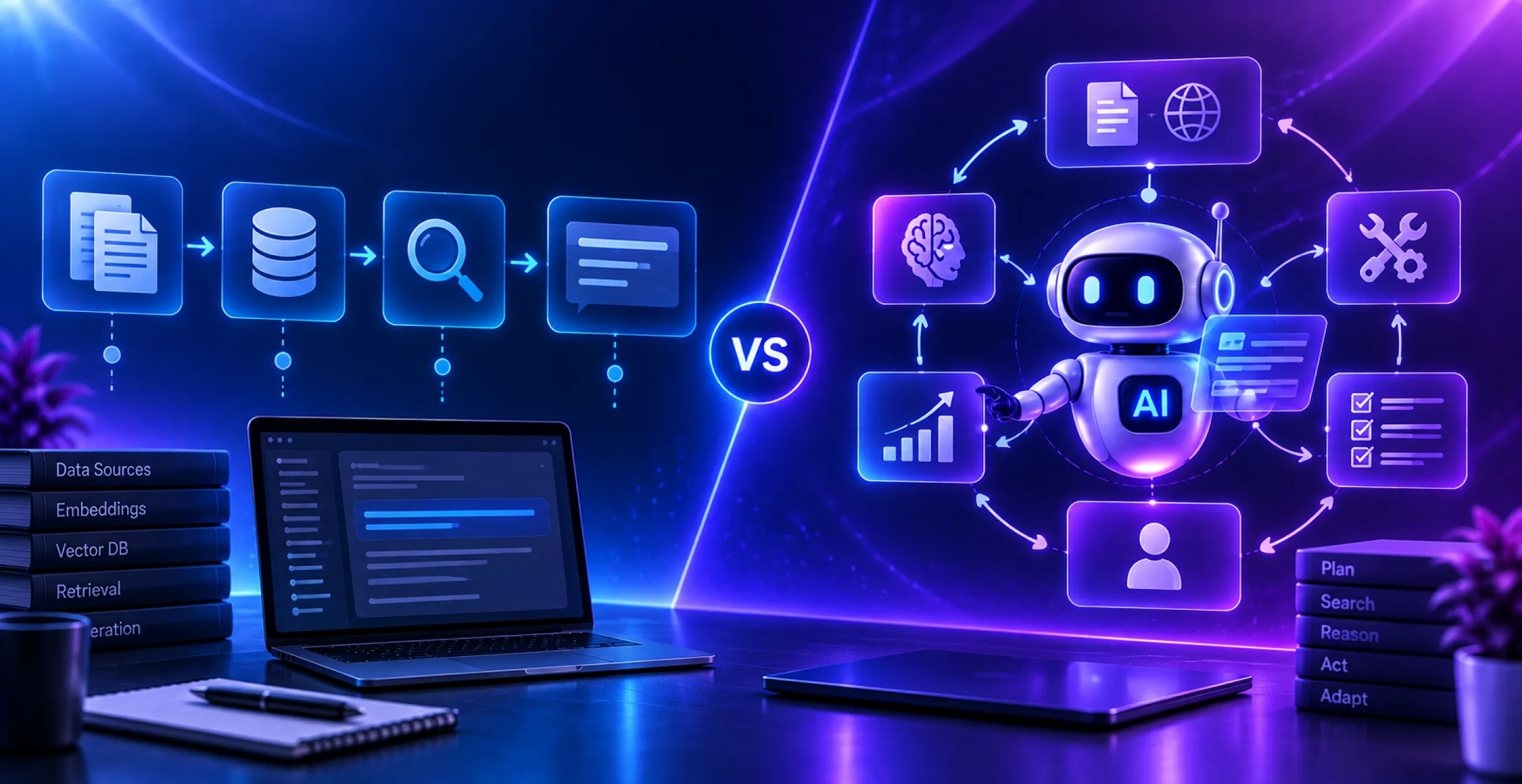
Every enterprise eventually hits the same turn in the road: build vs buy vs partner AI. Each option brings its own mix of control, pace, and cost, and choosing the wrong lane can quietly push an AI initiative back months. Before you zoom into cost or benefits in full detail, it’s useful to see what each route tends to look like day-to-day. This is also where a seasoned AI implementation partner lands in the whole decision.
1. Build: In-House AI Development
Building in-house means assembling your own data scientists and ML engineers. Along with the infrastructure people who can stand it up. This can give you maximum control and deep customization, but it also asks for serious time and budget. As well as highly specific skills, and a lot of enterprises don’t have them on staff.
2. Buy: Off-the-Shelf AI Solutions
“Buy” means licensing a ready-made AI product. Think a CRM’s built-in AI, a SaaS analytics tool with embedded intelligence, or a vendor’s out-of-the-box model. Well, often the quickest way to begin, but you may end up bending your workflows so they match someone else’s platform.
3. Partner: Working With an AI Implementation Partner
Partnering is the middle ground. An external AI implementation partner helps design, build, and then deploy custom AI solutions alongside your team. The idea is you get a customization level that’s closer to in-house work. While still experiencing buy-level speed and with less upfront risk.
Build: Developing Enterprise AI In-House
If you bring AI development in-house, enterprises gain real control and full ownership of their roadmap, data, and models. Still, before you pour in real resources, it is smart to figure out what “building” means and what it delivers in day-to-day terms. And where the whole process can quietly get expensive.
1. What Building In-House Involves
A. Talent
Building in-house means hiring ML engineers, data scientists, and MLOps specialists. This becomes a specialized little squad, and they often need 6-9 months to reliably recruit and retain.
B. Infrastructure
You will also need GPU compute, secure data pipelines, and model hosting infrastructure. However, that’s not one-and-done. It calls for continuous spending long past the first project budget most teams plan for.
C. Timeline
A production-ready in-house model often takes 9 to 18 months from scoping through launch. Depending on data readiness and internal AI maturity.
2. Benefits of Building Your Own AI Capability
A. Full Ownership
Complete control of the models, data, and roadmap means enterprises can tune AI to their own workflows precisely. Without having to rely on an external AI application development company.
B. Institutional Knowledge
In-house teams build practical AI knowledge over time, so later iterations involve retraining. Additionally, scaling goes faster once that foundational capability is established.
C. Data Security
Sensitive data never leaves your infrastructure, which matters most for regulated industries like banking, healthcare, and insurance, especially when handling confidential customer information.
3. Challenges and Hidden Costs of the Build Approach
A. Talent Costs
Hiring and keeping specialized AI talent can get pricey, and the market is competitive. It often ends up costing more each year than working with a reputable enterprise AI development company instead.
B. Ongoing Overhead
Costs for compute, monitoring, retraining, and security patching tend to stack up fast. In addition, it can end up doubling the original project estimate within the first two years.
C. Slower ROI
A slower time-to-value delays returns if there are any missteps in model design or data strategy. They compound over the next months, so you may need costly late-stage fixes.
Buy: Adopting Off-the-Shelf Enterprise AI Solutions
Buying pre-built AI tools is often the fastest way to get up the AI ladder. Furthermore, in the buy vs build AI debate, the off-the-shelf route usually sounds clean. But those ready-made solutions bring some trade-offs that enterprises should look at first. Not just after the budget is already committed.
A. What Buying Pre-Built AI Solutions Looks Like
1. Ready-made Products
Buying means you subscribe to a vendor’s existing AI offering, like CRM AI add-ons or analytics platforms. Or even tools tuned for specific industries, created by established AI development companies for immediate use.
2. Faster Setup
Implementation is mostly configuration, not custom building. So a lot of these can be ready in weeks instead of the months that in-house builds typically require.
B. Benefits of Buying vs Building
3. Lower Upfront Cost
Lower upfront costs and faster deployment. That combination makes buying practical for enterprises. That want quick wins without needing to hire and organize a full internal AI team.
4. Vendor-managed Upkeep
Vendors typically handle updates, security patches, and model improvements. So the long-term maintenance burden is lighter compared to what in-house teams would end up carrying themselves.
C. Limitations of Off-the-Shelf Tools for Enterprise Needs
5. Limited Fit
Pre-built tools rarely match unique workflows perfectly. This can lead to enterprises adapting their processes around the software instead of the reverse.
6. Customization Gaps
Sometimes partnering with an enterprise AI solutions company fills those missing pieces. Pure buy-only tools can’t close the gap by themselves.
Why Most Enterprise AI Fails & How to Overcome It
Even with heavy investment, most enterprise AI initiatives just stall out before they ever reach production. Once you see where things typically break. The first real move toward a better AI implementation services engagement.
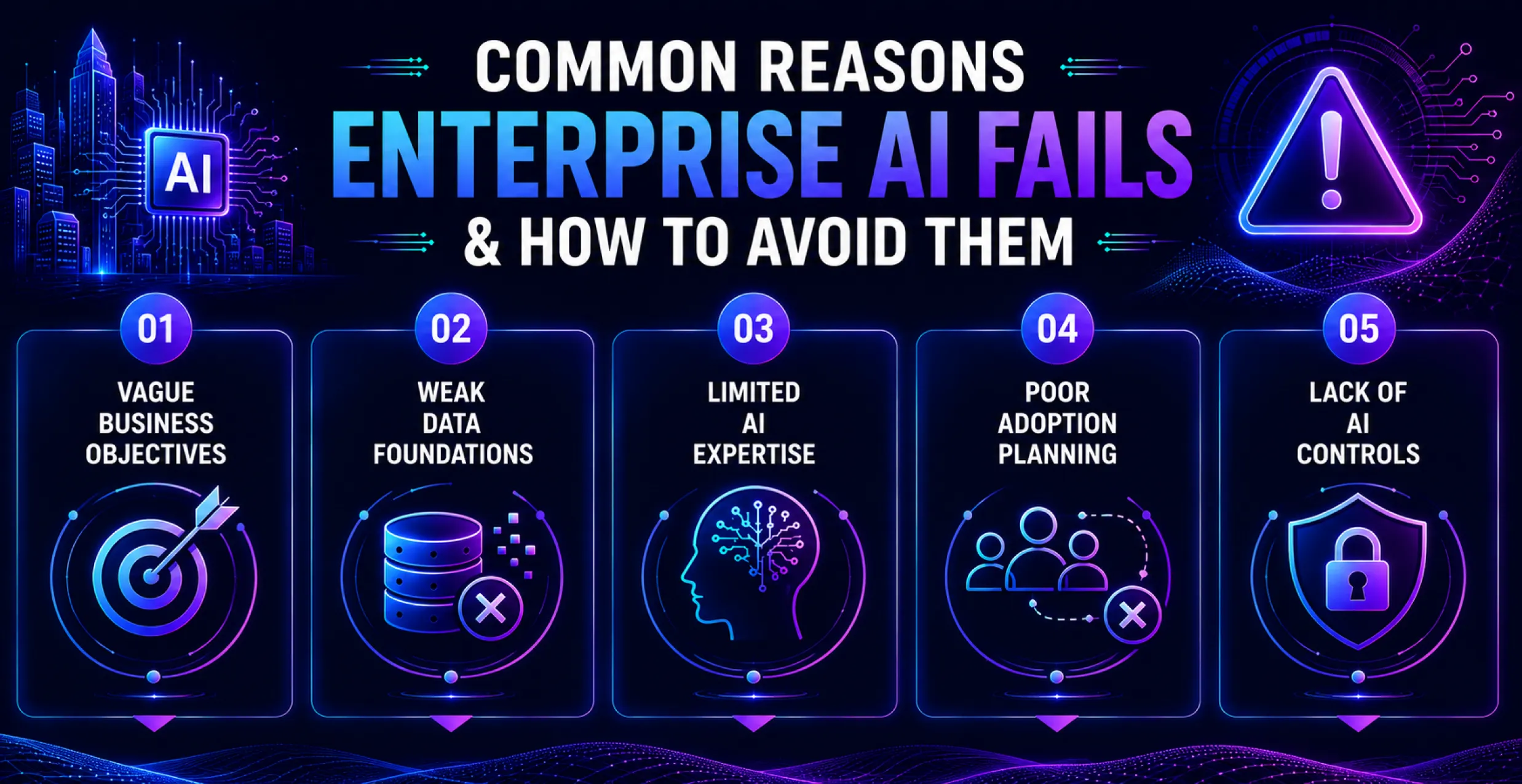
1. Unclear Business Goals
A lot of teams kick off by chasing the technology first, not the actual problem. And the result is AI pilots that don’t connect to anything you can measure, like ROI targets or business impact.
2. Poor Data Quality
When data is disorganized, siloed, or incomplete, it quietly drags down even the smartest models. Furthermore, trying to “repair the foundations” after the pilot tends to cost way more than doing it upfront.
3. Lack of Internal AI Skills
Without dedicated expertise, it’s hard to go beyond a proof-of-concept stage. So many enterprises end up depending on external AI integration services for delivery and scaling.
4. Weak Change Management
Employees often resist tools they don’t understand or don’t trust, so adoption freezes. Even when the AI model is doing exactly what it should.
5. No Governance Framework
Without clear ownership, ongoing monitoring, and compliance checks. AI systems can drift over time, lose accuracy, and end up creating risk rather than consistent value.
Build vs Buy vs Partner: Cost Comparison
Cost is usually the major decider in every build vs buy AI cost chat. If you line up build vs buy AI options side by side, looking at upfront and ongoing costs. Along with the less apparent hidden costs too, the picture gets clearer than just looking at price tags.
Upfront Costs Across All Three Models
| Model | Typical Upfront Cost (USD) | What It Covers |
| Build | $150,000 – $500,000+ | Talent hiring, infrastructure setup, initial model development |
| Buy | $10,000 – $100,000/year | License fees, onboarding, basic configuration |
| Partner | $50,000 – $250,000 | Custom scoping, development, and deployment via an experienced team |
Long-Term and Maintenance Costs
| Model | Typical Annual Cost (USD) | What It Covers |
| Build | $200,000 – $600,000/year | Salaries, computers, retraining, security |
| Buy | $20,000 – $150,000/year | Subscription renewals, add-on modules |
| Partner | $60,000 – $200,000/year | Ongoing support, optimization, model updates |
Hidden Costs Enterprises Often Overlook
| Model | Common Hidden Costs |
| Build | Talent attrition, compute overruns, delayed ROI |
| Buy | Vendor lock-in, integration gaps, customization limits |
| Partner | Dependency on external timelines if scope isn’t clearly defined |
No matter which route you pick, enterprises should model total AI development cost across a 3-year horizon. Not just year one to avoid budget surprises down the line.
Build vs Buy vs Partner: Side-by-Side Comparison Table
Once the numbers are on the table, it’s easier to see build vs buy AI solutions set out next to each other. This comparison pulls together speed, cost, control, scaling ability, and risk across all three enterprise AI solution paths.
| Factor | Build | Buy | Partner |
| Speed to deploy | Slow (9–18 months) | Fast (weeks) | Moderate (2–6 months) |
| Cost | High upfront | Low upfront, recurring | Moderate, scoped |
| Control & customization | Full | Limited | High |
| Scalability | Depends on internal capacity | Vendor-dependent | Flexible, expert-led |
| Risk level | High (execution risk) | Moderate (fit risk) | Lower (shared expertise) |
For enterprises that want deep customization without carrying the internal build load. Partnering with a team that provides full enterprise artificial intelligence development services can balance those five factors best.
Key Factors That Should Influence Your Decision
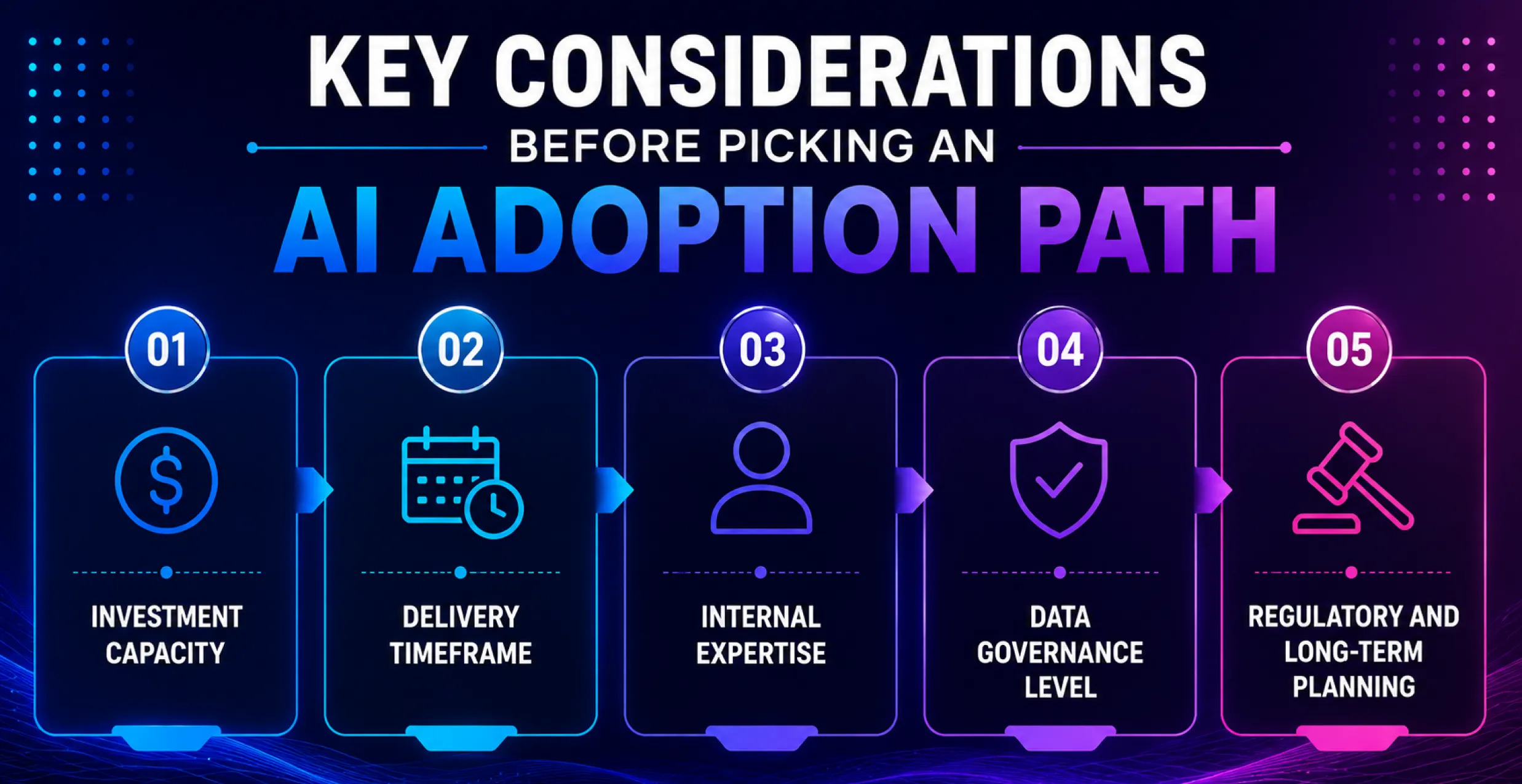
Choosing between build, buy, and partner is not that simple, and it’s definitely not a one-size-fits-all decision. The most sensible way for large enterprises to adopt AI depends on a set of internal realities. You should face them squarely first before anyone pins down budgets or timelines.
1. Budget
If you build, you’re generally looking at the heaviest capital spend, while buying is the lowest cost up front. Partnering often lands somewhere between those two. So you’d better match the plan to what your finance team can sustain over the long term.
2. Timeline
If executives are asking for noticeable traction within one quarter, then buying or partnering will almost always get you moving quicker than building an in-house enterprise AI adoption strategy from the ground up.
3. In-house Talent
If your organization doesn’t already have ML specialists, then you may need to hire AI developers or bring in external consultants before you even begin a serious internal build effort.
4. Data Maturity
When your data is organized, centralized, and properly governed, building or partnering becomes a lot more feasible. But when the data is messy, that often signals you should lean toward buying a proven, pretested solution instead.
5. Compliance and Roadmap
For regulated sectors, and for enterprises that are thinking long-term about AI, building or partnering frequently makes more sense. Off-the-shelf tools rarely meet strict audit, governance, and roadmap needs.
How to Choose the Right AI Adoption Strategy for Enterprise?
Turning this decision into action takes more than just gut instinct. Use this checklist to shape a practical AI transformation plan. That actually matches your enterprise’s real constraints and aims, not some idealized version.
1. Define the Business Problem
The exact outcome you’re trying to solve for before you even look at any vendor or platform or build it internally.
2. Audit Your Data and Infrastructure
A believable enterprise AI plan begins with figuring out what data you truly have and where the gaps sit.
3. Map Your Internal Capabilities
Take a hard look at what your team’s skills are versus what a build would demand. Including the upkeep and maintenance after the initial launch.
4. Evaluate Vendors and Platforms
Pick about two or three AI development platforms, then test how well each one plugs into your current systems and day-to-day workflows.
5. Pilot Before You Scale Day-to-Day
Run a smaller proof of concept with clear success metrics first before you tie up an enterprise-wide budget to any one option.
Case-Based Scenarios: Which Model Fits Which Business
Not every enterprise fits the same mold. How the “build, buy, and partner” choices shake out varies a lot based on business size and maturity. As well as how prepared the organization is to accept all that change, not just the technical part but also the operational things.
1. Startups
With limited budgets and small teams, buying off-the-shelf AI tools often feels like the easiest move, at least until product-market fit starts to click and revenue is strong enough to justify going deeper into custom, enterprise-grade AI agent development.
2. Mid-market Companies
For these organizations, it tends to work better to lean on an AI implementation partner. That way they can get bespoke capability without the extra overhead of spinning up a full internal AI department.
3. Large Enterprises
When budgets are higher, and workflows are more tangled, building in-house AI becomes more tempting. In many cases it’s particularly true for core, differentiating capabilities where control counts and long-term flexibility matters.
4. Regulated Industries
Banks, insurers, and healthcare organizations usually end up needing a hybrid approach. They partner for speed, but they keep sensitive data processing in-house to satisfy compliance requirements and to reduce exposure overall.
5. Fast-scaling Companies
When growth is rapid, flexible AI that’s built with partners and embedded into workplace tools becomes super compelling. It scales quicker than hiring an entire internal team, and that gap matters day to day, even when priorities keep shifting.
Common Mistakes Enterprises Make in Build vs Buy vs Partner Decisions
Even in well-resourced companies, that whole build vs buy vs partner AI decision. These recurring traps that keep popping up. They’re worth noticing early, before you commit to a budget or timelines.
1. Choosing Based on Trend
Starting an in-house build just because other companies are doing it. But not actually checking whether it fits your specific use case or whether your team has the genuine bandwidth.
2. Underestimating Maintenance
Teams think about the launch, but they forget the day-to-day stewardship so the models stay accurate, secure, and compliant over time.
3. Skipping Due Diligence
Picking the first enterprise AI development firm or vendor you happen to meet. Without validating references, looking at prior outcomes, or pulling apart their delivery record.
4. Ignoring Change Management
Rolling out a new tool to create AI app features without training staff results in low adoption, regardless of the tool’s technical quality.
5. No Exit Strategy
Getting stuck with a vendor or platform, with no clean route out or thoughtful scaling later, limits flexibility as needs evolve.
Why Partnering Often Offers the Best of Both Worlds?
Partnering fixes the stuff that a pure build or buy just can’t always touch. It mixes speed, tailored capability, and less risk into this workable forward path.
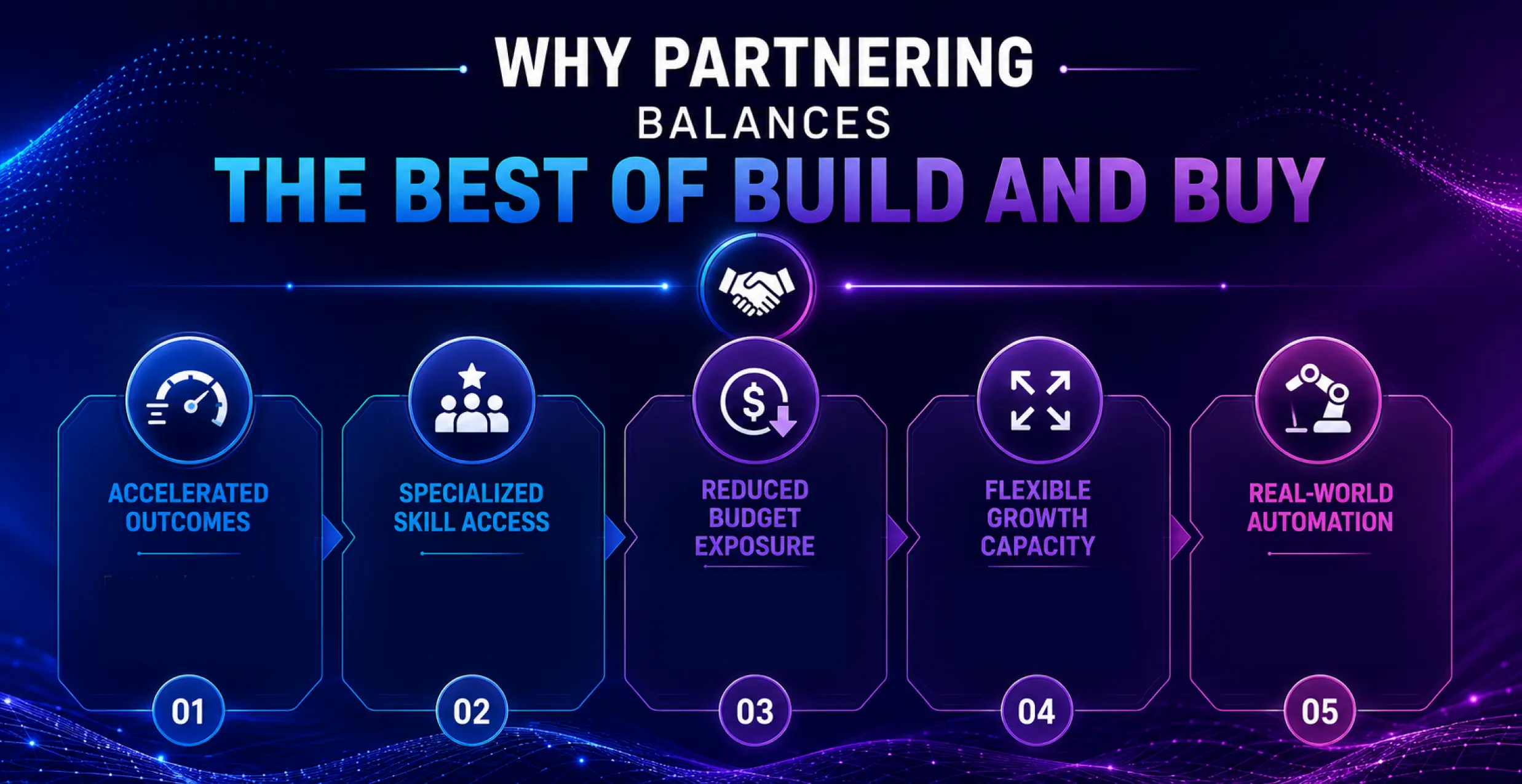
1. Faster Time-to-value
A partner comes with pre-built frameworks and experts who have done it before. So deployment is faster than starting an in-house build from zero.
2. Access to Specialized Expertise
The partner can deliver full AI implementation work, end-to-end. Without you paying for the whole cycle of hiring, training, and keeping a permanent AI team around.
3. Lower Financial Risk
With a defined scope, you limit how far things can stretch. Compared to open-ended internal efforts that can slowly drift over budget and timeline.
4. Built-in Scalability
A strong enterprise AI solutions company can expand or reconfigure the solution as your business evolves, without insisting on a full rebuild every time.
5. Practical Automation
Partners aim to solve operational challenges and deliver usable AI automation for business. Not just experimental proofs of concept.
Why Enterprises Trust Octal IT Solution for AI App Delivery
Octal IT Solution helps enterprises shift from AI ambition toward real working systems. We bring technical depth together with a practical, business-first delivery, so the “plan” becomes an operational setup.
- Full-stack enterprise AI development, starting from strategy and data readiness, then going through deployment and ongoing optimization.
- Experience as an AI application development company across blockchain, fintech, healthcare, and SaaS, with outcomes that are repeatable.
- Dedicated teams for GenAI development, agentic workflows, and custom model integration. All aligned to how enterprise systems are built and maintained.
- Clear scoping, fixed milestones, and post-launch support, which helps avoid the hidden costs that pop up in DIY builds.
- A partner-first approach that can adjust the build, buy, or hybrid roadmap based on what each enterprise actually needs.
Final Words
Choosing among building, buying, or partnering isn’t about landing on one perfect answer. More about fitting the approach to your budget, your timing, your available talent, and that greater long-term goal.
When you build, you get a lot of control, but you’re also signing up for time and real resources. When you buy, you usually gain speed, yet you might lose some flexibility or customization. Additionally, then there’s the partner option that often gives you a middle ground that many organizations seem to want.
Either way, the key is to treat AI like an ongoing capability, not just something you wrap up after one project. If you’re an enterprise comparing enterprise AI integration services vs handling it internally, then working with a highly experienced enterprise AI development company can help reduce the distance from your strategy to measurable, durable business outcomes.


 Get in Touch
 By
By September 25, 2026