


Smart contracts are changing the way businesses operate, making everything feel more automatic. They can handle many tasks on their own, and you do not always need intermediaries. In the end, it usually means more time saved, lower costs, and fewer mistakes.
Right now, a bunch of industries already rely on smart contracts for their everyday operations. Banks, hospitals, retailers, and logistics companies are a few usual cases. They use blockchain to keep the process quicker, safer, and more clearly visible, so that everything is easier to audit.
By 2026, the demand for smart contracts should keep climbing. The best smart contract development companies want solutions that are secure and also automated, especially for handling agreements and moving transactions. Smart contracts help because they execute fixed rules automatically, without someone manually stepping in.
This write-up examines 15 real-world smart contract use cases for 2026. You’ll see how different industries apply this tech to solve actual business problems. Also, these smart contract use cases should help you understand why blockchain is becoming a core part of modern business.
What Are Smart Contracts?
Smart contracts are self-executing digital agreements that run on a blockchain, triggering predefined actions when specific conditions are met. Instead of relying on third parties like banks, lawyers, or brokers, these smart contracts use programmable code to execute contract terms with speed, precision, and clear visibility.
After they are deployed, the contract executes the rules exactly as written, and transactions only complete once all agreed conditions are satisfied. Because the code runs across a decentralized blockchain network, each transaction gets securely logged. So in practice, the whole flow becomes immutable, easy to verify, and much harder for fraud or unauthorized changes.
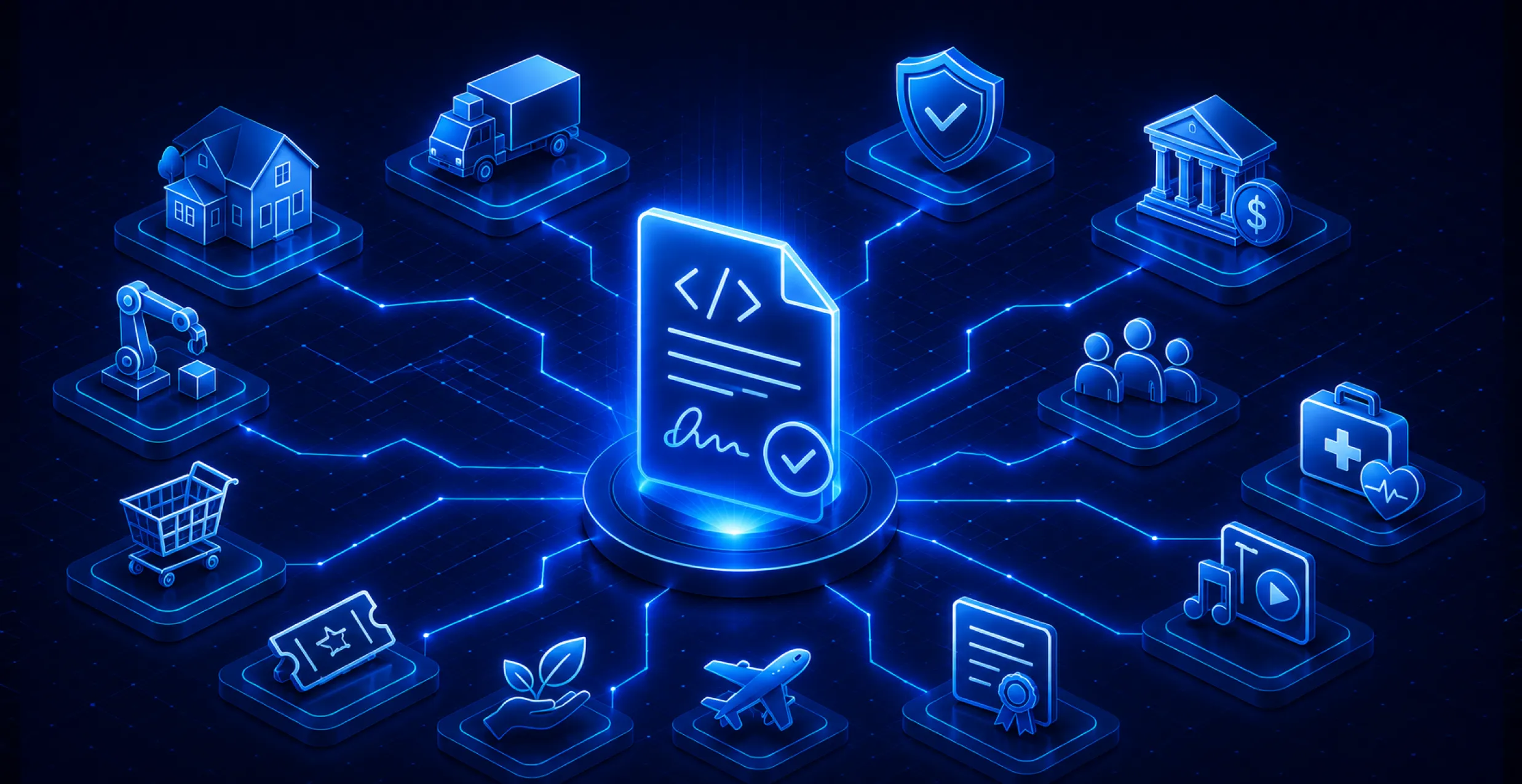
Smart contracts are changing how businesses manage transactions, not just by automating workflows but also by reducing operational costs, minimizing human error, and building greater confidence among parties. You can find them pretty widely in finance, healthcare, supply chains, insurance, real estate, gaming, and even government services, where they help streamline operations and form more capable digital ecosystems.
Why Smart Contracts Are Gaining Popularity in 2026
As businesses continue to move toward digital transformation. Smart contracts have emerged as an important way to automate agreements and build trust in decentralized spaces. In 2026, more people are using them faster because blockchain infrastructure is expanding quickly, and decentralized finance (DeFi), tokenized assets, enterprise blockchain solutions, and AI-driven automation are gaining momentum at the same time.
Several factors are driving this widespread adoption:
- Business Process Automation: Organizations are moving away from manual approval processes and replacing them with automated contract execution, reducing delays and admin overhead.
- Cost Efficiency: When intermediaries are removed, and paperwork is reduced significantly, smart contracts noticeably cut transaction expenses and day-to-day operational smart contract development cost.
- Enhanced Security: The cryptographic design of blockchain helps keep contract data away from tampering, unauthorized access, and fraud attempts.
- Greater Transparency: Since each transaction is recorded on a shared ledger, stakeholders can verify what happened and when, with full visibility into execution.
- Faster Transactions: Payments, settlements, and sign-offs occur automatically once the preset conditions are met, often reducing what used to take days to minutes.
- Support for Tokenized Assets: As tokenization spreads into real estate, financial securities, intellectual property, and digital collectibles, smart contracts provide the automation needed to handle ownership management and transfers without the usual friction.
- Enterprise Blockchain Adoption: Across industries such as banking, logistics, healthcare, and manufacturing, companies are integrating smart contracts into their enterprise systems to improve efficiency and compliance, even when workflows are complex.
- Integration with AI and IoT: Smart contracts are increasingly integrated with artificial intelligence and Internet of Things devices, enabling them to make autonomous decisions based on real-time information.
15 Real-World Smart Contracts Use Cases 2026
Smart contracts are helping companies automate everyday operations, reduce paperwork, and boost efficiency, all while maintaining more verifiable records. Here are some of the most practical smart contract use cases across different industries in 2026, and they keep getting more useful as the year goes on.
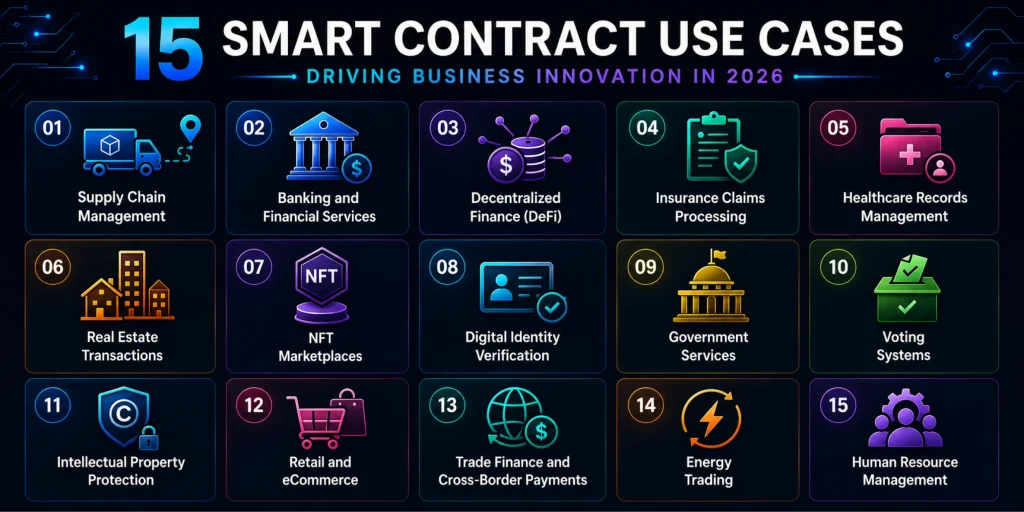
1. Supply Chain Management
The supply chain is still one of the most successful blockchain smart contract use cases today. Many organizations face delayed shipments, messy paperwork, and a lack of visibility throughout the process. Smart contracts, in a sense, fix these issues by automating basically each step of the supply chain. When preset conditions are met, such as a shipment arriving at a warehouse, the smart contract can automatically update records and even release payments.
Example: Walmart uses blockchain technology to improve food traceability. Instead of relying only on scattered files, it records supply chain data on a blockchain. Then, during recalls, the company can quickly track where a food product came from. This is where smart contracts come in; they support automated record checking and add transparency.
Overall, using smart contracts reduces paperwork, lowers the risk of fraud, speeds up deliveries, and helps businesses build credibility with both suppliers and customers.
2. Banking and Financial Services
Banks handle thousands of transactions each day. A lot of those need manual verification, so it can become slow and costly too. In the meantime, smart contracts take over financial agreements by triggering transactions once certain predefined conditions are fulfilled.
Example: JPMorgan created Onyx, a blockchain platform that leverages smart contracts for payments and settlement processing. With this approach, financial organizations can process transactions more quickly and lower operational costs.
With smart contracts in place, banks can set up auto loan approvals, cross-border payments, customer account checks, and and compliance reviews. Overall, this supports better efficiency, cheaper operations, and fewer moments where people make mistakes.
3. Decentralized Finance (DeFi)
Decentralized Finance, also called DeFi, leans heavily on smart contracts. Instead of going through banks, people just deal directly with blockchain applications. Smart contracts then keep everything running in the background, automating lending, borrowing, staking, and even cryptocurrency exchange activities.
Example: Tools such as Aave and Uniswap use smart contracts so users can lend assets, take loans, or swap cryptocurrencies without involving any traditional financial institution.
Also, these platforms operate all day long and transact automatically. This tends to give users more say over their holdings while making financial services quicker and easier to reach.
4. Insurance Claims Processing
Traditional insurance claims usually mean a lot of paperwork, manual checks, and those long, sort of endless approval periods. Smart contracts kind of tidy this up, because they can automatically verify policy conditions, then release the payment , in a more direct way.
Example: Flight delay smart contracts insurance use cases are one of the cleaner examples. If a flight is delayed past a set threshold, the smart contract validates the situation using trusted flight information, and it sends the compensation through without the customer having to file a claim.
So overall , this can reduce fraud, lift customer happiness a bit, and it also helps insurance companies cut down admin expenses.
5. Healthcare Records Management
Healthcare orgs deal with huge volumes of patient data pretty much every single day. The tricky part is keeping everything safe while still enabling approved access. Smart contracts assist here by giving patients stronger control over their medical information. They restrict access so only approved doctors, hospitals, or insurance providers can view records.
Example: Estonia has rolled blockchain technology into certain portions of its healthcare approach. The idea there is to protect medical records and to make data consistency feel more solid. Patients and healthcare providers can then reach trusted health information more efficiently.
With smart contracts in place, healthcare providers can reduce the back-and-forth paperwork, strengthen data protection, and speed up patient support. It also helps reduce the likelihood of unauthorized access and lowers the odds of data leaks.
6. Real Estate Transactions
When people buy or sell a house, condo, or any property, there are often banks involved, brokers, lawyers, and lots of paperwork. Smart contracts can simplify the whole thing by automating agreements along with payments. After every condition is satisfied, ownership can move over automatically, with no waiting around.
Example: Propy uses blockchain and smart contracts to help with digital property transactions. Buyers and sellers can complete many steps online with more transparency and fewer back-and-forth messages.
Smart contracts reduce paperwork, shorten transaction times, and lower costs, and they also limit the chances of fraud or disputes.
7. NFT Marketplaces
NFT marketplaces rely on smart contracts to create, buy, sell, and transfer digital assets. The contract keeps a record of who owns what, and then it carries out the transaction on its own once a buyer finishes the purchase.
Example: OpenSea uses smart contracts to manage NFT ownership and transactions. The platform also makes sure creators get royalties automatically when their NFTs are resold, not later, not manually.
So you get a marketplace that feels more transparent, where ownership is easier to check, and creators can keep earning from later sales.
8. Digital Identity Verification
Companies must verify customer identities while still protecting sensitive personal data. Smart contracts support this by letting users share only the required information, instead of giving away their full identity.
Example: Microsoft uses decentralized identity technology to help organizations verify identities securely using blockchain-based principles. This is sort of the “share the minimum needed” idea, and it works well in practice.
This method speeds up onboarding, reduces identity fraud, and gives users more control over their personal information.
9. Government Services
Governments end up managing a huge number of records like birth certificates, land records, permits/licenses, and tax papers. With smart contracts, those services can be automated a bit more, while also upping transparency and cutting down on paperwork.
Example: The United Arab Emirates has already rolled out several blockchain initiatives that aim to modernize government services and strengthen digital record-keeping.
In general, using smart contracts helps governments deliver things faster, lower the administrative spend, and also boost confidence among citizens.
10. Voting Systems
Online voting basically needs solid security and clarity. Smart contracts support that by logging each vote onto a blockchain, so it is not just stored; it is recorded in a way that is harder to mess with. Once a vote is in there, changing it is extremely difficult without showing signs of interference.
Example: Several universities, some local governments, and pilot election programs around the world have tested blockchain-based voting systems, mainly to improve election transparency and reduce the risk of tampering.
Smart contracts can also shape a more open voting workflow while reducing manual counting and increasing public confidence in election results.
11. Intellectual Property Protection
Keeping digital content safe is often hard because copying and re-sharing can be done quite easily without asking first. Smart contracts help creators by supporting proof of ownership and automating royalty transfers.
Example: Music and digital content platforms are looking at blockchain setups where artists are paid automatically whenever their work is bought, streamed, or licensed, all managed through smart contracts.
So, this approach protects intellectual property, supports fair compensation, and also avoids delays in royalty distribution.
12. Retail and eCommerce
Retail shops and eCommerce platforms can use smart contracts to handle payments, returns, loyalty perks, and order steps, all automatically. The result is a better customer journey and also less manual labor.
Example: If you run an online store, you can set up a smart contract so the payment gets released only after a customer confirms that the product arrived. Then, if the order gets canceled, the same contract can automatically push out a refund.
So, it builds stronger confidence between buyers and sellers while also making shopping online quicker and more secure.
13. Trade Finance and Cross-Border Payments
International trade is usually full of paperwork, approvals, and staged payment flows. Smart contracts make all that simpler because they automate things like document checking and settlement of funds.
Example: In some blockchain trade finance setups, banks around the world use smart contracts to speed up cross-border deals and to cut down the repetitive documents shared between trade partners.
That means lower transaction fees, fewer delays, and clearer visibility across the whole trade process.
14. Energy Trading
Renewable energy providers often end up producing extra power, which can be sold to other users. Smart contracts let parties trade electricity directly, so it becomes peer-to-peer, and you don’t need a single middle service holding everything.
Example: Power Ledger uses blockchain with smart contracts to let consumers buy and sell renewable energy directly to each other.
This supports a more responsive electricity market, and it also nudges more adoption of clean energy sources.
15. Human Resource Management
Human resource teams manage hiring, employment contracts, payroll, and employee records. In the end, it all turns into a lot of paperwork. Smart contracts can automate many of these steps, cutting down on manual labor and also improving accuracy a bit more than expected.
Example: A company can let a smart contract release salaries automatically on the scheduled payday, after attendance and work conditions are verified. So instead of waiting around and checking things twice, the process just follows the rules it was given.
This makes payroll management easier, reduces admin effort, and helps ensure employees get paid on time.
Why Businesses Trust Octal IT Solution for Smart Contract Development
Making a secure and dependable smart contract needs real expertise. At Octal IT Solution, we support companies in building smart contracts that are safe, scalable, and aligned to their particular needs. Whether you’re launching a DeFi platform, NFT marketplace, blockchain application, or enterprise solution, our team creates blockchain solutions that back your business targets.
Experienced Blockchain Team
Hire smart contract developers who have in-the-field experience creating smart contracts for finance, healthcare, supply chain, real estate, and eCommerce industries. You know, the usual high-stakes places where accuracy really matters.
Custom Smart Contract Development
No two businesses run the same way. We design and build smart contracts that fit your processes, business objectives, and the specific blockchain platform you’re using.
Security-First Development
Security is taken seriously here. Blockchain development company stick to industry best practices, run smart contract audits, and do thorough testing before deployment, so security risks and hidden vulnerabilities don’t sneak in.
End-to-End Blockchain Services
From consulting and planning to development, deployment, and ongoing maintenance, we deliver complete blockchain development services all in one place, under one roof, so you do not have to coordinate with too many vendors.
Scalable Solutions
Our smart contracts are built to support future growth. We develop solutions that can handle increasing users, transactions, and business demands without really losing performance, or at least not in the usual way. Basically, we aim to keep things smooth even as adoption gets bigger.
Ongoing Support
The relationship doesn’t really end after deployment. We provide continuous maintenance, updates, and technical support so your blockchain solution stays efficient over time, not just at the start.
Whether you need to build a new blockchain application or upgrade an existing platform, Octal IT Solution has the know-how to deliver secure and future-ready smart contract solutions.
The Final Words
Smart contracts are changing how businesses manage agreements, transactions, and day-to-day operations. They cut down manual work, bring up transparency, and automate processes across a bunch of fields like banking, healthcare, real estate, retail, and supply chain.
As blockchain adoption continues to grow, companies that invest in smart contract technology can boost efficiency, lower operational costs, and build more trust with customers and partners. The 15 real-world smart contract use cases for 2026 also make it clear this tech isn’t only about cryptocurrencies. It’s becoming a main piece of digital transformation across industries that maybe you wouldn’t immediately connect.
If you’re planning to implement smart contracts, teaming up with a smart contract development company that’s experienced can help you build secure and high-performing blockchain solutions that actually deliver long-term business value.


 Get in Touch
 By
By September 8, 2026