


You have now entered one of the meaningful areas of Fintech if you want to create a secure crypto wallet application. The crypto wallet is at the heart of a rapidly evolving world of digital assets, decentralized finance, and blockchain-powered payments.
This comprehensive guide covers everything, including wallet types and key features, technology stack options, security architecture, regulation needs, development cost, and advanced trends. This blog gives you a thorough, transparent roadmap, regardless of whether you are a company with a custom crypto wallet development project or a startup founder assessing your first build.
Why Build A Crypto Wallet App in 2026? (Market Overview)
In 2026, data presents an inescapable narrative that is more compelling than ever.
The crypto wallet market will accelerate at a compound annual growth rate (CAGR) of 26.7% from a current valuation of $14.84 billion in 2026 to 98.57 billion by 2034 (Fortune Business Insight). According to a different projection by The Business Research Company, the company can reach $54.79 billion by 2029 at a 30.4% CAGR, making it one of the fastest-growing fintech sectors.
Institutional confidence has never been stronger: 86% of institutional investors either hold or plan to hold digital assets, US spot Bitcoin ETFs have crossed $128 billion in AUM, and over 172 publicly traded companies now hold Bitcoin on their balance sheets.
The following explains why now is an ideal time to invest in crypto wallet development services:
- Explosive User Growth: 560M+ holders today, with 1 billion projected by the end of 2026.
- Stablecoin Boom: Active stablecoin wallets grew 53% YoY to 30 million, and are accelerating.
- Mobile Wallet Explosion: wallet downloads exceed 520M globally; digital asset payments set to spike 82% in 2026.
- DeFi Surge: 198M wallets (24% of all crypto wallets) active in DeFi in 2025, and rising.
- Gen Z Leading Adoption: Younger age groups (especially 25–34) dominate crypto ownership, and plan to increase crypto activity in 2026.
The market is not the most efficient yet, but it is expanding. Companies that build compliant, secure, and well-equipped wallets by 2026 are at the forefront of the fintech infrastructure transformation that will represent the next ten years.
Types of Crypto Wallet Applications
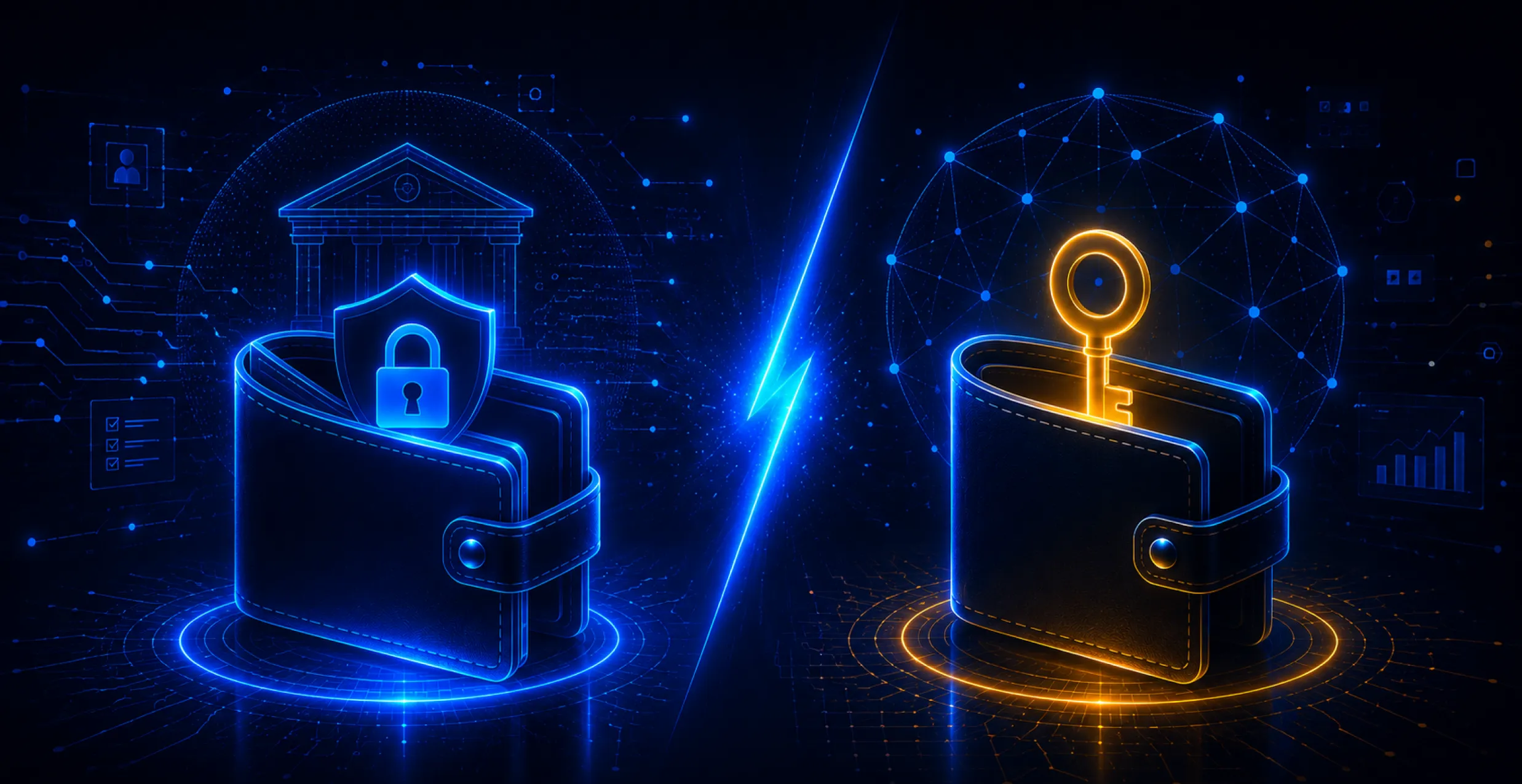
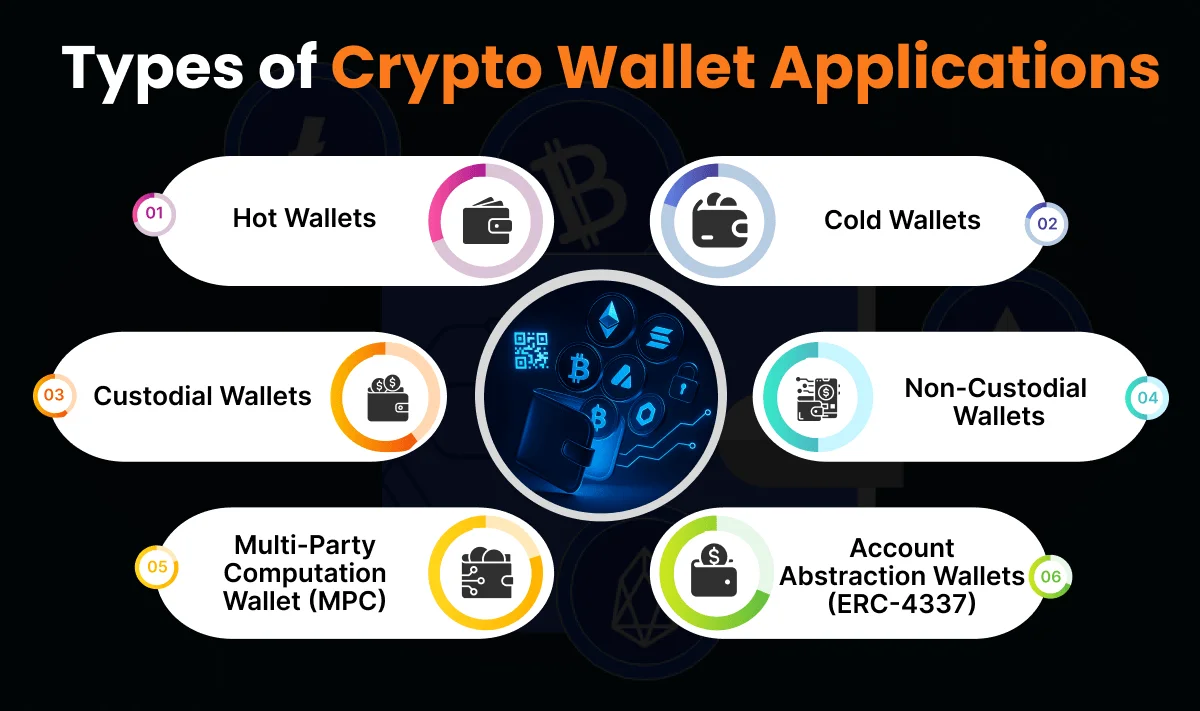
Each wallet is built differently. Your architecture, security model, legal requirements, and monetization capabilities are all determined through the type of wallet you operate. The complete breakdown is as follows:
Cold vs Hot Wallets
- Hot Wallets:
Connect to the internet. Fast and discreet for normal transactions. Trust wallets and MetaMask are two examples. Extended vulnerability to online threats, although important, is for DeFi clients actively using it.
- Cold Wallets:
Private keys are stored offline. Highest level of protection. Ledger and Trezor are two examples. According to analyses from 2026, more than 71% of wealthy cryptocurrency holders currently use hardware anemic storage. Ideal for protecting assets over the years.
Custodial or Non-Custodial Wallets
- Custodial Wallets
The user’s private keys are maintained through a third party. Easy recycling and user experience. Examples are Binance and Coinbase wallets (exchange mode). Increased regulatory responsibility flips you as a financial custodian.
- Non-Custodial Wallets
Users retain ownership of their private keys. Most of the surveillance and privacy. If the keys are lost, there is no recovery. Trust wallets and MetaMask are two examples. The model adopted by DeFi-native clients.
Multi-Party Computation Wallet (MPC)
In 2026, the predominant architecture for institutional and enterprise wallets. MPC divides the non-public key into cryptographic parts that can be dispersed among many participants; The whole mystery is by no means held in one area. Even with consumer wallets, MPC is rapidly displacing the traditional single-key model as the institutional standard for enterprise crypto wallet solutions. Additionally, it has implications for how Web3 wallet development projects handle large-scale key management.
Account Abstraction Wallets (ERC-4337)
The latest and fastest category. Unlike traditional externally held invoices, account abstraction wallets act as programmable smart settlement invoices. They facilitate batch transactions, session keys, gasless transactions, and social relocation (replacing seed phrases with guardians). ERC-4337 turned into 73% adoption of newly introduced Web3 features by 2025. This should be included in the structure of any major digital wallet app development project from the start.
Must-Have Features for a Secure Crypto Wallet App
Many of these features overlap with modern ewallet app development services, but crypto wallets go further with decentralized control and blockchain-based transactions.
Getting the features of a secure crypto wallet app right is the difference between a product that customers trust with their life savings and one that they abandon after the primary transaction, which is how securely the cryptocurrency wallet app is designed. What you need in your wallet in 2026 is as follows.
Core Features
- HD Key Management and Wallet Creation
Create pairs of public and private keys. Use seed phrases to support BIP-32/39/44 HD pocket specs. A completely seedless introduction based on Pasa-key is also expected in 2026.
- Send & Receive Transactions
Real-time streaming on blockchain networks with real-time status monitoring of payment estimation.
- Multi-Currency Support
Critical to the creation of multi-currency crypto wallet development. As a starting point, users take BTC, ETH, SOL, USDT, USDC, and well-known tokens. By 2026, there will be 185 million active stablecoin users worldwide, and the guidelines for stablecoins are no longer negotiable.
- Transaction History and Balance
Real-time segment view with complete transaction records for each row is supported.
- Scanner for QR Codes
Fast and error-free address reporting. It reduces entry errors that lead to irreversible financial losses.
- Biometric Authentication
PIN, fingerprint, and face ID. By 2026, it will be the standard for all mobile wallets in production.
- Restore and Backup
Back up your seed phrase using secure, monitored offline storage. or social renewal of wallets that use account abstraction.
Advanced Features for Crypto Wallet App
- DeFi Integration
Access to liquidity pools, yield farming, and in-wallet stacking. Important for some decentralized wallet development. With 198 million active DeFi wallets by 2026, DeFi wallets are one of the fastest-growing categories.
- In-Wallet Token Swap
Integration of DEX aggregates (0x, 1inch, Jupiter) allows you access to easy token exchange without ever leaving your wallet.
- NFT Management
NFTs can be viewed, sent, received, and displayed. NFT storage is already supported by about 19% of hardware wallets that will be introduced in 2024.
- Fiat Off-Ramp/On-Ramp
Enables the purchase and promotion of cryptocurrency using traditional money. By 2026, MasterCard’s MetaMask cards will be available at more than 150,000 retailers, demonstrating the importance of this relationship.
- Multi-Signature Support
Transactions in project fund wallets require two authorizations. Multi-sig is already supported through 33% of institution-class wallets.
- AI-Powered Fraud Alerts
Phishing alerts and transaction risk rating in real time. With 60% of wallets predicting AI adoption through 2026, this is becoming a distinct differentiator much sooner.
Your entire custodial currency and user retention are strongly influenced by these crypto wallet app features. Set priorities according to your target market. Enterprise customers require multi-sig compliance tools, while DeFi users require swaps and staking.
Crypto Wallet App Tech Stack for 2026
The scalability, efficiency, security ceiling, and long-term maintainability of your wallet are all determined with the help of the crypto wallet app tech stack. The full breakdown for 2026 is as follows.
Crypto Wallet App Development
- iOS – Swift: native performance, hardware-backed key storage accessible by iOS Secure Enclave access.
- Android – Kotlin: StrongBox Keymaster integration allows for secure key storage and simple syntax.
- Cross-platform: Flutter or React Native (saves 25–40% development time compared to native). Susidda, M.V.P. Note: There may also be issues with cryptocurrency flows that require multiple monitors that include hardware wallet signing or real-time charting.
Backend Infrastructure
- Languages: Python for information processing and analysis; Node.js for REST APIs; and node architecture available with Go (Golang) for high-performance blockchain capabilities.
- Frameworks: gRPC for high-throughput inter-service communication between providers; Shoot.js, FastAPI, or Gin, depending on the language.
- Databases: Redis for storage and negotiation monitoring; MongoDB for an adaptive document storage; and PostgreSQL for structured transaction records.
- Cloud: Docker + Kubernetes makes it possible to orchestrate boxes and scale space on AWS, Google Cloud, or Azure.
- Node Infrastructure: Use a self-hosted blockchain node or service like Alchemy, Infura, QuickNode, or Ankr for reliable RPC access.
Blockchain Integration
- EVM and Ethereum Chains: The Ethereum wallet development is based on Ethers.js v6 and Web3.js. Polygon, Arbitrum, Ground, Optimism, and zkSync are also blankets.
- Bitcoin: The basis for Bitcoin wallet app development is BitcoinJS and BitcoinJS SDK. Note: Layer 2 is now used for 92% of Ethereum transactions; Your stack should help L2s.
- Solana: @sólána/web3.js. Growing rapidly, South Asian transaction volume grew 80% per year by 2025 in 12 months.
- Multichains: Lagnull, Polkadot.js, Cosmos SDK, and wallet connection v2 for cross-chain compatibility.
Security Libraries & Tools
• Libsodium and OpenSSL for cryptographic functions
• FIPS-certified Hardware Security Modules (HSM) for corporate key management
• GCP Cloud HSM, Azure Key Vault, and AWS KMS for cloud-based key management
• Qredo SDK or Fireblocks for MPC key management systems
• Third-party security audit companies: Halborn, Trail of Bits, and CertiK
Emerging Technologies to Watch (2026 & Beyond)
Account Abstraction (EIP-7702/ERC-4337)
Session keys, social recovery, and gasless behavior. ERC-4337 is used by 73% of new Web3 projects by 2025. Standard wallets can now instantly serve as a smart compromise wallet route to EIP-7702, which are secured within the Ethereum Pectra upgrade and allow mass transactions on the chain.
MPC – The New Institutional Standards
Swapping out conventional private keys. Although the MPC adoption is completely immune to nonmarital factors of failure, it will increase developmental values by $40,000 to $100,000. By 2026, an MPC is the preferred collateral structure for any wallet that includes institutional assets.
Zero-Knowledge Proofs (ZKPs):
Privacy-protecting behavioral research. ZK-powered Layer 2 networks currently handle 92% of Ethereum transactions by volume.
AI-Powered Automation & Security
Automated portfolio management, anomaly detection, behavioral risk grading, and real-time fraud detection. By 2026, 60% of wallets will have Agent AI.
Seedless/Passkey Authentication
By removing the credentials, the biometric-based full access to the wallet significantly reduces the most common cause of irreversible loss of funds.
Quantum-aware cryptography
In 2026, as crypto wallet companies prepare for incoming quantum risks. Quantum-resistant signature technology has been added to the MPC framework.
Security Architecture for Crypto Wallet Applications
You don’t add security at the end. It serves as the foundation on which everything else is built. In 2026, this is more important than ever.
Figures for the entire year of 2025 are about: In accordance with PeckShield, regular cryptocurrency theft exceeded $4.04 billion, an increase of 34.2% from 2024. The largest opportunity, the Bybit attack in February 2025, was a theft of $15. documented. In 2025, at least $2.02 billion was found to have been stolen by actors belonging to the North Korean nation itself, a 51% upward push from the last 12 months to 2025, with $1.7 billion stolen in just 34 incidents, making it the most expensive attack vector.
From 5 million dollars to nearly $15 million, the average loss per incident has more than doubled by 2025. Currently, attackers focus on costly centralized infrastructure over smaller targets. For this reason, choosing how to build a secure crypto wallet is your most crucial choice.
Here is what crypto wallet security best practices development looks like in 2026:
Private Key Management
- Use too much entropy randomness to generate keys; They should in no way be seeded from reliable sources.
- Place encrypted private keys in hardware-backed static enclaves that are not accessible to the control device, such as an Android StrongBox or iOS Secure Enclave.
- Open large-cap stocks via MPC to corporate wallets; The whole key should not be in one place at any one time.
- Under no circumstances should private keys be transmitted over a shared connection.
Authentication Layer
- By 2026, all production wallets will use biometric authentication (Face ID or fingerprint) as the primary method of access.
- Instead of using SMS, which is still vulnerable to SIM switching attacks, 2FA uses authenticator packets (TOTP).
- YubiKey hardware protection keys for system names are vulnerable to tampering.
- After a certain period of inactivity, auto-logout
- Extensive rights for dApp interactions on session keys (through ERC-4337).
Data Protection
- TLS 1.3 is required for all information in transit without exception.
- At rest, all data is encrypted using AES-256.
- Seed phrases: Ask users to document offline and not transact digitally at all on a cloud carrier.
- Supply chain protection: Before integration, evaluate all third-party SDKs, libraries, and browser extensions. By 2025, chain attacks were delivered multiple times.
Threat Migration
- CertiK, Trail of Bits, or Halborn for reliable third-party tests; Smart settlement audits before releasing any DeFi integration
- Detecting fraudulent pre-user signing reconciliation calls before they are corrected through transaction simulation.
- MasterCard’s crypto certificate (2026) demonstrates phishing detection with verification and wallet offers.
- Anomaly detection for real-time transaction risk scoring using AI and ML
- Frequent revenue checks: Compared to the average breach value of $10.22 million, a mid-market penetration test costs between $20K and $50K.
At every step, from key generation to dApp interaction to third-party SDK integration, a robust crypto wallet backend architecture needs to consider the capability attack surface. The days of “move fast and fix security later” are long gone in 2026.
Regulatory Compliance & KYC/AML Requirements
In 2026, compliance will become a requirement for market access, not optional. Institutional users, banks, and payment partners will not partner with wallets that cannot demonstrate they can be equipped to comply with the regulation.
Important Framework for Regulation in 2026
- MiCA (Markets in Crypto-Assets)
As of July 1, 2026, all 27 EU member states are subject to the full enforcement of the EU’s comprehensive framework. It focuses on retail operators, stablecoin issuers, and crypto asset transfer providers (CASPs). No gateway entry to the EU market affects compliance.
- GENIUS Act (USA):
The Trump administration’s pro-crypto effort led to the passage of the US stablecoin framework in 2025, which greatly boosted institutional confidence in creating compliant US-market wallets.
- GDPR
All wallets serving clients within the EU must comply with registration privacy regulations. It controls how you handle deletion requests, maintain personal records, and deal with security breaches.
- FATF Travel Rule
It requires the disclosure of recipient and source information for cryptocurrency transfers that exceed predetermined limits. Fully functional in the majority of significant jurisdictions.
- FinCEN (USA)
Suspicious Activity Reporting (SAR) Guidelines, AML Software Requirements, and Financial Services Business Registration.
- VASP Enrollment
Important for any business that provides digital asset services within the majority jurisdiction that includes wallet custody.
- Hong Kong Stablecoin Bill
It surpassed in 2025, establishing the first regulated stablecoin environment in Asia, which is important for any wallet aimed at Asian customers.
KYC/AML Implementation
- Includes third-party KYC vendors for identity verification, including Jumio, Onfido, and Sumsub (Amount & Subject). The consolidation will raise development rates from $5,000 to $20,000.
- Create automated OFAC, UN, and EU sanctions list checks to monitor AML transactions.
- Establish tighter processes for filing suspicious activity reports (SARs), transaction limits, and due diligence for high-value transfers.
- Maintain immutable audit records for all compliance-related activities critical to regulatory reporting.
- The cost of obtaining a VASP license for a custodial wallet within the EU is between €3,500 and €30,000, depending on the country, as well as the cost of continuous monitoring.
Compliance is not a one-time development cost, but rather an ongoing operating cost. Before starting on any regulated market, understand funds precisely and seek legal advice from an organization that specializes in cryptocurrencies.
Step-By-Step Process to Develop Crypto Wallet Apps
Here’s a roadmap for how to develop a secure crypto wallet app step by step in 2026:
Define Your Wallet Strategy
Before you write a line of code, and then answer the primary questions: Who is the user you need to reach? Which blockchains will you help with? MPC, noncustodial, or custodial? In which regulatory jurisdictions will you be dealing with a commercial company? How do you make money? These reactions serve as the foundation for all subsequent decisions.
Competitive Analysis and Market Research
Try leading wallets, including Rainbow, Phantom, Coinbase wallet, MetaMask, Trust wallet, and more. Determine security vulnerabilities, unfulfilled user needs, and UX capabilities. Reading consumer reviews, rather than company advertisements, often gives a better competitive impression. At this stage, many businesses also consult a blockchain app development company to validate their product strategy and technical feasibility.
Choose your Technology Stack and Architecture
Select a database, backend language, mobile framework, and blockchain network. Choosing between custodial, non-custodial, or MPC structures can have a 30–50% impact on blockchain app development cost. For the majority of the latest wallets in 2026, MPC or ERC-4337 account abstraction should be taken critically from the start.
Create UI/UX Design
Traditional wallet onboarding abandonment exceeds 80% for non-crypto users. Design with ERC-4337 enabling email login, gasless transactions, and clear Web2-style flows, not for blockchain experts.
Create Core Wallet Functionality
Build key generation, wallet creation, and send/receive functionality using proven libraries, Ethers.js, BitcoinJS, or @solana/web3.js. This is your MVP foundation.
Implement Security Architecture
Integrate each security layer, which includes delivering supply-chain dependency checks, transaction emulation, biometric authentication, TOTP-based total 2FA, secure seed phrase processing, and key encryption in stable enclaves. Lastly, this stage is essential for secure crypto wallet app development.
Assemble KYC/AML and Compliance
Set up GDPR-compliant information governance, set up AML controls, connect KYC providers, and if necessary, create VASP registration paperwork. This should be completed before publication; then, building compliance can be 3 to 5 times as expensive and require complete architectural renovation.
Smart Contract Audit (for DeFi Wallets)
Before going live, any DeFi or smart contract integration must undergo a third-party security audit. Set aside $15,000 to $80,000+ for a reliability audit through Halborn, Trail of Bits, or CertiK. Ignoring these is an existential rather than an economic threat.
Quality Control and Testing
Trying to crack devices (Android QA is 25–30% higher than iOS, owing to device variations), unit testing, integration testing, login testing, and complete security auditing. A vulnerability in the live wallet can cost some users everything, and so this cannot be compromised in any way.
Launch & App Store Submission
Submit to the Apple App Store and Google Play Store. Check each platform’s specific, ever-changing rules on cryptocurrency applications before submitting. For applications mentioning cryptocurrency, the two additional review delays can be up to four weeks.
Post-Launch Support & Maintenance
Blockchain networks are new. Rules evolve. There are new ways of attacking. Commit to daily feature releases, compliance improvements, and security audits. Set aside 15% to 25% of the initial development cost for maintenance every year.
Crypto Wallet App Development Cost Breakdown
Based on current daily market prices instead of a projection for 2023, below is a thorough and up-to-date breakdown of a crypto wallet development cost for 2026.
If you’ve already researched the mobile banking app development cost, you’ll notice crypto wallets often require additional investment in blockchain infrastructure, cryptographic security, and compliance.
| Wallet Type | Cost Range (2026) | Timeline | Key Inclusions |
| Basic MVP (single-chain, custodial, no DeFi) | $25,000 – $55,000 | 8–12 weeks | Single blockchain, send/receive, basic security, simple UI, hosted custody |
| Consumer-Grade Wallet (multi-chain, non-custodial) | $60,000 – $150,000 | 4–6 months | Multi-chain (BTC/ETH/SOL), biometrics, 2FA, KYC/AML integration, DeFi basics |
| Advanced DeFi Wallet (swaps, staking, NFTs) | $100,000 – $200,000 | 6–9 months | DEX integration, staking, NFT support, fiat on-ramp, account abstraction |
| Enterprise / MPC Wallet (institutional grade) | $200,000 – $500,000+ | 9–15 months | MPC key management ($40K–$100K alone), multi-sig, compliance suite, HSM, SOC-2 |
For real-world benchmarking, a completely practical, multi-chain-compliant Coinbase wallet app development cost, developed by a US team, will fall between $250,000 and $500,000 or more.
Standard MetaMask wallet development cost is between $150,000 and $250,000 for browser plugins with mobile, non-custodial, multi-chain voting system.
The estimated Trust Wallet app development cost with multi-chain compatibility is $100,000 to $200,000.
MVP crypto wallet development cost for enterprise proof of concept variations ranging from $25,000 to $55,000 for centralized monolithic production, takes 8 to 10 weeks with a small group of professionals
Licensed pre-built solutions with the changes above can cost from $15,000 to $70,000 upfront for white label crypto wallet app solutions. It’s a faster route to market than growing from scratch.
Typically, 25–40% of the total development budget is security architecture, MPC, HSM integration, and third-party audits. Such costs are not optional. It is the cost of not losing your customer’s money.
Key Factors that Affect Development Cost
Compared to the cost to develop ewallet app, crypto wallet development is typically higher due to added layers like private key management, blockchain integration, and advanced security protocols.
Depending on these variables, the crypto wallet development budget estimate varies significantly. Understanding them early will help you avoid high-priced mistakes later:
The Custody Model
This single decision has a 30–50% impact on the public price. Stronger key control is essential for non-custodial wallets. A VASP license (€3,500–€30,000 in the EU) and a compliance infrastructure, which can cost $50,000–$120,000+, are conditions for custodial wallets.
Blockchain Support
Node infrastructure, address configuration handling, fees logic, and QA scope are all delivered with each new L1 blockchain (BTC, ETH, SOL, etc). The multi-currency wallet development cost increases significantly with each new chain.
Security Architecture
Implementation of MPC: $ 40,000–$ 100,000 for third-party security audits:$15,000 to $80,000, for HSM integration: $20,000 to $50,000. Typically, 25–40% of the budget is allocated to defense.
KYC/AML Integration
Integration with third-party KYC carriers costs between $5,000 and $20,000. The infrastructure for AML surveillance provides even more. This is extended through multi-jurisdictional alignments (EU + US + APAC).
Platform Coverage
Mobile-first MVP versus simultaneously using iOS, Android, and the web. Because of the device change, Android QA is 25–30% more expensive than iOS.
Team Location
US teams: $150 to $200 per hour. Eastern European teams (including Interex-Innovoice): $40–70 per hour, a savings of 60–70% without sacrificing high quality. The crypto wallet app development cost in India can be 40–60% much lower than comparable US builds.
Advanced Features
Fiat on-ramps, DeFi integration, NFT guidance, wallet exchange, AI-powered fraud detection, and all growth scope and cost.
Ongoing Maintenance
Each year, 15–25% of initial development funding is allocated to feature releases, security patches, compliance with blockchain enhancements, and compliance updates.
Get complete proposals with instances from the best crypto wallet app development company to individual profit estimates, verifiable custodial audit track records, and cryptocurrency wallet app development cost.
Future Trends in Crypto Wallet App Development
The wallet you build today ought to no longer remember the current state of the industry but also where it is headed in 2027, 2028, and beyond. The following trends actively change the field.
Agentic and AI-Powered Wallets
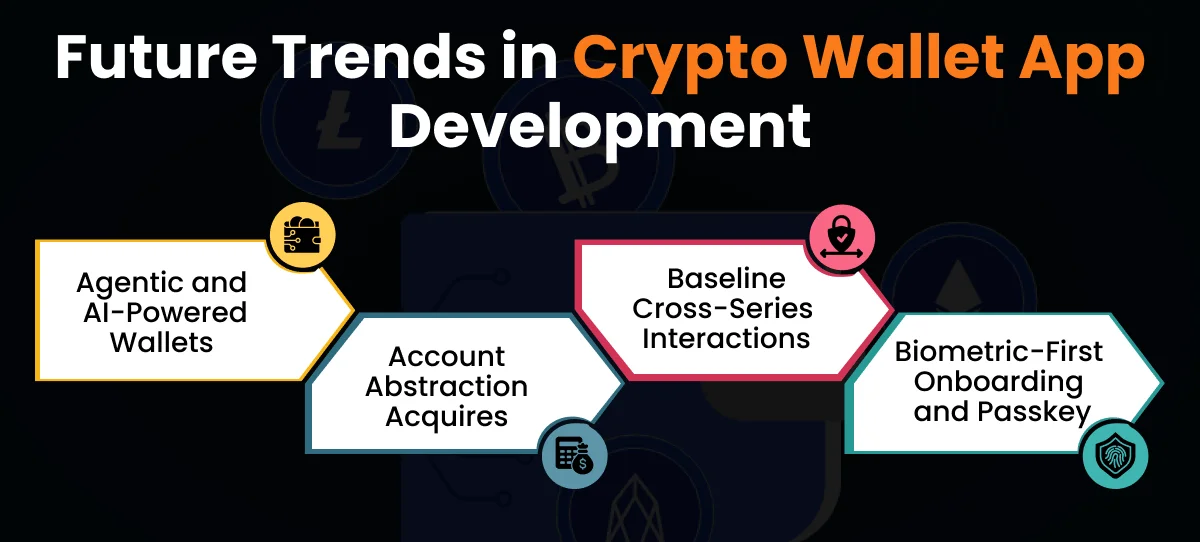
Agent AI is expected to be integrated into nearly 60% of cryptocurrency wallets for automated DeFi operations, fraud detection, and portfolio monitoring by 2026. In February 2026, Coinbase launched the x402 protocol for device-to-device payments and integrated Agentic spending management. In March 2026, Trust Wallet outsourced its infrastructure to external AI vendors through TWAK (Trust Wallet Agent Kit). Vehicles get animated monetary co-pilots as opposed to passive toolpaths for AI.
Account Abstraction Acquires
The new standard for any serious wallet project is ERC-4337; it’s not tested. By 2026-27, 73% of new Web3 jobs will use it. This is extended via EIP-7702, which in 2025 changed to be covered within Ethereum Pectra and borrows standard wallet funds to be briefly characterized as a smart settlement wallet, enabling mass transactions, gasless operations, and session keys. Starting in 2026, all Web3 wallet development should start with ERC-4337.
Baseline Cross-Series Interactions
Now, Layer 2 networks (Base, Arbitrum, and Optimism) fully handle over 92% of all Ethereum-based transactions, bringing average prices all the way down to less than $0. The need to build pipeline bridges to new ecosystems. Integrated multichain portfolio dashboards and cross-chain atomic exchanges are rapidly replacing separate transactions with comprehensive capabilities.
Biometric-First Onboarding and Passkey
Seed phrases are being phased away. 12-word seed phrases are being replaced as the standard for user onboarding by passkey-based biometric verification, which significantly reduces the most frequent source of permanent fund loss and lowers the onboarding abandonment rate from 80%+ to almost Web2 levels.
Common Challenges of Developing a Crypto Wallet App
It’s really hard to build a cryptocurrency wallet. It is easier to plan, budget, and recruit appropriately if you are aware of these obstacles before you begin:
Scale Security
One of the most valuable goals in software is a wallet. The average loss per cryptocurrency security incident more than doubled to about $15 million in 2025. For your users, a single architectural error could be disastrous and irreversible.
Complexity of Private Key Management
It is technically difficult and has no tolerance for mistakes to generate, store, back up, and recover keys correctly. Even cold wallet infrastructure is susceptible if nearby systems are compromised, as demonstrated by the $1.46 billion ByBit attack.
Fragmentation of Regulation
The EU is governed by MiCA. US stablecoins are governed by the GENIUS Act. The FATF Travel Rule is applicable everywhere. Each jurisdiction has its own VASP licensing requirements. One of the biggest challenges in compliance engineering is building for numerous markets at once.
Risk to App Store Policy
Regarding cryptocurrency apps, Google and Apple both have changing, occasionally contradictory policies. Include two to four weeks in your launch schedule for any policy-triggered review cycles.
AI-Powered Phishing & Deepfake:
In the first quarter of 2025, deepfake voice phishing increased by 1,633%. Your wallet’s warning systems and transaction review processes need to take into consideration the fact that social engineering is now AI-augmented and much more difficult for users to spot.
In-House vs Outsourcing: What’s Right for You?
Choosing whether to hire mobile app developers with a custom crypto wallet development company or hire crypto wallet developers is one of the most important choices you will make. Here’s an honest assessment for 2026:
| Factor | In-House Team | Outsourcing |
| Cost (2026 rates) | US senior blockchain dev: $160K–$240K+ salary + benefits. Plus recruitment fees and onboarding time. | Eastern Europe / India: $40–$70/hr equivalent. 60–70% saving vs US rates with comparable quality. |
| Time to Start | 3–6 months to hire, onboard, and reach velocity. | 2–4 weeks to kick off with an established team that has built wallets before. |
| Control | Full daily control over team, code, and architecture decisions. | Managed through PMs and milestones. Requires clear specs and active stakeholder involvement. |
| Expertise | Specialized blockchain security + MPC + compliance engineers are rare and expensive to hire. | Top outsourcing firms bring proven crypto wallet delivery track records from day one. |
| Scalability | Slow and expensive to scale up or down as phases change. | Flexible, scale team composition to match project phases (MVP vs. full build vs. maintenance). |
| Best For | Long-term product requiring permanent full-time engineering capacity post-launch. | MVPs, first builds, defined-scope projects. Also: adding capacity to the in-house team for specialist phases. |
In reality, a hybrid approach often yields better results: transfer critical skills in-house for long-term product ownership after outsourcing the first build to a seasoned bespoke crypto wallet development business for speed and specialized knowledge.
Proven blockchain wallet development services with verified case studies, documented security audit experience (ask to view actual audit reports), compliance delivery track record, and technical capability across your desired blockchain stack are all important considerations when assessing partners.
Look especially for Top ewallet app development companies that have experience in decentralized wallet development services for DeFi-focused products. Give mobile crypto wallet development offerings and experts top priority for mobile-first products.
Final Thoughts
The business opportunity, technological maturity, legal clarity, and consumer demand have never been better, yet developing a secure crypto wallet app in 2026 is not an easy task.
The fundamentals are the same whether you are developing a full-stack digital wallet app development services platform with DeFi, NFT, stablecoin payments, and AI-powered portfolio management or a focused Bitcoin storage wallet: security architecture first, compliance integrated from the start, and user experience that hides blockchain complexity from the end user.
With more than 560 million cryptocurrency users worldwide today and one billion expected by year’s end, the infrastructure is prepared, the users are present, and the legal frameworks are at last in place. Businesses that execute carefully, beginning with the appropriate crypto wallet developer and a steadfast dedication to security, will have the opportunity.
The quickest and safest way to market is to work with a seasoned secure crypto wallet development company who have produced production-grade wallets.
Recommended Read : cryptocurrency exchange development companies


 Get in Touch
 By
By August 20, 2026