


What You’ll Learn in This Guide:
- What AI in digital transformation truly means in 2026 beyond buzzwords and automation
- Why AI in digital transformation is now a business necessity, not a competitive advantage
- How AI reshapes enterprise operations, customer experiences, and decision-making
- The core technologies and data strategies powering successful AI transformation
- Real-world use cases, costs, and ROI considerations across industries
- Common AI in digital transformation mistakes and how to avoid them
- How to measure success and choose the right AI development partner
AI in Digital Transformation: What It Really Means
The main function of AI in 2026 works as the engine driving digital transformation. Many people still connect AI with basic functions to operate automation systems and customer support chatbots. The process of AI in digital transformation involves creating intelligent business systems that learn continuously, make predictions, and develop their capabilities.
The current AI adoption process enables organizations to make decisions in real time while offering predictive capabilities and personalized solutions that operate at a large scale for their customers. Organizations implement AI technology throughout their business operations, customer experience processes, and organizational development activities because they want to become data-driven organizations that operate with proactive strategies.
The year 2026 stands out as a distinctive period because it marks complete organizational development. The field of AI research has advanced beyond its initial testing phase. Organizations now expect to achieve measurable results that include better forecasting capabilities and smarter business operations, reduced operational risks, and sustainable organizational growth. The present organizational focus has shifted to evaluating AI alignment, which assesses AI performance based on its connection with business objectives, data systems, and institutional values.
The guide provides an explanation of how AI in digital transformation processes will be throughout 2026 by presenting actual benefits, operational usage, and implementation methods that exist beyond common understanding.
Why AI-Driven Digital Transformation Is No Longer Optional?
Digital transformation with AI has evolved from being a strategic advantage to becoming an essential business requirement. Organizations that want to survive in 2026 must establish meaningful AI systems because any failure will lead to their permanent decline. The need for AI implementation has become essential because multiple forces are driving this change across all business sectors.
Market Shifts Driving AI Adoption
Market volatility, combined with excessive data availability and technological advancements, has created a new standard for global market operations. The existing decision-making framework lacks the ability to address current real-time operational requirements. Businesses employ AI technology through AI Integration Services to handle extensive data sets, allowing them to identify trends and track market changes in real time. AI technology now serves as a fundamental requirement for businesses that want to compete in today’s fast-paced commercial environment. Many organizations are also exploring multi-agent AI systems to automate complex workflows and improve decision-making across different business functions..
Rising Customer Expectations
AI-native companies establish new industry standards that enable them to deliver better operational efficiency, customized services, and fast customer responses. Customers now expect digital experiences that are fully personalized and available at all times and seamless across all points of contact. Static systems fail to meet customer expectations while AI systems keep evolving according to user behavior, preferences, and feedback, which results in competitive advantages for AI-driven organizations.
The Cost of Not Transforming with AI
Business operations experience multiple negative effects because organizations postpone their AI implementation plans. Businesses face increased costs, decreased productivity, reduced customer retention, and lost expansion prospects. Declining customer satisfaction results in lost financial resources, market presence, and brand value. The most significant danger in 2026 occurs when organizations choose to remain static instead of adopting AI in digital transformation.
Key Differences: Traditional Digital Transformation vs AI-Driven Transformation
While traditional digital transformation laid the foundation for modern enterprises, AI in digital transformation represents a fundamental evolution. The difference exists between systems because their operational functions, learning capabilities, and value creation methods develop through different time periods.
| Aspect | Traditional Digital Transformation | AI-Driven Digital Transformation |
| System Logic | Operates on predefined, rule-based workflows and fixed logic. | Uses machine learning models that continuously learn and improve from data. |
| Decision-Making | Relies heavily on human intervention and historical data. | Enables data-driven, real-time, and predictive decision-making. |
| Primary Focus | Process digitization and task automation. | Intelligence-driven optimization and autonomous decision support. |
| Automation Level | Automates repetitive and manual tasks. | Adds contextual understanding, prediction, and adaptive actions. |
| Response to Change | Limited flexibility; changes require manual reconfiguration. | Dynamically adapts to changing data, user behavior, and market conditions. |
| Business Impact | Delivers short-term efficiency and cost reduction. | Drives long-term adaptability, innovation, and competitive advantage. |
| Scalability | Scaling often increases complexity and maintenance effort. | Scales intelligently with improved accuracy and performance over time. |
| Strategic Value | Supports operations. | Actively shapes strategy and future growth. |
Core Technologies Highlighting the Role of AI in Digital Transformation
The AI in digital transformation process, which AI drives, requires intelligent technologies that let systems operate without human intervention to achieve their objectives. The technologies will operate together in 2026 to create business results that use data and provide real-time services at an expandable capacity.
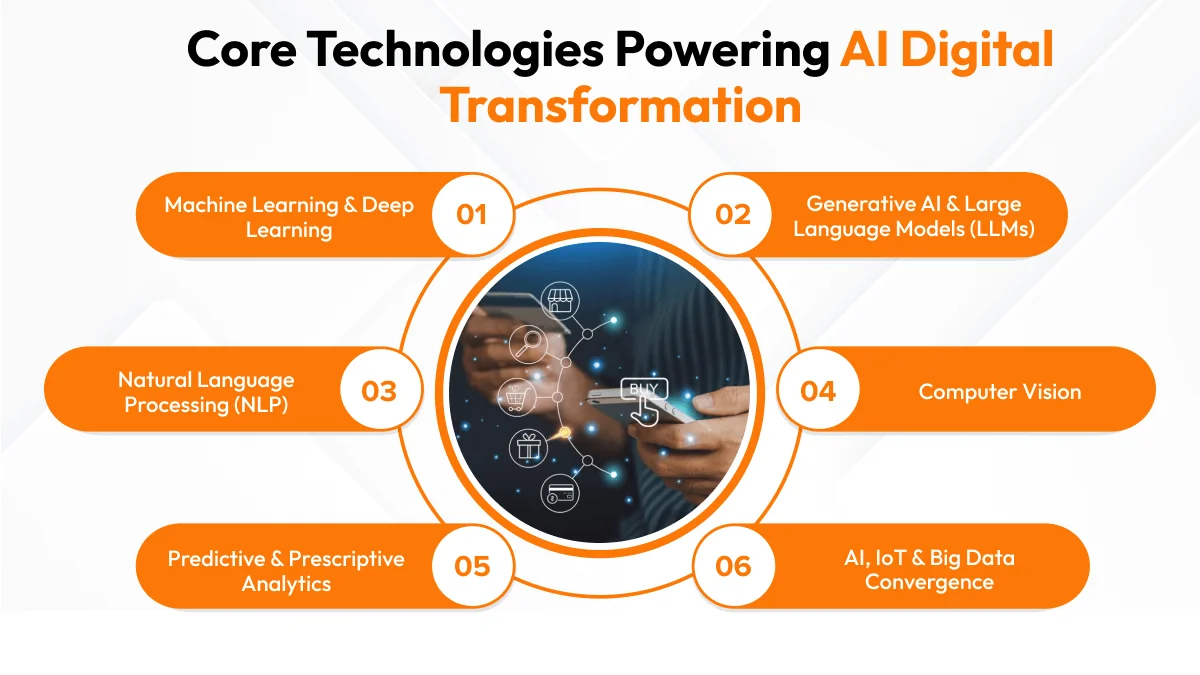
Machine Learning & Deep Learning
- Uses past and current data to learn without requiring any specific coding instructions.
- It can detect various kinds of patterns while processing data at extremely large volumes.
- Enables multiple applications, including fraud detection, demand forecasting, and predictive maintenance.
Generative AI & Large Language Models (LLMs)
- Gen AI produces text, code, and images, and insights that resemble human output.
- Supports virtual assistants, conversational AI, and enterprise copilots.
- It helps content creation, customer support, and development teams become more productive, and an AI detector free of charge lets them quickly review generated copy before it is published
Natural Language Processing (NLP)
- It processes human language through both spoken and written text.
- Extracts data from unstructured sources, which include emails, chats, and documents.
- The system enables sentiment analysis through its support of chatbots, voice assistants, and document automation technology.
Computer Vision
- It helps to process visual data through image and video analysis.
- The system performs automated visual inspection, surveillance, and image recognition tasks.
- It improves operational efficiency and accuracy in manufacturing, healthcare, and security fields.
Predictive & Prescriptive Analytics
- Uses past and current data to forecast upcoming trends and outcomes.
- Suggests the best strategies that help decision-makers to enhance their decision-making process.
- It helps organizations to develop better plans, manage risks, and use resources more effectively.
AI, IoT & Big Data Convergence
- Integrates real-time sensor data with extensive data analytics services.
- It creates intelligent automation systems that make decisions at the current moment.
- Operates smart factories, connected healthcare systems, and intelligent supply chains.
Read More: AI in Banking: Use Cases that Drive Results
AI in Digital Transformation Strategy: Step-by-Step Roadmap
Successful AI digital transformation requires three essential elements, which include organizational strategy, data assets, and their execution to achieve success. This framework shows organizations how to create a pathway that will enable them to achieve their desired results from their plans.
1. Identifying High-Impact AI Use Cases
Start by establishing connections between AI projects and the goals of your business. The team should concentrate on particular issues that AI can solve to achieve specific results through improved customer experience, lower operational expenses, higher revenue generation and better risk management. The team should evaluate use cases based on their practical implementation possibilities and available data and expected financial returns instead of testing purposes.
2. Data Readiness & Infrastructure Assessment
The effectiveness of AI systems depends entirely on the quality of their input data. You need to evaluate your data according to three criteria which include its quality and accessibility and its governance standards. Your organization needs to construct an infrastructure which includes cloud services and data management systems and storage facilities that handle real-time data operations while meeting security and compliance standards.
3. Choosing the Right AI Models & Tools
Organizations should choose AI models and tools according to their specific needs and the level of their organizational development. Organizations can use different types of machine learning models which include basic machine learning solutions and deep learning models and generative AI technologies. The assessment process should consider four criteria which include system accuracy and explainability and system scalability and ongoing maintenance requirements.
4. Build vs Buy vs Customize Decisions
Organizations need to choose between three options which include developing their own AI technology through in-house creation or acquiring pre-existing software or modifying software they already own. Building enables organizations to maintain full authority over their operations while they create unique solutions which take time to develop, whereas buying enables them to quicken their market entry process, but customization lets them achieve operational excellence through tailored approaches.
5. Deployment, Integration & Scaling
The AI models require deployment into actual operational processes which need connection to current operational systems. The system tracks performance while supporting ongoing model training and model improvement throughout the entire process. The organization needs to establish ethical governance and change management procedures which will enable successful AI adoption throughout the business operations.

How Data Strategy Powers AI in Digital Transformation?
A strong data strategy is the backbone of any successful AI-driven digital transformation services in 2026 organizations that treat data as a strategic asset, not just a technical resource, will achieve responsible AI scalabilit,y according to research findings
Data Collection, Quality & Governance
- Collect relevant, high-value data aligned with business objectives
- Ensure data accuracy, consistency, completeness, and timeliness
- Eliminate data silos through centralized or well-integrated data systems
- Define clear data ownership, access controls, and usage policies
- Implement governance frameworks to maintain transparency and accountability
Structured vs Unstructured Data
- Leverage structured data such as databases, logs, and transactional records
- Unlock insights from unstructured data, including text, images, videos, and audio
- Use AI technologies like NLP and computer vision to process unstructured data
- Combine both data types for richer analysis and more accurate AI outcomes
Privacy, Compliance & Ethical AI Considerations
- Comply with data protection and industry-specific regulations
- Secure sensitive and personal data through encryption and access controls
- Minimize bias and ensure fairness in AI models
- Maintain explainability and transparency in AI-driven decisions
- Adopt responsible and ethical AI practices to build long-term trust
Industry-Wise Use Cases of AI in Digital Transformation
The digital transformation of businesses through artificial intelligence technology brings different results for various industries because their data maturity, operational complexity and customer needs differ. The year 2026 marks the transition of artificial intelligence from an experimental technology to a fundamental component of business operations which enhances productivity and precision and supports better decision-making.
1. Healthcare
AI technology improves healthcare delivery through better patient treatment, medical testing, and health system management. The system uses machine learning algorithms to identify diseases early while processing medical images and developing suitable treatment regimens. AI technology improves healthcare operations by automating administrative tasks, which include scheduling appointments and creating clinical records, and distributing healthcare resource,s thus enabling providers to achieve better results with less effort.
2. Fintech & Banking
AI in digital transformation has become essential for all contemporary banking operations and financial service activities. The system enables banks to detect fraudulent activities and assess credit risks while providing personalized financial advice to customers in real time. Financial institutions and banks use artificial intelligence to streamline regulatory compliance processes, enhance customer onboarding, and build secure digital banking platforms.
3. Retail & E-Commerce
Retailers implement artificial intelligence to develop customized shopping experiences while improving business processes. Businesses use recommendation systems and demand estimation tools, and flexible pricing strategies to enhance their sales results and inventory control. AI retail digital transformation enables businesses to develop better marketing strategies and to operate supply chains more effectively.
4. Manufacturing
AI technology empowers manufacturing processes through its capabilities for predictive maintenance, quality assurance, and process efficiency improvements. Computer vision technology identifies production flaws during the manufacturing process, while artificial intelligence systems examine operational data to decrease machine downtime and enhance production efficiency.
5. Logistics & Supply Chain
Agentic AI in Supply Chain Management operations because it provides better visibility and quicker response times. Organizations use predictive analytics to enhance their delivery operations because it helps them manage their routes and inventory, and delivery schedules. This process leads to quicker deliveries, which results in decreased expenses and better operational performance.
6. Education
AI brings educational transformation through its capability to create unique learning paths and develop smart tutoring systems. The adaptive learning system uses student assessment results to create customized learning materials and study schedules. Educational institutions use AI technology to automate their administrative functions because it helps with assessment duties and student monitoring tasks.
7. Real Estate
AI technology enables real estate professionals to assess property values and estimate market demand and gather customer information. Investors and developers use predictive analytics to discover valuable opportunities. AI-enabled virtual tours and chatbots improve customer interactions for buyers and tenants.
8. Media & Entertainment
Media and entertainment organizations employ AI technology to create personalized content suggestions, which enhance their advertising campaigns and provide insights into audience viewing patterns. AI assists content development through its editing and distribution functions, which enable platforms to distribute interactive experiences that utilize data across large audiences.
Learn More: AI in eCommerce: Exploring AI Use Cases in the eCommerce Industry
Real-World AI Digital Transformation Case Studies
AI adoption throughout organizations shows different results across various organizations. Some companies manage to expand their AI operations while other companies find it difficult to advance their pilot programs. Startups and enterprises can benefit from understanding which strategies succeed and which ones fail.
Startups vs Enterprises
Startups tend to implement AI technologies faster than established businesses because they lack legacy systems so their flexible infrastructure operates with an AI-first approach. The company uses artificial intelligence in digital transformation to deliver fast services which create personalized experiences while reducing operational costs. Organizations with substantial budgets and extensive datasetsface difficulties from data silos and compliance obligations and internal resistance. Enterprise app development services achieve success by updating their data systems and developing their AI programs to match their business goals.
What Worked, What Failed, and Why
The role of AI in digital transformation achieve success when organizations establish specific business objectives which use reliable data and receive backing from executive management. The organizations that built scalable data pipelines paired with cross-team work networks experienced actual performance improvements. The organization encountered failures because of inadequate data standards and insufficient system connections and the organization treated AI as a separate initiative instead of a fundamental change process.
Key Lessons from Successful AI Adoption
The most successful organizations treat AI as a continuous journey instead of treating it as a one-time deployment. The organization begins with small projects, which it expands through planned growth while allocating resources to establish governance and ethical practices and manage organizational change. The organization uses AI technology to solve actual business problems, which they consider their main focus instead of using AI for the sake of achieving technological progress.
Cost of AI Digital Transformation: Budget, ROI & Investment Planning
Learn about the cost of AI digital transformation, budget planning strategies, infrastructure expenses, and ROI metrics businesses should track to maximize AI investment value.
AI Development & Implementation Costs (USD)
| Cost Component | Estimated Cost Range ($) | Description |
| Data preparation & management | $10,000 – $75,000+ | Data cleaning, labeling, integration from multiple sources |
| AI pilot / PoC development | $30,000 – $120,000 | Small-scale validation of AI use cases |
| Production-ready AI solution | $120,000 – $500,000+ | Custom AI model development and deployment |
| Enterprise AI platform | $250,000 – $1,000,000+ | Multi-department, scalable AI systems |
| Custom & advanced AI systems | $300,000 – $1.5M+ | LLM-based, computer vision, or agentic AI systems |
| Integration with existing systems | $15,000 – $80,000 | ERP, CRM, legacy software integration |
Infrastructure & Cloud Expenses (Monthly, USD)
| Infrastructure Area | Estimated Monthly Cost ($) | Description |
| Basic cloud infrastructure | $800 – $4,000 | Storage and compute for small AI workloads |
| Mid-scale AI workloads | $4,000 – $15,000 | Analytics, recommendation systems |
| High-scale / Generative AI | $15,000 – $60,000+ | LLM inference, real-time AI applications |
| Data storage & transfer | $300 – $3,000 | Depends on data volume and usage |
Ongoing Training, Maintenance & Scaling Costs (Annual, USD)
| Cost Area | Estimated Annual Cost ($) | Description |
| Model retraining & optimization | $10,000 – $60,000 | Maintaining model accuracy over time |
| Monitoring & performance tuning | $5,000 – $30,000 | Drift detection and reliability monitoring |
| Cloud usage & scaling | $15,000 – $75,000+ | Growing compute and storage needs |
| Security & compliance updates | $5,000 – $25,000 | Governance, audits, and data protection |
| Typical maintenance benchmark | 15–30% of initial AI cost | Industry standard |
Calculating ROI from AI Initiatives
| ROI Area | Typical Impact Range | Business Outcome |
| Cost reduction | 10–40% | Lower operational and labor costs |
| Revenue growth | 5–30% | Personalization, smarter pricing |
| Productivity gains | 15–50% | Faster workflows, fewer bottlenecks |
| Risk reduction | Significant loss avoidance | Fraud detection, compliance |
| Customer satisfaction | Higher retention & NPS | Improved CX and engagement |
Benefits of AI in Digital Transformation
The implementation of AI in digital transformation solutions brings tangible business benefits because organizations gain the ability to work more efficiently and rapidly adapt to change. The advantages of the system will reach beyond automation capabilities in 2026 because the system will influence executive decision processes and customer interaction methods and long-term growth strategies.
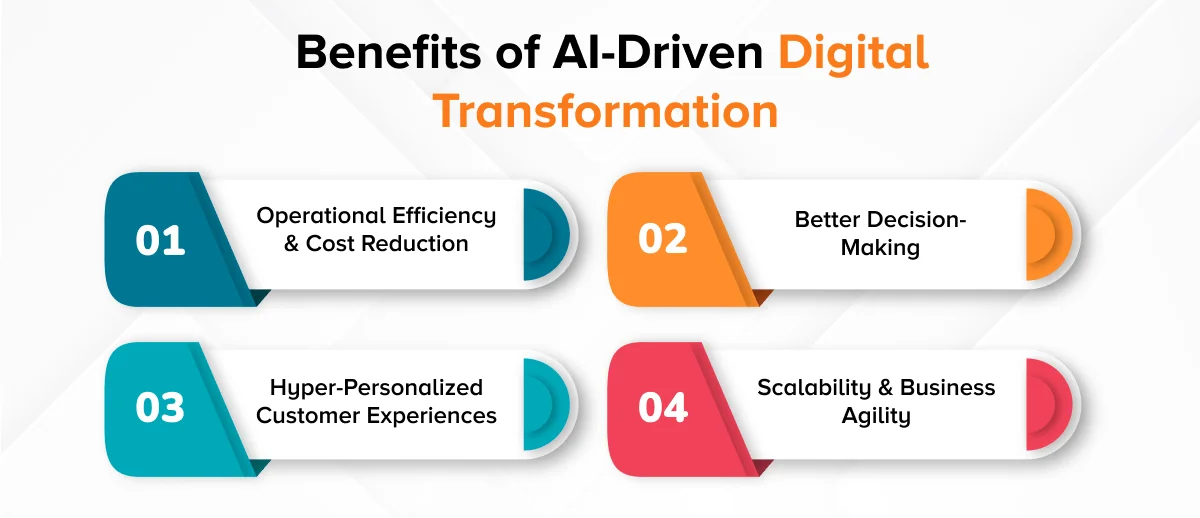
Operational Efficiency & Cost Reduction
AI powered digital innovation performs two functions by automating basic tasks and streamlining complex work processes that cross different departments. Automated systems decrease human errors while they also boost operational uptime and better handle available resources. Artificial intelligence digital transformation company succeed in achieving ongoing cost reductions while they continue to achieve maximum operational efficiency.
Better Decision-Making
AI technology improves decision processes through its capability to process extensive datasets in real time while generating valuable business insights. Predictive and prescriptive analytics help leaders anticipate trends, assess risks, and make informed choices with greater speed and confidence.
Hyper-Personalized Customer Experiences
The role of AI in digital innovation delivers personalized customer experiences through its ability to analyze various data points about customer behavior and preferences and their future needs. Businesses can deliver tailored recommendations, proactive support, and context-aware experiences that improve customer satisfaction and loyalty.
Scalability & Business Agility
AI-driven systems function as scalable solutions because they handle increasing data volumes and user numbers and operational needs. The systems enable organizations to maintain their competitive edge because they can quickly adjust to market shifts and customer preferences and emerging business opportunities in the fast-changing digital environment.
Challenges of Implementing AI in Digital Transformation
The organizations must handle the challenges which arise from digital transformation and AI because they bring valuable advantages to their operations. The year 2026 requires successful outcomes through AI technology adoption and effective handling of risks generated by increased system scale and operational complexity and corporate accountability demands.
Data Bias & Model Accuracy Issues
AI models learn from historical data which may contain biases inconsistencies or gaps. The problems will result in prediction errors and biased outcomes and decreased confidence in AI systems according to their current state. The system requires continuous tracking plus various data sources and frequent model checks to ensure it operates correctly and remains unbiased.
Integration with Legacy Systems
The existing systems of many organizations depend on outdated infrastructure which lacks compatibility with artificial intelligence technologies. The process of connecting AI solutions to legacy systems creates multiple challenges which result in extended implementation times and restrictions on capacity growth. The organization can solve its current problems through modernization of its data infrastructure and implementation of modular system integration methods.
Talent Shortage
The process of AI transformation needs professionals who possess advanced expertise in data science and machine learning and engineering and governance. Organizations encounter difficulties in developing their internal AI systems because there exists a shortage of qualified AI personnel who possess relevant work experience. The organizations use two main methods to solve their staffing shortages which involve training current staff who work with AI technology and establishing partnerships with AI specialists.
Security & Compliance Risks
AI systems process extensive volumes of confidential information which results in increased vulnerability to security breaches and strict regulatory examination. The organization must protect data privacy and safeguard its models while adhering to all regulatory requirements. Organizations need to establish effective security measures and implement ethical artificial intelligence standards while developing compliance systems to protect their business interests and establish trust with stakeholders.
How to Overcome AI Digital Transformation Challenges
The majority of AI and digitalization projects fail because organizations make strategic and operational errors instead of facing technological challenges. Organizations need to avoid these frequent errors, which will lead to the successful implementation of AI-based transformations that can develop into large-scale operations in 2026.
Starting with Technology Instead of Strategy
The methods they will use to achieve their objectives. Many organizations make this mistake because they start using AI tools without establishing specific business needs that they want to achieve. The implementation of AI as an independent technological solution does not show any measurable benefits to organizations. The organization needs to establish measurable objectives that will direct the development of AI projects while securing executive backing throughout the entire process.
Poor Data Management
The success of AI systems relies on their ability to obtain high-quality data through effective data management practices. The combination of inconsistent data, siloed data, and outdated data results in untrustworthy outcomes, which restrict organizations from expanding their operations. Organizations need to establish efficient data governance systems together with data integration processes and ongoing data quality maintenance to develop their AI programs.
Over-Automation Without Human Oversight
Excessive automation, which occurs when organizations implement all automation solutions at once, brings about great dangers that result in reduced organizational responsibility. Human decision-making needs assistance from custom AI development company, which should not function as complete replacements. The presence of human operators during the process helps maintain better decision-making combined with ethical standards, which creates trust in AI results.
Ignoring Change Management
AI transformation brings changes to all aspects of an organization, including the way work gets done, how employees behave, and how the company develops its identity. Organizations that want to succeed need to prepare their teams for upcoming changes because failure to do so will lead to workers resisting new ways of working. The process of change management needs to include both educational programs and open dialogue, as well as early engagement of all stakeholders to succeed in implementing AI solutions throughout the organization.
AI Myths vs Reality: What Businesses Get Wrong
The increasing usage of AI technology has not eliminated the public’s misunderstandings about AI, which continue to create false beliefs about its capabilities. The process of AI transformation requires an accurate understanding of what is true and what is false to help people make decisions that support environmental sustainability.
Myth: “AI Will Replace Humans”
Reality: AI is designed to augment human capabilities, not replace them. Human judgment, creativity, and oversight must be present for AI to perform its work. The most successful organizations use AI to empower employees, improve productivity, and enable higher-value work.
Myth: “AI Works Without Clean Data”
Reality: People believe that AI systems function properly without the need for clean learning data. AI systems depend on the quality of their training data, as that data determines their performance. The presence of poor-quality information, together with incomplete data and biased information, results in unreliable results.
Myth: “AI Guarantees Instant ROI”
Reality: The myth of AI instant ROI leads people to believe that AI systems deliver immediate financial returns for businesses. AI transformation requires financial commitment from organizations because it develops over an extended period. The majority of use cases need time to prepare data and improve models before organizations can fully adopt them.
Measuring AI Transformation Success: KPIs & Performance Metrics
To evaluate the real impact of AI-driven digital transformation, organizations should track performance across multiple dimensions:
Business KPIs
- Revenue growth driven by AI-powered products or services
- Cost reduction through automation and process optimization
- ROI and payback period of AI investments
- Market competitiveness and time-to-market improvements
Operational KPIs
- Process efficiency and cycle time reduction
- Automation rate and task completion accuracy
- Reduction in manual errors and operational downtime
- System scalability and performance consistency
Customer-Centric Metrics
- Customer satisfaction (CSAT) and Net Promoter Score (NPS)
- Customer retention and churn rates
- Personalization effectiveness and engagement levels
- Faster response times and improved service quality
AI Model Performance Metrics
- Model accuracy, precision, recall, and F1 score
- Bias detection and fairness indicators
- Model drift and performance degradation over time
- Training, inference speed, and resource utilization
Visit to Know More: AI in Real Estate: Transformative Use Cases in Real Estate
The Future of AI in Digital Transformation: Beyond 2026
As AI technologies mature, digital transformation will move beyond automation and analytics toward intelligent, self-evolving enterprises. The next phase will be defined by deeper autonomy, contextual intelligence, and stronger human–AI collaboration.
Autonomous Enterprises
Organizations will evolve into autonomous enterprises where AI continuously monitors operations, makes real-time decisions, and optimizes workflows. This shift enables proactive, self-adjusting systems across IT, supply chains, and core business processes.
AI Agents & Copilots
AI agents and copilots will become embedded across departments, supporting decision-making, coding, customer service, and analytics. These systems understand context, learn from usage, and boost productivity while keeping humans in control.
Hyper-Contextual
Future AI systems will leverage real-time data, user intent, and environmental signals to adapt dynamically. Applications will move beyond static logic to deliver instant, personalized, and situationally aware experiences.
AI–Human Collaboration
AI will augment, not replac,e human roles by handling repetitive and data-heavy tasks. Humans will focus on creativity, strategy, and ethics, driving faster innovation through collaborative intelligence.
How Octal Helps You Choose the Right AI Development Partner for Digital Transformation
Choosing the right AI development partner is a critical step in any digital transformation journey. At Octal, the focus goes beyond building AI solutions it starts with aligning technology, data, and business objectives to drive measurable impact and long-term scalability.
Technical Expertise
Octal brings hands-on expertise across machine learning, generative AI, data engineering, and cloud-based AI infrastructure. With a strong emphasis on MLOps, secure deployments, and seamless system integration, Octal ensures AI and digital transformation are production-ready, scalable, and compliant with enterprise standards.
Proven Industry Experience
With experience delivering AI-powered solutions across healthcare, fintech, retail, logistics, and more, Octal understands the operational realities and regulatory challenges of different industries. This domain knowledge enables faster implementation, smarter use-case identification, and AI systems that deliver real business value.
Avoiding Common Pitfalls
Octal helps businesses avoid common AI transformation mistakes such as poor data readiness, over-reliance on generic models, and unrealistic ROI expectations. By prioritizing transparency, customization, and long-term support, Octal ensures AI initiatives remain sustainable and outcome-driven.

Closing Perspectives on AI and Digital Transformation
AI-powered digital transformation is no longer about experimentation or isolated innovation. In 2026, it represents a fundamental shift in how organizations operate, compete, and create value. Businesses that treat AI as a strategic capability rather than a technology add-on are better positioned to adapt to market changes, customer expectations, and emerging risks.
Successful transformation requires more than advanced algorithms. It depends on data readiness, the right technology stack, skilled talent, ethical governance, and a clear roadmap aligned with business outcomes. Organizations that invest in these foundations can unlock long-term efficiency, intelligence, and scalability.
As AI continues to evolve toward autonomous systems and collaborative intelligence, the real advantage will lie in how effectively businesses integrate AI into everyday decision-making. Those who act decisively today will define the digital leaders of tomorrow.


 Get in Touch
 By
By October 9, 2026