


The idea of on-demand app development is taking industries, such as food delivery, ride-hailing, and healthcare, by storm. But the road leading to an on-demand app that can generate profit and be functional is filled with many hurdles.
Many businesses encounter challenges in on-demand app development, which in turn result in delays in the launch schedule, increased budgets, or even a drop-off in user experience.
This guide examines the areas of concern and the related solutions that provide the support you need to smoothly navigate the mobile app development process.
Why On-Demand Apps Are in High Demand?
On-demand apps are capable of delivering a variety of services right to the users’ doorsteps in a matter of minutes, and that is the primary reason behind their worldwide popularity.
If you are thinking of hiring mobile app developers or partnering with an on-demand app development company for your business, it is going to be very important for you to understand the challenges of the mobile app industry in order to achieve success.
These applications require a powerful foundation, uninterrupted service flow, and backend systems that can readily be updated with new users or data.
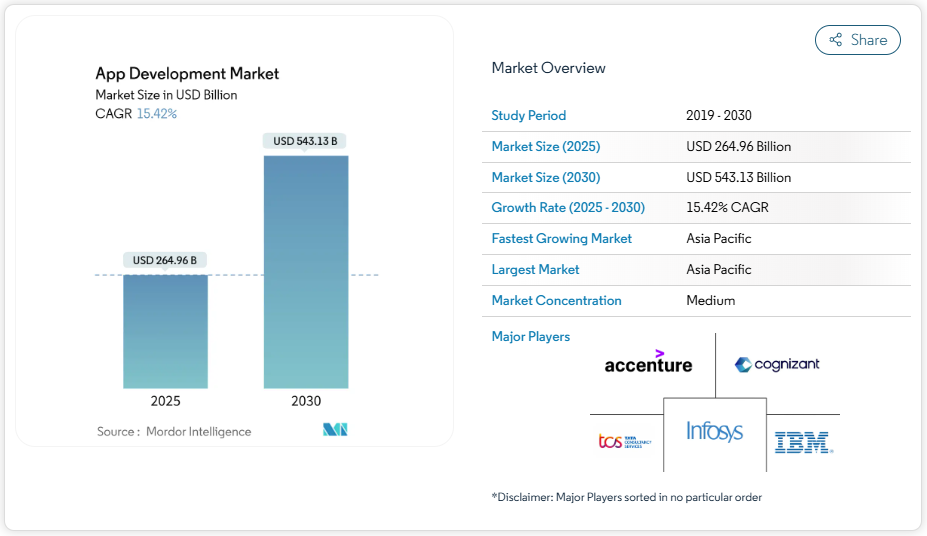
According to Mordor Intelligence, the total App Development market is estimated to be around USD 264.96 billion in 2025 and is projected to reach USD 543.13 billion by 2030 at a CAGR of 15.42% during the years 2025-2030. A significant portion of this is expected to come from on-demand apps as they continue to grow with user demand and technology.
Key Challenges in On-Demand App Development
There are a multitude of serious challenges in on-demand app development, which will ultimately lead to problems with growth, performance, management, and user engagement with the application. You will need to solve these problems in order to successfully complete the mobile app development cycle.
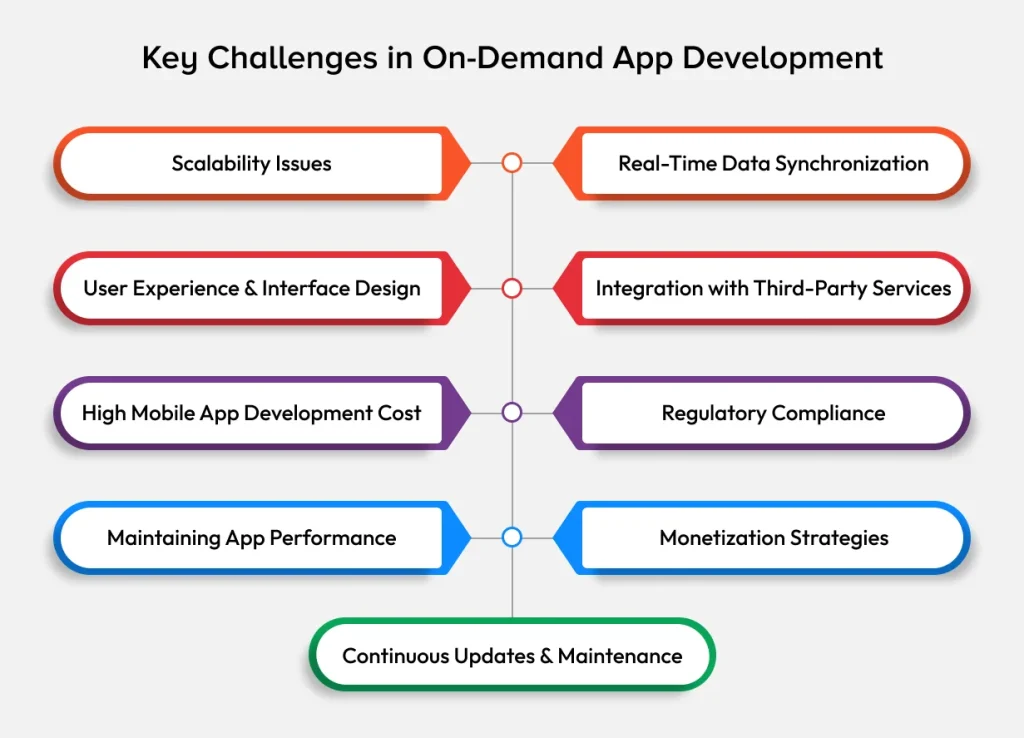
1. Scalability Issues
Like all applications, on-demand apps are required to scale without significant effort and sustained efficiency at a particular time with loads of user traffic. Poor scalability choice inevitably leads to app crashes, slow run-time, and greater customer dissatisfaction.
- Solution: Utilize technologies with unlimited virtual storage and backend solutions. Stress-test your apps regularly to show what they are capable of handling during high user demand.
2. Real-Time Data Synchronization
Real-time updating features such as live tracking, chat, and notifications are important to the app experience. Delays, lag, or errors can throw doubt into the users’ sense of trust.
- Solution: Building an effective real-time communication protocol, such as WebSockets, would solve the time lag. Optimize for minimum latency for data synchronization.
3. User Experience and Interface Design
A confusing, cluttered, or overly busy design can lose users. On-demand apps need easy-to-use interfaces, and speed is a necessity.
- Solution: Focus on user design when creating a user experience. To get to a user-centric design, usability testing and revision based on user testing or feedback will be required.
4. Integration with Third-Party Services
On-demand apps usually have interfaces with 3rd party APIs (application programming interface) for payments, maps, and notifications.
- Solution: Choose a reliable 3rd party provider that has been proven to perform and integrate well with your app. Always monitor the performance of your API, and have a couple of alternatives as a backup
5. High Mobile App Development Cost
On-demand apps can be costly to develop when hiring outside developers for a feature-rich mobile application, especially when they are employing manicured technologies and building in multiple APIs (application programming interface).
- Solution: Carefully plan your budget. Escalating or saving money on an on-demand app could make sense if you hired offshore app development experts.
6. Regulatory Compliance
Every region has its own regulations governing the processing of data, payments, and preservation of customer privacy.
- Solution: Be aware of the local laws and update yourself frequently. Hire lawyers to guide you in avoiding violations of the law.
7. Maintaining App Performance
Your app’s reputation could be influenced negatively by such factors as slow loading times or frequent crashes, which are performance issues.
- Solution: Optimize your code, use good algorithms, and perform testing for the application regularly.
8. Monetization Strategies
It is very important to figure out a monetization model that fits well with your business in order to maintain it for a long time.
- Solution: Select a strategy such as subscription fees, in-app purchases, and ads. Also, try out different models to know which one will bring you the best results in terms of customers.
9. Continuous Updates and Maintenance
The apps that are on-demand always have to be equipped with new versions to remove errors, add new features, and boost the security level.
- Solution: Create a schedule for maintenance. Facilitate the process of updates through the use of automated testing tools.

How to Overcome Challenges in On-Demand App Development?
Addressing concerns in the development of on-demand apps entails having a well-planned and timely execution by top-notch professionals to guarantee that the app can easily grow, is safe, and performs without hitches. Establishing a relationship with skilled developers and refining the process of mobile app development are two ways that lead to the expected result.
1. Partner with the Right Mobile App Development Company
It is essential to work with a mobile app development company that fits your needs. Check companies that have experience in the field of on-demand solutions and have a satisfactory reputation.
- Tip: Before making a choice, inspect portfolios, client testimonials, and case studies.
2. Hire Mobile App Developers with Relevant Expertise
Suitable developers can resolve the technical issues the app has and ensure it runs smoothly.
- Tip: Look for developers who have worked extensively with real-time systems, cloud integration, and security protocols.
3. Leverage Offshore App Experts
Hiring offshore app experts is an option that the company can take in order to save money and use talent from a pool of existing talent anywhere in the world.
- Tip: To ensure that the communication is clear and there are no misunderstandings, you should plan the meetings and progress reports regularly..
4. Focus on User Feedback
The input of users into what your app is playing plays a very important role because it provides you with limitless opportunities to make improvements and solve the issues that users are encountering.
- Tip: Make user communication with users easy and set a priority for them to decide on the updates.
5. Optimize the Mobile App Development Process
Having a well-planned mobile app development process is a wonderful way of ensuring that the work is done on time, within the set budget, and to the preferred quality.
- Tip: It is recommended to use agile methodologies to be more flexible and faster in making iterations.
6. Monitor Mobile App Development Cost
Regularly examining the costs during the development period is one of the ways that can help you avoid spending beyond your budget.
- Tip: To keep track of expenses and the proper allocation of resources, you should use project management tools.
Why Choose an On Demand App Development Company?
Choosing the best on demand app development company is a great partnership with the following benefits:
- Professional experts available to hire
- Shorter launch time to market
- Affordable options
- Continuous support and updating
These companies are great at solving the problems that come with the development of on-demand apps, and they take the time to make quality solutions.
Best Practices for On-Demand App Development
The on-demand app development project will be a success if the user-friendly design and the backend system’s robustness are managed as interchanges, hence the best practices. Please read through the following best practices:
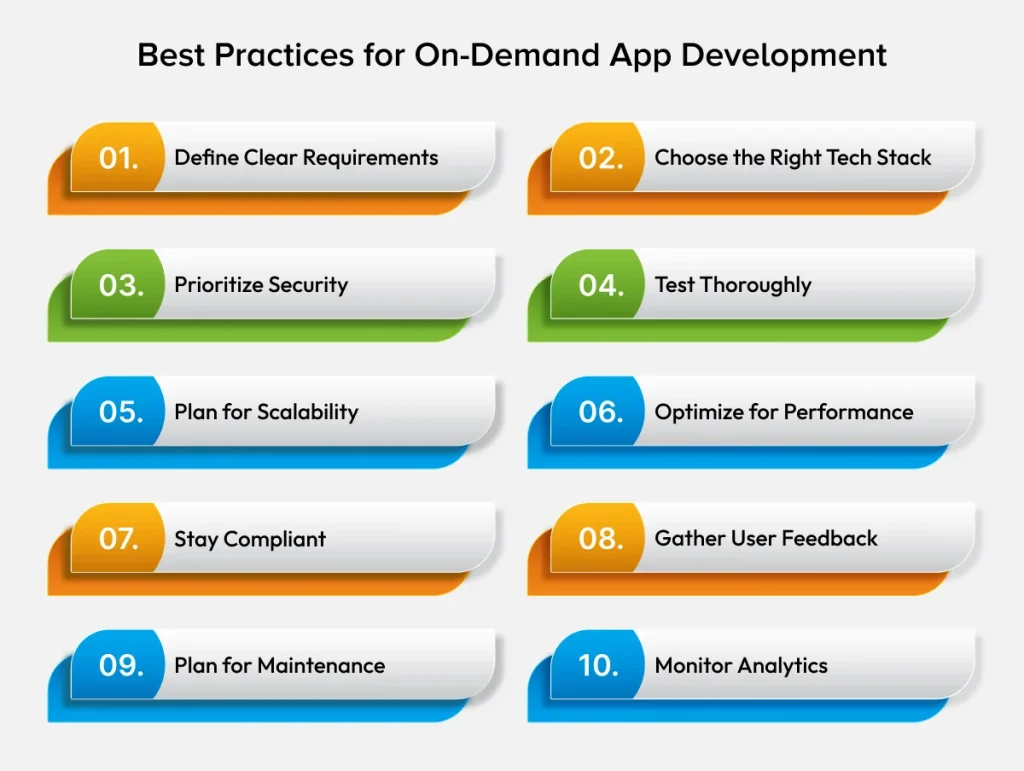
1. Define Clear Requirements
The company will want to produce a very definite project brief that will list the project features, audience, and technology needs.
2. Choose the Right Technology Stack
A company can choose to use a technology stack based on the standards of scalability, security, and performance.
3. Prioritize Security
The app should be built with all the important security features integrated right at the beginning of the process.
4. Test Thoroughly
Your app will require extensive testing, ideally including unit, integration, and user acceptance testing.
5. Plan for Scalability
Your plan needs to encompass how the app will be able to scale or adapt to a larger number of users.
6. Optimize for Performance
Your app should be fast in loading and offer optimal and smooth navigation throughout.
7. Stay Compliant
You will be required to follow the laws and regulations of the countries where your app will be available, as this is a collaboration issue.
8. Gather User Feedback
The most effective way to enhance the user experience is to continuously gather user feedback and refine features.
9. Plan for Maintenance
Your plan should also include regular updates and maintenance to ensure the app functions correctly.
10. Monitor Analytics
You must have access to the user behavior tracking analytics along with the app’s performance data so that you can pinpoint areas needing improvement.
The Role of Offshore App Experts
Offshore app experts offer cost-effective measures without quality sacrifice. The benefits are:
- World-class talent accessibility
- Reduced development costs
- Various engagement models
It is very important that clear communication and the giving of regular updates are also present to maximize the positives from offshore development.
How to Hire Mobile App Developers?
If the preference is made to hire mobile app developers, the following points should be taken into account:
- Experience in working with on-demand apps
- Possession of necessary technical skills
- Previous projects portfolio
- Client feedback and testimonials
The right team will help your application to be in line with the users’ and the company’s expectations.
Understanding Mobile App Development Cost
The mobile app development cost is dependent on the functionalities, complexity, and approach. The main influencers are:
- Functionality and features of the app
- Design intricacy
- Stack technology
- Development team’s location
- Maintenance and upgrades
| Role | Responsibility | Estimated Cost (Monthly) |
| Project Manager | Oversees project, timelines, and communication | $4,000 – $8,000+ |
| UI/UX Designer | Creates wireframes, user flows, and app design | $3,000 – $7,000+ |
| Front-End Developer | Builds user-facing part (iOS/Android apps) | $5,000 – $12,000+ |
| Back-End Developer | Handles APIs, databases, server-side logic | $6,000 – $15,000+ |
| QA Engineer | Tests and ensures a bug-free, secure app | $3,000 – $6,000+ |
| DevOps Engineer | Deployment/CI, cloud infrastructure maintenance | $2,000 – $5,000+ |
| Solution Architect | Design’s overall technical framework | $1,000 – $5,000+ |
| Business Analyst | Research requirements, specs, and features | $2,000 – $6,000+ |
| Total (Team Estimate) | Varies by team size & app complexity | $30,000 – $70,000+ |
Being careful in budgeting is a way of avoiding the surprise of unplanned expenses.
Navigating the Mobile App Development Process
The mobile app development process involves a series of steps that are more or less standard for all projects:
- Requirement analysis
- Design and prototyping
- Development
- Testing
- Deployment
- Maintenance
Using a systematic approach not only guarantees but also prevents premature delivery, while assuring high-quality results.
Conclusion
The challenges in on-demand app development; nevertheless, the right tactics and partners will be capable of mitigating these barriers.
The combination of a trustworthy mobile app development firm, hire mobile app developers who have the required skills, and the use of offshore experts in app development will make your on-demand app successful.
Besides, the equilibrium between careful planning, continuous improvement, and user feedback will be the winning factor in the long run.



 Get in Touch
 By
By March 10, 2026