


Key Takeaways
- Vertical AI Agents specialize in specific industries, providing tailored solutions that improve efficiency, reduce costs, and enhance decision-making.
- The global Vertical AI market is projected to grow significantly, with healthcare AI reaching USD 187.69 billion by 2030.
- These agents utilize deep domain knowledge, task specialization, and contextual intelligence to outperform general AI in business operations.
- Real-world applications include healthcare diagnostics, financial fraud detection, retail demand forecasting, and manufacturing process optimization.
- Businesses must adopt Vertical AI Agents to remain competitive, improve customer satisfaction, and maximize ROI.
Vertical AI agents: AI systems targeted at particular industries and business areas are transforming intelligent business processes by providing domain knowledge, scale automation, and quicker decision-making processes that address the particular requirements of every area of operation. These specialized agents, unlike general AI, are knowledgeable of healthcare, financial, retail, manufacturing, and other aspects. To business owners, going vertical with AI agents will reduce their costs, improve their efficiency, and gain a competitive edge in a market where people are becoming more concerned with exactness, rather than widespread solutions. Concisely, one-size-fits-all AI will not determine the future of intelligent business operations, but industry-specific vertical AI agents.
Introduction
Artificial Intelligence is no longer just a buzzword; it’s a critical driver of transformation across industries. From customer support chatbots to predictive analytics, companies have already begun to regard AI as a tool to simplify operations. However, as organizations seek to drive further integration and industry-specific solutions, a different paradigm of Vertical AI Agents is flourishing.
Vertical AI agents, as opposed to general-purpose AI tools such as ChatGPT, Siri, or Alexa, are designed to fit a particular industry. They are trained on Industry-specific data, they are optimized by sector processes, and fine-tuned to the specific needs of a business in that industry, such as finance, retail, healthcare, logistics, and manufacturing.
To business owners who are operating in a more competitive environment, vertical AI agents are the next step in operational excellence: more intelligent automation, reduced costs, and plans that are more specific to the language, regulations, and subtleties of their business.
The blog discusses the reasons why vertical AI agents will be the future of intelligent business operations, backed by market statistics, real-life applications, and trends into the future, and offers practical insights into business leaders willing to accept the new direction of business operations.
The Market Stats: Why Vertical AI is Gaining Momentum
The global AI market is booming, but within it, vertical AI is becoming a dominant segment. Let’s look at the numbers:
- Global AI market size- The global AI market size is projected to reach USD 1,811.75 Bn by 2030 with a growing CAGR of 35.9% from 2025 to 2030.
- Vertical AI market size & CAGR – The market was USD 10.2 billion in 2024, projected to grow at ~21.6% CAGR from 2025-2034.
- Healthcare AI- The global AI in healthcare market was estimated at USD 26.57 billion in 2024, and is projected to reach USD 187.69 billion by 2030.
- AI / Agentic AI (Enterprise Software)- By 2028, 33% of enterprise software applications will include agentic AI, up from less than 1% in 2024.
- Manufacturing & Process Automation- McKinsey reports that in activities related to manufacturing and supply chains, task automations could reach up to ~70% across those activities.
These statistics highlight a clear trend- the demand is not just for AI, but for AI that understands the business vertical it serves.

What Are Vertical AI Agents?
Vertical AI agents are industry-specific applications of artificial intelligence that serve the interests of an industry. These agents also operate with accuracy and reliability, unlike general-purpose AI, which is trained on domain-specific data, industry vocabulary, and rules of compliance.
They bring three core strengths:
- Domain knowledge– Using industry data and regulations to provide contextual information.
- Task specialization– Specializing in important processes like insurance claims, healthcare patient triage, and detection of fraud in the banking industry.
- Contextual intelligence- Perceiving the industry-specific lexicon, client anticipations, and the gameplay peculiarities to improve decision-making.
To illustrate, a medical vertical AI agent may be used in healthcare to process medical images and identify abnormalities, and help in designing treatment strategies. In retail, it is able to anticipate demand, optimize inventory, and personalize marketing. Finance In finance, it has the potential to automate customer onboarding and risk analysis and enhance fraud prevention.
Vertical agents are more accurate, more trusted, and technologically provide a higher ROI by aligning AI with the realities of an industry. This area of expertise assists organizations in quickening the process of digital transformation, enhancing customer experiences, and maintaining a competitive advantage in rapidly changing markets.
Why Vertical AI Agents Outperform General AI in Business Operations?
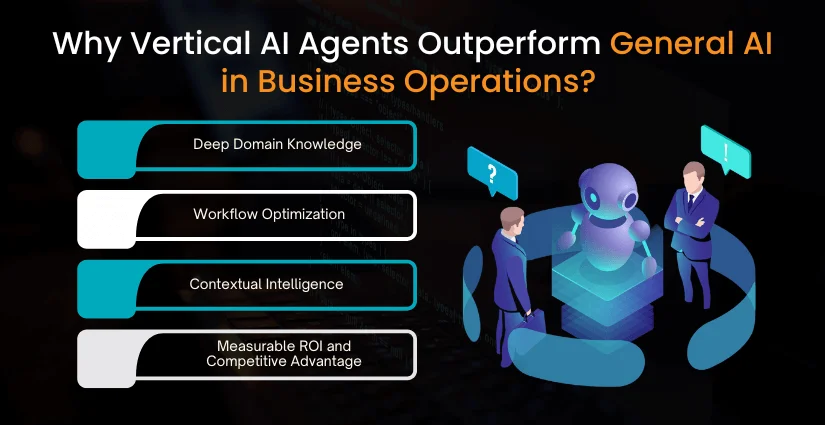
Artificial intelligence is no longer a fanciful technology; it is a major source of efficiency and innovativeness in industries. Nevertheless, businesses are soon to find that general-purpose AI tools do not work in highly-stakes, specialized environments. Here, Vertical AI agent development services come in to play a game-changer. These agents are structured to support the needs of certain industries, including healthcare, retail, finance, or manufacturing, and offer contextual intelligence and domain knowledge that general AI can never have.
Deep Domain Knowledge
General AI models are trained using very general data, and they are applicable in daily situations, such as writing material or answering general questions. However, in industries where strict compliance rules and industry expertise are involved, they are not precise. Vertical AI agents work using industry-specific data sets, regulations, and vocabulary that provide them the capability to process complex workflows with increased accuracy. In the case of the example, a healthcare AI agent may be able to process radiology scans as per the HIPAA standards, and a financial AI agent can comply with the KYC and AML regulations. Likewise, customer-facing applications such as AI Chatbots in Customer Service have the advantages of this specialization by providing a personalized, context-aware customer support, which general-purpose applications find difficult to offer.
Workflow Optimization
Vertical AI agents are also task-specific, unlike general AI, which gives solutions that fit all. They will integrate well into the current processes, whether in insurance claims processing or predictive maintenance in manufacturing. These agents also automate repetitive and high-volume processes, which minimize human error, accelerate operations, and liberate employees to attend to more valuable tasks.
Businesses often partner with an AI agent development companyto build custom vertical AI agents tailored to their industry, ensuring seamless integration, regulatory compliance, and long-term scalability.
Contextual Intelligence
Vertical AI agents have one of their strengths in the fact that they are able to interpret industry languages, customer demands, and industry issues. To take a few examples, in the retail business, they do not merely process information, but they also know the details of the demand forecasting, seasonal buying, and supply chain constraints. This kind of awareness of the situation ensures that a decision arrived at is not only right but viable in the business environment.
Measurable ROI and Competitive Advantage
The embeddedness of Vertical AI agents usually comes in the form of real financial and operational gains. Their limited scope of interest results in increased performance, less risk in compliance, and the insights that have a direct impact on profitability. Firms that use these agents say that they have increased customer satisfaction, reduced turnaround time, and better allocation of resources. Vertical AI has a better time-to-value and ROI than general AI, which can be highly customized to produce comparable outcomes. Collaboration with an established artificial intelligence development company enables the organization to develop industry-specific AI agents that are efficient in maximizing the efficiency of the organization, and at the same time maintain compliance and scalability.
Also Read: How Much Does AI Agent Development Cost?
Real-World Use Cases of Vertical AI Agents
Vertical AI agents are industry-focused product solutions that are meant to optimize workflows or other areas of decision-making and bring quantifiable business value. They are also customized to satisfy compliance, language, and industry issues (as opposed to general AI). These are some examples of AI agents in real-world use cases.
Healthcare
In the medical profession, AI agents enable healthcare providers to provide quicker and more precise care to the patient and lessen administrative workloads. Accessibility and patient engagement can also be improved with the help of AI virtual assistant apps that are managed by AI.
Use cases include:
- Assessment of patients with AI-based virtual assistants.
- Diagnostics assistance on the basis of X-rays, MRIs, and lab results.
- Individualized medical history-based treatment prescription.
Finance
Vertical AI agents are more precise, trustworthy, and compliant, which are necessary in the world of the finance industry. These allow institutions to seal deals and deliver smarter services to customers.
Use cases include:
- Anomaly real-time tracking based on AI-based fraud detection.
- Compliance checks to satisfy regulatory standards are automated.
- Smart customer risk-based investment advice.
Retail & E-commerce
AI in the retail sector assists companies in optimizing inventory, forecasting demand, and developing personalized shopping experiences. They are also using AI in product development and creating products that are actually desired by the customers.
Use cases include:
- Inventory optimization with predictive analytics.
- Personalized product recommendations for higher conversions.
- AI-powered demand forecasting for seasonal planning.
Manufacturing & Supply Chain
In production, quality and efficiency are of utmost importance. AI agents simplify the workflows, reduce downtimes, and maintain a high level of production.
Use cases include:
- Machinery predictive maintenance to prevent failures.
- Logistics planning with AI as a tool to be efficient in supply chains.
- Computer vision-based quality assurance.
Professional Services
In the case of service-oriented industries, Vertical AI agents can improve productivity by automating the knowledge-intensive processes, enabling professionals to work on strategy and client relationships.
Use cases include:
- Artificial intelligence contract review and documenting.
- Smart resource deployment amongst teams.
- Client reporting automatically becomes quicker.
Why Business Owners Can’t Afford to Ignore Vertical AI?
Business owners often ask: “Is AI worth the investment for my company?”
The answer lies in the numbers and competitive dynamics:
- Time savings: AI decreases human monotony by up to 40%.
- Revenue growth: The use of vertical AI in business leads to 20-30 percent increases in customer acquisition and retention.
- Competitive edge: First movers in a competitive industry with precision and speed as game changers.
The failure to focus on vertical AI will result in losing competitors utilizing it to make decisions more quickly, achieve improved compliance, and enjoy customized customer experiences.

Vertical AI vs. Horizontal AI Agents
The artificial intelligence agents may be categorized into vertical and horizontal categories. The question now is how vertical AI agents are different from horizontal AI agents. In order to give this clearly, we have stated a table to understand.
- Vertical AI agents are industry-specific, domain knowledge, compliance rules, and workflow optimized.
- Horizontal AI agents are general-purpose systems that operate across industries, but are not highly specialized.
Key Differences
| Aspect | Vertical AI Agents | Horizontal AI Agents |
| Focus | Industry-specific (healthcare, finance, retail, etc.) | General-purpose, applicable across sectors |
| Domain Knowledge | Trained on sector-specific datasets and compliance rules | Broad datasets without deep industry expertise |
| Use Cases | Patient triage, fraud detection, demand forecasting, predictive maintenance | Chatbots, document summarization, translation, and image recognition |
| Accuracy | High accuracy within targeted workflows | Moderate accuracy across diverse tasks |
| Compliance | Built to meet industry regulations (HIPAA, GDPR, KYC, etc.) | Not inherently compliance-focused |
| Customization | Pre-optimized for unique workflows | Requires significant customization for specialized use |
| Value Proposition | Delivers precision, efficiency, and ROI in niche domains | Offers flexibility and scalability across industries |
| Examples | AI Virtual Assistant for healthcare, AI-driven fraud detection in finance | ChatGPT, Google Translate, generic AI chatbots |
Key Takeaways
Vertical AI agents are industry-specific AI solutions that introduce accuracy, compliance, and quantifiable ROI. Unlike general AI, they are workflow-specific, which is indispensable to contemporary businesses.
Essential points:
- Tailored for industries like healthcare, finance, retail, and manufacturing.
- Deliver higher accuracy, compliance-readiness, and faster ROI.
- Power use cases such as patient triage, fraud detection, predictive maintenance, and personalized marketing.
- Adoption is rapidly growing, with the top 25+ artificial intelligence development companies leading innovation in this space.
- Businesses are exploring how to develop AI personal assistant app like Google to create next-gen, intelligent virtual assistants.
- For business leaders, embracing Vertical AI agents is a strategic necessity for long-term growth.
Read More : AI Agents in Modern Android Apps


 Get in Touch
 By
By October 9, 2026