


The healthcare industry has undergone a rapid transformation over the past few years. As we all know in healthcare, every second matters, and yet, many processes continue to slow down. From managing a vast amount of patient data to ensuring patients follow up on their treatment, healthcare professionals are under immense pressure.
Multiple latest technologies are used in the healthcare system for better task management and patients’ ease. And this is where Agentic AI also stepped into the healthcare industry. This technology is making a real difference in the healthcare systems to take over repetitive tasks, make accurate and speedy decisions, and help clinicians focus more on their patients.
In this blog, we will explore how agentic AI in healthcare is making a difference, easing these burdens by providing real-time support to healthcare professionals, handling arduous tasks like deciphering intricate medical cases and planning cohesive care plans in different departments of the hospitals throughout their treatment journey.
Understanding Agentic AI in Healthcare- A Transformational Shift
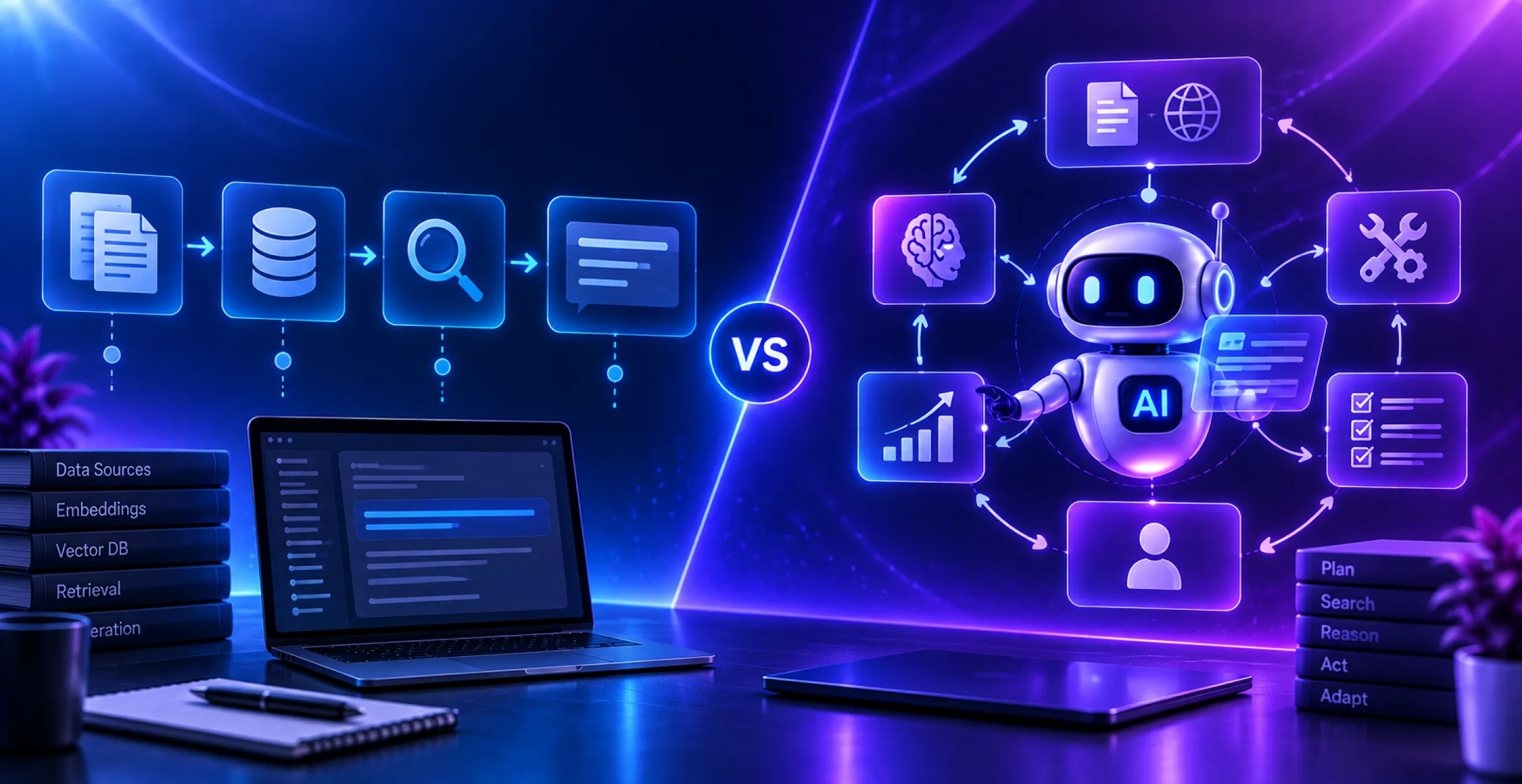
Most business owners often think of the question what are AI agents? Agentic AI is a system that can automatically execute tasks and make decisions based on data without constant human oversight. Or in simple words, we can say Agentic AI is the technology that works towards goals without needing human input. These agents can learn, perceive, plan, and even make decisions on their own by combining multiple models of AI.
These models include some of the top systems, such as
- RPA- The efficiency of robotic process automation
- The natural language processing (NLP) of chatbots
- The trial-and-error of machine learning (ML)
- The processing power of large language models (LLMs)
- The data-driven logic of predictive AI
- The novel outputs of generative AI (Gen AI)
In the healthcare industry, this means working on the unstructured data and coordinating across departments. and respond proactively to patient needs, all while maintaining healthcare safety, compliance, and transparency.
Market Stats Related to the Agentic AI Growth
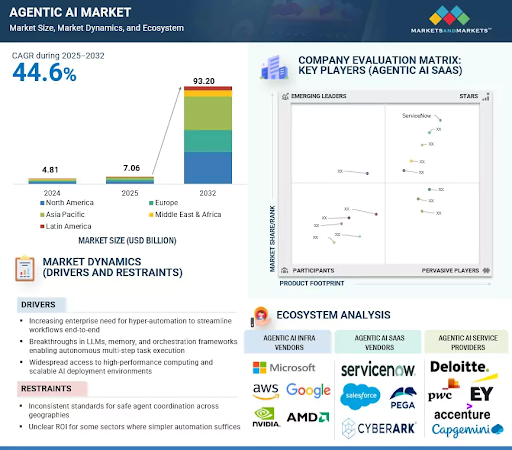
According to the research, it is observed that the Agentic AI market is slated to expand from USD 7.06 billion in 2025 to USD 93.20 billion by 2032 at a substantial CAGR of 44.6% during the forecast period ( 2025-2032).
Artificial Intelligence statistics show a boom in the global market over the past few years. It is expected to reach approximately $4.8 trillion by 2033.
The global agentic AI in healthcare market size was projected to reach USD 4.96 bn by 2030, growing at a CAGR of 45.56% from 2025 to 2030.

Overcoming Healthcare Challenges with the Power of Agentic AI
In the healthcare sector, there are multiple stages where healthcare professionals face various challenges that limit their effectiveness in delivering optimal patient care. A plethora of tasks require extreme expertise; thus, humans face limitations in managing high patient volume. data overload, administrative tasks, and creating hurdles that need addressing. Let’s have a look at different challenges and how Agentic AI is providing automation in healthcare and better solutions.
Challenge-
Physician Burnout: Physician burnout is a result of long hours, heavy workloads in administration, and emotional strain. This stress causes low job satisfaction, and eventually it affects patient care. Doctors with burnout tend to commit more mistakes or overlook important diagnostic information.
Solution-
Alleviating Physician Burnout: Assistants powered by AI make documentation and scheduling routine tasks more automatic. As an example, the Dragon Copilot created by Microsoft is based on voice-dictation and ambient listening technologies to simplify the clinical documentation, decreasing the administrative burden on the clinician.
Challenge-
Administrative Overload: Doctors are spending lots of time on administrative work and not on treating patients. According to research conducted by the American College of Physicians, 49 percent of physicians are on administrative duties such as charting and billing, and have little time to interact with patients.
Solution-
Reducing Administrative Burden: AI-based systems are able to work on tasks such as billing, coding, and processing claims, with minimal errors and administrative expenses. An experiment by the Healthcare Financial Management Association revealed that AI-based coding processes resulted in higher hospital revenue, and operations were simplified because coding errors were decreased by 80%.
Challenge-
Diagnostic Errors: A considerable percentage of medical errors is due to diagnostic errors. A report in JAMA put the figure of diagnostic errors as the cause of death of 10 percent of patients in the U.S. These mistakes can usually be the result of clinicians overlooking minor trends of data, imaging, or the history of a patient, and slow treatment or inaccurate diagnoses.
Solution-
Improving Diagnostic Accuracy: Artificial intelligence algorithms can handle large volumes of medical information, including lab data and medical image data, to detect trends and help a clinician diagnose a condition. On the same note, DeepMind AI developed by Google has fought mammograms and detected breast cancer with an accurate rate of 94.6 per cent, beating radiologists in some tests. This gives an added support to the clinicians, particularly in high-pressure settings.
Challenge-
Patient Engagement: Maintaining adherence to treatment plans and follow-up evaluations among patients is a challenge. The Journal of Clinical Psychology has published research that reveals that half of patients with chronic conditions fail to comply with the prescribed treatment regimens, leading to higher rates of re-hospitalization.
Solution-
Boosting Patient Engagement: AI-based technologies have the potential to interact with patients by reminding them, informing them about their health condition, and offering informational materials. To illustrate, Livongo Health operates AI to track blood glucose and provide patients with real-time feedback, which enhances adherence to the treatment plan.
Challenge-
Data Management: Electronic health records (EHRs) have made the handling and protection of large volumes of sensitive patient information a major issue. Unresponsive data management may result in a security breach, sluggish retrieval of patient records, and missed proactive care, undermining patient safety.
Solution-
Optimizing Data Management: Data management systems that are powered by AI are safe to process and analyze extensive amounts of data in real-time. Artificial intelligence (AI,) such as Google Cloud Healthcare API, enables hospitals to manage EHRs, automating patient records so that important data is readily available and up to date.
Use Cases of Agentic AI in Healthcare
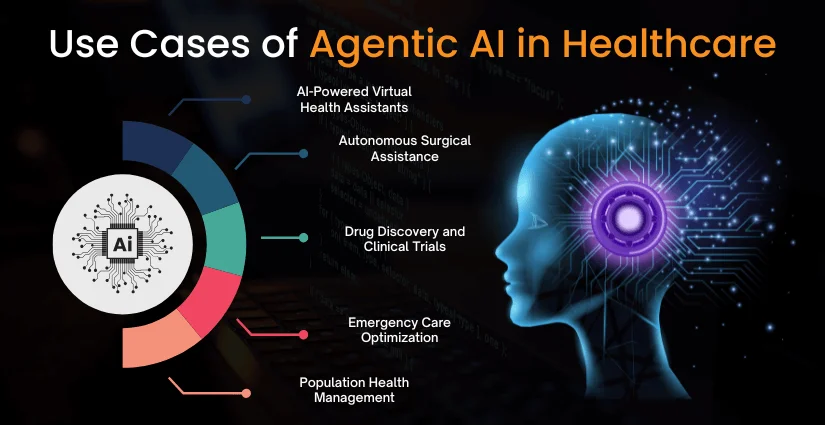
From virtual health assistants and autonomous surgeries to drug discovery, emergency triage, and population health management, Agentic AI transforms care delivery with precision and efficiency.
AI-Powered Virtual Health Assistants
These assistants not only answer the frequently asked questions, but they may also schedule tests, follow up on medication adherence, and coach on lifestyle to enhance engagement and decrease the number of cases of hospital readmission. They are also capable of offering multilingual support, which means that they are reachable by a wide range of patients. They provide more personalized recommendations with time as they keep learning about the interaction with patients.
Autonomous Surgical Assistance
The AI-driven robotic systems are also agentic agents that can aid surgeons during the process by predicting the next action in surgery, alleviating exhaustion, and enhancing accuracy. They reduce the chances of human error, as the movements in complex surgeries are constant and consistent. Moreover, they are able to gather surgical performance information and keep on improving clinical practices.
Drug Discovery and Clinical Trials
Independently searching biomedical databases and trial outcomes, Agentic AI can help find a promising drug candidate faster and pair patients with appropriate clinical trials. This eases the time and expense of the conventional R&D cycles in the pharmaceutical sector. It is also better in enhancing diversity of trials by recognizing underrepresented patient groups and proposing inclusion recruitment plans.
Emergency Care Optimization
The Agentic AI may be used in the emergency room where the clinicians are able to prioritize the urgent cases without making patients wait up to the triage. It is also able to forecast real-time resource requirements, including bed and specialist support. Non-critical cases can be automated, which enables the medical staff to concentrate on the life-threatening conditions.
Population Health Management
The Agentic AI and state-of-the-art healthcare IT solutions can help public health organizations to monitor disease outbreaks, anticipate future healthcare needs, and provide preventive actions before the crisis can reach critical levels. It allows policymakers to make decisions based on the analyzed patterns by demographics, geography, and socio-economic groups. Further, it is able to model the effect of various interventions to enable governments to select the best public health interventions.
Benefits of Agentic AI in Healthcare
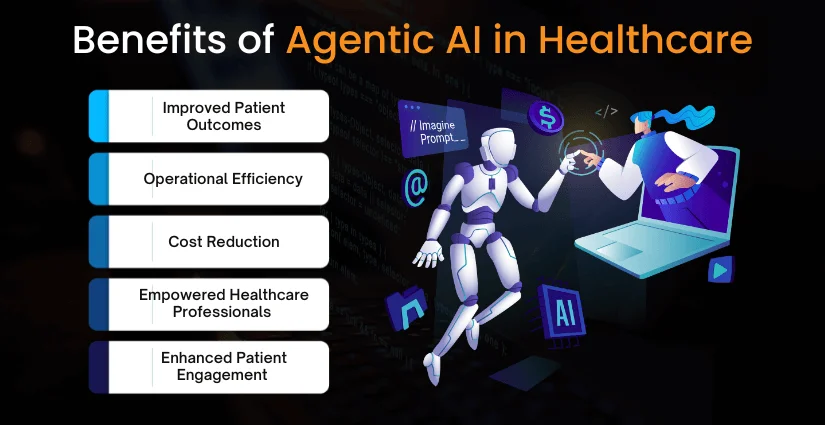
Improves patient outcomes with accurate diagnoses, boosts operational efficiency, reduces costs, empowers clinicians to focus on care, and enhances patient engagement through intelligent, proactive healthcare support.
Improved Patient Outcomes
The accuracy of diagnosis is improved by agentic AI, which is able to analyze masses of data and medical histories of patients and test results in just a few seconds. The result is the prompt diagnosis of health problems and enables prompt and individualized treatment regimes. More accurate interventions, fewer complications, and generally better care are associated with the benefit of patients. A professional Artificial Intelligence Development Company would be able to assist healthcare providers in developing tailored solutions that are guaranteed to achieve better patient outcomes at scale.
Operational Efficiency
Manual processes and disjointed systems tend to create inefficiencies in hospitals and clinics. The workflows that are simplified by agentic AI include patient scheduling, medical records retrieval, and allocation of resources. Its optimization of operations lowers bottlenecks and results in increased coordination of the various departments, resulting in greater efficiency and better patient experiences.
Cost Reduction
The world keeps increasing in terms of the cost of healthcare, and it has a toll on both the providers and the patients. Agents AI is able to cut overhead costs by automating repetitive administrative duties. It also reduces diagnostic errors and redundant tests, reducing wastage and making healthcare entities better able to manage resources.
Empowered Healthcare Professionals
Nurses and doctors waste considerable time doing paperwork and documenting. The repetitive duties are eliminated by agentic AI, and professionals have more time to interact with patients, demonstrate empathy, and make difficult decisions. This not only enhances productivity but also minimizes burnout.
Enhanced Patient Engagement
Patients can be provided with timely help and constant communication through the use of AI-based virtual assistants and personalized care reminders. This will result in an increase in adherence to treatment, trust in medical personnel, and, eventually, health outcomes.
Also Read: AI Agent Development Cost in 2026
How to Build an AI Agent for the Healthcare Industry
In this section, we will walk you step-by-step from problem selection through production, compliance, validation, and monitoring with concrete architectures, tech choices, and checklists you can use today.
Defining the Problem and Use Case
The initial stage in the development of an AI agent in the healthcare field is to define a clear, high-value problem. Organizations should begin by automating a use case that can be quantified, like a clinical documentation assistant, ER triage agent, remote patient monitor, or radiology and pathology decision support tool. There must be clear KPIs, such as the accuracy of diagnoses, false positives, the decrease in the readmission rate, and the time per clinician, which offer measurable success metrics. The implementation of a focused strategy will guarantee that the agent produces real-world effects and instills confidence in the stakeholders.
Compliance, Privacy, and Regulations
Healthcare is a field that works under strict regulatory environments, and therefore, compliance is not negotiable. The use of any AI agent that deals with Protected Health Information (PHI) should be in compliance with HIPAA in the United States or GDPR in Europe. Medical devices that facilitate diagnosis or treatment can also be regulated by the FDA, and lifecycle documentation, risk assessment, and premarket review are required. Since the first day, teams are required to apply data lineage, audit trails, change management, and cybersecurity controls. Regulatory preparedness that is built into the development process prevents expensive rework and expedites the process of obtaining permission to deploy the clinical systems.
Building the Right Team
A medical AI agent is not merely a technology project; it needs an interdisciplinary team. Clinical subject-matter experts give workflows real-world context and make them valid, whereas data engineers and MLOps specialists work on pipelines and models. Security guards enforce rules, and the user experience designers create user-friendly and clinician-friendly interfaces. Clinician involvement in the design phase yields early detection of workflow misfit and enhances uptake. A balanced team makes sure that the AI agent is technically fit, compliant, and useful in clinical settings.
Data Strategy and Governance
Data is the lifeblood of the healthcare AI, and it must be handled conscientiously. The sources are frequently electronic health records (EHRs), laboratory findings, image information, and wearables. Data pipelines must be encrypted, auditable, and rules of access compliant. The ground truth labeling process is likely to require the participation of a clinician to be correct. In development settings, de-identified or pseudonymized data should be employed to provide patient privacy, and production systems should be operated with severe PHI security. Retrieval-Augmented Generation (RAG) is increasingly applied to make sure that the knowledge is stored on a guideline, protocol, and patient record level, and that they are more personalized and trustworthy.
Designing the Agent Architecture
A useful healthcare AI agent must be designed in a layered structure. The interface layer is at the top, and it supports chat or voice interactions as well as being integrated with EHRs. A workflow, tool calls, and decision-making are handled by an orchestration layer. Models include LLM in Healthcare applications to natural language understanding, diagnostic models in imaging or vitals, and RAG-enabled knowledge retrieval. A rules engine applies rigid clinical restrictions, such as the dose of medication. This is accompanied by a compliance layer, which supports encryption, consent checks, and audit logging, and MLOps pipelines that support performance monitoring and retraining. The agent is perceived as a toolkit of discrete functions that make verification, auditing, and scaling much easier, safer, and efficient in clinical workflow.
Model Selection, Safety, and Implementation
Clinical use is not applicable to every model. Models that have been validated and are specific to the domain, which have been fine-tuned with de-identified clinical data and are residing in HIPAA-capable environments, should be prioritized by teams. As safety measures, the filters should be used to prevent hallucinations or dangerous guidance, and the most dangerous advice should always be sent to the clinician. It is necessary to be explainable; agents are expected to provide evidence of sources and the rationale of outputs. Implementations by Common AI scribes: transforming speech into structured clinical notes, triage bots: routing patients to an appropriate service by their symptom severity, and anomaly detection in remote patient monitoring. Safety is put at the front line by conservative thresholds and by human-in-the-loop controls.
Validation, Testing, and Deployment
Healthcare AI agents should be subjected to strict validation before being put into operation. This involves technical reliability unit testing, retrospective testing using historical data, and prospective silent-mode testing in which the AI is implemented to run in parallel without making any decisions. The most important metrics are sensitivity, specificity, time saved by the clinician, patient satisfaction, and false alarms. Demographic imbalances should be audited by bias. After the validation, it should be deployed in cloud environments that are HIPAA-eligible, encrypted, and have CI/CD security checks and firm access restrictions. Post-market surveillance is applied continuously to ensure maintenance of safety and performance during real-world operation.
Adoption, Ethics, and Long-Term Success
Technology is not the only form of success; usability, trust, and ethics determine the adoption. AI agents should become part of clinician workflows and be characterized by simple interfaces, provenance tracking, and options to override. Resistance among staff is minimised due to training and support. Such ethical protections are patient consent models, fairness audits, and transparent reporting. To make faster adoption possible and remain compliant, governments and healthcare providers are beginning to collaborate with specialized vendors, including an AI Agent Development Company. This needs to be monitored in the long term and updated iteratively, and with a culture of collaboration between clinicians and technologists.
The Future of Healthcare with Agentic AI
Making healthcare systems all over the globe smarter with the help of Agentic AI will usher in an era of intelligence-based care. Hospitals will increasingly use AI-powered autonomous systems over the next decade to support diagnostics, automate scheduling, and optimize day-to-day operations, helping minimize inefficiencies and human error. A custom healthcare app development company can help integrate these intelligent capabilities into healthcare applications, enabling patients to receive more individualized and proactive care, with treatments and preventive measures tailored to their medical history, genes, and lifestyle.
Organizations in the field of public health will learn how to utilize Agentic AI to identify and prevent pandemics, track disease outbreaks in real-time, and manage chronic conditions on a scale of large populations. To clinicians, AI will not be a supplement tool, but a smart companion that preempts requirements, helps in decision-making, and minimizes administration overheads.
Finally, the healthcare of the future is going to be more patient-centered, efficient, cost-effective, and accessible, with Agentic AI being the basis of this digital revolution.
If you are also looking for an agentic AI inclusion in the healthcare industry or want an AI agent for your business at Octal, we have developed a healthcare AI app that can help you.

Conclusion
The healthcare sector is in a paradigm shift, and Agentic AI is leading the change. It is transforming the path to a more intelligent, responsive, and fair healthcare system by tackling workforce shortages, cutting administrative overhead, enhancing diagnostics, and tailoring treatments. Collaborating with a custom healthcare software development company allows providers to apply custom AI solutions that will blend well with the current workflows without compromising compliance and scalability.
The emphasis of policymakers, healthcare providers, and technology leaders as they prepare this future must be on creating trustworthy AI systems that put ethics, transparency, and patient health as priorities. The effect of Agentic AI is not only regarding the development of technologies, but rather the remaking of healthcare to provide a higher quality of care to all.


 Get in Touch
 By
By September 25, 2026