



- Market Report Forecast Analysis of Media and Entertainment
- Use Cases of AI in the Entertainment Industry
- Advantages of Integrating AI in Media and Entertainment
- AI Implementation in the Real World: Examples
- Concerns With AI Implementation in Entertainment & Media
- Trends to Look For In the Media and Entertainment Sector
- Final Words
- Frequently Asked Questions About AI in Entertainment
The media and entertainment industry has infinite possibilities for creative and ingenious professionals. Entertainment is also an industry that gives you the platform to integrate technology.
Seeing every sector’s interest in Artificial Intelligence, the entertainment industry has also stepped forward, adopting it. The technology is surpassing in entertaining audiences as well as making movies. From surreal effects to explicit actions, the entertainment industry is intensively seeking AI to work to enhance user experience.
A survey was made in the United States in September 2023, and it was observed that 51% of respondents agreed that AI is capable of creating sound effects for films, TV, or games.
There are multiple reasons behind the surge in AI adoption. Increased content personalization, moderation tools, copyright protection, enhanced streaming activities, and much more. These features are expected to enhance the compound growth by 27.1% by the end of this year.
Furthermore, the entertainment and media market size is expected to reach $58.61 billion by 2029. AI-enhancing editing voice, language recognition, and predictive analytics skills, along with association with AR/VR technology, can propel the experiences.
Realistic virtual experiences and increased penetration of affordable internet have enhanced the U.S GDP by $66 billion. OTT platforms serving games and entertainment are most in demand, supporting more than 350,000 jobs.
Last year, the digital games and entertainment sector was worth $259 billion and is continuously spiking with AI-induced growth. Enhancing the entertainment segment, digital purchases have dominated at 95% with 3.2 billion gamers.
There is a reason to define AI in entertainment: unstructured data. Turning unstructured data into a defined model is critical as it requires specialized tools and techniques. Businesses using AI models can tailor content while structuring the data in no time.
It was observed in 2022, 87% of IT leaders focused more on unstructured data growth. Additionally, many media app development companies are focusing on developing AI cloud-integrated solutions. These solutions are meant to streamline the production processes and tailor viewer experiences. AI-powered cloud solutions utilize machine learning and automation for enhanced decision-making.
Market Report Forecast Analysis of Media and Entertainment

| Report Attribute | Details |
| Value in 2025 | $21.99 billion |
| Expected Growth By 2034 | $58.61 billion |
| Growth Rate | CAGR of 27.8% (2025-2033) |
| Estimated Countries Growth | Australia, Brazil, Germany, China, India, Indonesia, Japan, UK, USA, Italy, Spain, Russia, South Korea, France, Canada. |
Use Cases of AI in the Entertainment Industry
“The age of AI-driven entertainment is upon us, and it will be a fascinating and transformative journey.”
Artificial Intelligence can be integrated to drive data insights and navigate the modern consumer-centric marketplace. Additionally, AI can provide opportunities to businesses in the entertainment and media industry.
Gaming
Gaming is the platform that gives most users access to the entertainment industry. AI investments can significantly revolutionize entertainment paradigms. AI in gaming can help demonstrate complex behaviour, adapt players’ actions, and finally create a sophisticated and immersive experience.
Podcast
Entertainment is more than gaming; it has opened its doors to other ways, like podcasts. Over a period of time, Podcasts have revolutionized with strategic content creation. AI in podcasts can simplify audio editing. The technology can transcribe the audio into text format and generate subtitles for enhanced audio engagement.
Personalized Recommendations
AI is certainly capable of reshaping the creative content landscape, leveraging interactive experiences. By personalizing content, AI can also provide tailored recommendations. Disney+ (Plus) is the greatest example of customized recommendations and tailored solutions for its users. This integration of AI with entertainment enables accurate directions, contributing to contented users and continuous app success.
Emotional Analysis
AI integration is an absolute advantage to enhance audience engagement, drive innovation, and transform content creation and consumption. The reason is its emotional connection with the users. AI can resonate with the user’s emotions by analysing and perceiving the way the user consumes the content each day. Media and entertainment solutions providers can leverage the data or adding interactive elements and features in the application. Along with creating a sentimental experience, AI can help pave the way to continuous relatability and evolving trends.
Recognition (Voice)
Natural Language Processing, a part of AI, is one of the interesting subsets that facilitates hands-free control. With today’s effortless navigation, content search, command initiation, and much more, AI has made life entertaining and comfortable. The technology is efficient for specially abled users, allowing them to streamline content discovery and interactive storytelling. AI is simply improving accessibility while adding efficient and inclusive app experiences.
Film
One of the ever-evolving sectors that AI can revolutionize and provide promising results is the Film industry. AI is impeccably impactful when it comes to creating art, recommending engines, AI Image Enhancer tools for upscaling images, and much more.
The multidimensional components of AI can assist filmmakers in creating complex visuals, reshaping the traditional paradigms of the film industry. The creative visions can be converted into real-time effects as well as streamline the whole pre- & post-production process. Filmmakers can also use Kling AI prompts to generate cinematic scenes, storyboard concepts, and visual effects ideas that align with their creative vision.
Publishing
AI can also be creative when it comes to publishing a book. Since the technology can efficiently automate repetitive tasks, it can also make valuable predictions. With AI, creative writers and publishers can lower their costs while managing the publishing process effortlessly. AI-powered tools can help publishers build texts that are most relevant and exciting for their readers.
AI can also summarize a book, curate a synopsis, produce book layouts and covers in a short period based on a set of rules.

Also Read : Top Software Development Statistics That Highlight Industry Evolution in 2025
Advantages of Integrating AI in Media and Entertainment
With AI, the entertainment and media industry can enhance operational efficiency, elevate user experiences, and reshape dynamics. From personalized content to crafting persuasive marketing strategies, AI can meet expectations like never before. Additionally, AI has other advantages to look into:
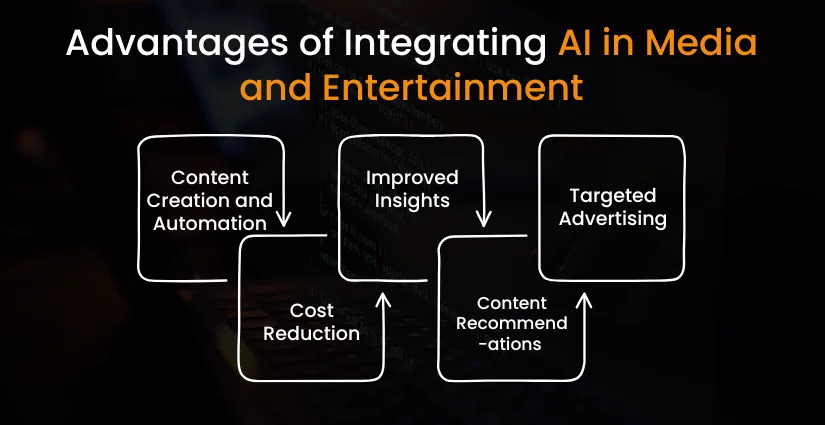
Content Creation and Automation
The first benefit of AI-embedded systems for media app development is streamlining the production process. AI can assist companies in generating scripts, creating creative scripts, graphics, and editing videos. Video generation with AI leads to a faster and more efficient production workflow. The technology is capable of maintaining high-quality standards while saving precious time.
Cost Reduction
AI’s extensive feature is automating repetitive tasks, which saves a lot of operational costs. The technology also limits human resource reliance and energy consumption. Automation content creation and distribution can lower utility costs.
Improved Insights
AI is a powerful tool that can analyze and structure large datasets, considering audience behaviour and trends. An AI-embedded platform can empower the entertainment industry in making informed decisions and better content creation as per the audience’s preferences.
Content Recommendations
AI algorithms are a powerful code that upgrades and improves with new data. The technology analyzes user behaviour that tailor recommendations for entertainment that involves TV shows, movies, and music. This also improves the experience by enhancing satisfaction and retention rates.
Targeted Advertising
Any business can reach a wider audience and quicken expansion when it markets and advertises strategically. AI can assist businesses in understanding market trends to create and distribute personalized ads. This increases the effectiveness of advertising, improving the overall ROI of marketing.
Also Read: AI in Telecommunications: Key Trends and Benefits
AI Implementation in the Real World: Examples
If you are confused about whether AI will give you what you desire or if investing in this technology can be fruitful, then these examples are worth reading. These are some of the major players in the entertainment and media industry that have implemented AI for good.
They are popular names, and they are generating more than expected ROI with AI embedded to provide personalized recommendations and immersive experiences.
Amazon Prime
Yes, the very popular and worldwide known entertainment is integrated with machine learning & AI. Alexa is one of the popular and best-selling products from Amazon for entertainment. Alexa is known to speak 15 languages and is available in 80+ countries with continuous improvements.
Netflix
One of the leading entertainment platforms, Netflix, is known for its high-quality entertainment. Widespread across 190 countries, Netflix leverages powerful AI and ML to analyze data histories.
Rich metadata content helps Netflix efficiently target its audience and develop more tailored highlights. Netflix also uses bitrate streaming functionality to help analyze internet connectivity & speed in real-time for regulated video quality.
Visit: Iguana Integrated Solutions
Concerns With AI Implementation in Entertainment & Media
| Disadvantage | Description |
| Loss of Human Touch | AI-generated content can lack emotional depth, nuance, and originality. |
| Job Displacement | Automation in editing, writing, and animation may reduce demand for human roles. |
| Ethical Concerns | Use of deepfakes and synthetic media raises privacy and authenticity issues. |
| Bias in Algorithms | AI systems can reinforce stereotypes or biases based on flawed training data. |
| Over-reliance on Automation | Excessive use of AI may hinder creative risk-taking and innovation. |
To overcome these challenges, it is always suggested to collaborate with an AI development company with the right experience and expertise to guide you and build a scalable application.
Trends to Look For In the Media and Entertainment Sector
With AI becoming powerful each day, its algorithms is updating and becoming smarter and predictable. The future is promising if invested smartly. Below, we have mentioned some of the trends that can make you feel confident when investing in AI for future business prospects.
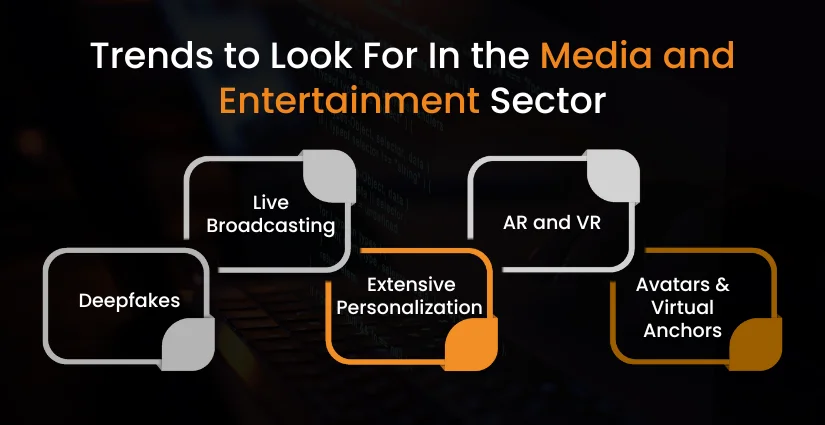
Deepfakes
We will see AI become smarter in detecting malicious activity to maintain security. Also, to ensure trust with the users, AI will have deepfake technology integrated. This will also preserve the integrity of the platform while reducing fake news.
Live Broadcasting
As one of the benefits was aforementioned as broadcasting, the future element will be enhancing live broadcasts. The enhanced automation will be able to improve content accessibility, quality, overlays, graphics, and much more.
Extensive Personalization
AI and ML together are improving, making the content more relatable and engaging. What we see the tailored content will become much more personalized and intuitive, which would engage users for a longer period effortlessly.
AR and VR
We will expect the merger of these three technologies for a hyper-immersive experience. AR and VR are, anyway, defining shopping methods. Together, AR/VR and AI will open doors to new possibilities and alter the ways of consuming media.
Avatars & Virtual Anchors
The future will revolutionize the media industry by introducing quick and effortless virtual anchors. The avatars, often designed using advanced AI actors, will look very much real and offer a personalized touch, catering to audiences in diverse demographics worldwide.

Final Words
AI is revolutionizing the entertainment industry by personalizing user experiences, streamlining content creation, and unlocking new avenues for storytelling and engagement. From AI-generated music and scripts to smart content recommendations and virtual influencers, the integration of artificial intelligence is not just a trend—it’s becoming a core part of the industry’s evolution. As technology continues to evolve, creators and companies embracing AI will be better positioned to innovate, captivate audiences, and stay ahead in an increasingly competitive landscape.
Frequently Asked Questions About AI in Entertainment
AI is used for content recommendation, script writing, video editing, CGI enhancement, and audience analytics.
Yes, AI can generate music, write scripts, and even create short films or animations with minimal human input.
Benefits include cost-efficiency, faster production, personalized content delivery, and enhanced viewer engagement.
AI supports creativity but doesn’t replace human imagination. It helps creators be more efficient and innovative.
Netflix’s recommendation engine, AI-generated TikTok filters, deepfake tech in films, and virtual influencers like Lil Miquela are prime examples.
 By
By September 22, 2026




 Get in Touch