


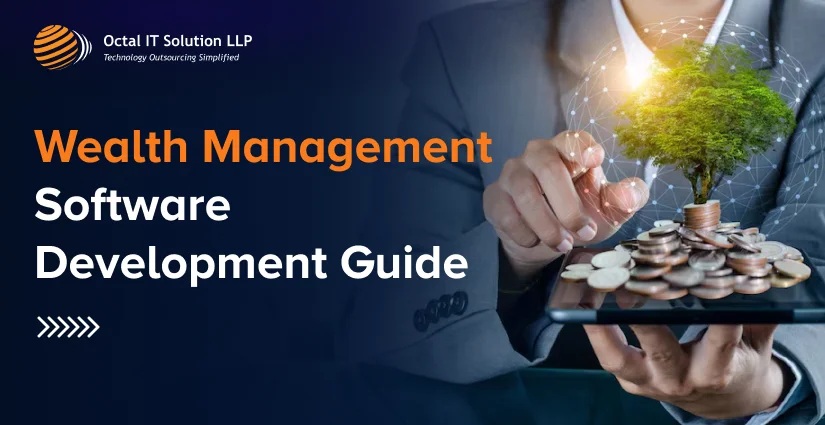
The development of wealth management software has become a necessity for financial institutions, investment firms, advisory companies, and other current fintech startups aiming to automate portfolio management, improve decision-making, and provide customized financial services.
In this guide, you can learn about the characteristics, technologies, costs, advantages, and development process of building sophisticated digital wealth management platforms. It also gives reasons as to why contracting a professional company in the development of wealth management software will guarantee regulatory compliance, data security, performance, and scalability.
As automated financial planning grows in demand, robo-advisory solutions, AI-based solutions, and secure client dashboards, businesses are engaging specialized finance management software development partners to assemble a strong and future-proof fintech solution.
Introduction
In the modern, data-driven financial landscape, the development of wealth management software is transforming how financial institutions provide advisory, investment, and portfolio services.
Octal IT Solution is a global IT pioneer offering targeted fintech and finance management software solutions to businesses, startups, and investment organizations.
Customers are increasingly demanding rapid service, transparency, secure internet communications, and more intelligent money-management devices; therefore, companies that want to remain competitive will have to seek modern solutions from a professional wealth management software development company.
This blog provides a comprehensive tutorial on features, technologies, cost factors, trending innovations, and development steps to help you launch future-ready wealth management platforms.
- Introduction
- What Is Wealth Management Software Development?
- Why Businesses Need Wealth Management Software?
- Key Features of Wealth Management Software
- Types of Wealth Management Software
- Tech Stack for Wealth Management Software Development
- Steps to Build Wealth Management Software
- Cost of Wealth Management Software Development
- Why Hire a Professional Wealth Management Software Development Company?
- Conclusion
- FAQs
What Is Wealth Management Software Development?
Wealth management software development is an end-to-end process that covers the design, development, and implementation of technologies. It assist individuals and organizations with investments, portfolios, assets, financial plans, tax documents, and the advisory process.
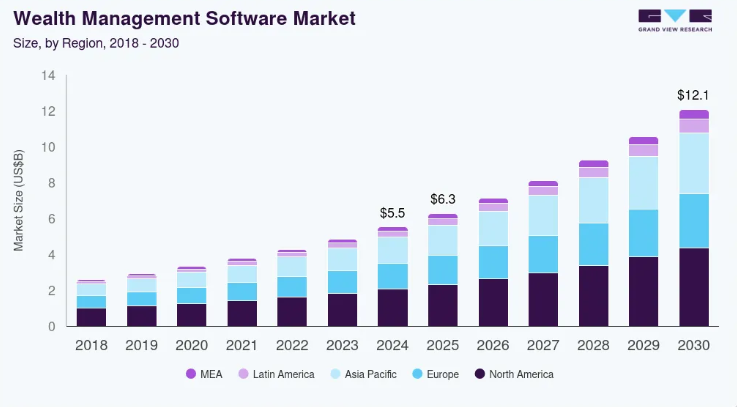
As per the reports published by Grand View Research, the global market for wealth management software was valued at about USD 5.5 billion in 2024 and is expected to grow to roughly USD 12.07 billion by 2030, reflecting a compound annual growth rate of 14.0% over the 2025–2030 period.
Fintech software development entails developing digital products that enable portfolio visualization, real-time market monitoring, risk analysis, compliance verification, secure transactions, and automated financial planning. These systems minimize manual workload, eliminate spreadsheet management, and increase precision.
Why Businesses Need Wealth Management Software?
Below are the fundamental reasons why enterprises, banks, and advisory firms invest in wealth management software development services.
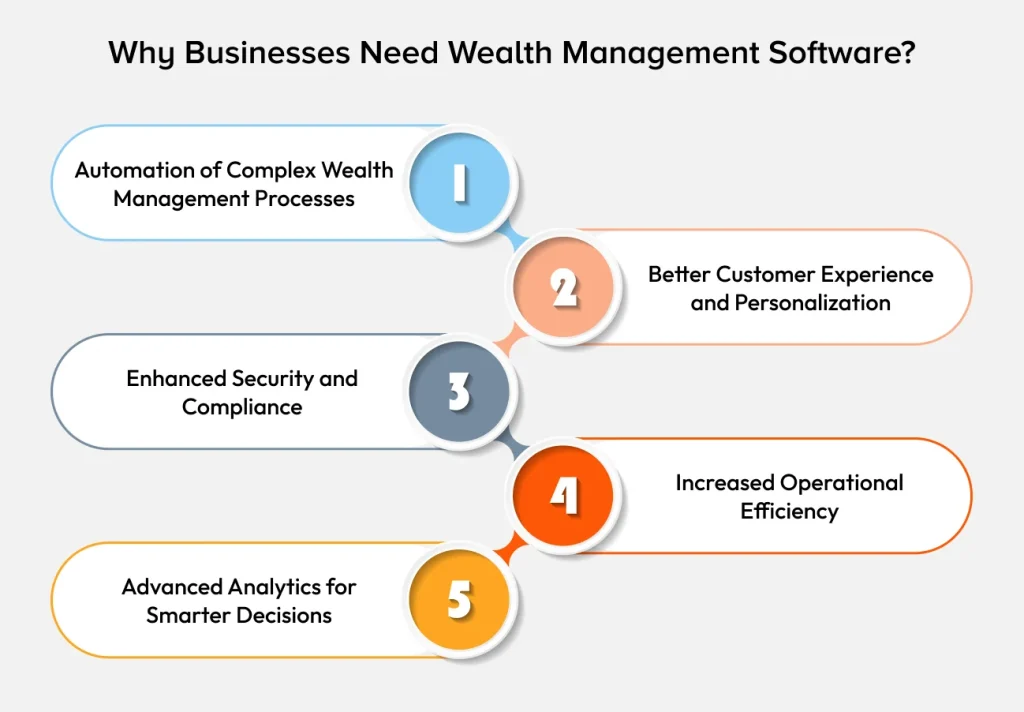
1. Automation of Complex Wealth Management Processes
Investment allocation, reporting, rebalancing, tax calculation, risk profiling, and performance tracking are automated. It eliminates monotonous workloads, reduces operational costs, increases precision, and speeds decision-making based on data and supported by knowledge.
2. Better Customer Experience and Personalization
The modern user demands transparency, real-time information, and control over their personal data. The wealth platforms provide real-time dashboards, automated advice, customised investment recommendations, and goal-oriented planning, enhancing user satisfaction and retention.
3. Enhanced Security and Compliance
Financial institutions handle classified customer information; therefore, security is paramount. Platforms: Wealth platforms are encrypted, multi-factor-authenticated, comply with KYC/AML requirements, maintain audit trails, and store data securely to prevent fraud and cyberattacks.
4. Increased Operational Efficiency
Wealth management software minimizes reliance on manual accounting and spreadsheet tools. They simplify operations, consolidate customer information, and aggregate computed financial information, leading to greater productivity and efficiency in organizations.
5. Advanced Analytics for Smarter Decisions
The use of AI-powered analytics enables real-time market predictions, risk scoring, investment forecasting, and performance analytics. Such insights empower advisors and clients to make wiser, more informed financial decisions.
Key Features of Wealth Management Software
Below are the significant features of wealth management software that can be incorporated by hiring a top fintech app development company.
1. Portfolio Management Dashboard
An integrated dashboard provides customers with full access to their assets, investments, returns, risk, and performance history. It combines market data, charts, and sophisticated analytics to make investment tracking easier for advisors and clients.
2. Financial Planning Tools
The tools assist the user in setting financial objectives, planning retirement, considering saving plans, calculating cash flows, and investing in the future. Goal-based planning increases users’ confidence, providing them with a systematic framework for long-term wealth creation.
3. Robo-Advisory Integration
Robo-advisors are automated and based on algorithms and risk profiles to make investment recommendations. They provide low-cost advisory services, real-time recommendations, portfolio rebalancing, and effective client administration to clients who prefer to use their wealth services digitally first.
4. Risk Assessment and Compliance Tools
Risk engines assess client risk tolerance, contrast market factors, and impose regulatory rules on compliance in an automatic manner. Such systems ensure mitigation of the legal risks and facilitate safe financial planning and advisory services.
5. Investment Tracking & Real-Time Market Monitoring
The stock prices, mutual funds, cryptocurrencies, ETFs, bonds, and other alternative assets can be tracked in real-time by the users. It makes sure that decision-making is carried out in line with market fluctuations and performance measures.
6. Document & Tax Management
Compliance and paperwork are made easier with the help of automatic document generation, tax calculation, the support of the digital signature, and secure archiving. These characteristics guarantee accuracy and minimise human error and manual workloads.
7. Client Relationship Management (CRM)
An Inbuilt CRM, developed by a trusted CRM software development company, assists advisors in managing the profiles of the clients, their history of communication, financial goals, and requests for services. It promotes customizing and customer segmentation and enhances engagement with automated reminders and updates.
8. Reporting & Analytics
High-tech analytics generate informative financial statements, investment overviews, risk boards, and performance bar charts. These insights help advisors analyze portfolios, predict trends, and provide precise advice with relevant data.
Types of Wealth Management Software
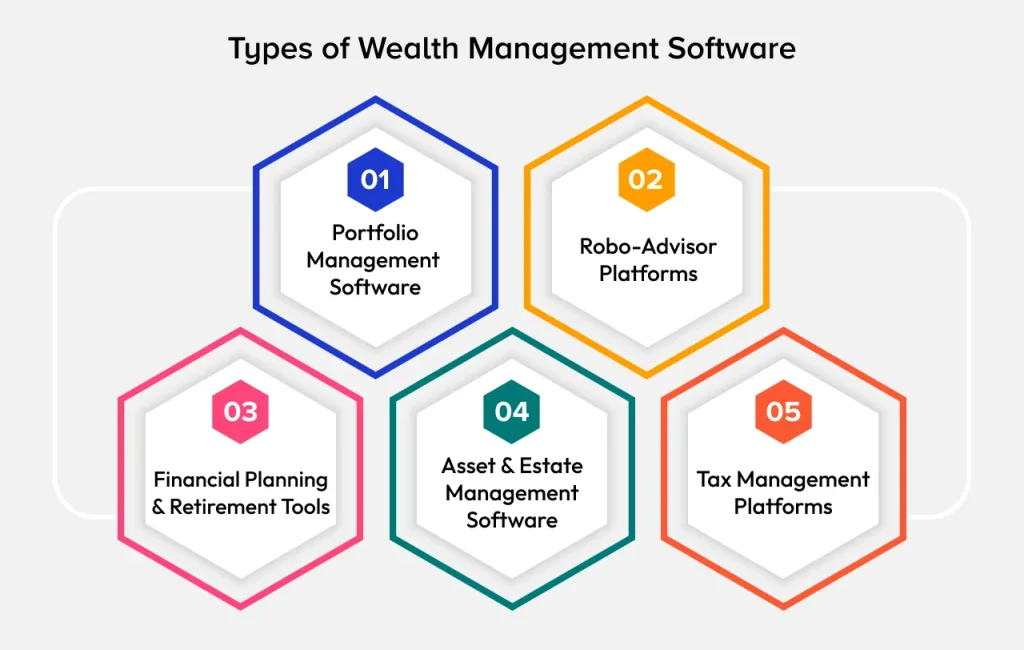
Below are the major types of wealth management software trending in 2025.
1. Portfolio Management Software
Laid out to monitor investments, returns, risks, and the strategy of allocation. It works hand in hand with performance analytics, visualization, and rebalancing, which is why it suits both investment firms and individual investors who need to do their work with various portfolios.
Also, Read: A Comprehensive Guide on Portfolio Management Software Development
2. Robo-Advisor Platforms
Robotic investment systems are algorithms and AI systems used to offer plans of action on investing, operating portfolios, and rebalancing investments. They lower the advisory fees, streamline the onboarding process, and attract tech-sensitive clients that want automated wealth management.
3. Financial Planning & Retirement Tools
Such software applications allow a person to plan long-term income, track savings, evaluate life situations, and forecast income in the future. They integrate budgeting applications, prediction software, and personal suggestions on their behalf to plan better.
4. Asset & Estate Management Software
The software specializes in asset distribution, estate planning, inheritance processes, insurance processes, and valuation tools. It provides seamless paperwork and clear procedures to the clients going through complicated life-stage financial transitions.
5. Tax Management Platforms
Tax software automates the calculation of the tax amount, creates e-filing reports, and ensures that they are filed on time. The platforms decrease the number of manual mistakes and assist users in making tax-efficient investment choices.
Tech Stack for Wealth Management Software Development
Let us go through the major technology stack used while developing wealth management software.
1. Front-End Technologies
React, Angular, and Vue are front-end frameworks that develop responsive interfaces, interactive panels, and promptly loaded analytical charts. Such technologies improve customer experience and provide very engaging online financial opportunities.
2. Back-End Technologies
Scalable server operations, secure API processing, and strong data processing are supported by such technologies as Node.js, Python, Java, or NET. They facilitate the high-performance wealth management platforms to handle the complex financial functions with ease.
3. Database Systems
PostgreSQL, MySQL, MongoDB, and Oracle databases provide safe storage of massive blocks of financial records. They are fast, intensively encrypted, and adhere to the international requirements of financial controls.
4. Cloud Platforms
Cloud computing platforms such as AWS, Azure, and Google Cloud have scalability, data backup, cost-effectiveness, and real-time data retrieval. The Cloud architecture guarantees the continuity of the provision of services and the simplification of collaboration with third-party tools.
5. AI & Machine Learning
AI and ML can be used to study the behavior of the users, forecast the results of investment, automate recommendations to investors, and detect fraud. The technologies enhance the performance of the portfolio and wealth management platforms to be more personalized.
6. Blockchain Technology
Blockchain guarantees transparency, safe transactions, and record-keeping that is not tampered with. It promotes smart contracts, token-based investments, and improved authentication of a digital wealth management solution.
Related Blog: How Blockchain App Development is Revolutionizing Business Operations?
Steps to Build Wealth Management Software
Below are the major steps that we take while building wealth management software.
1. Define Goals & Market Needs
The process begins by identifying user expectations, financial workflows, regulatory requirements, and core features. Clear goal setting ensures that the platform delivers value and aligns with business objectives.
2. Create Wireframes & UI/UX Design
Designers build intuitive layouts, dashboards, and navigation flows. A well-designed interface enhances user satisfaction, reduces cognitive load, and supports efficient financial decision-making.
3. Choose the Tech Stack
Select technology based on scalability requirements, performance needs, platform type, and security standards. The right tech stack ensures long-term maintainability, quick integrations, and future-proof development.
4. Start Front-End & Back-End Development
Developers code the user interface and server logic. This phase focuses on feature integration, performance optimization, database handling, and ensuring seamless interactions within the wealth management ecosystem.
5. Integrate AI, Analytics & Security
AI algorithms, predictive models, and advanced security tools like encryption and authentication get integrated. This ensures smarter advisory systems and safe financial operations for all users.
6. Testing & Quality Assurance
Software undergoes functional, security, performance, and compliance testing. QA ensures the platform works smoothly, supports complex operations, and meets financial regulatory standards worldwide.
7. Deployment & Maintenance
After launch, ongoing updates ensure the platform stays secure, optimized, and compatible with new financial technologies. Continuous support helps businesses maintain reliability and user trust.
Cost of Wealth Management Software Development
Cost depends on features, integrations, complexity, tech stack, security layers, and development model. The following table shows the estimated cost by type of wealth management software.
| Type of Wealth Management Software | Estimated Cost (USD) | Description |
| Basic Wealth Management Platform | $20,000 – $50,000 | Includes simple dashboards, basic portfolio tracking, and essential planning tools. |
| Mid-Level Platform with Analytics | $50,000 – $120,000 | Adds AI insights, reporting modules, and enhanced security. |
| Enterprise-Grade Platform with AI & Automation | $150,000 – $300,000+ | Includes advanced analytics, robo-advisory, automation, and high-end security features. |
| Custom Robo-Advisory System | $80,000 – $200,000 | AI-driven automated investment tools with risk assessment. |
| Wealth Management Mobile App | $30,000 – $150,000 | Full-featured app with dashboards, security, notifications, and integrations. |
Why Hire a Professional Wealth Management Software Development Company?
It is highly significant to hire a professional wealth management software development services provider like Octal IT Solution. We have listed the major reasons below.
1. Expertise in Financial Domains
Experienced developers understand financial workflows, regulatory environments, and security standards. They build platforms that ensure accuracy, transparency, and long-term compliance with evolving financial regulations.
2. Faster Development with Modern Technologies
A specialized team uses proven frameworks, AI tools, automation systems, and cloud technologies to build platforms faster. Their expertise reduces delays and ensures high-quality output.
3. Strong Security & Compliance Knowledge
Financial platforms must meet global standards like PCI-DSS, GDPR, and AML/KYC rules. Skilled companies ensure every module is secure, compliant, and robust against cyber threats.
4. End-to-End Software Development Services
A custom software development company handles research, UI/UX, coding, testing, deployment, and support. This ensures smooth delivery, coordinated workflows, and long-term operational success for your financial platform.
Conclusion
Wealth management software development plays a crucial role in modernizing investment firms, financial advisors, and fintech startups. By adopting AI, automation, analytics, and secure digital workflows, businesses can deliver futuristic wealth solutions. Partnering with an expert wealth management app development company ensures scalability, compliance, performance, and long-term sustainability.
If you want tailored finance management software development for investment platforms, robo-advisors, or financial planning tools, Octal IT Solution can help you build a world-class product.
FAQs
Development timelines vary based on complexity, integrations, and customization. A basic MVP may take 3–5 months, while full-scale platforms with advanced analytics, multi-channel support, and regulatory-compliant infrastructure may take 9–18 months to complete.
Compliance is built into the design through features like automated KYC/AML checks, audit trails, data governance controls, secure data storage, and user-access management. The software is aligned with regulations such as SEC, FCA, MiFID II, GDPR, and local financial rules applicable to the client’s region.
Yes. Modern wealth management platforms are designed to integrate with core banking systems, market data providers, CRM tools, accounting software, and third-party APIs. Custom integrations ensure seamless data flow, improved reporting accuracy, and better operational efficiency.
Wealth management platforms often leverage a mix of technologies, including cloud infrastructure (AWS, Azure, GCP), microservices architecture, AI/ML models for predictive analytics, secure APIs for integrations, blockchain for transaction transparency, and robust frontend frameworks like React or Angular for intuitive user interfaces. These technologies help ensure scalability, security, and high performance.


 Get in Touch
 By
By July 9, 2026