



By 2025, machine learning will still be the top technology that will revolutionize different business sectors by being the driving force of smarter applications, automation, and data-driven decision-making. Machine Learning Frameworks are at the core of these innovations as they provide the needed tools and libraries for building, training, and deploying models efficiently.
According to Grand View Research, the machine learning market in the year 2024 is valued at around USD 72.6 billion, which will extend toward a market size of USD 419.94 billion by 2030, at a CAGR of 33.2% during the forecast year 2025-2030. Artificial intelligence occupies a very prominent role, with emerging technologies having prospected ways of transformation for both the businesses and the operations of people.
For any business, from a startup to an enterprise, choosing the right frameworks for machine learning is the most important thing that helps to speed up the development and get quality results. As the world of technology is moving forward, the selection of the latest and most flexible open source Machine Learning Frameworks will be of great significance in the coming times in distributing the capacity of the Machine Learning revolution to the entire business community globally.
- What is a Machine Learning Framework?
- Importance of ML Frameworks in 2025
- Best 15+ Machine Learning Frameworks
- Other Emerging ML Frameworks in 2025
- Best Frameworks for Machine Learning Production Deployment
- Trends Shaping Machine Learning Frameworks in 2025
- Best Machine Learning Frameworks for Beginners
- How to Choose the Right Machine Learning Frameworks for Your Project?
- Conclusion
- FAQs
What is a Machine Learning Framework?
A Machine Learning Framework is basically a programming library or software system that contains the necessary tools, functions, and pre-built segments for enabling the developers and data scientists to make the machine learning models. These frameworks are designed in a way that they take the user from carrying out the tedious chores of data preprocessing, model training, and evaluation.
To give an example, deep learning libraries such as TensorFlow and PyTorch and lightweight solutions like Scikit-learn and Machine Learning Frameworks give the teams the opportunity to concentrate more on innovations rather than rebuilding algorithms from scratch. Numerous of them are open source Machine Learning Frameworks. Thus, they are open and customizable for every business of any size.
Importance of ML Frameworks in 2025
By 2025, the demand for AI-driven applications is over the top and Machine Learning Frameworks development is of utmost importance in fulfilling this demand. Such frameworks for machine learning make the running of experiments at a higher speed, better scalability, and the smoother going of models into production easier.
As businesses have become more dependent on custom Machine Learning Development services, the choice of an appropriate Machine Learning Framework can assist in cutting down costs and development time as well as enhancing model accuracy and performance.
In addition, the upsurge of open source Machine Learning Frameworks has facilitated the perpetuation of innovation as it leads to increased accessibility of the market, which in turn keeps companies competitive in the AI race. If you need some help, collaborating with a reliable Machine Learning Development Company may be your best bet in selecting the right option.

Best 15+ Machine Learning Frameworks
Due to the exponential growth of AI technologies, developers and businesses have a great number of powerful Machine Learning Frameworks at their disposal in 2025. These frameworks facilitate the designing, training, and deploying of models for a wide range of applications, from predictive analytics to advanced AI solutions.
Regardless of whether you are looking for open source Machine Learning Frameworks or enterprise-grade platforms, there is a suitable tool for every project. Here, we list some of the best Machine Learning Frameworks for 2025.Before adopting any framework, teams should consider how its setup, architecture, APIs, deployment processes, and maintenance requirements will be documented. Clear technical documentation services makes the framework easier to implement, troubleshoot, and maintain over time
1. TensorFlow
TensorFlow is definitely the top choice among the frameworks for machine learning in 2025. It is supported by Google to provide deep learning, neural networks, and production-ready deployments with flexibility. The rich ecosystem of TensorFlow supports framework development for mobile, cloud, and edge devices.
2. PyTorch

Its simplicity and dynamic computation graph are the features that make PyTorch so popular. In 2025, it still remains a favorite among researchers and developers who are creating custom AI development services and AI-driven applications.
3. Scikit-learn

Scikit-learn is suitable for beginners and production systems, it supplies an undemanding API for classic machine learning algorithms. This open source Machine Learning Framework is the leader in such tasks as classification, regression, and clustering.
4. Keras

TensorFlow and Keras are fully integrated; the latter is of the utmost importance for neural network design. Its simple and user-friendly interface makes it the choice Machine Learning Framework for both testing and implementation.
5. XGBoost

XGBoost is the top gradient-boosting algorithm for structured data. Due to its speed and accuracy, it is extensively used in competitions and the production of Machine Learning framework development projects.
Also Read: 15 Best Front-end Frameworks for Web Development
6. LightGBM
LightGBM from Microsoft is a platform for efficient training and learning with low memory consumption. It is perfect for processing large data and is the most popular choice among enterprise-grade Machine Learning Development Company projects.
7. CatBoost

CatBoost is a very efficient Machine Learning Framework for categorical data. It achieves the highest accuracy with the least preprocessing, thus it is the best choice for the business applications.
8. Apache Spark MLlib

As a part of the Spark ecosystem, MLlib is the platform for scalable machine learning on large data sets. It is perfectly integrated with distributed systems and is the most popular in the Machine Learning Frameworks Development Company teams.
9. H2O.ai

AutoML is the leading feature of H2O.ai products that are open source as well as enterprise. It is a good opportunity for a business to speed up their Machine Learning Frameworks development with the help of model tuning and deployment which are carried out in an easiest manner.
10. MXNet

MXNet is a machine learning framework designed to be highly efficient in deep learning tasks; it is capable of multiple languages and is highly scalable. It is the best choice for the large-scale distributed training of the model.
Learn More: Top 15+ Web Development Frameworks
11. Theano (and its continued relevance)

While Theano has been dropped out of active development, it still serves as an inspiration to new frameworks. A few legacy systems and educational tools make use of this old Machine Learning Framework even in 2025.
12. Chainer
Because of its dynamic nature, Chainer gives users the possibility to research heavy projects. It still represents only a small and difficult Machine Learning Framework development part, but it is valuable for advanced research projects.
13. JAX
Jax is becoming more and more popular because it is fast and can perform automatic differentiation. It is particularly favored in research and custom Machine Learning Development services.
14. PaddlePaddle

Developed by Baidu, PaddlePaddle is one of the most popular open source machine learning frameworks in China. It is designed to carry out both the deep learning and the AI applications of the industrial sector.
15. ONNX

ONNX is basically an open standard that represents machine learning models and enables easy interoperability between the frameworks. It is also a key player in Machine Learning Solutions that implements the combination of tools such as PyTorch and TensorFlow.
16. Microsoft CNTK

Though its use is less widespread now, some enterprises still stick to CNTK when it comes to high scalability deep learning tasks and integration with Microsoft tools.
17. RapidMiner

RapidMiner provides customers with a no-code environment where they can create machine-learning models. Such an option for building models has made it popular among business analysts and non-programmers.

Other Emerging ML Frameworks in 2025
Towards the end of 2025, the same names you can find on many lists of machine learning frameworks are joined by other new players – in particular, they are the ones that are gaining much more attention from the community.
These new kits mostly deal with areas like automated machine learning, privacy-preserving AI, and edge computing; they are aimed at markets that are hunting for the most suitable Machine Learning Development services.
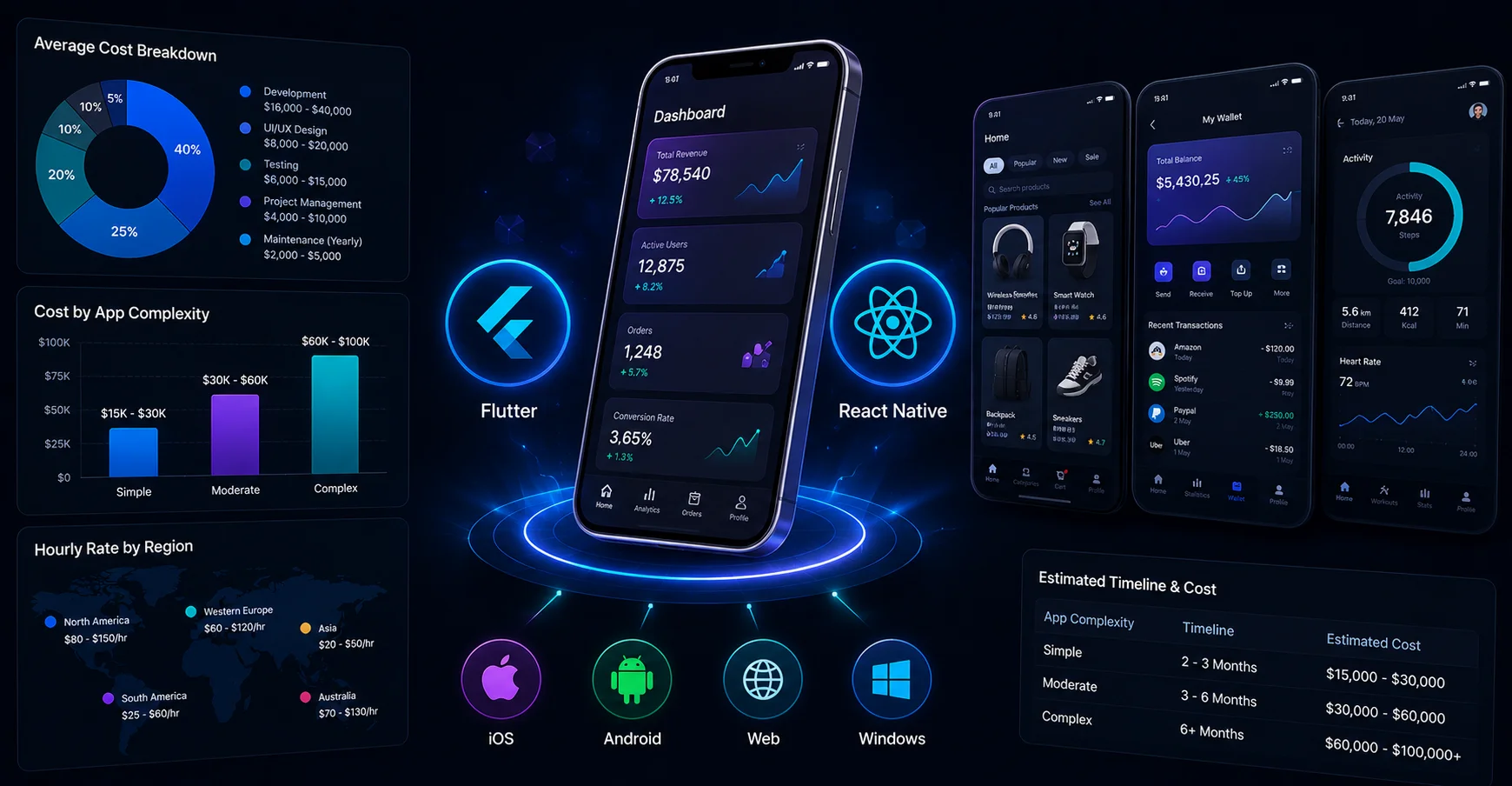
Seeking professional assistance? Team up with an ML Development Firm to help you find the most appropriate framework for your project or investigate the Costs of Machine Learning framework development for budgeting.
Comparison of Top ML Frameworks
| Framework | Performance & Scalability | Ease of Use | Community Support | Compatibility & Integration |
| TensorFlow | Excellent for large-scale production; great on cloud and edge | Moderate (easier with Keras API) | Very strong; backed by Google | High; integrates with many platforms/tools |
| PyTorch | High, especially for research and production | Easy and intuitive for developers | Very strong; backed by Meta | High; ONNX, TensorFlow, many libraries |
| Scikit-learn | Good for small-medium tasks; not for deep learning | Very easy; great for beginners | Strong; widely adopted in industry | Works well with NumPy, pandas, SciPy |
| Keras | Good (built on TensorFlow, so inherits its scalability) | Very easy; high-level API | Strong; supported via TensorFlow | Tight integration with TensorFlow |
| XGBoost | Excellent for structured data; fast and efficient | Moderate; some learning curve | Strong; popular in competitions | Compatible with Python, R, Spark |
| LightGBM | Excellent; fast training on large datasets | Moderate | Growing; strong in enterprise use | Works with Python, R, Spark |
| CatBoost | High; handles categorical data well | Easy (less preprocessing needed) | Growing; good documentation | Integrates with Python, R |
| Apache Spark MLlib | Excellent for big data, distributed systems | Moderate (requires Spark knowledge) | Strong in big data community | High with Spark ecosystem |
| H2O.ai | High; good for AutoML and enterprise scaling | Easy (GUI available) | Strong; both open source and enterprise support | Integrates with Spark, Python, R |
| MXNet | High; good for distributed training | Moderate | Niche but stable | Integrates with multiple languages |
| Theano | Legacy; limited scalability in 2025 | Harder (low-level code) | Weak; no longer maintained | Limited; used mostly in research legacy code |
| Chainer | Good; dynamic graphs flexibility | Easy for researchers | Small but dedicated community | Works well with NumPy |
| JAX | Very high for research; fast computations | Moderate | Growing fast | Compatible with NumPy, TensorFlow |
| PaddlePaddle | High; designed for industrial AI | Moderate | Strong in Asia | Works with Python, C++ |
| ONNX | N/A (model format, not a framework itself) | N/A | Strong (cross-framework support) | Excellent for interoperability |
| Microsoft CNTK | High for deep learning at scale | Moderate | Smaller community today | Integrates well with Microsoft stack |
| RapidMiner | Good for business analytics | Very easy (no-code/low-code) | Strong among business users | Works with various data sources |
Best Frameworks for Machine Learning Production Deployment
Deciding on the best Machine Learning Framework while deploying machine learning models at scale is very important if you want to ensure that the performance, reliability, and easy integration with production systems are guaranteed.
In the current year 2025, firms are betting on reliable, thoroughly tested Machine Learning Frameworks that not only support extensive datasets but also enable distributed training as well as go smoothly while deploying to cloud, mobile, or edge environments.
With these frameworks, you can simplify Machine Learning framework development, reduce downtime, and plan for long-term maintenance. The list below shows some of the most popular frameworks for machine learning that today’s companies use in their production work.
| Framework | Why It’s Good for Production | Performance & Scalability | Integration & Deployment |
| TensorFlow | Excellent scalability, wide support for cloud, edge, mobile | Excellent | Strong (works with major cloud providers, mobile platforms) |
| PyTorch (TorchServe) | Flexible and production-ready with TorchServe | Excellent | Strong (ONNX, AWS, Azure, etc.) |
| Apache Spark MLlib | Designed for big data and distributed processing | Excellent | Strong (integrates with Spark, Hadoop, Kafka) |
| H2O.ai | Fast deployment with AutoML and model interpretability | High | Strong (integrates with Spark, enterprise tools) |
| LightGBM | Fast for large-scale gradient boosting on structured data | High | Good (works with Python, Spark, R pipelines) |
| ONNX | Enables model export and deployment across multiple platforms | N/A (model exchange format) | Excellent (supports cross-framework deployment) |
Trends Shaping Machine Learning Frameworks in 2025
Being shaped by new technologies and business needs, Machine Learning Frameworks development is in 2025. From automation to edge computing, contemporary frameworks for machine learning are evolving to accommodate more flexibility, scalability, and efficiency.
These trends have forced both open-source and enterprise-grade Machine Learning Frameworks to get smarter and more adaptable so that businesses can deploy custom data analytics services on scale.
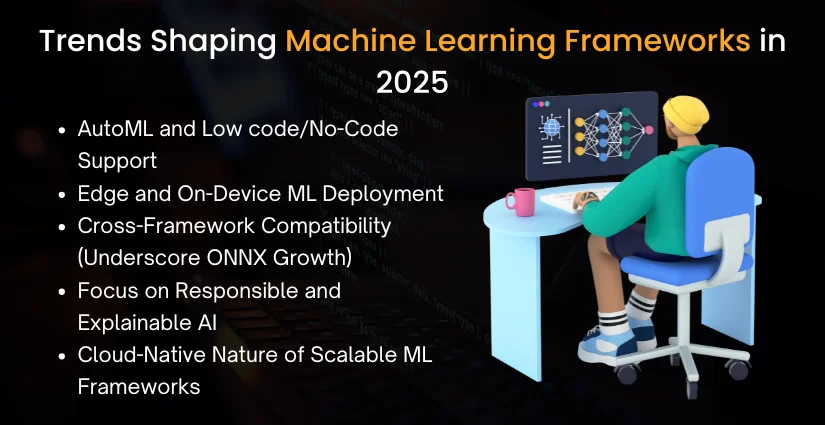
1. AutoML and Low code/No-Code Support
More and more Machine Learning Frameworks include AutoML capabilities for low-code implementations that help teams deliver models faster with little to no programming experience. By doing this, open-source Machine Learning Frameworks become accessible to the non-technical population.
2. Edge and On-Device ML Deployment
Frameworks are optimized to deploy models on devices, that mobile device, IoT hardware, or edge servers. This trend will guarantee that Machine Learning Solutions would run with real-time considerations even in poor connectivity.
3. Cross-Framework Compatibility (Underscore ONNX Growth)
ONNX brings a steep rise in interoperability between different frameworks so models can be trained in one framework and deployed in another without any conversion issues.
4. Focus on Responsible and Explainable AI
There’s increasing demand for Machine Learning Frameworks that allow interpretability, fairness, and transparency of the models, especially in industries like healthcare and finance.
5. Cloud-Native Nature of Scalable ML Frameworks
Frameworks are turning cloud-native, without any hiccups while integrating with AWS, Azure, and GCP for the creation of scalable Machine Learning Frameworks and faster production deployment.
Read More: Top 15+ Chatbot Development Frameworks
Best Machine Learning Frameworks for Beginners
For beginners who have decided to venture into the AI and data science fields, the choice of the right Machine Learning Framework is very important. The best Machine Learning Frameworks for beginners have user-friendly APIs, well-written documentation, and an active community to provide educational and experimental support without much confusion.
Various open Machine Learning Frameworks of 2025 have morphed into those that are geared toward a novice, but they still allow one to work on advanced topics as skills improve. Selecting a good framework guarantees a more comfortable learning journey and assists you in establishing strong foundations in Machine Learning framework development.
| Framework | Why It’s Good for Beginners | Ease of Use | Community Support |
| Scikit-learn | Simple API, excellent for basic ML tasks (classification, regression, clustering) | Very Easy | Strong (large community, great docs) |
| Keras | High-level API, intuitive design, integrates with TensorFlow | Very Easy | Strong (via TensorFlow) |
| PyTorch | Clear, Pythonic syntax; good for learning deep learning basics | Easy | Strong (great tutorials, active community) |
| RapidMiner | Drag-and-drop interface; no coding required | Very Easy | Strong (business user friendly) |
| H2O.ai (AutoML) | Easy setup with AutoML features for beginners | Easy | Strong (helpful docs, community, and enterprise support) |
How to Choose the Right Machine Learning Frameworks for Your Project?
Choosing the right Machine Learning Framework is the most significant step in your journey into machine learning. The best framework for your project should take into account the complexity of your project, data size, deployment needs, and team expertise.
In 2025, with an overflowing number of frameworks at hand, from lightweight source Machine Learning Frameworks to enterprise-grade platforms, making the right choice can help reduce costs, speed up development, and ensure success. Here’s what to consider when choosing a framework.
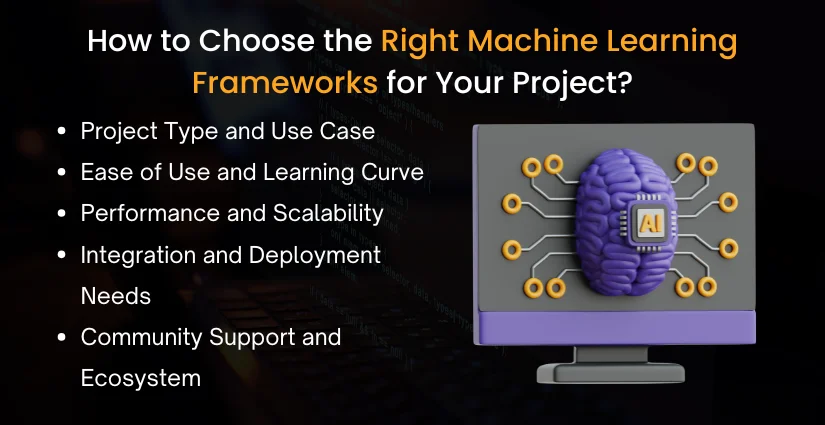
1. Project Type and Use Case
What exactly are you creating? The answer: deep learning, traditional machine learning, or big data processing? Different Machine Learning Frameworks focus on different aspects of deep learning, TensorFlow, classical algorithms Scikit-learn, and for big data Spark MLlib.
2. Ease of Use and Learning Curve
In case your team consists of beginners in the machine learning domain, go for frameworks that have clear and ample documentation, tutorials, and beginner-friendly APIs e.g. Keras or Scikit-learn. This is even more significant if you count on custom Machine Learning Development services.
3. Performance and Scalability
Choose a Machine Learning Framework that is able to scale smoothly across CPUs, GPUs, or distributed systems if you plan to deploy your model in production or you have large datasets. Among the best-performing are TensorFlow, PyTorch, and LightGBM.
4. Integration and Deployment Needs
Think about the level of compatibility between your current tech stack and the framework you choose. TensorFlow, PyTorch, and ONNX are the most flexible platforms in terms of deployment across cloud, mobile, and edge environments, which, in turn, means they are the best choices for a modern Machine Learning framework development project.
5. Community Support and Ecosystem
Better community support results in increased learning resources and more frequent updates. Open-source machine learning platforms such as TensorFlow, PyTorch, and Scikit-learn have very active communities that quickly address problems.

Conclusion
The year 2025 will provide businesses and developers with ever-so-powerful, flexible, and user-friendly tools in the landscape of Machine Learning Frameworks. If one is trying out open source Machine Learning Frameworks for the research or needs production-ready solutions for heavy-scale implementation, picking the right framework for Machine Learning is an essential part of the framework in which AI applications will be built. There are competing Machine Learning Frameworks, whether TensorFlow and PyTorch or the newer ones engineered for automation and edge AI. All stand to offer something that other frameworks do not, depending on what one is trying to achieve.
By understanding the tools and trends, one can take the right steps in reducing the cost, maximizing the time to build the Machine Learning Frameworks, and delivering valuable results. Should the consideration of the next AI project come to the fore, a Machine Learning Development Company or Machine Learning Frameworks Development Company can be engaged to guide towards the right framework choice and smooth implementation. Are you ready to create smart solutions? Review Machine Learning Frameworks Development Cost or look into custom Machine Learning Development services!
FAQs
In 2025, TensorFlow and PyTorch continue to be arguably the most used Machine Learning Frameworks because of their flexibility, performance, and strong community support.
Most of the famous Machine Learning Frameworks- TensorFlow, PyTorch, and Scikit-learn, to name a few- are open-source Machine Learning Frameworks and are free of cost.
In deep learning, the big players are TensorFlow and PyTorch because they work with advanced neural network models and facilitate up-scaling of training.
Apache Spark MLlib is the best Machine Learning Framework for big data. It is a distributed processing system and can handle big datasets well.
TensorFlow and PyTorch will continue to dominate the space as the leading Machine Learning Frameworks in 2025 and beyond, with increased support for production deployment, edge computing, and AI research.

 By
By September 10, 2026





 Get in Touch