



By 2025, the Internet of Things (IoT) is seen as an absolutely key transformation enabler with possibly billions of devices joining the networks across various industries. IoT mechanisms produce so much data every second; in healthcare, monitoring patient vitals is a case in point, whereas in manufacturing, the activities of plants and machinery are being monitored, and in retail, inventories are kept in time.
The true worth of this data lies in its analysis. Machine learning converts the raw data coming in from the IoT into an actionable insight for automation, predictive analytics, anomaly detection, and intelligent decision-making. In manufacturing, ML is used to predict failure of equipment; it also serves to give early warning of health incidents from wearable data in healthcare, and in retail, it is applied to supply chain optimization and demand forecasting.
The ML-IoT intersection is currently turning devices into intelligent systems that learn, adapt, and act autonomously to push efficiency, foster innovation, and open up channels for new business opportunities across sectors.
- What Is Machine Learning in IoT?
- Machine Learning in IoT Market Statistics 2025
- How Machine Learning is Powering IoT Applications?
- Top Use Cases of Machine Learning in IoT
- Key Benefits of Machine Learning in IoT Solutions
- Challenges of Integrating Machine Learning with IoT
- Future of Machine Learning in IoT Beyond 2025
- Conclusion: The Road Ahead for ML-Driven IoT
- Why Choose Octal IT Solution for ML-IoT Development?
- Frequently Asked Questions
What Is Machine Learning in IoT?
Initially, the connected devices were fed with huge datasets through which intelligent algorithms learned to identify patterns and, therefore, act autonomously. While IoT assured a continuous streaming of data from sensors, wearables, and smart devices, ML has empowered the system to learn and adapt independently thereafter. Working hand-in-hand, data-raw gets converted into knowledge for anomalies detection, failure prediction, operation optimization, and experience customization. In this way, ML-IoT solutions, across the industries of healthcare, manufacturing, logistics, energy, agriculture, and smart cities, open doors toward further efficiency, cost reduction, and safety enhancement.
Beyond 2025, with the strengthening of such intersections between iot in machine learning, not only will it strengthen existing processes, but give rise to new revenue streams spawned by innovation for mother smarter autonomous ecosystems that buy, relate, and act in almost real time.

Machine Learning in IoT Market Statistics 2025
Below are the latest 2025 market statistics that highlight the scale, opportunities, and future potential of ML in IoT.
- The global AI in IoT market is projected to grow from USD 93.12 billion in 2025 to approximately USD 161.93 billion by 2034, expanding at a CAGR of 6.35% during the forecast period.
- Other reports estimate the AI in IoT market size at USD 60.71 billion in 2025, with projections to reach USD 168.69 billion by 2030, advancing at a 22.7% CAGR.
- In the U.S., the AI in IoT market size was USD 20.21 billion in 2024 and is projected to be worth around USD 38.46 billion by 2034, poised to grow at a CAGR of 6.65% from 2025 to 2034.
- The global industrial AI market reached USD 43.6 billion in 2024 and is expected to grow at a CAGR of 23% until 2030, reaching USD 153.9 billion, driven by a renewed push for AI initiatives in industry following the advent of generative AI in 2022.
- The global consumer IoT market is set to grow 8.8% in 2025, driven by generative AI, the Matter standard, and rising demand for smart home solutions.
How Machine Learning is Powering IoT Applications?
The Internet of Things (IoT) has expanded swiftly, connecting billions of devices worldwide. However, truly harnessing the powers of an IoT feels that it is not only a matter of acquiring data but also a matter of making sense of it. This is the realm of machine learning in IoT. When a device learns from patterns in data and improves its performance without any explicit programming, it essentially acts as an ML layer that makes IoT more efficient, predictive, and adaptive.
The following elaborate the ways in which ML empowers IoT applications:
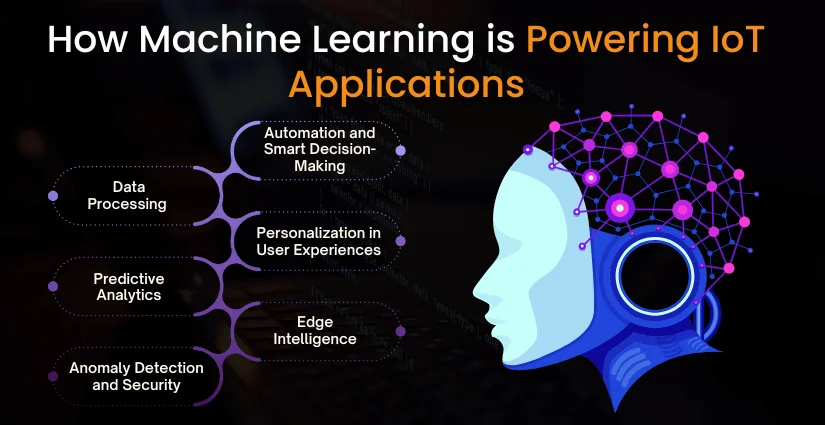
1. Data Processing
IoT devices generate huge streams of unorganized data every second, from various sensors to cameras, from machines to connected devices. When unprocessed, this enormous chunk of information would be overwhelming and next to impossible to utilize. ML algorithms in for this very task: to filter, organize, and analyze unstructured data in real time.
2. Predictive Analytics
Perhaps the most useful function machine learning solutions contributes to IoT is predicting future outcomes based on past and real-time data. Given a set of highly advanced predictive models, IoT systems can foresee outcomes such as equipment failure, sudden spike in energy demand, road cops or untraced congestion, and even user behavior trends.
3. Anomaly Detection and Security
The establishment of any IoT, network, in particular, means a higher chance of cyberattacks and/or data breaches. Therefore, applications of machine learning in iot ensures the security of IoT by continually observing activities of the devices, their data flows, and network behavior.
4. Automation and Smart Decision-Making
ML and IoT empower devices to make smart decisions completely autonomously from human intervention. A smart home can download recipes of light and energy use with very little or no human intervention, while industrial IoT makes the production lines efficient; hence ML-based IoT-purchases make a service more efficient.
5. Personalization in User Experiences
The more such technologies on connected devices powered by ML are able to identify individual user preferences and behaviors, the more wearable devices, health apps, and smart contract development company analyze behavioral data and then provide alerts, recommendations, and services tailored to an individual.
6. Edge Intelligence
Conventional IoT setups tend to rely heavily on cloud computing power and, therefore, have high latency with bandwidth consumption. On the other hand, if processing algorithms or Machine Learning (ML) models are pushed more toward the edge closer to those IoT devices, businesses can have real-time data processing and speedy decision-making.
Also Read: IoT in Telecom: Key Use Cases and Benefits
Top Use Cases of Machine Learning in IoT
Together, Machine Learning in IoT make for a dual that enables the application of disruptive technologies. To achieve this monumental application, ML allows IoT devices to analyze data, learn from patterns, and intelligently make decisions. Therefore, ML accelerates the adoption of innovation into mainstream society in and beyond 2025. Some of the prominent uses are as follows:
Smart Homes and Buildings
In smart home technology, ML-powered IoT systems are redefining how human interaction works with living spaces. The systems learn behaviors of individuals and make decisions to save energy through smart means of controlling lighting, heating, and cooling. Under the security umbrella, systems comprise smart surveillance cameras and biometric entry systems that can alert for any abnormal activities in real-time.
Healthcare and Wearables
Healthcare has always been one pressing machine learning applications in iot. These connected wearables, such as fitness trackers and smartwatches, as well as remote patient monitoring devices, apply ML algorithms to continuously track the vital signs of a patient’s body, including heart rate, oxygen, and glucose levels. They also work as early warning detectors. Predictive insights poise further prevention approaches and timely intervention of medical attention.
Industrial IoT (IIoT)
ML and IoT form the backbone of Industry 4.0 for manufacturing. Predictive analytics can be used in a factory setting to detect an impending equipment failure and thus prevent occurrence of expensive downtime. ML sensors can also assist in quality control by detecting defects in products in real-time during production.
Smart Cities
Cities are nowadays becoming more ML-driven IoT to be smart, green, and efficient. Vehicle flow is being monitored in real-time by traffic management systems to reduce congestion and emissions. IoT-enabled smart bins optimize the routes for waste collection, cutting edge app development operational expenses.
Retail and Supply Chain
The retail side is using ML-IoT to improve customer experience and operational efficiencies. Real-time inventory checks and never-ending product supply through auto-replenishment assure that products are only demanded. ML models list out trending demands so that the retailers can more efficiently handle product stock and reduce wastage.
Agriculture and Farming
A digital transformation is underway in agriculture owing to the precision farming-driven ML-IoT. Smart sensors monitor the soil’s health, moisture content, and nutrient content, giving farmers real-time insights into the state of the crops. By detecting weather trends, ML helps forecast the best times to plant and harvest.
Transportation and Autonomous Vehicles
Transportation is experiencing fast adoption of ML-IoT to travel safely and efficiently. IoT-Monitor-vehicles ML to observe the engine performance, predict maintenance requirements, and improve fuel efficiency. In another advanced scenario, ML algorithms would empower autonomous vehicles to make split-second decisions based on real-time inputs from their sensors, cameras, and GPS systems.
Energy and Utilities
Electric and energy service providers resort to ML-IoT to smartly manage the evolving grid. Energy consumption patterns are studied with ML algorithms by smart meters and the connected grid to balance supply and demand and outright detect or claim possible outages. Utility companies address issues pre-emptively, hence reducing downtime and increasing customer satisfaction.
Learn More: Machine Learning in Healthcare: Applications & Benefits
Key Benefits of Machine Learning in IoT Solutions
Machine Learning in IoT integration brings an upside for both companies and customers, not just a mere upgrade in technology. ML converts raw data from IoT sensors into actionable intelligence and brings to the table several advantages of machine learning in iot for improved efficiency, cost reduction, and better user experience.
1. Real-Time Decision Making
Continuous IoT data are fed into ML algorithms for analysis and hence, allow systems to take accurate decisions about the present situation without assistance from human intervention.
2. Improved Operational Efficiency
From manufacturing floors to logistics chains, ML-enabled IoT solutions determine ways to automate processes, optimize resource usage, and reduce downtimes.
3. Cost Reduction
Predictive analytics, powered through IoT app development services, help reduce maintenance costs, optimize energy utilization, and avoid the needless wastage of resources.
4. Enhanced User Experience
IoT, paired with ML, fits the bill by observing user behavior and granting the user experiences from smart home adjustments to custom-tailored healthcare insights.
5. Predictive and Preventive Capabilities
Failure events are anticipated by ML models, with anomalies being detected, and preventive measures suggested so as to reduce risk to businesses and ensure continuity.
6. Stronger Security and Fraud Detection
By spotting odd behavior patterns and potential threats, ML can help fortify IoT ecosystems against cyberattacks and unauthorized access.
7. Scalability for IoT Ecosystems
In tandem with the expansion of IoT networks, the importance of machine learning in iot lies in its ability to help systems manage increasing data volumes efficiently at scale.

Challenges of Integrating Machine Learning with IoT
While the convergence of Machine Learning (ML) and the Internet of Things (IoT) offers immense opportunities, it also brings a set of challenges that organizations must address to ensure successful adoption. These challenges span technology, security, infrastructure, and cost considerations.
1. Data Privacy and Security Concerns
IoT devices collect sensitive information, including health records, location data, and financial transactions; this data must be protected. An additional complication is how to implement machine learning in iot since large datasets must be securely transmitted and stored to avoid cyber breaches.
2. Scalability Issues
Data generation in IoT-strengthening networks grows exponentially. Massive training sets demand Data analytics services and Infrastructure resources for ML model training, possibly difficult to scale efficiently.
3. Integration with Legacy Systems
In many industries, the IT systems in use are outdated. Mnemonic System created by ML-powered IoT frequently create compatibility issues with legacy infrastructure as well as stalling their deployment.
4. High Implementation Costs
Building and maintaining ML-IoT ecosystems require resources for sensors, edge devices, cloud platforms, and human skills. It is, therefore, quite an expensive investment for SMEs, which cannot afford such expenses.
5. Complexity in Model Training and Accuracy
Data from IoT sources is usually unstructured and inexact. Training machine learning in IoT models with such data is highly complicated, and poor accuracy in the models results in improper prediction.
6. Latency and Real-Time Processing
Several IoT applications (approximate autonomous vehicles and health monitoring) demand real-time decision-making processes. Ensuring an ML process with minimum latency on edge devices still poses a technical threat.
7. Shortage of Skilled Talent
Deploying ML in IoT requires everyone to have a good steep in data science, AI, cybersecurity, and cloud infrastructure. The dearth of such talents usually delays adoption and leans heavily on third-party providers.
Future of Machine Learning in IoT Beyond 2025
As the bigger picture of machine learning integration into the Internet of Things (IoT) changes and develops, so shall the larger, more transformative innovations. From about 2025 onward, ongoing improvements in computing, networking, and AI will perpetually further enhance the ML-powered IoT systems. This trend has just begun to shape the immediate future.
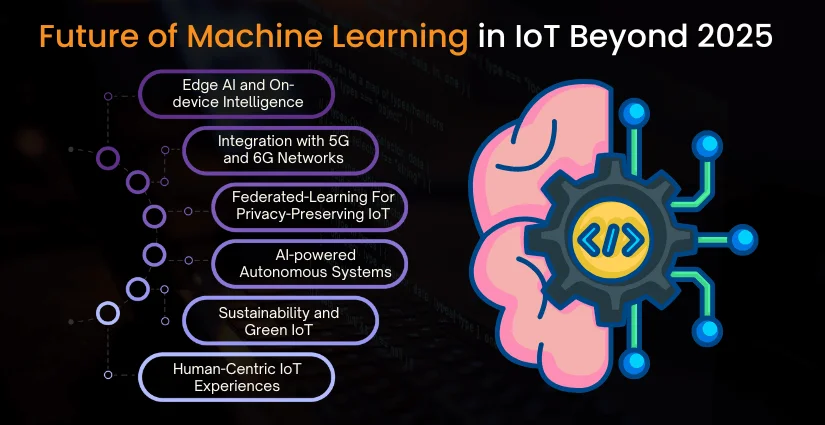
1. Edge AI and On-device Intelligence
Data generated locally shall be processed nearer their origin. Edge AI removes latency, enables real-time analytics, and lessens the reliance on cloud infrastructure-a must-have application of machine learning in iotfor vehicle autonomy and healthcare monitoring.
2. Integration with 5G and 6G Networks
High-speed and low-latency networks will enable IoT to move and process huge data sets, and 6G shall make these ML-IoT ecosystems more interrelated and responsive.
3. Federated-Learning For Privacy-Preserving IoT
Federated learning will be increasingly used as a solution to the data privacy issue; it establishes conditions for IoT devices to train ML models locally without sharing sensitive data with centralized servers.
4. AI-powered Autonomous Systems
Right from smart manufacturing to autonomous fleets, an ML-IoT would allow fully autonomous systems to negotiate activities for their own optimization and execute complex decisions without any human intervention.
5. Sustainability and Green IoT
Environmental concerns have defined the very course of the future, and ML will enable the IoT development company systems to optimize energy consumption, reduce waste, and employ sustainable processes; i.e., making greener smart cities, supply chains, and industries.
6. Human-Centric IoT Experiences
IoT solutions shall henceforth become user-centric and use machine learning in iot to develop distinctly tailored healthcare, retail, and lifestyle solutions that adapt to the fit of an individual while in-use.

Conclusion: The Road Ahead for ML-Driven IoT
From industries using predictive maintenance to personalized healthcare and sustainable smart cities, IoT solutions, empowered by ML, are increasingly deploying their curse on business and human relations through technology. Data privacy, infrastructure cost, and model accuracy are the major challenges that still hamper its development. With edge AI, federated learning, and 5G/6G connectivity bolstered to speed IoT ecosystem smartness, speed, and security, however, a new dawn is arising!
Future and forefront is in early adoption of this convergence and in investment in scalable solutions while leveling the playing field with expert partners to realize its full potential. Henceforth, ML in IoT will not just optimize operations; instead, it will work on new ideas and evaluate efficiency with human experiences within a connected world.
Why Choose Octal IT Solution for ML-IoT Development?
At Octal IT Solution, we build smart, scalable, and secure ML-powered IoT applications tailored to meet an array of business needs. They have very rich expertise in Artificial Intelligence development services, ML, and IoT integration, producing such solutions that increase efficiency, reduce operational and IoT app development cost, and generate revenue opportunities.
End-to-end development services, custom solutions for industry-specific applications, and a propositional emphasis on security, scalability, and innovation give your IoT ecosystem a real shot at being future-ready and adaptable. For Octal, a truly proven experience and a global clientele make a trusted partner for any organization willing to make full use of Machine Learning in IoT.
Frequently Asked Questions
Machine Learning enables IoT devices to analyze a large volume of real-time data, detect patterns, and take decisions automatically, without human intervention. This allows for intelligent automations, predictive maintenance, and greater efficiency in various industries.
ML-IoT brings major benefits to industries like healthcare, manufacturing, logistics, and retail, among others, as it enhances operation, safety, customer experience, and cost optimization.
Some of the major challenges are privacy of data, costly infrastructure, edge devices with limited processing power, and maintaining the model accuracy in dynamic real-world scenario.
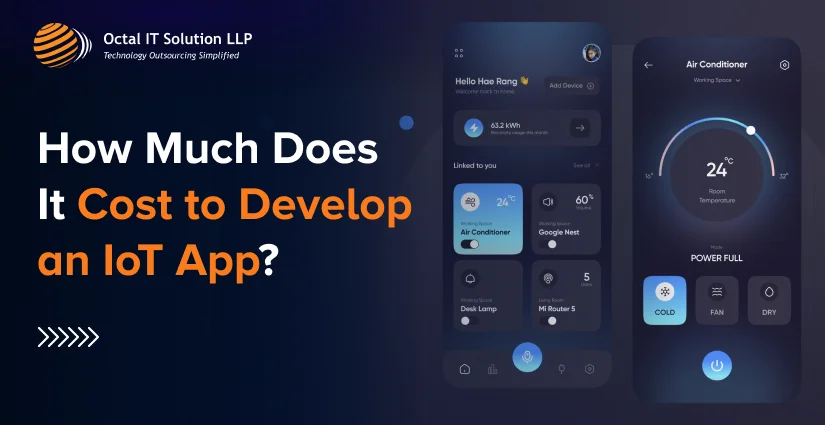
Cost depends upon parameters such as solution complexity level, industry use case, number of devices concerned, technology stack and integration requirements. On average, a reliable ML-IoT solution may cost anywhere between $30,000 to $150,000+ based on scale and features.
Octal IT Solution, with proven expertise, end-to-end services, industry-specific solutions, security, and scalability focus, is a trusted partner for businesses that aim to utilize the Machine Learning in IoT.

 By
By July 9, 2025



 Latest Stories
 Get in Touch