



Key Takeaways
- The global PWA market is expected to grow from USD 2.08 billion in 2024 to USD 21.24 billion by 2033.
- PWA development costs range from $5,000 for a basic build to $150,000+ for enterprise-grade applications.
- Easy PWA takes 2 to 6 weeks. A full-featured PWA takes 2 to 4 months.
- Real brands like Twitter, AliExpress, and Pinterest have revealed a 40-104% jump in conversions after switching to PWAs.
- The right way to select a PWA development company is to check their live Lighthouse level, not just their pitch deck.
- When selecting a PWA development company, red flags matter as much as green flags.
Find the Right Progressive Web App Development Company
Choosing a PWA partner is a lot like hiring a contractor for your home. Everyone puts up a nice portfolio. Few show who will actually build your product.
Progressive web applications combine the reach of a website with the experience of a native application. They load quickly, work offline, and install without an app store. But building one well requires real technical skill, not just online claims.
This guide walks you through how to choose right progressive web app development company for your project. We will cover market trends, technical checkpoints, red flags, and actual costs. By the end, you’ll know exactly what to look for before signing a contract.
PWA Market Overview: 2026 & Beyond
The PWA marketplace is entering its fastest-growing phase yet. In 2026, the global progressive web apps market reaches around $3.14 billion. Analysts expect the market to grow at a CAGR of over 30% throughout the next decade.
Gartner projects that more than 50% of app-related customer interactions will use PWAs by 2027. It’s a significant shift away from native-only app strategies for most businesses.
Industry experts predict that offline-first design will become standard practice in 2029, especially for retail and navigation systems. Analysts expect adoption to grow faster in low-bandwidth regions like Africa and Southeast Asia. Mobile-first companies use PWAs to reach customers with limited connectivity.
Analysts project that the global PWA market will reach $9.4 billion by 2030, and grow at a CAGR of around 26% from 2024 onwards. Retail, travel, and social media industries will likely drive the next wave of PWA adoption.
Several companies are now claiming to be progressive web app development companies without PWA experience. That’s why the checklist in this guide is more important than marketing claims.
What Makes PWA Development Different From Regular Web Development
A regular website displays only content. The PWA behaves like an app, even within a browser tab. That difference comes down to 3 core technologies.
Service Worker
The service worker is a background script that runs separately from your web page. It stores content and allows your app to work even without an internet connection.
Web App Manifest
The manifest is a small JSON file with your app’s name, icons, and colors. When a user launches an app, it tells the browser how your app should behave.
Mandatory HTTPS
Every PWA requires a secure HTTPS connection to work. Without it, service workers and installability won’t work.
Cross-Browser Installation
Not every browser handles PWA installation the same way. Chrome and Edge support one-click installation, while Safari requires a guided installation.
Many general web companies can create a website. Few can properly configure caching strategies, offline fallbacks, and install experiences across different browsers. That’s exactly the difference you want to test before hiring anyone.
Signs You Are Ready to Hire A PWA Development Company
Before you start vetting companies, get clear on your project first. These signs will tell you when you’re really ready to start reaching out.
A Defined Feature List
You wrote down the targeted tasks needed, such as offline access or push notifications. This makes it easier to estimate your project cost and avoids confusion about scope later.
Realistic Budget Range
Set a realistic budget before your first sales call. This keeps conversations focused and makes it easier for you to spot vendors who overpromise.
Clarity on Your Starting Point
You’ve decided whether to modify an existing website or create a PWA from scratch. Converting an existing website is usually cheaper and faster than starting from scratch.
Sense of Your Timeline
You know whether you want a strict MVP or a fully-featured version. This shapes what engagement model and team size actually fits your project.
Key Criteria to Evaluate In A PWA Development Company
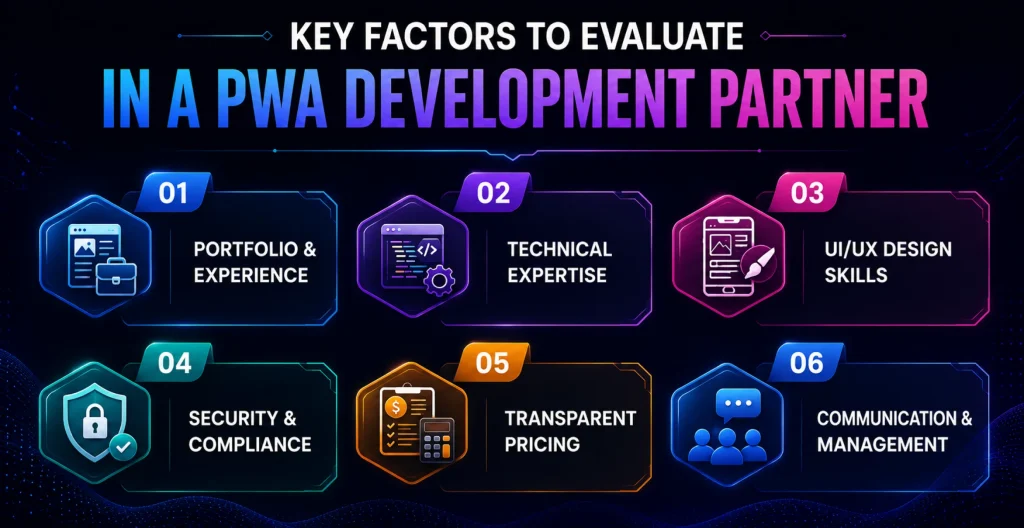
Wondering how to choose a progressive web app development company? Do not let a sales pitch mislead you. Start with the six pointers. Here’s what actually matters once you are deep in the evaluation process.
Portfolio & Industry Experience
Find real, actionable PWAs in your industry, not just screenshots anymore. Click through their case studies and install the app yourself.
Technical Stack Expertise
Ask what modern frameworks they use, such as React, Angular, or Vue. Every provider has different tooling and offline support.
UI/UX Design Capabilities
A PWA should feel like a native app, not a browser tab. Ask to see mobile-first design work, not just desktop layouts.
Security & Compliance Knowledge
If you manage billing or health records, ask about their encryption and data protection practices. This is especially important as PWAs move toward collecting sensitive information.
Transparent Pricing Models
A company that hides its pricing structure is harder to negotiate with later. Get a full breakdown before you decide to do anything.
Communication & Project Management
Ask who will manage your project and how often you’ll receive updates. Poor communication is the top reason tasks run over budget.
These six factors matter a lot, but they are most effective in telling you whether the provider sounds qualified. The next section helps you verify those claims.
The PWA-Specific Technical Checklist Most Businesses Skip
Most businesses ask, “Do you get PWA experience?” That question is too easy to answer with a simple “yes”. Here’s what to ask alternatively.
Live Lighthouse Scores
Lighthouse is Google’s open-source auditing tool for PWA overall performance and configurability. Ask the agency to run it live on a past client project, not the demo.
Their iOS Safari Solution
However, Safari handles PWA installation differently. The strong team should clearly explain its course of action.
The Offline Caching Strategy
There is a real difference between pre-caching key pages and dynamic caching when customers browse. The professional team should clearly explain their caching approach without hesitation.
Push Notification Proof
Many companies require a push notification guide, but frankly haven’t successfully implemented one. Ask them to demonstrate it on a live client app.
If the company cannot answer clearly, this is useful information to keep in mind while making a decision. That tells you they can sell better than they can deliver.
Engagement Models: Freelance vs. Agency vs. Full Scale Development Company
Not every project needs the same team size. Here is a short method tailored to the right model for your project.
| Engagement Model | Best For | Typical Cost | Risk Level |
| Freelancer | Small MVPs, tight budgets | Lowest | Higher – single point of failure |
| Boutique Agency | Mid-size projects needing design + dev | Moderate | Medium – smaller backup team |
| Full-Scale Dev Company | Complex, enterprise-grade PWAs | Higher | Lower – dedicated QA and support teams |
Freelancers can work well with simple, low-risk builds with limited scope. However, if a freelancer becomes unavailable out of nowhere, your project can stall.
If you are looking to choose progressive web app development company options, start by evaluating the team size. Match the team to the complexity of your project. The budget should not drive this choice alone.
A full-scale progressive web app development company brings in dedicated QA, project managers, and backup designers. As the complexity of your application and enterprise risk increases, this matters more.
Questions to Ask During Your Discovery Call
Have this list with you when you make your first call. It quickly filters out vague answers.
- What is your process for testing offline functionality before launch?
- Can you share a Lighthouse PWA rating from a live client project?
- How do you deal with iOS Safari’s installed limitations?
- What post-launch support services do you provide?
- How do you structure pricing: fixed price, hourly rate, or dedicated team?
- Who will be my primary point of contact throughout the project?
- What happens if you end up missing a deadline?
These are real questions to ask a PWA development company before signing anything. Vague or evasive answers here are worth taking seriously.
Red Flags That Signal A Risky PWA Partner
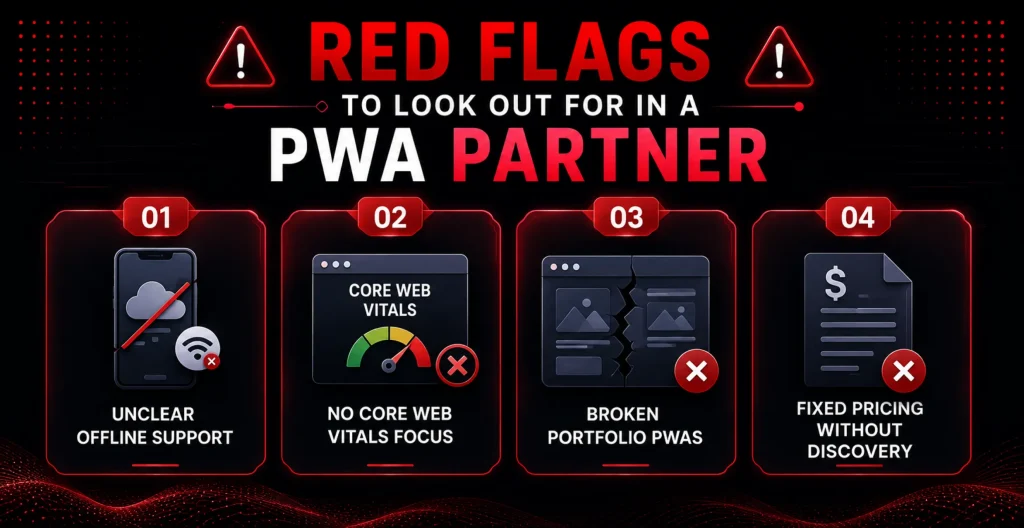
Most guides simply tell you what to look for. Few will tell you what to run from. Here are the warning signs that matter the most.
Vague Answers About Offline Functionality
Ask the team to explain their caching method in simple terms. If they can’t, they probably haven’t built one right.
No Mention of the Core Web Vitals
These are Google’s iconic performance metrics for speed and cost. A serious PWA team should track and optimize for them by default.
Broken or Uninstallable Portfolio Links
If their own case study PWAs don’t install or work offline, that’s a red flag. Check for yourself before you believe their claims.
One-Size-Fits-All Pricing Without Discovery Calls
Actual PWA pricing depends on your specific project and complexity. A flat offer is a shortcut to unexpected costs, not a plan.
Don’t judge a company by one red flag alone. However, several red flags together should make you think twice.
Cost of Hiring a PWA Development Company
How much does PWA development cost? It depends on complexity, features, and team size. Here is a detailed breakdown based on modern 2026 market information.
| Project Type | Features Included | Estimated Cost | Typical Timeline |
| Basic PWA | Manifest, service worker, offline caching, no login | $5,000 – $15,000 | 2-6 weeks |
| Standard PWA | User accounts, push notifications, 1-2 integrations | $15,000 – $50,000 | 6-12 weeks |
| Enterprise PWA | Complex backend, multiple integrations, compliance needs | $50,000 – $150,000+ | 3-6 months |
The developer’s hourly rate also shapes your final bill. Senior PWA developers typically charge $100-$200 per hour, even as mid-level developers charge $70-$120 per hour.
Don’t neglect post-launch maintenance fees. Most companies charge 15-20% of the standard build cost each year for upgrades and security patches.
Remember: PWA development cost is almost always 30-40% lower than creating separate iOS and Android apps. It is certainly one of the biggest financial arguments for going the PWA route.
Why This Decision Impacts Your Business Long-Term
Choosing the right partner is not just about launch day. Real-world data shows what businesses can achieve when they build a PWA properly.
Twitter Lite saw a 65% jumpin pages per session, and a 20% decrease in bounce rate after launch. AliExpress saw a 104% increase in conversions from new users, with iOS conversions increasing 82%.
Pinterest’s PWA rebuild increased time spent by 40% and helped ad revenue in emerging markets by 44%. These are no small victories. They resulted from sound builds, not lucky guesses.
Additionally, a poorly designed PWA is an ongoing risk. Browser developers frequently update guidelines, especially as they introduce new PWA rules for iOS Safari. Your development partner needs to track these shifts and update your app as a result, long after release.
Why Octal IT Solution is the Right Partner for PWA Development
Octal IT Solution builds PWAs the way this guide recommends you evaluate them: with proof, not promises. Our team runs a Lighthouse audit on every build before delivering it to the client.
We work with React, Angular, and Vue for progressive app development frameworks. Each framework is chosen by our team in accordance with your company’s requirements. Push alerts, offline functionality, and browser-specific installation experiences, including peculiarities with Safari, are implemented by our team.
Beyond PWAs, Octal IT Solution also offers full progressive web app development services. Our team covers mobile-first design to backend structure and QA.
If your roadmap consists of blockchain capabilities, we are also a trusted Web3 development company. That approach allows your PWA to scale to more complex integrations later, without switching development partners.
Every project includes clear pricing, a committed project manager, and post-launch support. You understand your costs, timeline, and point of contact before development even begins.
Are you still deciding how to select the right web app development company for your industry? Schedule a free consultation call, and our team will help you find the best solution.
Conclusion
Choosing the right PWA partner comes down entirely to credentials, not pitch decks. Ask for a live Lighthouse score and iOS Safari handling. Look for vague answers around offline caching.
The factors to consider when choosing a PWA development company require careful evaluation. Ask the right questions to choose the right development partner. Use this guide’s checklist and red flags to evaluate your preferred development partner.
Ready to build a PWA that’s technically sound from day one? Talk to the team at Octal IT Solution and get a free project scoping call.
FAQs
How much does PWA development cost?
Most PWAs range in fees from $5,000 to $150,000, depending on features and complexity. A basic PWA sits near the low end, while enterprise builds with compliance needs cost more.
How long does it take to develop a Progressive Web App?
A simple PWA takes 2 to 6 weeks. A full-featured PWA with logins and integrations typically takes 2 to 4 months.
How do I know if a PWA development company is actually good?
Ask for live Lighthouse scores from real client projects, not demos. If a company does not present its portfolio apps clearly, consider it a warning sign.
Can my existing website be converted into a PWA, or do I need to start over?
You can change most websites without a complete redesign. You want HTTPS, a service worker, and the web app manifest added to your current website.
What technologies are used in PWA development?
PWAs use HTML, CSS, JavaScript, service workers, and a web app manifest. Developers typically build them on top of React, Angular, and Vue.
Do PWAs actually work on iPhones the same way they do on Android?
Often, but with limitations. Safari does not support computerized layout effects, so users must manually add the PWA to the home screen.
What are the real benefits of hiring a PWA development company vs. building?
A skilled team already knows caching strategies, browsing quirks, and avoids common pitfalls. This usually saves months of trial and error compared to building in-house.
What does the full Progressive Web App development lifecycle look like?
The process starts with discovery, design, and service worker setup. It continues through development, cross-browser testing, deployment, and continuous post-launch monitoring.
Is a PWA actually cheaper than building separate iOS and Android apps?
Yes, generally 30-40% cheaper than creating and maintaining one native app after another. A codebase covers each platform.
What questions should I ask before signing with a PWA development company?
Ask about their offline storage method and how they handle iOS Safari compatibility. Also discuss pricing, app size, and support required for deployment and ongoing maintenance.
 By
By August 27, 2026



 Latest Stories
 Get in Touch