


The data analytics used in the retail industry is transforming the way retailers conduct business, enabling retailers to make decisions based on the data, comprehend their customers, and improve profitability. It allows forecasting demand, personalized marketing, effective inventory oversight, and smarter pricing. Although it is associated with challenges as data silos, costs, and skill shortage, the advantages it offers, including enhanced customer experience, increased sales, and operational efficiency, are hard to deny. Octal IT Solution gives retailers the power to develop innovative data analytics solutions that reveal insights into long-term growth and success.
Introduction
The retail industry is undergoing a massive transformation. As competition intensifies, customer needs evolve, and e-commerce continues to grow rapidly, retailers seek more intelligent ways to operate. Data analytics in retail is one of the most potent tools for transforming it.
As per Mordor Intelligence, Big Data Analytics in the Retail Market is projected to be valued at USD 7.73 billion in 2025 and is anticipated to grow to USD 20.22 billion by 2030, registering a compound annual growth rate (CAGR) of 21.2% between 2025 and 2030.
Retailers can use data from various sources including customer transactions, loyalty programs, supply chains, and digital channels to make smarter, faster, and more profitable decisions. This blog will discuss the meaning of data analytics in the retail industry, its uses, advantages, difficulties, and its ability to transform the future of the retail ecosystem.
What is Data Analytics in Retail?
Data analytics in retail is the process of gathering, examining, and interpreting data generated across various retail operations to extract insights that inform decision-making. It has become a core pillar of retail digital transformation, as retailers move sales, inventory, and customer data into the cloud to analyze it in one place. It helps retailers understand consumer behavior, optimize pricing, manage inventory, and predict future market trends.
For example, data analytics in the retail sector may help a retailer determine which products sell the most during the festive season, which promotions interest certain demographics, or how store layouts affect consumer buying behavior. Basically, it helps retailers convert raw data into actionable insights to enhance performance across all channels.

Types of Data Analytics Used in the Retail Industry
| Type of Analytics | Purpose | Example Use Case in Retail |
| Descriptive Analytics | Understands what happened in the past | Analyzing last quarter’s sales data |
| Diagnostic Analytics | Explains why something happened | Understanding the reasons for a sales dip in a region |
| Predictive Analytics | Forecasts what could happen | Predicting next season’s best-selling products |
| Prescriptive Analytics | Suggests actions to achieve desired outcomes | Recommending optimal pricing and promotions |
These different types of data analytics in the retail industry work together to help retailers make strategic, informed, and data-backed decisions.
Importance of Data Analytics in Retail
The importance of data analytics in retail is increasing, as it helps make decision-making more evidence-based rather than intuitive. In the modern, data-heavy world of retailing, a retailer’s success will be determined by its ability to interpret and use data effectively.
Data analytics software development can help retailers better understand customers, identify emerging market trends, and make strategic decisions that drive improved profitability. It makes operations more efficient, marketing more targeted, and customer experiences more tailored. In simple terms, retailers may lose their relevance in a competitive market without analytics.
What is the Role of Data Analytics in Retail?
The role of data analytics in retail is applicable to all business processes. It facilitates inventory control, marketing control, demand control, and customer relationship control. By analyzing sales trends and customer relationships, retailers can forecast future demand and keep the right products available at all times.
Analytics is also helpful for fraud detection, human resource management, and supply chain optimization. It enables retailers to make better, timely decisions that lead to greater customer satisfaction and profitability. Finally, data analytics in the retail industry enables organizations with real-time, data-driven intelligence.
Applications of Data Analytics in Retail
Data analytics in retail is applied across a number of critical areas that affect customer-facing and back-end processes. The following are some of the key use cases detailed below:
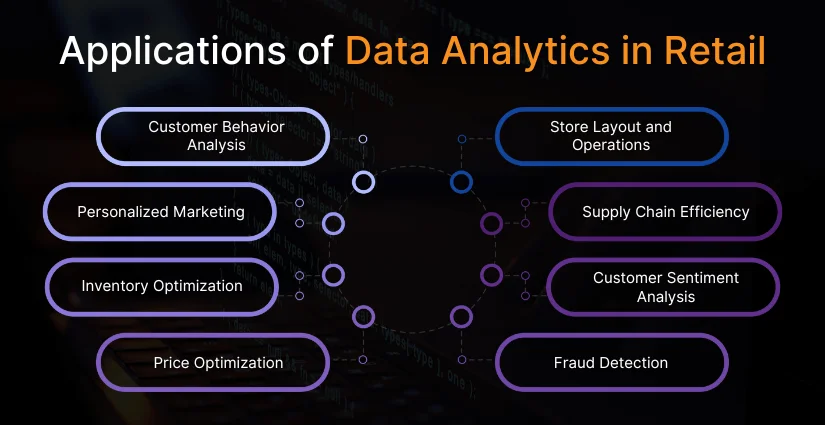
1. Customer Behavior Analysis
Purchasing histories, website visits, and mobile app use enable retailers to understand customers’ preferences and buying behavior. The information can be used for segmentation, targeted marketing, and better product recommendations to enhance the overall shopping experience.
2. Personalized Marketing
Predictive analytics enable retailers to develop a unique offer for each customer based on shopping patterns, demographic information, and past purchases. This customization increases the conversion rate and customer loyalty.
3. Inventory Optimization
Data analytics in retail can help a company predict demand, preventing stockouts and overstock. This ensures customers get what they want when they need it, enhancing customer satisfaction and minimizing waste.
4. Price Optimization
Retailers can examine market demand, competitor pricing, and seasonality to develop the most effective pricing strategy. The dynamic pricing models also help them stay competitive and maximize their profit margins.
5. Store Layout and Operations
Analytics will help retailers analyze customer flow in stores to identify busy areas. Knowledge derived from this information helps boost product placement and enhance the shopping experience.
6. Supply Chain Efficiency
Analytics provides end-to-end supply chain visibility, including both supplier and shipment performance. It helps retailers reduce delays, streamline operations, and make products available when needed.
7. Customer Sentiment Analysis
By analyzing social media comments, reviews, and feedback, retailers can gauge customer satisfaction and brand image. The experience in this area informs product development and marketing.
8. Fraud Detection
Data analytics tools detect unusual events and anomalies in purchase activity, enabling retailers to avoid fraudulent transactions and protect their businesses from losses.
Also Read: Data Analytics in Healthcare: Key Use Cases & Benefits
Key Applications and Benefits of Data Analytics in Retail
| Application Area | Analytical Focus | Resulting Benefit |
| Customer Analysis | Studying purchasing habits | Improved personalization and loyalty |
| Inventory Optimization | Predicting product demand | Reduced stockouts and waste |
| Pricing Strategies | Dynamic price adjustments | Higher margins and competitiveness |
| Marketing Optimization | Campaign performance tracking | Better ROI and customer engagement |
| Supply Chain | Shipment tracking and demand forecasting | Faster delivery and lower logistics costs |
With every application of data analytics in retail, businesses will be able to make smarter decisions and provide more value to customers.
Benefits of Data Analytics in Retail
The benefits of data analytics in retail affect both the strategic and operational levels. The following are the most notable advantages, which are discussed in detail:
- Improved Decision-Making
Data-driven decisions can help retailers make fast, precise decisions, minimise risk, and increase the probability of success of business actions.
- Enhanced Customer Experience
Retailers can use this knowledge to deliver a unique experience, making them more satisfied and loyal.
- Increased Sales and Profitability
Analytics assists in streamlining pricing, promotions, and merchandise mix in order to maximize sales and profitability.
- Operational Efficiency
Retail analytics simplifies the supply chains, minimizes waste, and makes sure that resources are used efficiently, minimizing retail software development cost.
- Customer Retention
Predictive analytics is also useful in identifying the at-risk customers and can be used to have targeted retention campaigns to retain them.
- Market Trend Identification
Retailers are able to identify new trends at an early stage and change their strategies as a way of remaining ahead of the competitors.
All these benefits of data analytics in retail will aid in the development of a more intelligent, efficient, and customer-oriented retail setting.
Examples of Data Analytics in Retail
The real-world examples of data analytics in retail indicate that successful retailers use analytics to demonstrate impressive outcomes.
- Amazon
Drives use of sophisticated predictive analytics to make highly individualized product recommendations, increasing sales and customer experience.
- Walmart
Uses analytics to help predict product demand in thousands of locations and manages inventory and waste.
- Starbucks
Relies on data analytics to determine new locations of stores, as well as creating specialized marketing programs in specific areas.
- Target
It uses predictive analytics in detecting shopping behavior and preempting the needs of customers before they occur.
- Sephora
Integrates both online and offline information to give customized beauty tips and enhance customer interaction.
These data analytics in retail examples show that integrating analytics into everyday operations drives innovation, efficiency, and profitability.
Read More: Data Analytics in Finance: Key Use Cases and Benefits
Impact of Data Analytics in Retail
The impact of data analytics in retail is revolutionary. It transforms the business model, increases customer interaction, and improves profitability.
Customers can now be studied in detail, and retailers know what drives them to buy. The insights based on data will allow accurate demand prediction, reduce costs, and make better decisions. Moreover, analytics enables the brand to introduce innovations at a faster pace, introduce products that are relevant, and remain nimble in a competitive market. The final result of all the impacts of data analytics in the retail sector is the enhancement of performance, the quality of customer relations, and long-term sustainable development.
Challenges of Data Analytics in Retail
Although its potential is enormous, many challenges of data analytics in retail require the attention of the business. Some of the major challenges are listed below.
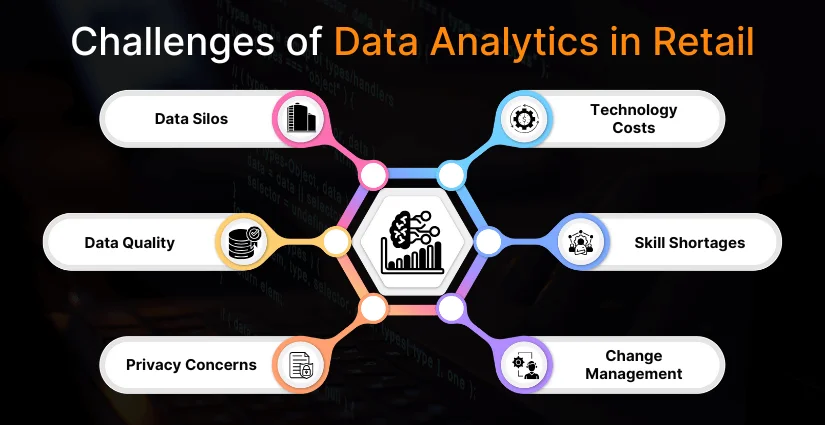
- Data Silos
The information is usually stored in unconnected systems, and hence it is very hard to combine and get any meaningful information out of it.
- Data Quality
Crap quality or negligent data may result in false conclusions and wrong decisions.
- Privacy Concerns
Retailers should treat customer data with respect and adhere to laws such as the GDPR privacy law in order to retain trust.
- Technology Costs
The cost of implementation of analytics platforms and data management systems may be unaffordable to small retailers.
- Skill Shortages
It might be difficult to find good data scientists and analysts who know the dynamics of the retail business.
- Change Management
A change in the culture of organizations is needed to shift to data-driven decision-making as opposed to the intuition-based one.
It is important to take note of these challenges of data analytics in retail to ensure a successful analytics initiative is successful in the long run.
Future of Data Analytics in Retail
The future of data analytics in retail is bright, as it will continue to develop and become even more innovative and automated. With the development of artificial intelligence (AI), machine learning (ML), and the Internet of Things (IoT), retailers will get better insights and predictive opportunities.
- AI-Powered Insights
The AI will assist the retailers in decisions made in real-time and customized based on customer behavior.
- Predictive and Prescriptive Analytics
They will project trends and give the most appropriate course of action to the retailers.
- Omnichannel Analytics
Online and offline data will be combined to achieve one customer experience.
- Sustainability Analytics
Information will be used to help retailers optimise energy consumption, waste reduction, and achieve sustainability objectives.
- Visual and Voice Data Analysis
As voice shopping and visual search increase, retailers will study new types of data to gain information.
The future of data analytics in the retail sector is a data-driven, customer-centric, and sustainability-oriented direction, which will be the next phase of development in the industry.

Conclusion
Data analytics in the retail business is no longer a choice, but a matter of survival and development. Through efficient use of data analytics in retail, retailers can better understand the needs of the customer, enhance operations, and make sound business decisions.
However, in spite of the difficulties that data analytics in the retail world has, it is an invaluable instrument in the hands of the contemporary retailer due to the benefits that it can possibly bring, not only to the content of the clients, but also to the substantial increase in revenue.
With the development of technologies and availability of top-notch custom software development services, the trend of using data analytics in retail will become even more powerful, changing the nature of relationships between retailers and customers and the rivalry in a competitive environment.
Frequently Asked Questions
The retail data analytics cost depends on the scale and tools. Small businesses can expend several thousand dollars per year, whereas big businesses investing in AI-powered analytics can spend more than $100,000 on the same.
The benefits of data analytics in the retail industry are high ROI – retailers can gain a 10-20% growth in sales and a 15-30% efficiency increase by using data analytics in the process of setting pricing, marketing, and operations.
The cost reduction through data analytics in the retail industry is seen through demand forecasting, minimizing stockouts, and efficient logistics. Automation and real-time data also allow retailers to reduce waste, streamline operations, and enhance employee productivity.
Yes, small retailers are not left behind in the use of data analytics in the retail industry, with low-priced cloud-based tools. Analytics assists them in monitoring the sales and customer behavior, and helps them make smarter inventory and marketing decisions at a lower cost.
Retailers that have not applied data analytics in retail would risk being inefficient, having poor inventory management, losing customer insights, and falling behind in competition. Decision-making without analytics is guesswork, which decreases the profitability and business sustainability in the long term.


 Get in Touch
 By
By August 31, 2020