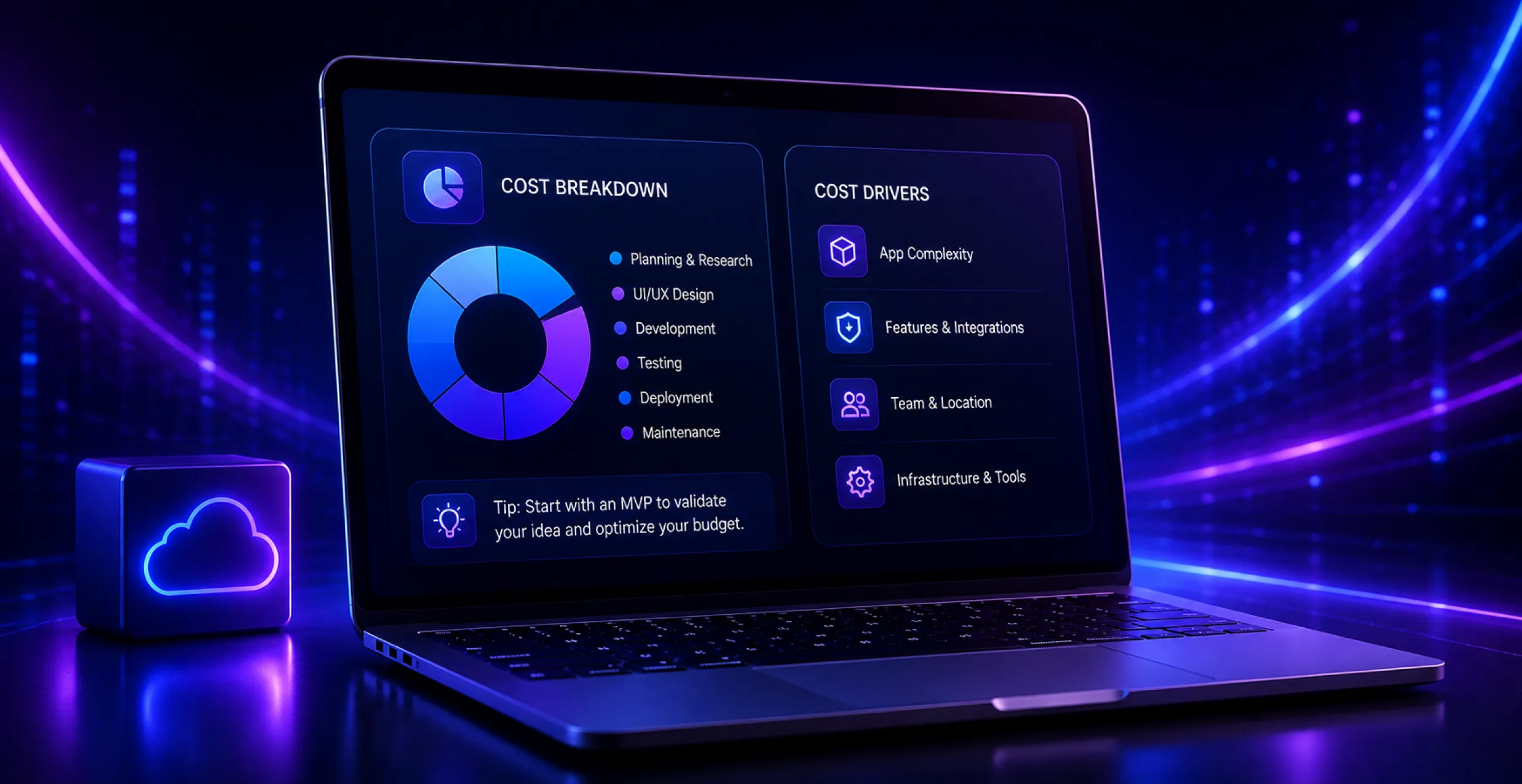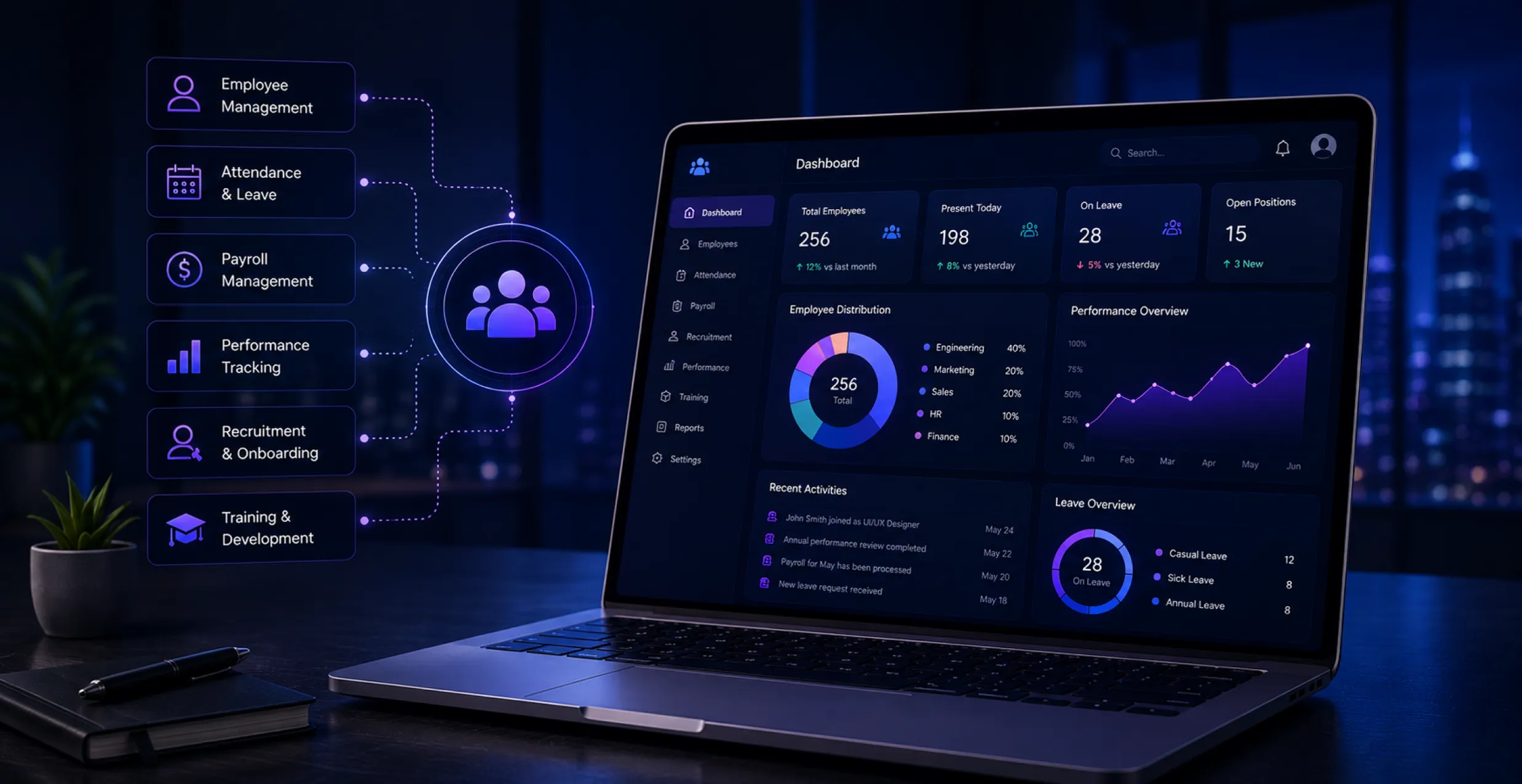



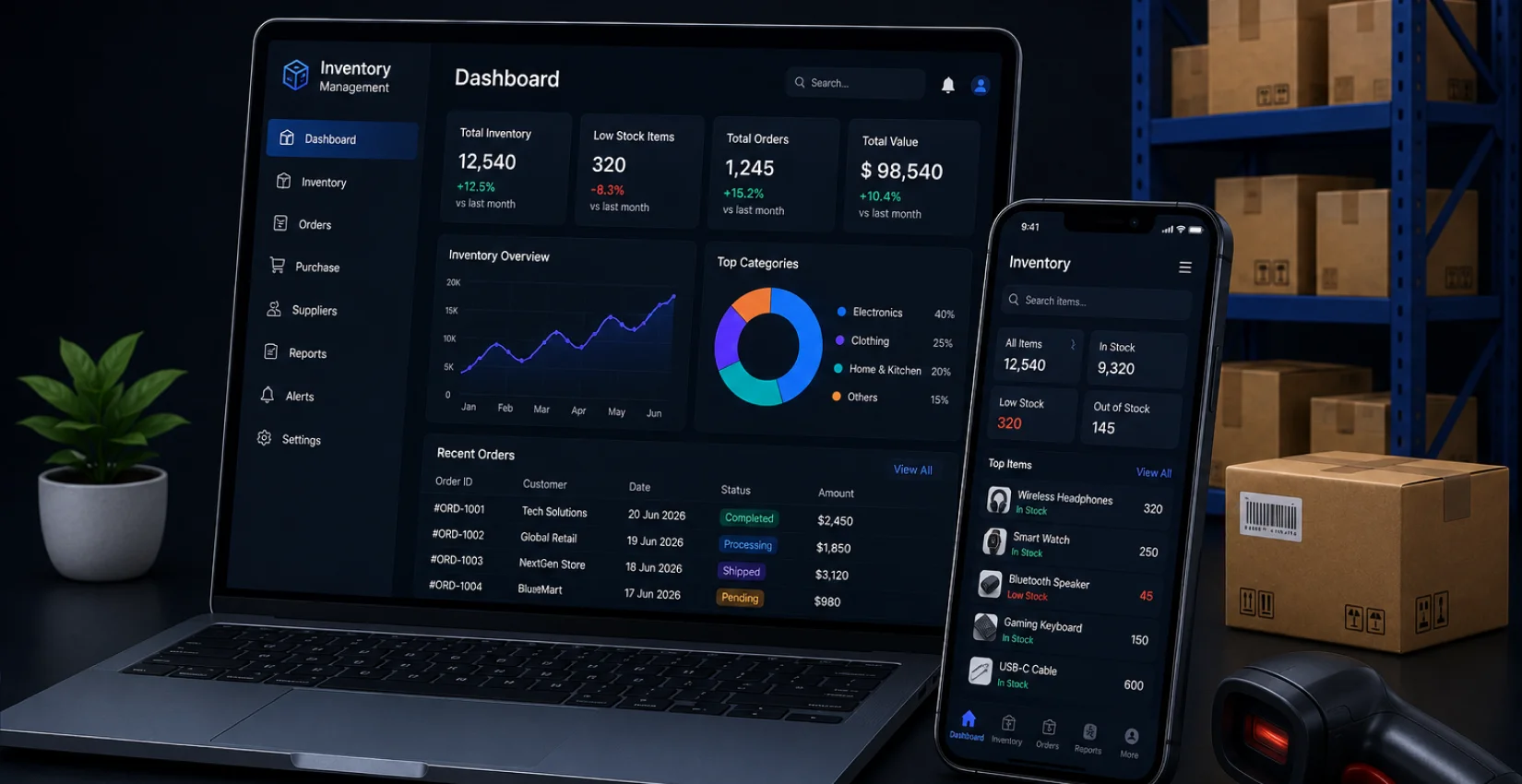
Are you still managing your inventory using spreadsheets and manual stock updates? In 2026, a lot of businesses are quickly transitioning to more intelligent, automated processes, frequently driven by inventory management software and cloud tracking systems. It’s not just about “keeping records”; it’s about not just trimming stock errors but also making the warehouse run smoother and more efficient. In general, newer solutions are reshaping the way businesses deal with inventory, even day to day.
According to Grand View Research, the global inventory management software market was valued at around USD 3.74 billion in 2025, and it’s expected to climb to about USD 7.14 billion by 2033. That growth pace comes in at a CAGR of 8.9% for 2026 through 2033.
So, more and more organizations are investing in inventory management software development to gain real-time inventory visibility and improve demand forecasting. These solutions also help businesses streamline daily operations across multiple locations without unnecessary operational delays.
What is Inventory Management Software?
Inventory management software helps companies track, organize, and manage stock levels, orders, warehouses, and deliveries all at once in real time. It makes the whole workflow feel less messy, even when things get busy.
Compared with traditional stock control systems, modern inventory tracking software tends to automate a lot of routine inventory chores, improve precision, and give businesses better decision-making. Especially if they’re dealing with large inventories or multiple places at the same time.
Key Benefits of Inventory Management Software Development
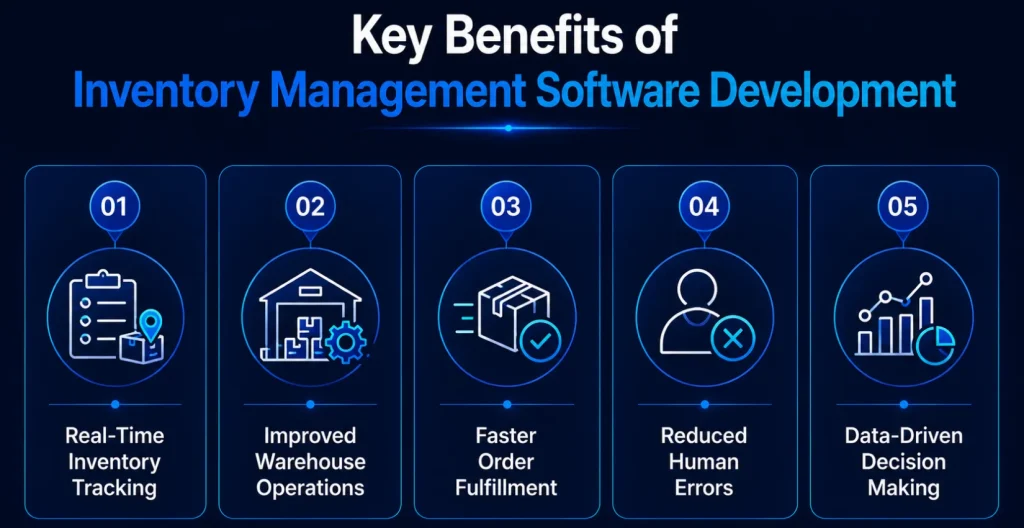
Modern businesses use inventory management software development to increase stock visibility, streamline daily operations, and reduce inventory losses. A carefully designed inventory management system can also enable tighter planning, reporting, and smoother day-to-day operations, mostly because of advanced automation along with integration capabilities.
1. Real-Time Inventory Tracking
Through real-time stock monitoring, organizations are able to view how inventory moves immediately throughout warehouses and stores. As a result, stock shortage issues will be easily mitigated, forecasts will become more accurate, and faster decisions will be made due to the connectedness of the platform.
2. Improved Warehouse Operations
Advanced processes in the warehouse can help manage inventories in the warehouse regarding how they are stored, selected, packed, and dispatched. With the help of inventory platforms and WMS, productivity is increased while simultaneously reducing any possible delays as well as human stock handling errors.
3. Faster Order Fulfillment
Automated order processing makes order fulfillment faster in terms of shipping and delivery services. Digital inventory systems assist businesses in getting real-time information on stock levels and fulfilling orders instantly.
4. Reduced Human Errors
Through automation, human errors during manual entry of inventory data, double-entry errors, and discrepancies in stock will not happen again. Organizations using barcode scanning in combination with automated inventory tracking get great benefits from their inventories.
5. Data-Driven Decision Making
Inventory dashboard and data analytics help in understanding demand and trends of product inventory and procurement. This information helps businesses plan their procurement and stocking strategies more efficiently based on forecasts.
Inventory Management Software Features Businesses Need in 2026
Today’s enterprises need efficient inventory management software so they can get better visibility, automation, and overall operational efficiency. The best customized inventory management option will really assist organizations with handling their inventory properly. As well as removing hand-driven tasks and tuning inventory workflows through smart integrations along with cloud-based technologies.
1. Real-Time Inventory Monitoring
Being able to follow inventory movement, warehouse activity, and those low-inventory notifications is crucial for preventing stockouts and supporting stronger operational choices.
2. Barcode & QR Code Scanning
When you use barcodes and QR codes for automatic product recognition, it supports automation of the workflow. Also, it improves inventory accuracy, and it also cuts down on those annoying manual errors.
3. Multi-Location Inventory Management
Inventory across an organization usually means you need to centralize stock oversight for multiple warehouses and also retail locations so the inventory management effort becomes more streamlined.
4. Cloud Inventory Management Capabilities
With SaaS-based approaches to developing inventory management systems, inventory control in the cloud environment becomes increasingly flexible, turning remote monitoring and collaboration into a regular practice.
5. ERP Inventory Management Integration
In cases where inventory management applications interact with ERP systems, organizations may expect greater organizational efficiency associated with the process.
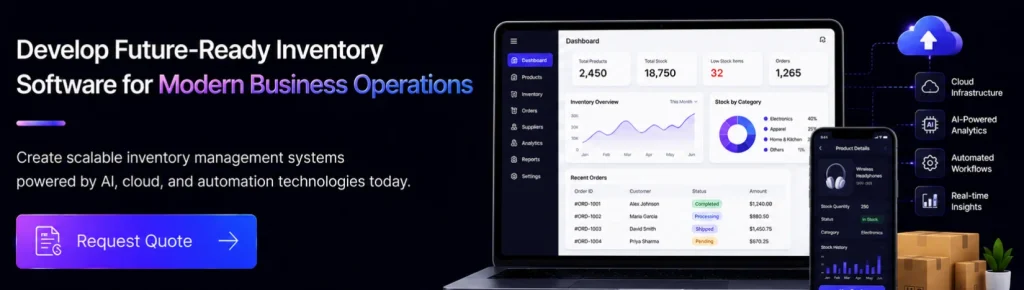
The Best Inventory Management Software of 2026
Nowadays, companies require scalable and easy-to-use inventory software that could help them manage inventory effectively, automate processes, and get better insights into their operations. Here is a list of some platforms that have powerful inventory management functionalities.
| Inventory Management Platform | Starting Cost | Customizable | Integrations | Easy to Use |
| Odoo | Free; Paid from $31/user/month | High | 16,000+ apps | Moderate |
| Square | Free; Paid from $49/month | Limited | Shopify, Wix | Easy |
| Katana | Free trial; Paid from $299/month | Yes | QuickBooks, Shopify | Easy |
| ShipMonk | Custom pricing | Moderate | 200+ platforms | Easy |
| NetSuite ERP | Custom enterprise pricing | High | Extensive ERP integrations | Moderate |
Cloud Inventory Management vs Traditional Inventory Software
Modern businesses are opting for smarter and scalable inventory solutions. The choice of the inventory management options is driven by operational requirements, budgets, and organizational growth strategies.
1. Deployment Differences
Traditional software requires installation and maintenance; cloud inventory software offers remote services to organizations. Businesses deploying inventory management software in small-scale organizations prefer the cloud option.
2. Cost Comparison
The subscription model followed in cloud computing reduces costs as compared to high maintenance and hardware costs in traditional inventory software.
3. Scalability & Flexibility
Organizations can conveniently expand and add storage space without installing physical hardware. With traditional inventory software, there will be a requirement to install more physical inventory systems.
4. Which Option is Better for Modern Businesses?
Cloud-based inventory management systems can support being more scalable, remote, and adaptive as compared to traditional systems. The use of cloud-based systems is preferred by software engineers due to scalability, automation, and future-ready inventory operations.
Industries Using Custom Inventory Management Solutions
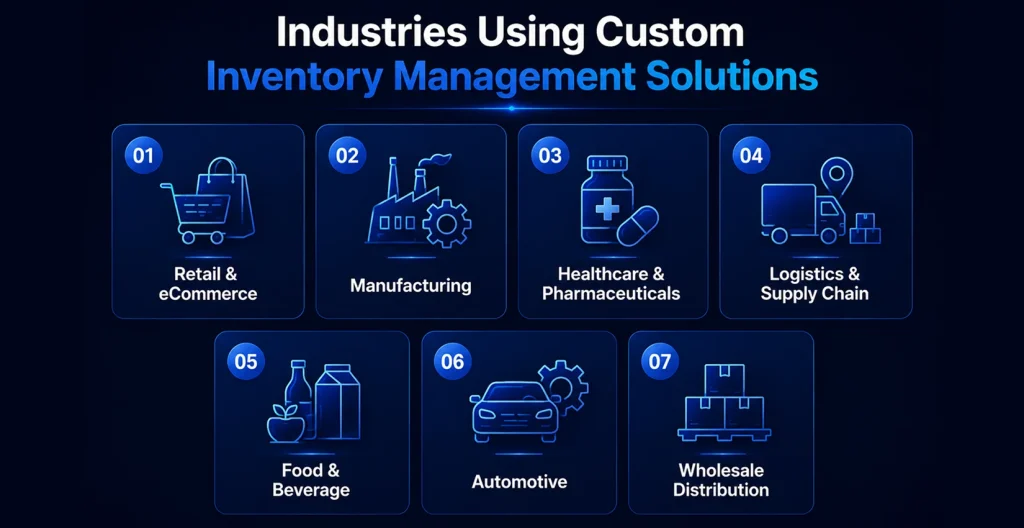
Various industries depend on complex inventory management systems in order to effectively handle their inventories. There are several benefits that can be obtained from inventory management systems such as minimizing error levels and improving inventory processes.
1. Retail & eCommerce
The retail industry uses inventory management systems to effectively handle its inventory and process orders as well. Improved inventory management will help to provide a better shopping experience to customers.
2. Manufacturing
Inventory management systems will assist manufacturers in monitoring stock related to products, materials, and the finished products themselves. Improved inventory management will ensure that the firms do not encounter wastage in their production processes.
3. Healthcare & Pharmaceuticals
The healthcare industry uses inventory management systems to monitor the expiry of medicines and medical equipment. Efficient inventory management will ensure that there are no legal concerns and that essential medicines are readily available.
4. Logistics & Supply Chain
The logistics industry implements stock tracking systems for the management of their warehousing stock, shipments, and logistics distribution systems. This makes work efficient and gives increased visibility of their processes during transportation and logistics operations.
5. Food & Beverage
The use of the inventory system that allows one to monitor the stock of food companies is very essential. Monitoring the stock helps to minimize wastage and provides a proper way of stock management.
6. Automotive
Automobiles need a stock system that will allow them to manage their spare parts, components, and warehouse stock. It is very important to track the stock because it ensures better coordination within the supply chain management and minimizes any delay.
7. Wholesale Distribution
Wholesale distributors utilize Custom Inventory Solutions to manage their warehouse stocks, coordinate with suppliers, and track orders. Most businesses utilize custom inventory solutions with logistics software development services.
Check Also: Continuity Of Care Software Solutions
Custom Inventory Management vs Ready-Made Inventory Software
Most businesses compare custom inventory management systems and ready-made inventory software to determine the best operational option for them. The choice is based on their needs and future business growth goals.
1. Benefits of Custom Inventory Management
The customized inventory management systems give the firms an enhanced level of flexibility, automation, and control over the whole process of inventory management.
2. Challenges of Off-the-Shelf Software
Prepared or pre-designed inventory management software might not be flexible, automated, and integrated.
3. When to Choose a Custom Inventory Management Solution
Businesses having a difficult inventory management operation or having an inventory management system in multiple locations will have to adopt a customized inventory management system.
4. Long-Term Business Advantages
Adopting a customized inventory management system gives the firm more flexibility and the ability to scale as per future requirements. The companies are investing in inventory management software development company services to achieve success in operations and returns on investments.
How to Develop Inventory Management Software Successfully?
Creating a successful inventory management system is more than just adding features; it is about creating a solution that seamlessly integrates with your business operations. Every single stage during the development of custom inventory software is equally important.
Step 1. Understand Business Requirements
First, one should analyze the problems in the field of stocks and their warehousing and then proceed with the development of the software.
Step 2. Plan Features & Choose the Right Technologies
The second thing that must be done is to define the features of the developed software, such as the ability to manage stock, barcode scanning, reporting, etc.
Step 3. Design a Simple & User-Friendly Interface
Thirdly, there is a need to develop a user-friendly interface that facilitates the performance of inventory management tasks for employees.
Step 4. Integrate Essential Business Tools
Fourthly, integrating the software with other systems makes it possible to automate business processes. However, many companies tend to integrate inventory software with CRMs.
Step 5. Test, Launch & Improve Regularly
Before deployment, the software should be tested for performance, security, and overall usability. Once it’s launched, though, regular updates plus routine maintenance make it easier to keep everything reliable, secure, and somewhat synced with the business needs
Technology Stack for Inventory Management Software Development
Choosing the right tech stack is essential if you want to build a scalable and secure inventory setup. Companies that are investing money in inventory management software development should lean on modern tools that help with automation, third-party integrations, and cloud infrastructure and also prepare for the future through efficient ERP software development practices.
| Technology Area | Technologies Commonly Used |
| Frontend Technologies | React.js, Angular, Vue.js, HTML5, CSS3 |
| Backend Frameworks | Node.js, Django, Laravel, .NET, Spring Boot |
| Mobile Development | Flutter, React Native, Swift, Kotlin |
| Cloud Platforms | AWS, Microsoft Azure, Google Cloud |
| Databases | MySQL, PostgreSQL, MongoDB, Firebase |
| AI & Automation | Python, TensorFlow, OpenAI APIs |
| IoT & RFID | RFID Sensors, IoT Gateways, BLE Devices |
| Security Technologies | OAuth 2.0, JWT, SSL Encryption, MFA |
| DevOps Tools | Docker, Kubernetes, Jenkins, GitHub Actions |
| Analytics & Reporting | Power BI, Tableau, Google Data Studio |
Inventory Management SaaS Development Trends in 2026
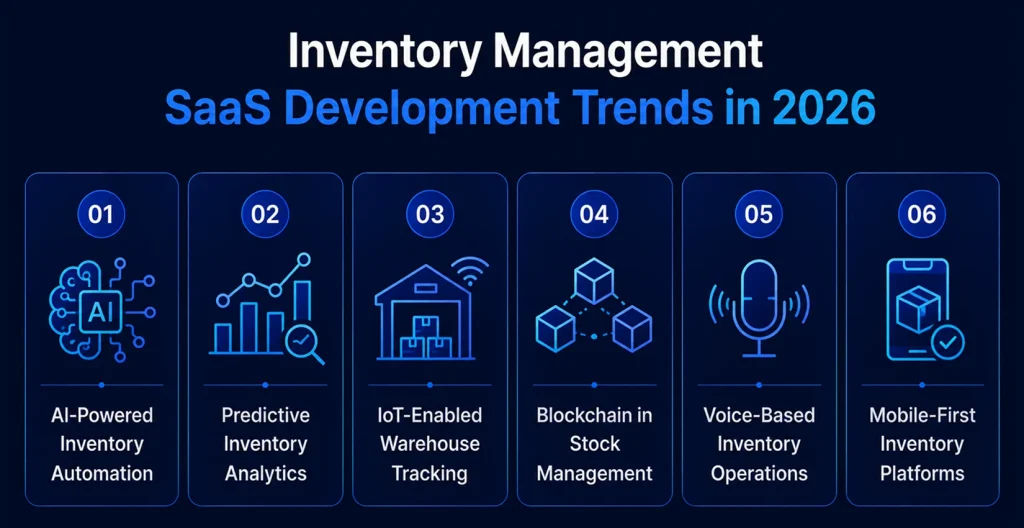
In 2026, inventory platforms are moving fast, mainly powered by AI, automation, and cloud technologies. Organizations building inventory management SaaS solutions are putting more focus on scaling smoothly, “smarter” forecasting, and operational automation that feels seamless, so it supports long-term business growth without constant friction.
1. AI-Powered Inventory Automation
Predictive analysis enables AI-assisted automated inventory tracking, ordering, and forecasting. Intelligence-driven automated systems can help organizations reduce the burden of work and better manage inventory.
2. Predictive Inventory Analytics
Businesses can precisely predict customer demands and inventory movements by using predictive analysis. With this, businesses can optimize their planning process, avoid any shortage of stock, and make purchases efficiently.
3. IoT-Enabled Warehouse Tracking
The use of the Internet of Things and radio frequency identification will assist companies in tracking their warehouse and inventory. It enables companies to monitor their inventories without being at risk of losing transparency.
4. Blockchain in Stock Management
This technology will enable businesses to track their inventories and make sure that they have enough stock. It assists organizations in tracking inventories while ensuring complete transparency of transactions.
5. Voice-Based Inventory Operations
Voice assistance allows workers in the warehouse to control their inventories hands-free. Voice-enabled processes ensure the efficiency of operations and save time for organizations.
6. Mobile-First Inventory Platforms
Businesses increasingly prefer mobile-friendly inventory platforms, which are more beneficial as they allow remote access and flexible working. The investments in SaaS application development help businesses improve their workforce collaboration and inventory management using mobile platforms.
Cost Breakdown for Building an Inventory Management System
The overall inventory management software costs involve a lot of factors, such as the business requirements, complexity, the ability to integrate the software, and also the location from which it can be developed.
Cost by Team Roles
| Development Role | Estimated Hourly Cost |
| UI/UX Designer | $20–$50 |
| Frontend Developer | $25–$70 |
| Backend Developer | $30–$80 |
| QA Engineer | $20–$45 |
| Project Manager | $35–$90 |
Cost Based on Development Phase
| Development Phase | Estimated Cost |
| Requirement Analysis | $2,000–$5,000 |
| UI/UX Design | $3,000–$8,000 |
| Development | $15,000–$80,000 |
| Testing & QA | $4,000–$10,000 |
| Deployment & Maintenance | $3,000–$12,000 |
Software Complexity Cost Breakdown
| Software Complexity | Estimated Cost |
| Basic Inventory System | $15,000–$30,000 |
| Mid-Level Inventory Platform | $35,000–$70,000 |
| Enterprise Inventory Software | $80,000–$200,000+ |
Cost According to the Development Region
| Region | Average Hourly Rate |
| North America | $80–$180 |
| Western Europe | $60–$150 |
| Eastern Europe | $35–$80 |
| Asia | $20–$60 |
Key Cost Considerations
While creating a budget for custom inventory software, it is important for the organization to keep in mind the following key cost factors. In any case, there is no doubt about the fact that many organizations also use inventory software with custom software development services.
Challenges in Inventory Management Software Development
Developing a scalable inventory platform is tricky; there are technical complexities, plus operational planning and integrations. Companies that are looking at the best inventory management software development services really do need to deal with performance, security, and scalability challenges to ensure long-term software reliability.
1. Complex Inventory Workflows
The processes related to inventory management, as well as warehousing, vary from one industry to another. Therefore, while developing the software that will perform customized processes of inventory management, one should have a good plan for developing an appropriate architecture.
2. Data Security & Compliance
During the process of managing inventory information, businesses accumulate information about their activities. Thus, the issue of security is important when implementing encryption and other safety mechanisms required for protecting inventory information from cyber threats.
3. Integration with Legacy Systems
Many companies are still using outdated enterprise resource planning systems and other types of business management applications. Consequently, it is important to consider the problem of legacy systems compatibility during software development.
4. Scalability Issues
While growing, businesses face certain scalability challenges for their inventory systems because of the increasing number of transactions to handle, the number of system users, and warehouse processes.
5. Managing Multi-Warehouse Operations
For managing operations in multiple warehouses, it is necessary to use the data instantly and operate centrally. If companies want to integrate inventory management with warehouse management software, they can achieve this goal successfully.
How to Choose the Right Inventory Software Development Company?
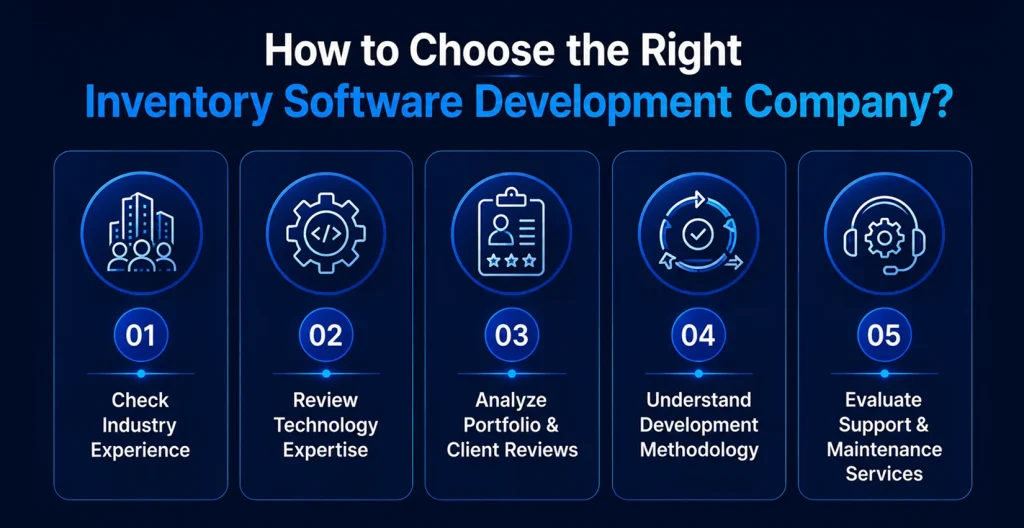
Choosing a suitable inventory management software development provider depends on various factors. While choosing a company, businesses must consider the technical and technological skills of a company as well as its experience and support capabilities.
1. Check Industry Experience
Experience and knowledge of the company about inventories and warehousing solutions will help the company understand problems related to inventories better.
2. Review Technology Expertise
The technical team must be proficient in cloud computing technology, AI integration, automation, and scalable back-end infrastructure to develop efficient software solutions.
3. Analyze Portfolio & Client Reviews
Looking into previous projects and feedback from clients can help the business know the capabilities of the company in terms of software development and project handling skills.
4. Understand Development Methodology
The agile approach is considered best in software development since it brings flexibility, fast delivery, and transparency in project execution.
5. Evaluate Support & Maintenance Services
Post-development services are very crucial for any software product. Businesses often look for companies that offer full-fledged logistics software development solutions.
Future of Inventory Management Software Development
The future of inventory management software development involves the combination of AI, automation, robotics, and predictive analytics. Many businesses invest in advanced inventory systems that will help them optimize their operations and increase the precision of forecasts and warehouse automation for sustainable development in the future.
1. AI-Driven Stock Optimization
Artificial intelligence solutions analyze trends in demand and flows of inventory and help in optimizing stock levels so that there is no waste, and automatic purchase orders are made.
2. Autonomous Warehouses
Warehouses are moving toward robotics and IoT devices, plus other automation tech. This helps the whole inventory process run faster, with less hands-on work, and usually with higher accuracy.
3. Smart Inventory Forecasting
Using machine learning techniques in predictive analysis allows a business to predict inventory demands with increased accuracy and minimize negative effects on its inventory management.
4. Robotics and Automation Trends
Automation is basically smoothing out warehouse work like sorting, packaging, and inventory tracking. It increases operational speed, and it tends to improve overall productivity across teams.
5. Future Opportunities for Custom Inventory Solutions
Companies are leaning into scalable custom inventory solutions, with AI, along with cloud technologies. So, businesses that invest in SaaS application development can create more flexible, future-ready inventory platforms that can adapt when requirements change or when volumes increase.
Final Words
Modern businesses require efficient and scalable inventory management systems that help organize stock effectively, automate processes, and ensure transparent and faster decision-making. After implementing an inventory management software solution, an organization is more likely to get better inventory visibility and fast order fulfillment, hence ensuring higher efficiency in operations in the long run.
Since companies are moving towards using automation, cloud solutions, and AI these days, there will definitely be a huge demand for inventory management software development in the coming years.
By choosing the most suitable development strategy, companies will find themselves able to integrate modern technologies and develop ERP software that will provide inventory management solutions for the future and ensure company scalability and accuracy of operations.
Also Read : HL7 Interface Development


 Get in Touch
 By
By September 30, 2026