




You need to hire blockchain developers, and every guide you’ve read so far tells you the same thing. Learn Solidity. Check out GitHub. Post a job. None of that tells you why many of these blockchain hires quietly fail within months. This guide tells you what you actually need. It tells you how to choose the right role, verify real skills before the first call, and avoid the mistakes that cause most blockchain hires to fail.
Your business will also learn how to price a hire correctly, structure the contract, and look at the specific security risks in this field. By the end of this blog, you will know exactly how to proceed, whether you search yourself or bring along a team that has already done it.
The Blockchain Developer Market in 2026
The expert talent pool is smaller than it was two years ago. That changes how you should search.
Why the Talent Pool is Smaller But More Experienced
Electric Capital’s developer tracking shows monthly active crypto developers peaked at around 31,000 in 2022. That number dropped to around 18,000 by mid-2025, with many junior developers moving into AI jobs, according to CoinDesk’s analysis. What remains is a smaller group of much more experienced developers.
Why Enterprises Are Turning to External Partners
Building an in-house team can take months, and many businesses cannot afford that delay. This pushes more businesses toward specialized blockchain development companies instead of hiring solo. The organizations provide the entire team, from smart contract engineers to security auditors, without a six-month hiring process.
What This Means for Your Timeline & Budget
Expect your search to take longer than a typical software hire. Senior blockchain developers are rarely easy to find through standard job postings. Budget more time for sourcing, and verify every candidate’s experience beyond the resume.
A small, more senior market also means that competition is fierce. Crypto-native firms have been hiring from this same pool for years. If you’re a first-time buyer looking to hire blockchain programmers, expect to compete on more than salary alone. A clear project pitch and quick hiring decisions can help you compete for that talent.
Who You Are Actually Hiring: The 4 Blockchain Developer Roles
“Blockchain developer” covers several very different roles. Choosing the right one can save you months.
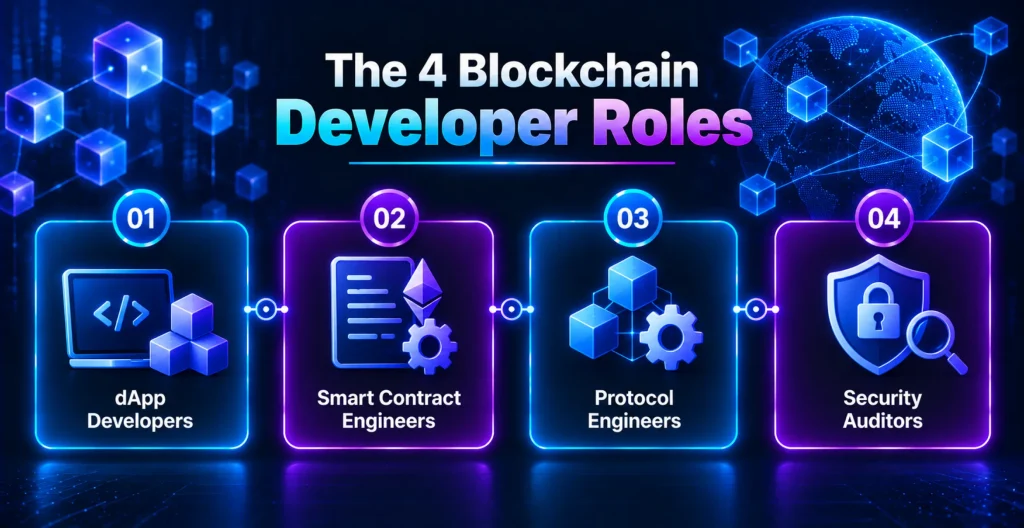
1. dApp Developers
These developers create wallets, dashboards, and interfaces that talk to the blockchain. They read data and connect wallets through tools like ethers.js. If your product needs a smooth front end for crypto customers, this is the role you prioritize first.
2. Smart Contract Engineers
Smart contract engineers write code that actually holds and moves funds. Once deployed, smart contracts can be difficult or risky to modify, depending on their architecture. Mistakes here are permanent and expensive, so this role deserves the deepest testing of the four.
3. Protocol Engineers
Protocol engineers build blockchain clients, consensus mechanisms, and core infrastructure that other developers rely on. This skill is rare and is not required by most companies at all. Unless you’re making your own personal chain or rollup, you can probably skip this role entirely.
4. Security Auditors
Security audit engineers study contracts the way an attacker would. This skill set is critical for almost any serious enterprise, especially once you’re delivering contract updates on a daily schedule rather than a single launch.
| Role | What They Build | Verify First |
| Application developer | Wallets, dashboards, dApp UI | Shipped wallet integrations |
| Smart-contract engineer | On-chain logic holding funds | Verified mainnet contracts |
| Protocol engineer | Chains, consensus, client code | Merged commits on a live protocol |
| Security/audit engineer | Vulnerability testing | Published audit findings |
Do You Need A Blockchain Developer At All?
Before you post a role, ask a question. Does your code hold funds on a public chain, or just read records from one? If you’re only displaying chain data, a strong back-end engineer with Web3 libraries may be a good fit. You don’t always need to hire a blockchain developer for that job.
Choosing Your Engagement Model
Once you know the role, decide how you want to bring that developer or team on board.
In-House vs. Freelancer vs. Development Agency
An internal hire gives you full control but takes months to onboard. A freelancer moves quickly but puts all your risk into one person. A development company sits in the middle, providing you with a prepared team without a long ramp-up.
Matching the Model To Your Project Stage
Early-stage products validating an idea often start with a freelancer or small business team. Once the product has proven itself, many companies turn to long-term partners or bring core roles in-house. Match the prototype to where your product actually stands, not where you probably want it to be.
Contract, Direct Hire, or Dedicated Team
A quick, limited project is well suited for contracting. Long-term products that require years of maintenance typically require direct hire or a committed team. If you’re unsure how senior the role should be, a contract-to-hire arrangement lets you evaluate the fit first.
Where a Dedicated Team Outperforms a Solo Hire
No one checks the work of a freelancer. If they disappear midway, you’re stuck. When you hire dedicated blockchain developers for the long-term, you get built-in code support and backup coverage. It also creates shared responsibility across the team.
Recommended Read: Blockchain Use Cases
Must-Have Skills and 2026 Tech Stacks to Vet For
Skill requirements shift quickly in this field, so keep your checklist up to date.
1. Languages That Matter Now
Solidity is still common for Ethereum and EVM-compatible chains. Rust is the preferred language of Solana and many more modern chains. Go still powers much of the protocol-level work behind the scenes.
2. Token Standards Worth Knowing
If your project involves tokens, look for hands-on experience with ERC-20 for currencies, ERC-721 for NFTs, and ERC-1155 for mixed token sequences. A developer who has honestly delivered these standards moves more quickly than one who has only read about them.
3. Cryptography & ZK Skills
Basic cryptographic concepts such as hashing and digital signatures are essential for this work. Zero-knowledge proof experience is also a real differentiator, especially for privacy-focused and scaling projects. However, it is a small pool, so don’t assume every candidate has this.
4. Tools They Should Already Know
Look for hands-on experience with Hardhat and Foundry for testing, and Remix for quick contract development. Look for experience using block explorers to verify deployed code. If you want to hire blockchain experts for an important build, those tools should already be second nature to them.
Ask candidates to walk you through a setup they have actually used, not just naming the tools. Anyone who uses Foundry every day can describe their workflow in seconds. Someone who has only read about it usually can’t answer those questions.
Verify Before You Commit
Most hiring guides skip this step, but it can save you the most pain later.
1. Verify the Developer’s Real Work
One advantage of blockchain work is that much of it is publicly verifiable. Use that to your advantage. Ask for the mainnet contract address, not just a GitHub link. Open the address on Etherscan or Solscan, and check when it went live. Also check how many transactions are handled and whether the source code is verified.
Then check the published audit report and any bounty payments associated with their names on platforms like Immunefi. Before you make a hiring decision, this 20-minute check can tell you more than an entire interview loop.
2. Verify An Agency’s Practices
If you’re comparing an organization rather than a person, ask specific questions. Do they send the smart contract to the third-party auditor, or do they evaluate the work entirely through their internal team?
If a delivered contract is exploited, who is responsible? Does support end at launch, or do they monitor the contract afterward? These questions matter as much as examining the individual’s portfolio.
Blockchain Developer Hire Cost, Salary & Contract Essentials in 2026
Budget planning here goes beyond a single hourly number.
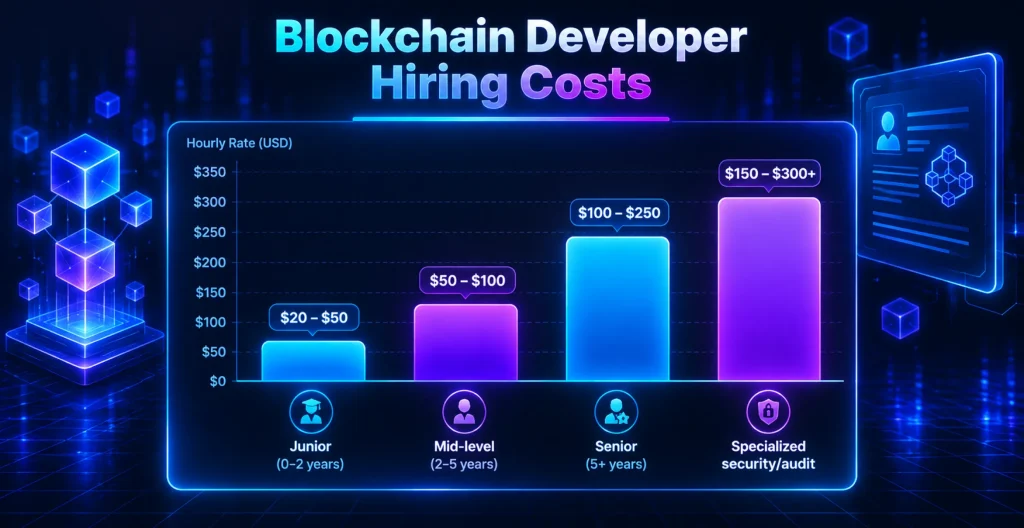
Typical Blockchain Developer Rates by Experience
Rates vary significantly by location, employment type, specialization, and whether you are hiring directly or through an agency.
| Experience Level | Hourly Rate (USD) |
| Junior (0–2 years) | $20–$50 |
| Mid-level (2–5 years) | $50–$100 |
| Senior (5+ years) | $100–$250 |
| Specialized security/audit | $150–$300+ |
Cost by Engagement Model
In the US, senior smart contract engineers can command six-figure salaries, with compensation varying by location, experience, and specialization. Agency fees for the same tenure typically range between $50 and $250 per hour, depending on scope.
Understanding the actual blockchain app development cost for each model helps you compare options fairly. This approach helps you avoid choosing based only on the lowest price.
Cost by Region
Within the US and UK, developers sit at the top of the pay scale. Eastern Europe and India offer strong technical expertise at lower prices. Proper vetting can help maintain code quality.
Key Cost Drivers
Seniority is not the only factor that drives cost. Custody logic, the number of chains supported, and audit scope all push pricing higher. A simple dashboard requires far less than a contract managing millions in user funds.
Hidden Costs
Third-party audits, ongoing monitoring, and potential redeployment after a bug all add real cost. Factor these in before you set a budget, not after a problem arises.
A single independent audit can run anywhere from a few thousand dollars to well over $50,000. This depends on the project complexity. Skipping it to save money is generally the expensive shortcut in blockchain development.
IP Ownership, NDAs, & Payment Structure
Get IP ownership terms in writing before work starts. Use an NDA for everything before launch. Milestone-based invoicing will save you more than a flat hourly rate. It lets you adjust payments as you review and approve each stage.
Sourcing & Briefing Your Search
Finding the right developer is only half of the job. How you approach them matters just as much.
1. Freelance Marketplaces & Their Limits
General marketplaces work fine for small, meaningful tasks. For anything touching real funds, however, the vetting on these platforms is often too thin. If your project is remote-first by design, use platforms built for remote hiring. Choose platforms that help you hire remote blockchain developers with verified track records.
2. Vetted Networks & Development Agencies
Vetted networks screen candidates for technical proficiency and communication skills before you ever see the profile. Organizations go further, often bundling architecture, development, and post-launch support under one team.
3. Sourcing Through the Work Itself
The strongest candidates rarely apply for job posts. Look who’s contributing to protocols similar to yours or whose names appear in audit reports for comparable products. A specific note about their work will get more attention than a generic outreach message.
This approach takes more time than posting a job and waiting for applications. However, it is the most effective way to reach experienced developers. Most of them aren’t browsing job boards at all.
4. Writing A Brief That Attracts Senior Talent
Describe what the code will protect, not just the technology stack. “Own settlement contracts run six figures a month” tells the serious engineer more than a list of languages. If you are hiring for a business-critical product, clearly outline the required blockchain app development services. Cover everything from smart contracts to ongoing assistance.
Interview & Technical Vetting Framework
A robust interview process helps filter out candidates who communicate well but lack hands-on delivery experience.
1. The Live Code-Review Test
Give the candidate an actual contract with a real flaw in it. Ask them to figure out where the attacker will take the money. Strong candidates identify the flaw quickly and explain how an attacker could exploit it.
2. Questions That Reveal Real Experience
Ask about a defect they encountered in production and what it costs to fix. Ask which of their past designs they would change today. Vague answers generally mean limited hands-on experience. When you hire blockchain app developers, specific answers about real failures matter more than polished theory.
3. Why Blockchain Puzzles Miss the Point
General coding puzzles test programming ability, but they do not reveal how candidates handle blockchain-specific risks. What matters here is how someone reasons about attackers and financial incentives together. A live code review shows that far better than a tech-home test ever will.
Look at how candidates read code, not just how fast they type. Strong engineers pause at the parts that move money and ask questions before touching anything else.
Security Red Flags in Blockchain Hiring
Blockchain hiring carries security risks that most standard hiring processes were never designed to address.
Identity Fraud & State-Backed Infiltration
North Korean-linked hackers stole $2.02 billion in cryptocurrency in 2025, according to Chainalysis. That represented a 51% increase from the previous year. Chainalysis notes that the IT staff carried out most of these attacks. These schemes involved fraudulent remote workers gaining access to companies and, in some cases, using insider access to facilitate theft. In a separate case, the U.S. Department of Justice found that fraudulent remote workers secured jobs at over 100 U.S. companies. Several of these companies were in the Fortune 500.
Why Identity Verification is a Security Control
Treat identity checks as part of your security setup, not paperwork to rush through. Independently verify the candidate’s identity, and run a real interview on camera. This step matters for anyone who works on code that can access or move customer funds.
References You Source Yourself
Don’t rely on the 3 references the candidate hands you. Reach out to people who worked with the candidate on verified past projects. This small step can uncover issues that a resume will never catch.
None of this suggests treating every candidate like a suspect. Most people applying for those roles are exactly who they say they are. However, if your product handles customer funds, a few extra checks cost very little compared with the damage a bad hire could cause.
Read Also: Top Blockchain Development Agencies in UK
Why Blockchain Hires Fail After 90 Days
Most failed blockchain hires don’t fall apart in the first week. They break down months later.
Lane Mismatch
An application developer handed smart contract work often struggles quietly. They may be capable developers, but they may not think like security engineers or attackers. And that gap shows up in production as well.
Deploy Processes Built for the Wrong Kind of Code
Many companies run deploy pipelines designed for software that can be rolled back at any time. Smart contracts don’t work that way. Build a deployment process around the fact that smart contracts may be difficult or impossible to roll back after deployment.
Skipped or Delayed Audits
Teams often push audits back when deadlines get tight. By the time anyone circles back, many unreviewed contracts have stacked up. This is one of the most common and most avoidable reasons blockchain hires go wrong.
Engineers who raise this concern early often stop raising it after being ignored. Not long after, they start looking for a new role. Treating audit timelines as fixed, not flexible, protects both your product and your team.
Quick Decision Framework: Which Hiring Path Fits You
Use this quick framework to match your project with the right role, hiring model, and budget.
| Your Situation | Role You Need | Best Engagement Model | Typical Cost Range |
| Displaying on-chain data only | Backend/full-stack developer | Freelancer or in-house | $20–$60/hr |
| Building wallet or dApp UI | Application developer | Freelancer or agency | $40–$100/hr |
| Custody-grade smart contracts | Smart-contract engineer | Agency or direct hire | $100–$250/hr |
| Continuous contract releases | Security/audit engineer | Dedicated team | $150–$300+/hr |
| Building a chain or rollup | Protocol engineer | Direct hire (rare talent) | $150K–$250K/year |
Why Choose Octal IT Solution for Blockchain Development
If you want to skip the sourcing and vetting process, a qualified development partner can handle it for you.
1. A Team That Verifies Its Own Work
We build audit checkpoints into every project before it ships to mainnet. You get code that’s been checked twice, not just once, before it touches real funds.
2. Dedicated Teams, Not A Single Point of Failure
A solo freelancer disappearing mid-project can stall your launch for months. Our engagements come with a full team behind every contract, so coverage never depends on one person.
3. Flexible Engagement Model
You may need a dedicated team, a fixed-scope build, or staff augmentation. An established blockchain app development company can support each model. You get vetted talent without running the search yourself, and a point of contact instead of managing individual contractors.
4. Post-Launch Support
A launched contract still needs eyes on it. We monitor deployed contracts after launch and stay on for fixes, upgrades, and scaling, so hiring blockchain app experts isn’t a one-time transaction.
Wrapping It Up
Hiring blockchain expertise shouldn’t be a guessing game. Start by defining the exact role you need. Verify real-world work before the interview, then choose an engagement model that fits your project and risk level.
You can handle this process yourself or hire blockchain developers through a skilled partner. Either way, this guide helps you avoid costly blockchain mistakes.


 Get in Touch
 By
By September 4, 2026