


Is your oil and gas operation stuck on systems from a decade ago? Is your team again getting that annoying “why did this fail now?” feeling when equipment breaks down? With all the technology at our fingertips right now, why is it still hard to actually run an oil and gas business?
According to Towards Chem & Materials, the global oil & gas market size is likely to reach USD 7.47 trillion by 2026. Additionally, it seems to reach USD 10.59 trillion by 2035, at a CAGR of 3.95%. So, the industry is expanding, not contracting.
The main point is that digital transformation in oil and gas has been a topic of conversation for years. But many organizations are still struggling with the same routine problems. Older assets, missed maintenance windows, scattered data, and compliance issues that pile up faster than teams can resolve them.
In this blog, we walk through 7 challenges the oil and gas industry still faces. That’s why the right software solutions are no longer optional. If you work upstream, midstream, or downstream, you already recognize these issues.
7 Oil and Gas Industry Challenges Software Can Solve
The sustainability challenges in the gas and oil industry aren’t new, but somehow they just keep getting harder to ignore, day by day. Here’s a quick look at 7 functional challenge spots where energy software solutions are making a real difference.
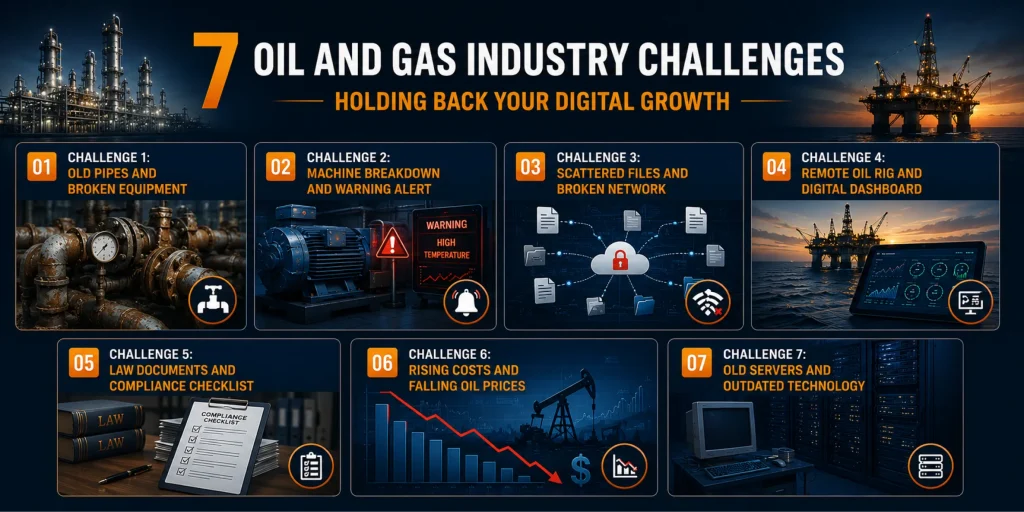
Challenge 1: Aging Infrastructure and Poor Asset Visibility
A lot of companies are still relying on equipment that can easily be 20 to 30 years old. Moreover, when you don’t have proper oil and gas asset management software. Teams tend to have only vague awareness of what’s actually going on with their assets.
Then unplanned shutdowns show up, budgets are overrun, and safety risks that are entirely preventable. With enterprise asset management software, the whole approach shifts. Instead of guessing, operations teams get real-time tracking and a much clearer live view.
Challenge 2: Unplanned Equipment Downtime and Reactive Maintenance
Keeping things running “until they fail” sounds normal, but it is a costly routine. Reactive maintenance costs the industry billions each year due to emergency repairs and downtime. And also supply disruptions that can ripple outward fast.
Predictive maintenance software flips the script. It uses sensor data and machine learning use cases in oil and gas to recognize patterns. Along with flagging potential failures before they happen. The outcome is fewer surprises, reduced expenses, and machinery that keeps working longer.
Challenge 3: Siloed Data and Disconnected Enterprise Systems
If you ask an operations manager where their production data lives. You might get a totally different answer than the finance team says. Data silos stay around, persistent, across the sector. When field operations, maintenance, procurement, and finance run on separate platforms, decision-making slows.
But with a connected oil and gas enterprise software , you pull all this information together. So it supports that digital transformation in oil and gas that actually moves the needle on efficiency.
Challenge 4: Remote Asset Monitoring Across Distributed Sites
Oil and gas operations never sit in one place. They move across deserts, offshore platforms, and those remote pipelines that are hours out from the nearest town. So sending technicians regularly every time something needs checking is just not practical or affordable.
With remote asset monitoring through digital oilfield solutions. Teams get eyes on everything from one central dashboard, spotting issues early and lowering the number of site visits. As well as keeping operations running smoothly, even when locations are very hard to reach.
Challenge 5: Navigating Complex Compliance and Regulatory Requirements
Compliance in oil and gas really isn’t a one-time checklist; it’s a moving target. Environmental regulations, safety standards, and emissions rules shift all the time across regions. However, staying on top of all of it manually is nearly impossible at scale.
This is one of the most difficult ecological challenges right now for the gas and oil sector. The oil and gas compliance management software handles a lot of the documentation work. It also automates the paperwork, monitors regulatory changes as they occur, and identifies weaknesses before they become infractions. That way, companies avoid expensive penalties and also brand damage.
Challenge 6: High Operative Costs and Pricing Volatility
Oil prices can swing hard within just a few months. When they fall, profit margins can shrink quickly too. Many companies get stuck because they lack real-time data. So they can neither respond quickly nor make fully informed decisions.
Furthermore, the IT challenges in the oil & gas industry range from old ERP systems to manual reporting steps. This makes it even harder to react quickly. The organizations that do this best tend to invest in connected platforms. Designed to link cost information to functional outcomes in real time.
Challenge 7: Resistance to Digital Transformation and Legacy IT Systems
Sometimes the biggest obstacle to change isn’t technology; it’s the people and systems that are already in place. Many oil and gas operations have really deeply entrenched legacy IT infrastructure, and replacing it feels risky.
And then you have teams that do things a certain way. And suddenly, digital transformation consulting becomes a sort of change-management ordeal, not just a technical one. Oil and gas software development services that lean toward gradual integration. Well, rather than tearing out everything at once, it usually gets much better uptake and more reliable results.
How Custom Oil and Gas Software Development Solves These Challenges
Off-the-shelf tools can only take you so far. The complexity of oil and gas operations means you need solutions built for how your business actually runs.
That’s where an experienced oil and gas software development company makes the difference by creating platforms. It helps to match your workflows, instead of the other way around.
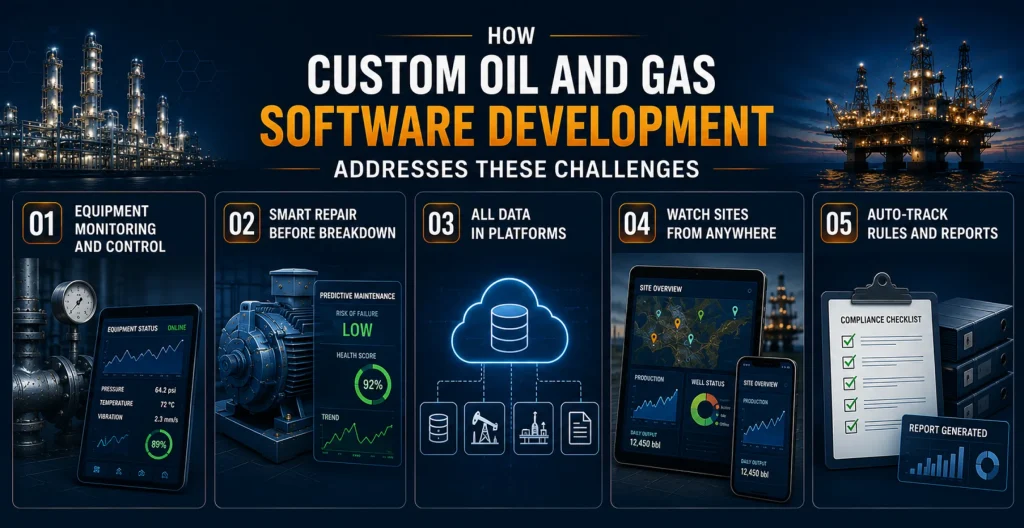
- Asset tracking and management: Custom-built asset dashboards that plug into what you already have in the field. So teams get real-time insight across every single site.
- Predictive maintenance engines: AI-driven maintenance tools that keep process sensor data and alert teams before failures occur.
- Remote monitoring solutions: IoT-enabled platforms where you get live data from remote sites. Well, without needing teams physically there for every routine check.
- Integrated data platforms: Custom software development services help to break down the silos. And bring together your working, financial, and compliance info into one unified view.
- Compliance automation: Software that stays in step with changing regulations. Furthermore, it auto-generates the paperwork your teams need to stay audit-ready at all times.
When built right, custom oilfield software solutions do more than solve one problem at a time. Along with that, they end up forming a connected functional base that keeps growing with your business.
Final Words
The core challenges laid out in this blog, from aging infrastructure and reactive maintenance to compliance headaches and legacy systems, aren’t different for one company. It’s more like these are broad industry problems that have kept showing up because the right tools were never really within reach. But that is changing. As digital oilfield solutions become easier to access and more purpose-built, the difference between what’s possible and what’s actually being executed is closing.
For organizations that are focusing on long-term efficiency and resilience. The next step isn’t only about grabbing new technology; it’s about finding the right partner to build it. Our enterprise application development services help turn stopgap repairs into a connected, extensible digital foundation. The industry isn’t waiting, and neither should you.
 By
By September 23, 2026




 Get in Touch