




Key Takeaways
- The offshore software development market is surging toward $204 billion by 2026, shifting from simple cost-cutting to a high-value engine for global innovation.
- Leveraging cost-effective software development in regions like Asia or Eastern Europe can reduce overhead by 60% to 80% compared to local hiring.
- Partnering with an offshore software development company eliminates the local skills gap, providing immediate access to senior offshore software developers and niche tech stacks.
- Utilizing an agile offshore development model ensures 24/7 productivity, drastically accelerating time-to-market for complex digital transformation services.
- 2026 offshore software development trends prioritize AI-driven automation to maintain a competitive edge.
Do your internal teams face difficulties when trying to meet the increasing demands of digital innovation while your operational expenses continue to grow? Offshore software development has become an essential driver for international innovation because companies today need more than just cost savings in their competitive markets.
Recent data suggests this shift will continue to accelerate because the offshore market will expand from 178.32 billion dollars in 2025 to 204.32 billion dollars by 2026, resulting in a compound annual growth rate of over 14% until it reaches a value of almost 350 billion dollars in 2030, according to Research and Markets.
Businesses that partner with offshore software development companies now use their outsourcing relationships to obtain expert knowledge, helping them develop their core business strategies for sustainable growth and operational flexibility. A critical IT talent shortage will affect almost 90% of organizations by the end of 2026, which means that companies must adopt global delivery models because these models have become essential for their operations.
Why Companies Choose Offshore Development Over In-House Teams
Managing an internal department results in companies facing substantial expenses and enduring prolonged periods to hire new staff. Companies have started to use external partners because these partnerships enable them to compete while they avoid the need to handle local administrative tasks.
1. Accessing Niche Expertise
Your hiring process restricts you from recruiting talent from your local area. Offshore software development services enable you to access specialized skills that are hard to find or too expensive in your home city.
2. Significant Overhead Reduction
The organization needs to pay for office space, hardware, and employee benefits. They can convert its fixed costs into operational expenses through an offshore model, enabling cost distribution across various budget categories.
3. Round-the-Clock Productivity
The organization can use its worldwide workforce to implement a “follow-the-sun” approach. The offshore software developers work while your local team sleeps, enabling your business to achieve double its normal output and efficiency.
4. Reduced Hiring Risks
Organizations need to invest considerable resources when they search for and train a new employee. Offshore models enable you to evaluate expertise during initial testing and reduce your workforce when project needs become less demanding.
5. Lower Management Burden
The professional offshore partners take care of all HR functions together with payroll processing and infrastructure management. Your leadership team can concentrate on strategic matters because a software consulting services partner will handle all technical execution.
The Core Benefits of Offshore Software Development
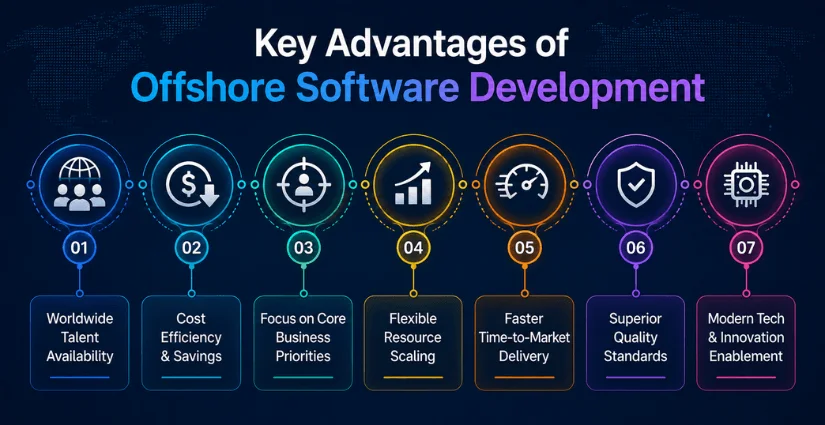
Global partnerships boost your development capacity through their financial backing and provide your company with operational benefits that matter in today’s digital world, which prioritizes fast delivery.
1. Global Talent Access
You gain immediate access to software developers from around the world who work in offshore locations. This ensures your project is staffed by experts who have experience in diverse industries and complex tech stacks.
2. Optimized Operational Costs
The adoption of affordable software development services enables you to use your financial savings for marketing expenses, research, and development activities. The company provides engineering services at a cost that is substantially lower than the rates charged by nearby markets.
3. Strategic Business Focus
Your organization can use outsourcing to handle technical development and maintenance work while your primary team maintains its focus on business expansion through customer acquisition.
4. Rapid Scalability
Companies can increase or decrease their offshore staff within a timeframe of weeks instead of waiting several months. Startups and enterprises need this capacity to adapt because they experience both unpredictable market conditions and seasonal project requirements.
5. Accelerated Development Speed
Offshore teams achieve faster delivery of their minimum viable product through their dedicated resources and optimized workflows compared to internal teams, who deal with company-wide administrative commitments.
6. Enhanced Quality Assurance
Most offshore companies follow international regulations, including ISO and CMMI standards. This process ensures that delivered code functions properly while maintaining secure and scalable performance.
7. Advanced Tech Adoption
Leading offshore companies maintain their advantage by using advanced technologies through AI, blockchain, and IoT. When you work with these companies, you gain immediate access to their technology stack, which requires no training.
Understanding How Offshore Software Development Works
The offshore project’s success depends on how its members work together. The process starts with your team identifying its goals and is completed when your team achieves flawless project execution.
1. Consultation & Roadmapping
The process starts to define project scope and technical requirements. The roadmap development process must guarantee the successful delivery of all your planned business goals.
2. Selection of Model
You can select from three pricing models, including a fixed price for complete projects, time & materials for projects with changing needs, and a dedicated team model that supports extended work and system development.
3. Talent Onboarding
The offshore software development team is built after establishing the operational framework. The team requires a short time period to learn your company’s standards about cultural and technical aspects.
4. Agile Execution
The team uses sprints and daily stand-ups to create the product through incremental development. The process provides visibility into work progress while collecting user input and enabling developers to adjust their work when market conditions shift during development.
5. Deployment & Support
The software proceeds to the deployment stage after completing extensive testing procedures. The majority of offshore software development companies deliver continuous product maintenance together with software updates to maintain product market competitiveness while fixing software defects.

Offshore vs. Nearshore vs. Onshore Development
Businesses need to select their preferred geographical development model because this choice determines their project development speed, communication needs, and financial results. Companies must learn about offshore software development and its nearby alternatives because this knowledge will help them create strong technical solutions.
| Feature | Onshore Development | Nearshore Development | Offshore Software Development |
| Location | Within your own country | Neighboring country (same continent) | Distant country (different continent) |
| Cost Efficiency | Lowest (Standard local rates) | Moderate (Regional savings) | Cost-effective software development |
| Time Zone | Identical | 1–3 hour difference | 5–12 hour difference (Offshore IT development) |
| Cultural Fit | Highest | High / Similar | Diverse / Varies by offshore software development team |
| Communication | Real-time / In-person | Near real-time | Asynchronous / Overlapping hours |
| Talent Pool | Restricted to local market | Regional access | Unlimited access to offshore software developers |
| Best For | High-touch, sensitive projects | Collaborative, agile projects | Scalable [custom offshore software development services] |
| Expertise Access | Limited by local competition | Regional specialization | Global [digital transformation services] |
Understanding the Cost of Offshore Software Development
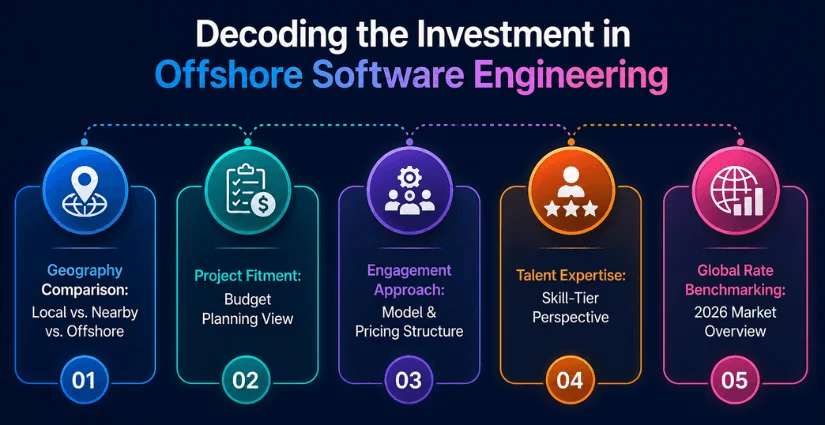
The cost of offshore software development varies significantly based on the maturity of the tech hub and the seniority of the talent. Below is a breakdown of the typical financial expectations when you seek cost-effective software development across popular global regions.
1. Location Basis: Onshore vs. Nearshore vs. Offshore
The table demonstrates how geographic development models create significant price differences, driving companies to seek cost-effective software development solutions.
| Aspect | Onshore (US/UK/Western Europe) | Nearshore (Mexico/Poland) | Offshore Software Development (India/Vietnam) |
| Hourly Rate ($) | $120 – $250+ | $60 – $110 | $25 – $55 |
| Monthly Cost per Dev | $19,000 – $40,000 | $9,600 – $17,600 | $4,000 – $8,800 |
| Cost Savings | 0% (Baseline) | 30% – 50% | 60% – 80% |
| Context | Local hiring market | Regional [software consulting services] | Global offshore it development |
2. Project Suitability: Budget Allocation Basis
Offshore software development costs depend on the specific product you are creating from the beginning to its final stage.
| Project Type | Typical Scope | Estimated Total Budget ($) |
| Startup MVP | 3–4 months dev | $30,000 – $60,000 |
| Mid-Sized App | 6–9 months dev | $75,000 – $150,000 |
| Enterprise Solution | 12+ months dev | $250,000+ |
| Maintenance | Monthly support | $2,500 – $5,000 mo |
3. Operational Basis: Engagement Models & Pricing
The table demonstrates how your monthly charges will change based on the software outsourcing model you select.
| Engagement Model | Pricing Structure | Estimated Monthly Rate ($) |
| Staff Augmentation | Hourly rate per dev | $4,000 – $9,000 /dev |
| Dedicated Team | Monthly flat fee | $15,000 – $40,000 (Team of 4) |
| Project-Based | Milestone-based | Fixed $10k – $100k+ |
| Agile Team | Sprints / Iterative | $10,000 – $25,000 sprint |
4. Developer Experience: Skill-Level Basis
The cost of offshore software development services depends on the experience level of the developers you hire from international markets.
| Seniority Level | Avg. Hourly Rate ($) | Monthly Salary Equivalent ($) |
| Junior Dev | $20 – $35 | $3,200 – $5,600 |
| Mid-Level Dev | $35 – $55 | $5,600 – $8,800 |
| Senior/Lead Dev | $55 – $90 | $8,800 – $14,400 |
| Project Manager | $40 – $70 | $6,400 – $11,200 |
5. Regional Comparison: 2026 Global Rates
The country where an offshore software development company is located serves as the main factor that determines its development costs.
| Region | Junior ($/hr) | Senior ($/hr) |
| India / SE Asia | $18 – $30 | $45 – $65 |
| Eastern Europe | $30 – $45 | $60 – $95 |
| Latin America | $35 – $50 | $70 – $105 |
| Africa | $20 – $35 | $45 – $75 |
Addressing Offshore Software Development Challenges & Risks
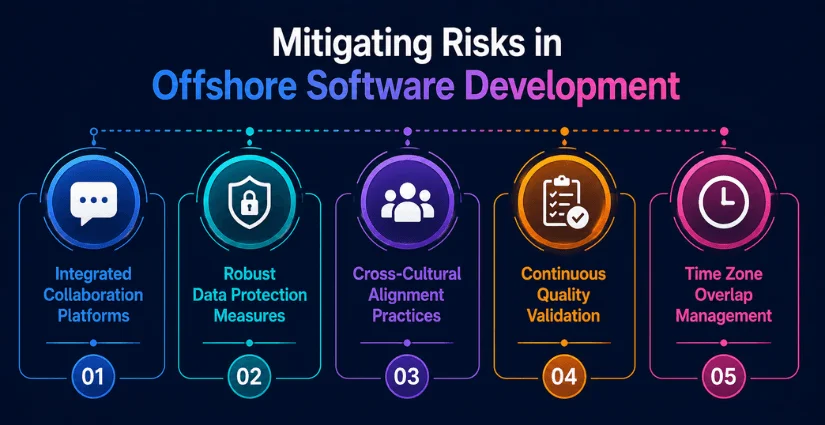
Organizations need to implement conflict resolution methods because international team management brings numerous benefits, but is hindered by two main issues: these issues include communication delays and data protection challenges.
1. Unified Communication Tools
Slack, Jira, and Zoom create a software solution that enables teams to collaborate effectively. The project uses proper documentation and scheduled work time overlaps to maintain transparent and collaborative offshore software development services.
2. Stringent Security Protocols
The protection of intellectual property represents the highest priority. Non-disclosure agreements, secure virtual private networks, and encrypted data storage systems enable trustworthy software outsourcing companies to protect their proprietary information from security threats.
3. Cultural Integration
Understanding local holidays and work ethics helps to stop friction between different parties. Successful offshore software development team establishment requires organizations to recognize their unique cultural differences while creating an environment that respects both their organizational goals and mutual relationships.
4. Quality Control Sprints
The combination of regular code reviews with automated testing processes protects software systems against technical debt accumulation. The continuous monitoring process confirms that each output meets the established standards of excellence required by digital transformation services.
5. Overlapping Work Hours
The team needs 2-4 hours of synchronized time because this period helps them to address problems through real-time solutions. The project requires this time overlap because it helps maintain progress while preventing extended email communication.

How to Choose the Best Offshore Software Development Company?
These are the factors that can help you choose the best offshore software development company. With the help of these points, you can easily select the best one for your project.
1. Verify Technical Portfolio
Your organization needs to search for projects that match your specific requirements. The best offshore software development company should provide evidence of successful project delivery that matches both your industry needs and your technology preferences.
2. Assess Agile Maturity
Verify that the company operates as an agile offshore software development company. This methodology enables project teams to handle changing requirements through its flexible features and its ability to deliver project updates.
3. Check Client References
The evaluation of their trustworthiness should proceed through discussions with former and current customers. The organization provides better authentic feedback about their communication abilities and problem-solving skills than any marketing brochure or website.
4. Evaluate Communication Skills
Language proficiency is a non-negotiable. The team must demonstrate their capacity to explain technical matters during initial meetings because this skill helps prevent misunderstandings and results in expensive software development delays.
5. Review Security Standards
Security needs protection standards and data. security protection requirements, The organization needs a partner who operates with security and compliance requirements, including both GDPR and HIPAA standards for their business operations.
The Future of Software Outsourcing: 2026 Trends to Watch
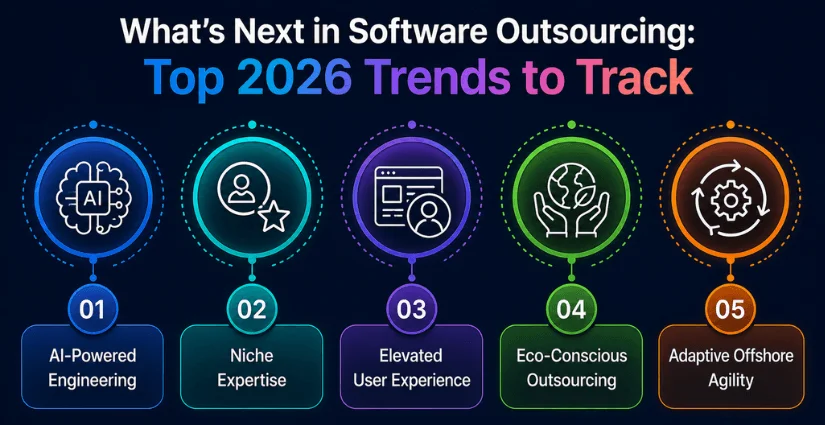
The outsourcing industry now develops strategic alliances that use artificial intelligence and advanced skills to create new business solutions for their organizations.
1. AI-Driven Development
Offshore software development will experience AI-assisted coding as the primary trend that organizations will adopt for their upcoming software projects. The development process achieves faster results because this method improves speed while decreasing human errors to produce the most accurate results.
2. Hyper-Specialization
The outsourcing process now requires organizations to select specialized partners who provide digital transformation services through their expertise in particular technological fields. Organizations will prefer to work with companies that possess industry-specific knowledge for FinTech, Healthcare, and EdTech instead of selecting partners with general business expertise.
3. Increased Focus on UX
The future will center itself around the needs of users. The offshore teams now include advanced UX/UI design capabilities as essential components of their services to guarantee their functional code produces optimal user experiences.
4. Sustainable Outsourcing
Business operations now focus on establishing ethical and sustainable practices. Clients select business partners who operate their companies through socially responsible methods and environmentally friendly data center operations.
5. Agile Offshore Development
The industry will continue to follow flexible work arrangements as its primary work structure. The agile offshore development model enables innovators to pivot their operations because it helps them respond rapidly to worldwide market changes.
Final Thoughts
People who want to succeed in the digital world need to work with partners who possess both expertise and operational capacity. Your business gains an advantage when you choose from the best offshore software development companies because this choice enables your company to deliver new products at a lower cost.
The appropriate offshore strategy will deliver the necessary protection for your 2026 legacy system modernization or complete new product development needs. Ready to scale? Connect with our dedicated development team for your project requirements.
 By
By September 23, 2026




 Get in Touch