


- Key Takeways
- What is IoT Software Development ?
- Key Components of IoT Software (IOT Software & Firmware Explained)
- Types of IoT Software Solutions and Applications
- IoT Solutions for Industries: Real-World Use Cases
- Frameworks for Developing Custom Software for IoT Devices
- IoT Software Development Process (Step-by-Step Guide)
- Key Features of Successful IoT Software Solutions
- Challenges in Custom Software Development for Internet of Things
- Cost of Custom Software Development for IoT
- Factors Affecting IoT Software Development Cost
- Tech Stack Used in IoT Software Development
- Latest Software Development Trends in IoT (2026 & Beyond)
- Why Choose Octal IT Solution as the Right IoT App Development Company?
- Final Words
- FAQs
Key Takeways
- The essential role of custom software development for IoT enables modern business operations to achieve both scalability and security.
- The IoT software development process analysis begins with embedded firmware development and ends with cloud-integrated dashboard creation.
- The 2026 cost analysis tables present detailed project expenditure information which developers can access based on three different factors including project complexity, specific developer roles and worldwide operating locations.
- The guide demonstrates actual IoT applications that help healthcare and manufacturing sectors to implement digital transformation.
- The research explains the newest technology stacks and frameworks that developers need to create AI-powered Internet of Things systems that will remain relevant in future times.
Is your business ready to navigate the hyper-connected era of 2026? The growth of the global IoT analytics market, which will reach $138.87 billion by 2032 after starting at $50.33 billion in 2026 (Research and Markets), has created an urgent need for custom software development dedicated to IoT software solutions.
Enterprises today face a problem because pre-existing products cannot satisfy their specific hardware limitations and security requirements. Through IoT software development, organizations can establish a connection between their physical sensors and their operational data, enabling them to transform collected information into industry leadership through better performance and real-time insights.
What is IoT Software Development ?
IoT software development is the specialized process of building digital systems, including firmware, cloud platforms, and user applications, to enable physical devices to connect through the internet and exchange data with each other. This system operates differently from typical web applications because it requires complete system integration between hardware sensors and backend processing.
Why Businesses Need Custom IoT Solutions
- Scalability: The network can expand from ten devices to ten million devices through the implementation of custom software development services to maintain system performance.
- Security: The custom builds use unique encryption methods together with their own security systems to secure industrial data against emerging cyber threats.
- Seamless Integration: The designers of high-quality custom IoT solutions create products that integrate seamlessly with existing ERP systems and CRM software development services, enabling businesses to centralize customer data and automate business workflows.
- Data Sovereignty: Businesses retain complete control over their data architecture instead of becoming dependent on a third-party provider who imposes strict platform limitations.
Key Components of IoT Software (IOT Software & Firmware Explained)
Building a robust IoT ecosystem demands more than an application because it needs an architectural system that operates through multiple software and hardware components.
1. Embedded Firmware
The system operates as the central processing unit, which controls all device functions through its core operating system. It controls fundamental device functions to ensure that it can execute commands during edge operations.
2. Cloud & Connectivity Layer
This layer uses custom IoT platforms to handle the incoming data stream, includes large data packets, and implements transmission protocols such as MQTT or CoAP.
3. User Interface (UI)
Users can access data through mobile applications and web dashboards, which serve as their main interface to the system. The development team creates user interfaces and provides real-time information through their knowledge of IoT product development processes.
Types of IoT Software Solutions and Applications
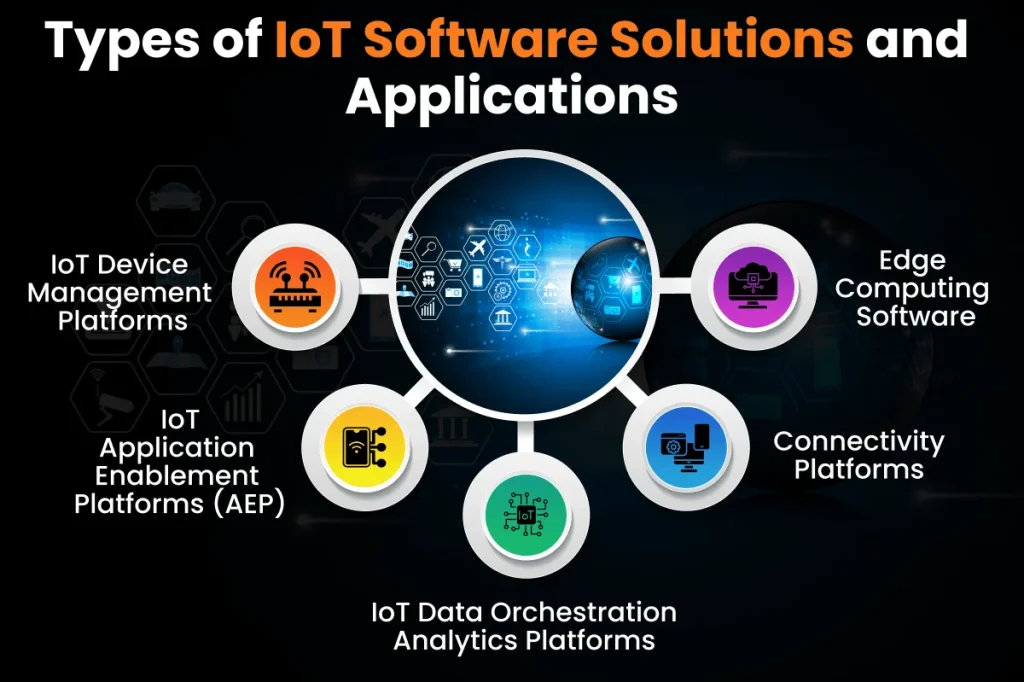
The Internet of Things (IoT) technology enables companies to monitor their remote assets while using automated systems to control their home climate.
1. IoT Device Management Platforms
This type of platform enables users to set up and track device operations while performing device updates through over-the-air system, security, and provisioning functions.
2. IoT Application Enablement Platforms (AEP)
The platform provides developers with tools, API services, and frameworks that enable them to create, distribute, and operate IoT applications with user interfaces.
3. IoT Data Orchestration/Analytics Platforms
The system controls how sensors send data, how data gets processed, and how data scientists analyze information. The tools of this system convert unprocessed information into valuable understanding through their application of artificial intelligence and machine learning methods.
4. Connectivity Platforms
Such platforms control all networking protocols and establish secure and trustworthy data connections between sensors and the cloud environment.
5. Edge Computing Software
The software executes data processing tasks on either the device or the local gateway to achieve lower latency and decreased bandwidth requirements.
IoT Solutions for Industries: Real-World Use Cases
The Internet of Things has become an active technology that transforms essential worldwide business industries through dedicated custom software development for IoT requirements.
1. IoT in Healthcare
The combination of remote patient monitoring systems and smart wearables enables continuous vital sign monitoring, resulting in fewer hospital readmissions and helping people stay alive.
2. Manufacturing & Industrial IoT
Predictive maintenance sensors warn engineers about potential machine failures, resulting in millions of savings and a decrease in software repair expenses.
3. Smart Homes & Consumer IoT
Custom software creates a complete experience for modern users who want to build connected homes through its control of automated lighting and intelligent security systems.
4. Retail & Logistics
The combination of real-time asset tracking and intelligent inventory management systems enables supply chains to maintain their operational visibility and their effectiveness throughout international trade activities.
Frameworks for Developing Custom Software for IoT Devices
Developers need reliable frameworks to provide tools for establishing secure connections, managing data, and maintaining system security to construct effective IoT systems.
| Framework | Primary Language | Best Used For |
| Node.js | JavaScript | Real-time data streaming and event-driven APIs. |
| Django | Python | Complex data analytics and ML integration in the backend. |
| Spring Boot | Java | Enterprise-grade, secure, and scalable IoT platforms. |
| PlatformIO | C/C++ | Professional embedded firmware development across multiple MCUs. |
| FastAPI | Python | High-performance, asynchronous edge-side services. |
IoT Software Development Process (Step-by-Step Guide)
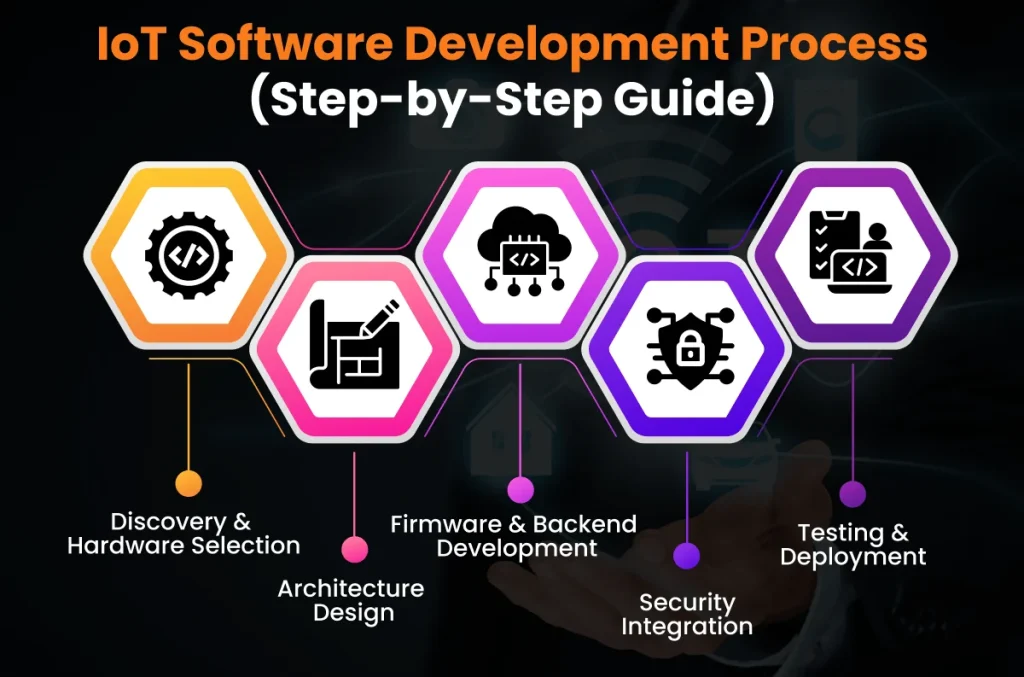
The IoT software development process needs an organized method to connect hardware functions with cloud computing operations. The guide provides a detailed approach that allows your IoT development work to proceed from its first prototype until it becomes operational in multiple industrial sites.
1. Discovery & Hardware Selection
Your project needs to establish its boundaries while choosing appropriate sensors that should meet your software development for startups requirements.
2. Architecture Design
This step requires the establishment of data transmission pathways linking devices to gateways to cloud storage systems while maintaining quick response times.
3. Firmware & Backend Development
The development team needs to create IOT software that operates the device together with its cloud-based data processing system.
4. Security Integration
The network requires protection through full encryption implementation, together with the creation of an identity management system.
5. Testing & Deployment
The team needs to conduct complete field tests to confirm that the IoT development projects function correctly in real-world environmental conditions.
Key Features of Successful IoT Software Solutions
An IoT product needs to deliver a superior user experience together with better connectivity features for its success in 2026.
1. Robust Security & Compliance
The security system protects data through complete encryption while it safeguards communication channels, including MQTT, HTTPS, and delivers automatic security updates together with security assessments.
2. Scalability & Flexibility
The system enables thousands or millions of devices to operate without performance issues through its use of modular cloud-based systems.
3. Real-Time Data Processing & Analytics
This delivers instant operational insights from data streams while it uses artificial intelligence to create predictive maintenance solutions and identify system irregularities.
4. Device Lifecycle Management
It enables remote management of hardware, including provisioning, configuration, and monitoring, along with over-the-air (OTA) updates.
5. Visualization & User Experience (UX)
The system offers users a simple, flexible dashboard and map options which they can use to track real-time data.
6. Interoperability
This enables seamless connection between different devices, sensors, and protocols, including Wi-Fi, BLE, and cellular technologies.
7. Automation
The system operates without human assistance because it processes data to create automated logic-based responses.
Challenges in Custom Software Development for Internet of Things
The process of custom software development for IoT needs to deal with many challenges. Look at these obstacles:
1. Security Vulnerabilities
Cybercriminals frequently attack IoT devices, creating essential challenges for protecting data, securing encryption, and authentication processes across distributed networks.
2. Interoperability and Standards
Different manufacturers’ equipment, protocols, and platforms become unworkable because of the existing absence of common standards that should connect them all together.
3. Scalability Challenges
The existing operational system fails to expand its data management processes when it needs to scale to thousands or millions, causing bottlenecks in data management.
4. Hardware-Software-Cloud Integration
The process of putting together PCB hardware with firmware and backend cloud applications becomes challenging and results in failed attempts at creating a complete system that works correctly.
5. High Development Costs & Talent Shortage
The development process for IoT projects requires organizations to invest in hardware, software, and cloud resources, yet the lack of skilled workers results in project delays.
6. Real-World Conditions & Maintenance
Software developers face challenges during the development process when they create software that must run reliably under unknown environmental conditions, including temperature variations and different usage patterns, because the software must receive control through over-the-air technology updates.
7. Data Processing and Management
Engineers encounter significant difficulties when gathering, maintaining, and analyzing extensive data sets while needing to comply with data privacy regulations.
Cost of Custom Software Development for IoT
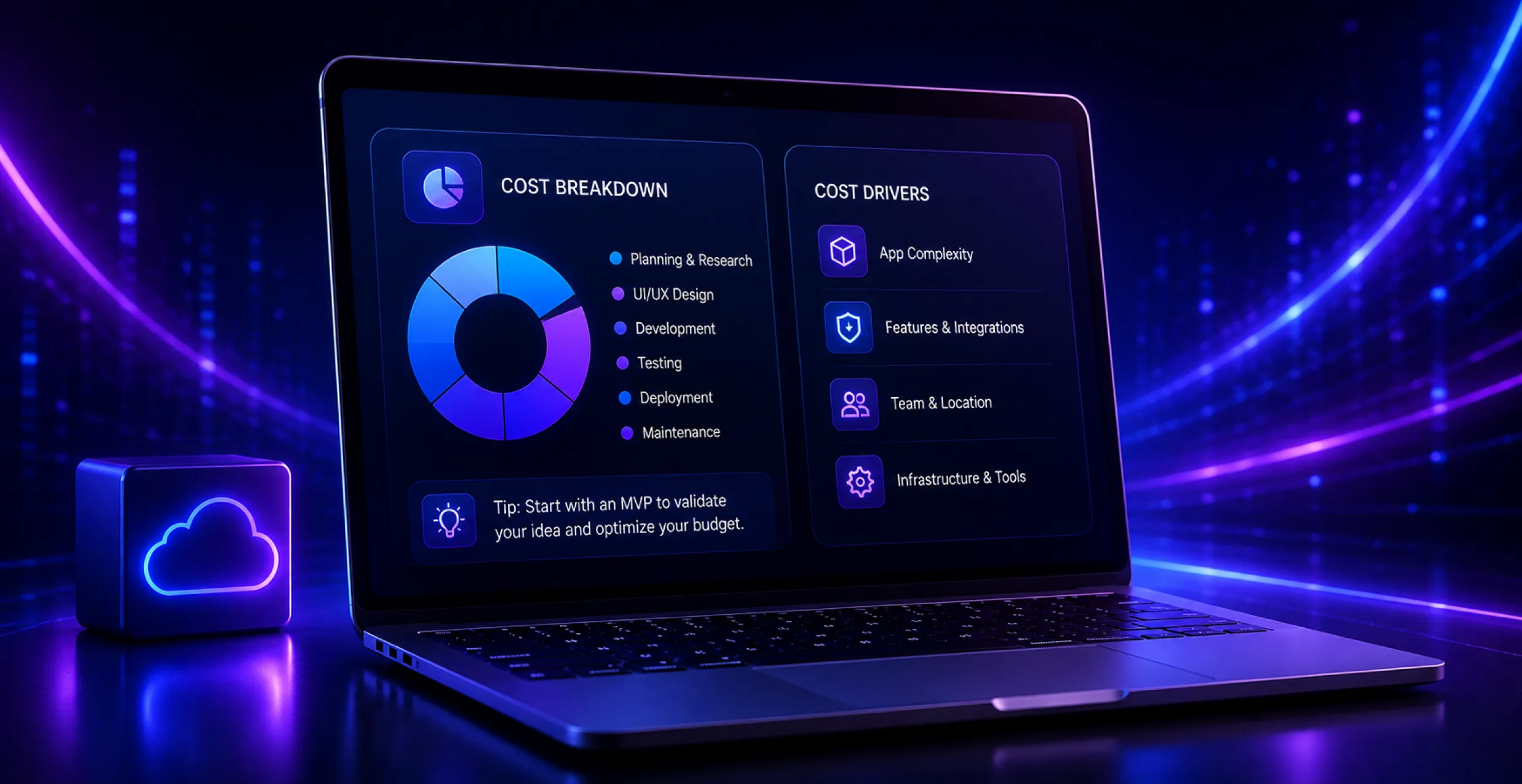
The process of determining custom software development costs for IoT requires organizations to evaluate their desired features against the challenges that come with implementing those features. The first base investment for 2026 begins with an MVP, which grows according to your needs for worldwide system integration.
1. Project Phase Wise IoT Development Cost
The “Discovery” and “Testing” phases of IoT projects require substantial funding because they need to address hardware integration risk.
| Project Phase | Percentage of Budget | Estimated Cost (USD) |
| Discovery & Hardware Consulting | 10% – 15% | $5,000 – $15,000 |
| UI/UX Design & Prototyping | 15% – 20% | $8,000 – $25,000 |
| Firmware & Backend Development | 45% – 50% | $25,000 – $80,000 |
| QA & Hardware Integration Testing | 15% – 20% | $10,000 – $30,000 |
| Deployment & DevOps | 5% – 10% | $3,000 – $10,000 |
2. Role-Wise Hourly Rates (2026)
The cost of custom software development for IoT needs specialized personnel who have different technical skills.
| Team Role | India / SE Asia | Eastern Europe | North America |
| IoT Solutions Architect | $45 – $75/hr | $80 – $130/hr | $180 – $280/hr |
| Firmware/Embedded Developer | $35 – $60/hr | $60 – $100/hr | $150 – $250/hr |
| Backend (Node.js/Python) Dev | $30 – $55/hr | $50 – $90/hr | $130 – $220/hr |
| UI/UX Designer | $25 – $45/hr | $40 – $75/hr | $100 – $180/hr |
| QA / Penetration Tester | $25 – $40/hr | $35 – $65/hr | $90 – $160/hr |
3. Region-Wise Estimates
Geography remains the biggest driver of the software development cost for global enterprises.
| Region | Average Hourly Rate | MVP Cost (Start) | Full System Cost |
| North America | $120 – $200+ | $80,000+ | $300,000+ |
| Western Europe | $90 – $160 | $65,000+ | $250,000+ |
| Eastern Europe | $40 – $85 | $35,000+ | $150,000+ |
| India / SE Asia | $25 – $55 | $20,000+ | $80,000+ |
4. Complexity Wise Cost Estimates
The total cost depends on its intelligence level, ranging from basic tracking to full AI-powered automation.
| Complexity Level | Cost Range (USD) | Timeline |
| Low Complexity | $25,000 – $50,000 | 3 – 4 Months |
| Mid Complexity | $60,000 – $130,000 | 5 – 8 Months |
| High Complexity | $150,000 – $500,000+ | 9 – 18 Months |
5. MVP vs. Advanced Solutions
An IoT app development company helps most businesses create their MVP that they later develop into a complete application with advanced features.
| Feature Set | MVP (Minimum Viable Product) | Advanced / Enterprise Solution |
| Cost Range | $20,000 – $55,000 | $120,000 – $400,000+ |
| Device Support | Single protocol (e.g., Wi-Fi only) | Multi-protocol (Wi-Fi, Zigbee, LoRaWAN) |
| Analytics | Basic data visualization | Predictive AI & Big Data Analytics |
| Security | Standard Encryption | End-to-end hardware-level security |
| Cloud | Shared infrastructure | Dedicated/Private cloud scaling |
| Integrations | 1-2 Essential APIs | Full ERP/CRM Integration |
Factors Affecting IoT Software Development Cost
The complete costs for developing software construction depend on many factors, which are:
1. Hardware Integration & Firmware (IoT Core)
The development of firmware through C/C++ programming needs to happen for both sensors and microcontrollers. The costs of the project increase when an agency needs to manage both embedded systems and application development. The budget for custom hardware development will decrease after the team finishes testing and certification of their product through the FCC.
2. Backend & Cloud Infrastructure
IoT systems require strong cloud infrastructure for their data collection to be processed and stored. The costs for using AWS IoT Core or Azure increase according to the amount of data that the system handles.
3. Project Complexity & Features
The addition of AI-powered analytics with complex user interfaces, voice control, geolocation features and real-time alerts causes the development process to take longer while increasing project costs.
4. Security Requirements
The development process requires high-level end-to-end security, including hardware encryption, secure firmware updates, and threat detection systems that protect against vulnerabilities.
5. Development Team Location & Expertise
The process of hiring IoT, embedded systems, and cloud architecture specialists requires substantial financial resources. North American workers charge between $50-$150 per hour, while offshore teams charge between $20-$50 per hour.
6. Maintenance & Updates
The costs for post-launch maintenance work, including bug fixes, security updates, and cloud infrastructure management, typically increase the yearly development cost by 15-25% starting from the first year.
Tech Stack Used in IoT Software Development
The establishment of a modern technological framework serves as the essential element for creating software that meets the Internet of Things needs. Our system uses high-performance programming languages together with secure custom IoT platforms to process substantial data volumes while achieving minimal latency.
| Layer | Recommended Technology |
| Programming Languages | C++, Python, Rust, Go, Swift |
| Embedded OS | FreeRTOS, Zephyr, Embedded Linux |
| IoT Cloud Gateways | AWS IoT Core, Azure IoT Hub, Google Cloud IoT |
| Protocols | MQTT, CoAP, HTTP/2, WebSockets, LoRaWAN |
| Databases | InfluxDB (Time-series), MongoDB, TimescaleDB |
| Front-end / App | Flutter, React Native, Angular (Dashboards) |
Latest Software Development Trends in IoT (2026 & Beyond)
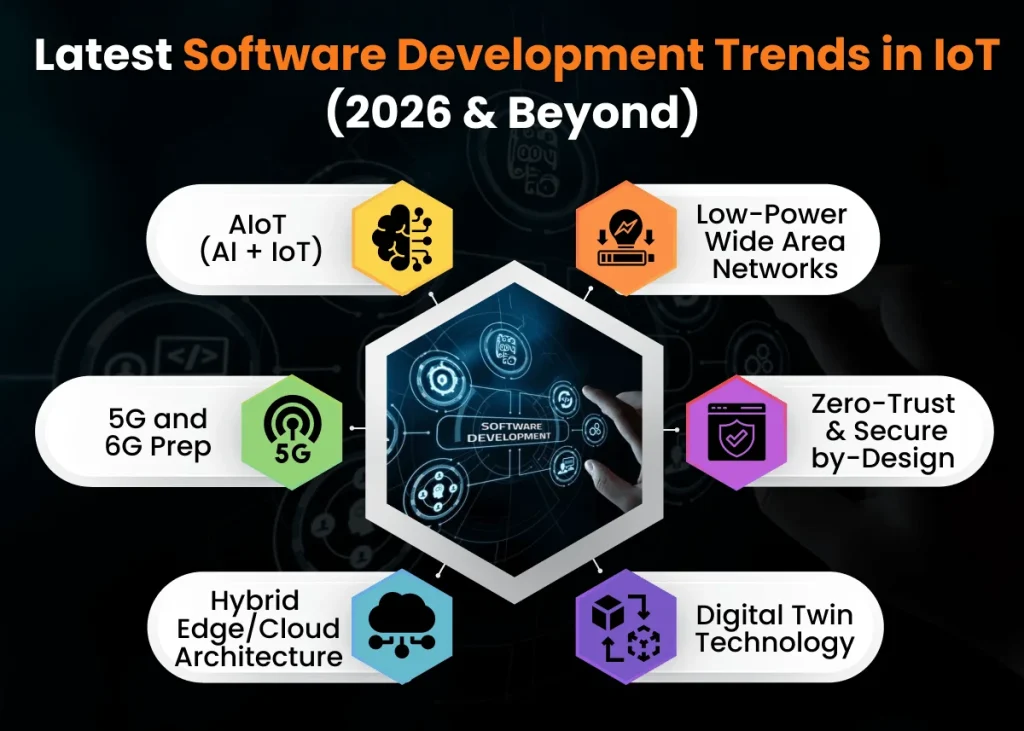
The market is experiencing a transition towards “Intelligence at the Edge” according to current software development trends. According to Intelegain, 92% of organizations will implement AI-based IoT solutions by the end of 2026.
1. AIoT (AI + IoT)
The process of machine learning model integration into devices enables those devices to make independent decisions.As organizations scale intelligent automation across connected ecosystems, the adoption of generative AI for enterprise is helping businesses improve decision-making, automate workflows, and extract actionable insights from the massive volumes of data generated by IoT devices.
2. 5G and 6G Prep
The 5G transition creates “Massive IoT” that permits one million devices to operate within each square kilometer, and this capability is driving new software development patterns.
3. Hybrid Edge/Cloud Architecture
The upcoming hybrid model implementation will start in 2026 when more than 50% of industrial companies adopt hybrid systems that combine cloud computing power with immediate edge computing access.
4. Digital Twin Technology
The process of creating virtual copies of physical objects enables users to test different scenarios before they implement their actual use cases.
5. Zero-Trust & Secure-by-Design
The main focus of security has shifted to core systems because billions of IoT devices will soon exist. The process begins with the development of systems, including blockchain authentication and zero-trust security measures, to safeguard operations.
6. Low-Power Wide Area Networks (LPWAN)
LoRaWAN and NB-IoT technologies have developed quickly because they allow economical sensor solutions that require minimal power for agricultural, utility applications, and remote asset monitoring since they can function without maintenance for several years.
Why Choose Octal IT Solution as the Right IoT App Development Company?
Octal IT Solution stands out as a premier IoT App Development Company by combining hardware expertise with advanced software engineering. We create complete operational systems through our coding work. Our developers track software development innovations to deliver products that remain useful and expandable in the upcoming times.
Our company serves as the perfect partner for your digital transformation needs because we operate with open methods and possess extensive knowledge about IoT in Healthcare and Manufacturing.
Final Words
Navigating the world of custom software development for the Internet of Things requires developers to establish a balance between accurate hardware measurement and flexible software development. The upcoming businesses of 2026 will succeed when they treat IoT technology as essential for their daily operations instead of viewing it as an optional extra.
The selection of a partner who possesses deep expertise in custom software development services will help you transform your unprocessed sensor information into your organization’s most critical resource. The time to start your IoT journey is now. Are you ready to create the future?


 Get in Touch
 By
By October 8, 2026