


The UK digital economy is facing a boom, and mobile-first approaches have become the focus of business expansion in the areas of fintech, retail, healthcare, logistics, and SaaS. With the investment that companies make in mobile products, one of the primary technology choices that occurs at the outset of the development process is deciding on native iOS applications or hybrid applications.
Although the hybrid systems offer the benefits of quicker deployment and cross-platform nature, an increasing number of businesses in the UK are preferring the native iOS programming in terms of performance, security, and scalability over time. This inclination is not a coincidence–it is predetermined by the changing user demands, by business-level needs, and by the development of the UK iOS development market.
This blog addresses the reasons that UK businesses are moving more towards native iOS applications than hybrid systems, backed by the market trends, technical comparisons, and business benefits.
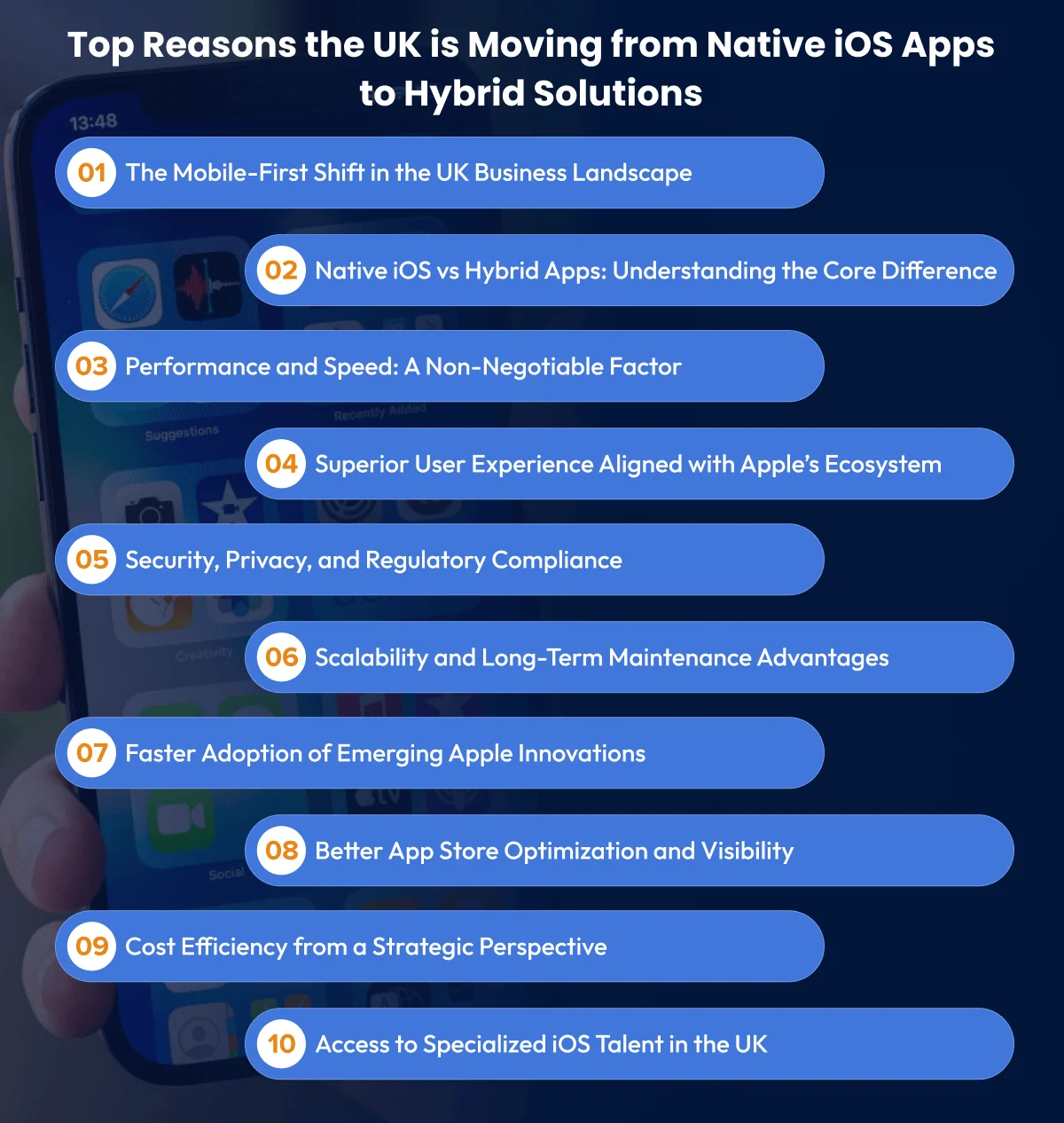
Top Reasons the UK is Moving from Native iOS Apps to Hybrid Solutions
Have a look at some of the top reasons why UK businesses are moving towards hybrid solutions from native iOS apps.
The Mobile-First Shift in the UK Business Landscape
In Europe, the use of digital is high among UK consumers. The UK markets have high penetration of iPhones, high in-app purchase behavior, and high user demands, and the businesses targeting the UK audience should create impeccable mobile experiences. This climate has influenced the iOS app development trends UK, where high performance, data confidentiality, and smooth UI are overridden by immediate saving on development.
Businesses are not just developing apps to be present anymore, but instead, they are creating platforms that combine payments, AI-driven personalization, secure authentication, and real-time analytics. These demands are usually beyond the capability of the hybrid architectures to support.
Native iOS vs Hybrid Apps: Understanding the Core Difference
One should understand the technical differences before setting preferences in the business. There are native iOS applications that are created specifically for the Apple ecosystem, created with Swift or Objective-C, and utilizing Apple SDKs. Instead, hybrid apps are built on web technologies and put in a container of native wrapping.
In the case of businesses that are yet to assess the platforms, a common suggestion in this Android vs iOS comparison is that iOS is the right platform when it comes to high-quality user bases, enhanced security, and returns on investments in the UK market.
Hybrid solutions can potentially cut down on the time to first development, but UK companies are growing less and less inclined to think of mobile apps as experimental technology and more as an investment in core digital assets: native development is becoming more strategic.
Performance and Speed: A Non-Negotiable Factor
The most frequently mentioned reason why UK enterprises prefer native iOS apps is performance. Native apps have direct access to the hardware of the device, which makes them load faster, have better animations, and stable background tasks.
The hybrid applications rely on a WebView layer that may create latency, particularly in cases where real-time information is to be developed, complex interaction of the user interface, or multimedia capabilities. In case of such industries as fintech and healthcare, any delays, however insignificant, can harm the user trust and adherence.
The latest iOS technologies have been improving, including Swift concurrency, Metal graphics acceleration, and Core ML, allowing native apps to perform much better than hybrid frameworks.
Superior User Experience Aligned with Apple’s Ecosystem
Apple’s design language is quite familiar to UK users. Native iOS applications follow Human Interface Guidelines to the letter, which translates into an easy-to-navigate experience, responsiveness to gestures, and a platform-congruent look.
Simulating these interactions in hybrid apps often requires extra effort, and even then, minor inconsistencies can be noticed by experienced iOS users. This is the reason why most iOS app developers UK suggest native development in case user experience is a number one priority.
In the case of customer-facing apps, the perceived brand is directly affected by the perceived app-native-ness, which hybrid solutions can hardly provide on a large scale.
Security, Privacy, and Regulatory Compliance
Information security is a pressing issue for UK companies that work on the framework of GDPR and industry-related compliance regulations. iOS native apps enjoy the inbuilt security features at Apple, which include secure enclave, Face ID, encrypted keychains, and sand boxing.
Hybrid applications, which are based on web-based elements, present a bigger attack area. This may make compliance audits difficult and may add vulnerability risks- particularly when they deal with apps that process payments, personal information, or health records.
This is why numerous companies prefer to hire iOS application developers with profound native knowledge to make sure that security has been baked in at the beginning of the project and is not added afterward.

Scalability and Long-Term Maintenance Advantages
Hybrid apps might seem to be inexpensive in the short run, but the long-term scalability tends to be a problem. Technical debt, as apps become more and more complex, is the cost of preserving third-party plugins, updating frameworks, and platform compatibility.
Native iOS apps are more predictably scaled, which enables the teams to implement new Apple features as soon as they are launched. Such flexibility can be considered particularly useful in the competitive UK iOS development market, where a timely adoption of new OS features can be used to distinguish a product.
The iOS app development cost in this context can help the business compare the total cost of ownership, not just the initial cost.
Faster Adoption of Emerging Apple Innovations
In ARKit, Apple is launching new APIs and tools every year, as well as on-device AI processing. Native apps are able to capitalize on these innovations as they happen, whereas hybrid frameworks are sometimes left behind.
Choosing the best framework for iOS app development within a native ecosystem ensures future readiness and technical stability.
This responsiveness enables the UK companies to be ahead of the pack with quick feature additions that support changing trends in constructing the iOS applications UK, including AI-based personalization, privacy-focused analytics, and user immersion.
Better App Store Optimization and Visibility
Apple’s App Store will discriminate against applications that are characterized by poor performance, high crash rates, and low user interaction. The Native iOS applications will always rank more points than the hybrid apps in these aspects and thus, be found more easily.
Visibility in the App Store is not a post-thought driver of growth for the UK startups and enterprises alike. Native apps offer better retention rate, greater system integration, and cleaner analytics, which are all beneficial for in-store performance.
Adapting to iOS app development trends will help the business align its product strategy with what users and Apple praise most.
Cost Efficiency from a Strategic Perspective
Although hybrid apps can minimize the initial development work, UK companies progressively evaluate the cost from a strategic perspective. The hybrid environments are usually more expensive to maintain, optimize performance, update security, and optimize the user experience in the long run.
Knowing the actual cost of hiring iOS app developers will assist companies in making achievable budgets and preventing trade-offs that would affect the quality of products. Native development is more cost-effective, particularly for a mission-critical application that is anticipated to go viral.
Access to Specialized iOS Talent in the UK
There is a high concentration of well-trained native iOS development engineers in the UK. These specialists possess profound platform knowledge, architectural best practices, and performance optimization expertise, which hybrid developers might not have.
A partnership with the best iOS app development company will enable the application of proven development practices, security standards, and post-launch support, which are vital to enterprise applications.
With the increase in the need for high-quality mobile experiences, shortcuts are becoming less important to businesses than expertise.
Conclusion: Native iOS as a Strategic Business Choice
The choice of native iOS application as preferred by the UK business community is not merely a technological phenomenon, but rather a business mode of thinking, which is performance-based, security-based, scalable, and has a sense of user confidence. Although hybrid solutions are appropriate in the context of rapid prototyping or internal utilization, they are not always appropriate in the context of the consumer-facing or enterprise-critical application.
As the trends of iOS apps in the UK continue to change, the UK has a well-established iOS development industry, and the new iOS technologies are changing fast; there is no better value than native development can bring. By collaborating with proficient iOS app developers in the UK, companies can develop future-oriented mobile solutions that satisfy the expectations of users and standards.
Native iOS applications are clearly preferable to those of UK enterprises that seek to compete on quality rather than compromise.


 Get in Touch
 By
By April 14, 2026