



Key Takeaways
- Blockchain in intellectual property gives creators a tamper-proof, time-stamped record of their work.
- The global blockchain market will grow from around $54 billion in 2026 to over 600 billion by 2031.
- China and the EU already accept blockchain timestamps as supporting evidence in IP disputes.
- With blockchain, AI catches breaches early before the damage spreads.
- Smart contracts automate royalty payments, reducing slow, opaque middlemen.
- Octal IT Solution builds custom blockchain IP platforms that fit different industries and budgets.
Ideas flow fast. Proof of ownership often doesn’t.
Getting a patent can take years. Pirates can copy digital content within hours. Counterfeiters copy trademarks across borders every day.
In intellectual property, blockchain eliminates a simple gap in how creators protect their work. It gives creators a permanent, time-stamped record of the moment they create something. Blockchain prevents anyone from editing or deleting this record later. That single fact explains how IP security works, especially for producers who can’t afford standard legal monitoring.
This guide breaks down how blockchain protects patents, copyrights, and trademarks in 2026, with real costs, real risks, and real examples. You can also see where the law currently stands in the USA, and what the next five years are likely to bring.
Key Market Forecasts for Blockchain (2026-2030)
The global business market will exceed $600 billion by 2031
The market will grow from $54.08 billion in 2026 to $610.96 billion by 2031, at a CAGR of 62.4%. Enterprise adoption across finance, supply chain, and IP management drives this growth.
Some forecasts predict even faster growth
Grand View Research puts the market at $108.3 billion in 2026, scaling it closer to $9 trillion by 2033. The gap in the forecasts shows how quickly perceptions are shifting as adoption accelerates.
Blockchain-AI spending continues to grow rapidly
The blockchain AI market will grow from $704 million in 2025 to more than $4 billion by 2033. This supports AI-driven breach-detection tools.
Asset tokenization hits an inflection point in 2026
Real-world asset tokenization should reach $9.43 trillion by 2030, marking 2026 as the year it begins to enter the mainstream. IP assets are the natural next category for this trend. And blockchain’s role in tokenizing intellectual property is only getting bigger from here.
Blockchain applications in intellectual property 2026 will grow alongside this trend.
Blockchain applications in intellectual property 2026 are moving from pilot programs into daily use for royalty automation and licensing. This growth is likely to continue through 2030, as more organizations are testing blockchain tools for IP management.
Regulation will shape where this growth goes
Businesses will likely rely on deeper AI integration and jurisdiction-accurate IP policies to reduce costs by 2030. Businesses that prepare now will adapt more easily to the future regulatory changes.
Why Traditional IP Management Has Problems
Traditional IP security was built for a slower, paper-based world. Here is where it breaks down for modern creators and businesses.
1. Slow Patent Registration
In busy jurisdictions, patent approval can take up to five years. During that time, no formal security protects your discovery.
2. Instant Copyright Theft
Pirates copy and republish content within hours of its publication. With assessments, implementation is slow and often requires crossing multiple countries to win.
3. Manual Licensing Process
Most licensing deals are subject to manual agreements, email chains, and late royalty payments. Each further step creates more delays and room for conflict.
4. Centralized Registration Risk
A breach, mistake, or outage can disrupt the registration process. They may put the records of thousands of creators at risk. There is no built-in backup verification layer.
5. Decentralized IP Management
Blockchain distributes records across many nodes instead of storing them in a single database. This makes tampering much harder and reduces the risk of a single point of failure.
6. High Registration Cost
Legal fees can quickly become expensive for many types of intellectual property. Many independent creators and small businesses simply go without protection.
Read More: Top Blockchain Use Cases
Understanding the Role of Blockchain in Intellectual Property
The blockchain is not magic. It is a unique and more reliable way to collect evidence. That’s how it really fits into blockchain intellectual property management today.
1. Shared Digital Ledger
Blockchain timestamps each entry, links it to the previous one, and makes it visible to all network participants.
2. Tamper-Proof Records
Once the network adds an entry, any change breaks the chain and is immediately visible. This is what makes blockchain useful as IP evidence.
3. Core IP Functions
These include proof of identification, automatic licensing, and royalty tracking. Most blockchain solutions built for creators focus on one or more of the 3 functions.
4. Digital Proof of Ownership
It permanently preserves the timestamp and the record. That credibility is what IP disputes need.
5. Registry Support
Right now, blockchain is not replacing patent offices or copyright registries. It adds a layer of reliable evidence that supports the claims you have presented to them.
How Blockchain Works for Intellectual Property
The process behind blockchain IP protection may sound technical, but it is truly simple. Here’s how the file goes from creation to verified proof.
Step 1: Upload Your Work
The creator uploads a file, design, or discovery detail to the blockchain platform. This can be a document, an image, a code file, or a technical drawing.
Step 2: Create a Digital Fingerprint
The platform creates a unique digital fingerprint, called a hash. Even a tiny change creates a completely different hash.
Step 3: Timestamp & Store it Permanently
The hash gets timestamped and stored across multiple blockchain nodes. No single party can delete or alter the record.
Step 4: Verify it Anytime
Anyone can compare the file against its stored hash to verify that it matches the original. Any change to the record breaks the match instantly.
Step 5: Blockchain for IP Protection Works Alongside Formal Registration
This process supports but does not replace registering your work with a patent office or copyright authority. Use both together for full coverage.
Step 6: Smart Contracts can Attach Usage Rules.
Smart contracts for intellectual property can store licensing terms, payment splits, and usage rules on the blockchain. This automates licensing without requiring manual legal reviews for every transaction.
Visit More: Blockchain Trends
Blockchain vs. Traditional IP Registration: Side-by-Side
Traditional registration and blockchain solve different problems. One gives you legal rights. The other gives you quick, tamper-proof evidence. This is how they compare, side by side.
| Factor | Traditional IP Registration | Blockchain in Intellectual Property |
| Legal ownership rights | Grants enforceable legal rights | Does not grant legal rights on its own |
| Time to protect | Weeks to years, depending on IP type | Minutes, once you upload the file |
| Cost | Higher, especially for patents | Lower, starting with basic timestamping |
| Proof of creation date | Based on the official filing date | Based on the blockchain timestamp |
| Tamper resistance | Centralized records can be altered or lost | Records sit across many nodes, hard to alter |
| Court admissibility | Accepted as primary evidence | Accepted as supporting evidence in most countries |
| Cross-border recognition | Varies by treaty and jurisdiction | Works the same way across borders |
| Best used for | Formal legal enforcement | Early proof and fast licensing |
Use both together, not one instead of the other. In blockchain, intellectual property on blockchain works best as a support layer. The traditional registry gives you the most powerful legal footing. Combine them, and you won’t lose the foundation on either side.
Benefits of Blockchain in Intellectual Property
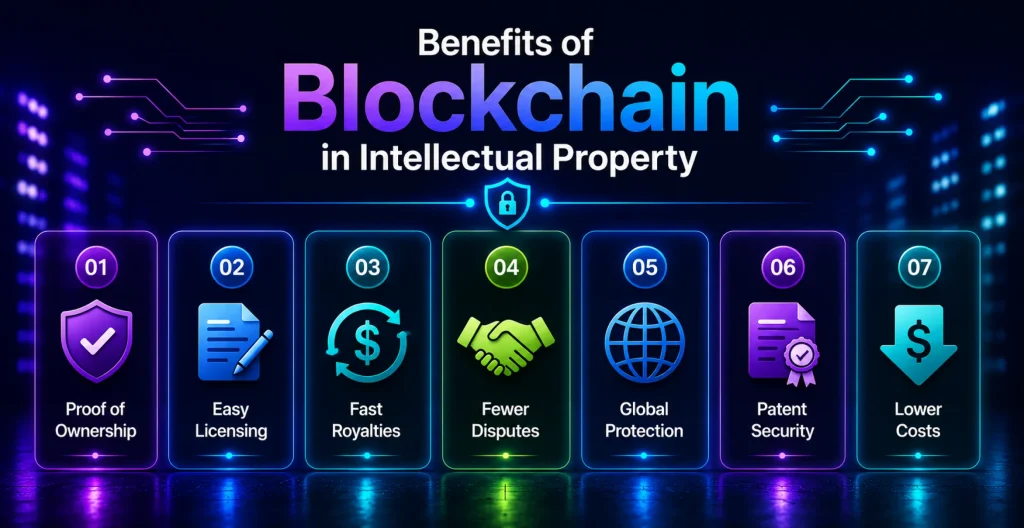
Blockchain does more than protect your data. It makes IP protection, licensing, and payments faster and fairer.
1. Permanent Proof of Creation Date
You get a tamper-proof, time-stamped file for patents, art, code, and designs. This report provides helpful evidence if anyone challenges ownership.
2. Less Licensing Paperwork
Automated agreements enforce permission rules when the conditions are met. This reduces manual tracking and back-and-forth emails.
3. Faster Royalty Payments
Payments that used to take months can now happen in real time. Smart contracts pay creators immediately when they record usage, instead of waiting for quarterly cycles.
4. Fewer Conflicts Overall
All parties have access to the same verified records rather than relying on separate paperwork. This reduces unnecessary back-and-forth that usually leads to conflict.
5. Blockchain IP Rights Travel Easily Across Borders
International licensing is simple because the file does not depend on any one country’s system. This helps creators to work with global partners or platforms.
6. Stronger, Faster Patent Protection
Companies are now using blockchain patent management to timestamp registrations. It proves invention dates instantly in multiple countries at once. This provides a reliable backup layer on top of standard patent office data.
7. Lower Fees for Independent Creators
Timestamps and original proof of ownership cost less than full legal filing. This makes early-stage protection a reality for small businesses and solo creators.
Blockchain Application & Use Cases in IP Protection
Blockchain applications in intellectual property show up in more ways than most people expect. Here are the real, working applications that companies are using today.
1. Instant IP Timestamping
Creators increasingly use a blockchain app in intellectual property management to timestamp their work. It records the work the moment they finish it. This closes the gap between creation and proof, a process that previously took days or weeks.
2. Custom Enterprise IP Platforms
Larger companies switch to custom blockchain software in intellectual property management built for their specific patent or content library. Creators control access, storage, and data integration with existing systems.
3. Smart Contract Licensing.
These agreements now manage license terms, fee splits, and usage limits without manual guidance. Once users fulfill the conditions, smart contracts automatically handle payments and access.
4. Automated Licensing Management
Many licensees use a blockchain licensing platform to pay for and access rights without a lawyer reviewing every transaction. This works especially well for high-volume licensing, such as stock content or software components.
5. Real-Time Royalty Distribution
Music platforms use blockchain to instantly distribute royalties between songwriters, producers, and record labels. Smart contracts distribute payments based on a transparent, pre-agreed split as soon as revenue comes in.
6. Shared Patent Pools
Patent pools use a common ledger so that multiple organizations share overlapping technology fairly. This eliminates repetitive negotiations and maintains shared usage records.
7. Supply Chain Design Protection
Manufacturers timestamp CAD files before sharing them with overseas factories. It stops design leaks before production even starts, closing a gap most guides never point out.
8. Open-Source Contribution Tracking
Blockchain can log who wrote a line of code through a shared ledger. This protects the contributor’s rights in disputes that may arise years after the original commit.
Read Also: Best Blockchain Development Platforms
Industries That Can Benefit From Blockchain
Some industries experience IP theft more than others and move faster to restore it. These are the areas that are seeing the biggest impact right now.
1. Entertainment & Music
Instant royalty splits and piracy-proof distribution records help artists and labels get paid fairly. The system tracks streaming and license usage in a shared, reliable place.
2. Medical
Companies use blockchain to protect drug formulas and prove research timelines during patent disputes. This matters most in industries where filing first is critical.
3. Fashion & Luxury Goods
Brands rely on blockchain trademark protection to verify authentic designs against fake knock-offs. Customers and retailers can check for originality before buying.
4. Software & Gaming
Developers prove unique code ownership and protect in-game assets from unauthorized copying. This is especially useful for studios that work with outside contractors.
5. Film & Media Production
Projects with many global collaborators can benefit most from decentralized intellectual property management because no single party controls the document. Every sponsor can verify the same shared ledger from anywhere.
6. Manufacturing
Companies secure product blueprints shared with third-party suppliers across different countries. This makes it harder to copy a design during production.
Recommended Read: Top 20 Blockchain Development Companies
How AI + Blockchain Together Detect & Prevent IP Infringement
Many guides overlook this part. Together, AI and blockchain transform IP security from reactive cleanup to proactive protection.
AI + Blockchain for IP Protection
Most guides on this topic only cover blockchain. Combining blockchain with AI monitoring and tracking is a significant shift happening in enterprise IP protection.
AI Scan for Infringements
It scans marketplaces, websites, and social platforms around the clock for copied designs, tutorials, or media. This captures potential infringements much faster than manual searches.
Blockchain Verifies Ownership
The moment AI spots a likely match, blockchain provides timestamped records needed to act immediately. This turns suspicion into useful evidence within minutes.
From Reactive to Proactive Protection.
This mix transforms IP security from cleanup after the fact to protection before the damage spreads.
DRM Adds AI Detection
Digital rights management blockchain systems are quickly adding AI detection as a built-in feature, not an add-on. Most new DRM systems will likely include this by default in the next few years.
Earlier Detection, Fewer Disputes
Businesses see fewer lawsuits filed months after a loss. Teams detect and resolve more violations within days rather than dragging cases out for months.
Octal IT Solution builds this monitoring layer on custom platforms. We integrate AI identification with blockchain evidence storage as a connected tool. Users receive alerts and supporting evidence in one dashboard, without stitching tools together themselves.
Know More: Blockchain App Ideas for Startups
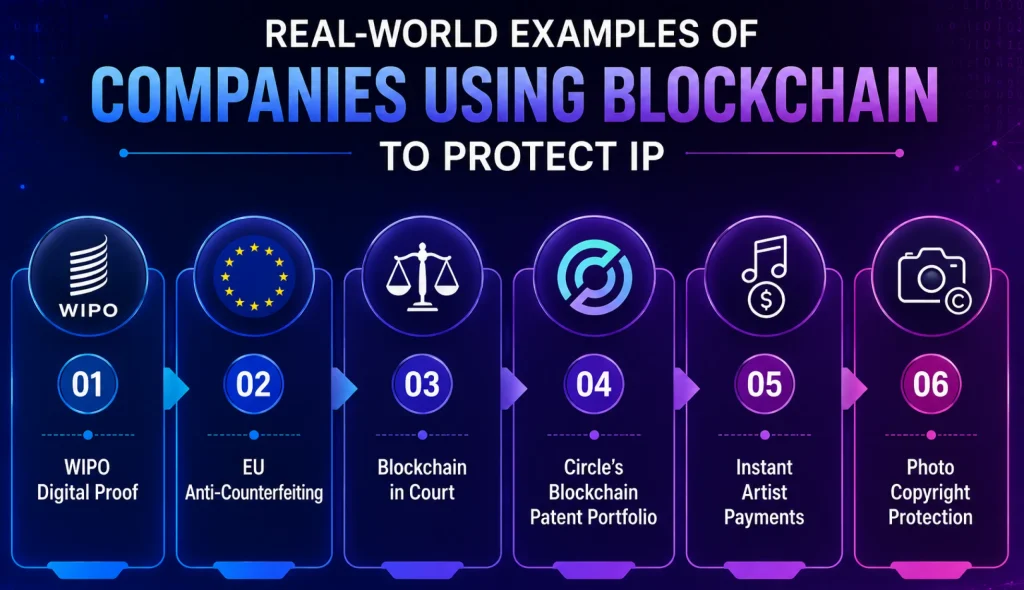
Real-World Examples of Companies Using Blockchain to Protect IP
Theory is one thing. Real-world adoption is another. These companies continue to use blockchain for IP protection today, not just in pilot programs.
WIPO PROOF
WIPO proof was a WIPO service that created a date-and-time-stamped digital fingerprint of a file. It provided evidence that the file existed at a specific point in time and complemented WIPO’s existing intellectual property systems. The service was discontinued in 2022, but previously issued WIPO Proof tokens remain valid and can still be verified.
EUIPO Anti-Counterfeiting Blockchain Forum
This initiative creates a common blockchain infrastructure to fight counterfeit goods across the EU. It brings together brand owners, customs authorities and regulators in one common system.
Beijing’s Internet Court
This court has accepted blockchain-stored evidence in copyright infringement cases, including one against a major platform. You’ll find the full case details in the legal recognition section below.
Circle’s Blockchain Patent Portfolio
In July 2026, Circle acquired nearly 1,000 blockchain patents from IBM in a deal. This made Circle the largest blockchain patent holder in the United States. The move shows how seriously fintech companies now treat blockchain IP as a real competitive asset.
Audius & Direct Artist Royalties
Music platforms like Audius pay artists royalties directly and immediately via blockchain rails. This skips the delays that usually come with working through a label or distributor.
Blockchain Copyright Protection for Photographers
Many photographers now rely on blockchain copyright protection to settle disputes over who took a photo first. A time-stamped authentic file makes it easier to prove who took the photo first.
How to Choose the Right Blockchain Platform for IP Use Cases
Not every blockchain platform is built for IP security. Here are the key things to consider before choosing one for your business.
1. Match Your Platform to Your IP Type
Check if the platform helps with the type of IP you are protecting, whether it is a patent, copyright, or trademark. Not every platform handles all 3 the same way.
2. Verify Legal Availability to Your Target Country
Ask if records from these platforms are admissible as evidence within the courts you care about. Businesses often overlook this detail during vendor selection.
3. Look for Built-In Smart Contract Support
If you plan to license your work, confirm that the platform supports smart contracts natively. Bolting this later generally costs more and takes longer.
4. Check the Node Distribution
Ask how many nodes verify and store records on the network. More distributed nodes usually result in more powerful resistance to tampering or data loss.
5. Work With a Proven Established Vendor
Choose a blockchain application development company with a longer track record than a generic provider. Ask for IP-focused case studies, not just general blockchain projects.
6. Get Expert Guidance Before You Build
Bring in blockchain consulting services early on to map your unique IP type to the right chain structure. This avoids costly platform switching after development has already started.
Is Blockchain Evidence Legally Recognized for IP Protection?
Blockchain evidence does not carry equal weight everywhere. Here is exactly where major countries stand with real cases behind each.
United States
Courts treat blockchain timestamps as supporting evidence, not a registry option. US courts have accepted blockchain records to confirm ownership timing in copyright disputes. However, you still need formal registration for statutory damages and full legal protection.
European Union
France set a clear precedent here. In March 2025, the Marseille Court identified blockchain timestamps as valid proof of prior ownership. The case involved AZ Factory’s fashion designs against a rival brand. The court called the blockchain evidence legitimate and compelling. This ruling strengthens the case for blockchain copyright registration across the EU.
United Kingdom
UK courts still examine blockchain evidence case by case. No landmark IP ruling has set a clear precedent yet. Courts usually ask for expert testimony to explain the technology. Expect this to shift as more disputes reach trials.
India
Indian courts are cautiously opening up too. In one IP dispute, the Bombay High Court identified the value of blockchain timestamps. However, the court still requires expert testimony to explain the technology. India also requires Section 65B certificates for any electronic evidence. Without it, evidence is generally rejected outright.
China
China leads the way on this front. In 2018, ByteDance sued Baidu for copyright infringement on its Huopai platform. The Beijing Internet Court accepted the anchored hashes as valid proof. It was the first case of its kind that the court ever heard. The Supreme Court of China later confirmed blockchain evidence as legally binding nationwide.
Singapore
Singapore evaluates blockchain evidence under its existing evidence law. There is no separate blockchain-specific statute yet. Case volume is still growing, but courts have stayed open to this proof. Expect clearer guidance as more disputes reach Singapore courts.
One pattern repeats across every country. The blockchain evidence supports your case. It does not replace registration. Combine both for strongest legal protection.
Explore More: Role of Custom Blockchain Development in Modern Business Security
Limitations: What Blockchain Can’t Do for IP
Blockchain helps prove ownership. But it has real limitations, and creators need to understand them early.
1. No Legal Substitute for Registration
Patents and copyrights that have been granted are not the same as blockchain timestamps. However, you still need to register with the right IP office. Skipping this step leaves your legal protection incomplete.
2. No Built-In Dispute Resolution
Blockchain cannot decide who owns the disputed idea or design. It only proves a file existed at some point. However, courts and IP offices still make the final ownership call.
3. Uneven Legal Weight Across Countries
Some courts treat blockchain IP rights as strong supporting proof. Others still demand expert testimony before accepting it at all. This uneven recognition makes outcomes hard to predict in cross-border cases.
4. Jurisdictional Enforcement Gap
A blockchain record proves ownership, but it has no enforcement power. You still need local legal action to stop infringement in each country. This gets expensive fast when infringement spans multiple areas.
5. No Protection Against Prior Art Challenges
Blockchain cannot tell you if someone else already owns similar IP. It only timestamps your own submission. You still need a proper search and legal review before filing.
6. Data Privacy Trade-Offs
Public blockchain makes records visible to all people. Sensitive details, like a formula or design, need more care. Store the hash on-chain, and keep the raw data off-chain instead.
Blockchain adds a strong layer of proof. However, full protection does require registration. And sometimes legal review, and occasionally a great blockchain consulting services partner to plan it right.
Challenges of implementing Blockchain in Intellectual Property
Blockchain is not a perfect fix and comes with significant trade-offs. Here are the top obstacles companies face and a way to work around them.
1. Challenge: Cost of Multi-Jurisdiction Compliance
Solution: Budget for local legal review in every country where you plan to enforce rights. This keeps your security strategy realistic instead of one-size-fits-all.
2. Challenge: Network Slowdowns at Scale
Solution: Choose structures with layer-2 scaling or single-chain options for heavy use. This keeps performance steady even as your record volume grows.
3. Challenge: NFT Ownership Confusion
Solution: Clearly state the rights you transfer in every license agreement. This avoids NFT intellectual property disputes after the sale or license has expired.
4. Challenge: IP Tokenization Awareness
Solution: Bring specific blockchain-IP advice early in the process. This is what IP tokenization really means in practice: licensing sensitive formulas without ever exposing them.
5. Challenge: High Enterprise Setup Cost
Solution: Start with a pilot on one IP category before scaling across the organization. It confirms the platform works for your needs, and it limits your upfront risk.
6. Challenge: Data Privacy Conflicts
Solution: Store the hashes on-chain and keep sensitive data off-chain. This helps you stay compliant, while still getting a reliable proof record.
Future of Blockchain in Intellectual Property
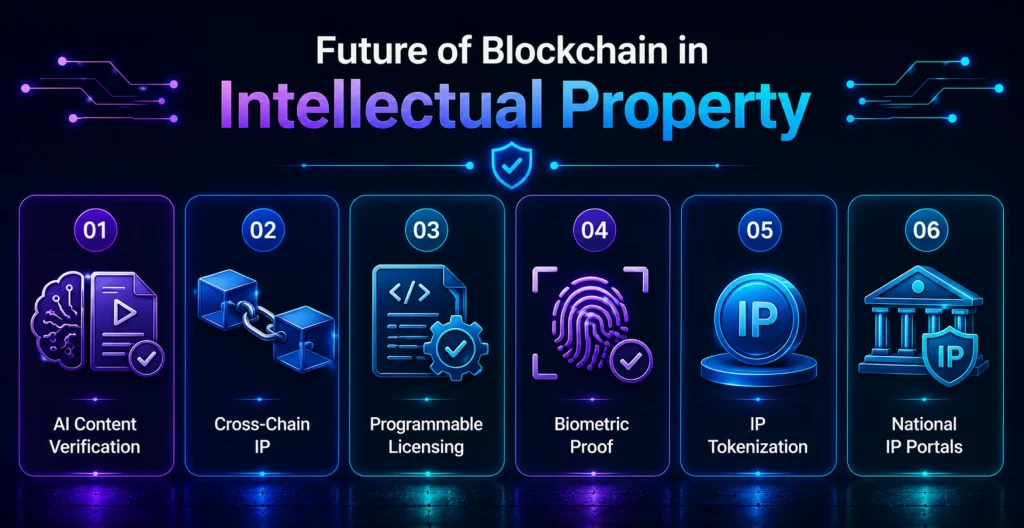
Blockchain will continue to evolve over the next two years, much further beyond the simple timestamp. Here’s what comes next for IP protection.
AI Content Verification
Ownership disputes over AI-assisted work will push blockchain into becoming the default proof-of-authorship layer. This is a process almost no modern manual addresses directly.
Cross-chain IP
Blockchain networks will verify a single work across multiple blockchains instead of tying it to one chain. This solves a real problem that creators face today.
Programmable Licensing
Royalty rates will change automatically based on real-time usage data. This moves the license away from static terms that expire within a year.
Biometric Proof
Wearable devices can also integrate data with blockchain timestamps to verify authorship. This makes it much harder to fake or dispute who honestly created something.
IP Tokenization
Companies will likely license formulas and processes without ever exposing the actual underlying formula. This opens up licenses for IP, which was previously too sensitive to share.
National IP Portals
Expect governments to move beyond today’s pilot programs into fully functional blockchain verification systems. This gives creators a direct, official way to verify records.
How Businesses Can Implement Blockchain for IP
Rolling out blockchain to IP doesn’t have to be complicated anymore if you follow the right steps. Here is a smart way to start.
1. Audit Your IP Assets First
Start by identifying the assets you want to protect most urgently, whether they’re patents, designs, or content libraries. This allows you to prioritize instead of trying to protect everything at once.
2. Choose the Right Blockchain Type
Choose public for transparency, private for privacy, or a hybrid for a mix of each. Your choice affects cost, speed, and who can access your data.
3. Bring In Specialists for Licensing Automation
You need a team for smart contract development to automate the license and royalty terms on the first go. Poorly written smart contracts can create bigger issues than they can solve.
4. Run the Pilot Before Scaling
Test the tool in one product line before rolling it out across the organization. This helps you identify issues early, while the cost of resolving them remains low.
5. Bring In Developers With The Right Experience
Hire blockchain developers who have worked in IP-focused structures, not just broad crypto apps. This gap in experience quickly shows itself once the real legal requirements come into play.
6. Train Your Legal Team
Make sure your legal team knows how blockchain evidence holds up for your target market. This keeps your security strategy aligned across departments.
Cost of Developing A Blockchain IP Management Platform
The cost varies depending on the blockchain type, number of integrations, and compliance requirements. Here’s a clear breakdown to help you budget.
| Platform Type | Core Features | Estimated Cost (USD) |
| Basic timestamping tool | Single-file proof of creation, hash generation, basic verification | $8,000 – $20,000 |
| Mid-size platform | Smart contract licensing, royalty automation, multi-user access | $25,000 – $60,000 |
| Enterprise-grade platform | AI infringement detection, multi-chain support, custom integrations | $70,000+ |
| Ongoing maintenance | Audits, node hosting, updates, and support (annual) | 15% – 20% of build cost per year |
Get an Accurate Estimate in Advance
Getting a clear blockchain app development cost estimate prevents unexpected costs. It also makes budgeting and approvals easier. Retailers should break down costs by feature, and not give one flat number.
Maintenance Factor From Day One
Ongoing maintenance, audits, and node hosting typically add 15 to 20% annually to the development cost. Planning for this in advance avoids gaps in coverage later.
Protect Your IP Rights With Octal IT Solution
Octal IT Solution creates custom blockchain structures for patents, copyrights, and trademarks.
Smart contract licensing and AI-based infringement monitoring require multiple solutions. Our team helps bring them together in one streamlined system. We work across industries including entertainment, pharma, fashion, software, and manufacturing.
Blockchain in intellectual property protection needs to fit your business, not the other way. That’s how we design every platform we build. Talk to our team to review your platform, timeline, and budget.
Conclusion
IP theft moves quickly, so your protection strategy should too. Blockchain doesn’t replace patent office records. Instead, it adds instant proof-of-ownership. But it gives you something they can’t: instant, tamper-proof, persistent proof of ownership. Combine it with legal registration, and you protect your IP on both fronts.
Companies adopting this approach in 2026 can reduce disputes and speed up royalty payments. They may also have stronger legal positions by 2030. Blockchain is no longer just another IP protection tool. It is becoming a tangible, functional part of how seriously companies protect what they invent.


 Get in Touch
 By
By September 8, 2026