


The field of manufacturing Data analytics is transforming how manufacturing operations are conducted by utilizing AI, IoT, and machine learning to restructure production data in the form of actionable insights. It increases efficiency, quality of products, and decision making, and cuts costs and downtime. The most important ones are predictive maintenance, quality control, supply chain optimization, and energy management. The benefits of EHRS, such as enhanced productivity, sustainability, and customer satisfaction, are enormous despite the challenges, such as data silos, high implementation costs, and cybersecurity risks. The future frontier, powered by AI, digital twins, and edge analytics, will bring smart, connected, and sustainable factories. Octal IT Solution provides personalized analytics solutions to help manufacturers become data-driven and grow and innovate.
Introduction
Data analytics in manufacturing has become a driving force of innovativeness, efficiency, and competitiveness. With changes in manufacturing processes with Industry 4.0 technologies, the companies are resorting to the use of data-driven insights to streamline operations, minimizing costs and enhancing efficiency and quality.
According to Mordor Intelligence, the global big data analytics in the manufacturing industry was valued at USD 7.30 billion in 2025 and is projected to grow to USD 14.30 billion by 2030, reflecting a CAGR of 14.40%. This rapid growth highlights manufacturers’ increasing focus on transforming shop-floor data into actionable, real-time insights that minimize downtime, enhance production efficiency, and mitigate the impact of raw material price fluctuations.
With modern technologies such as AI, IoT, and machine learning, manufacturers can now derive actionable insights from large volumes of production data.
Octal IT Solution is delivering smart, scalable digital transformation services that help manufacturers make informed decisions, forecast equipment failures, streamline resources, and achieve sustainable growth.
This blog discusses what data analytics in manufacturing is, its main applications, the benefits and challenges of data analytics, and how it will transform the manufacturing world.
What is Data Analytics in Manufacturing?
Data analytics in manufacturing is the intentional deployment of data collection, processing, and analysis to improve various facets of production.
It involves the utilization of real-time and historical information that machines, sensors, and systems produce to maximize outputs, minimize wastes, and the general efficiency of operations.
Simply put, it concerns processing the raw factory data into something thatis meaningful to aid the decision-making process. This will entail the detection of inefficiencies, product quality, and supply chain management.

The Importance of Data Analytics in Manufacturing
The importance of data analytics in the manufacturing sector is that it transforms data into a strategic resource. Businesses generate mountains of data daily, whether it’s production lines and supply chains or customer feedback and energy consumption. In the case of no adequate analysis, this information will not be used.
By implementing robust data analytics systems, manufacturers can:
- Gain complete visibility into operations.
- Predict and prevent costly downtimes.
- Enhance product quality and customer satisfaction.
- Optimize resources and reduce waste.
- Enable faster and more confident decision-making.
In a nutshell, data analytics in manufacturing aims to establish a responsive, smart, and efficient manufacturing environment where decisions are based on facts rather than assumptions.
The Role of Data Analytics in Manufacturing
Data analytics are not only helpful in monitoring machines; they can also enable digital transformation in manufacturing. Analytics helps manufacturers understand production trends and demand forecasts and maintain consistent product quality.
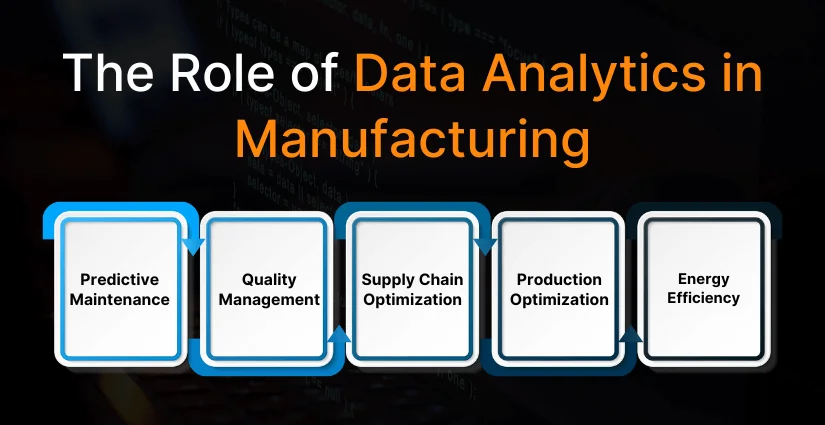
Some of the most crucial roles include:
1. Predictive Maintenance
Predictive analytics enable manufacturers to anticipate equipment failures before they occur, minimizing downtime.
2. Quality Management
Analytics assists in identifying the weaknesses at an early stage and thereby putting the best product to the market.
3. Supply Chain Optimization
The logistics and inventory are enhanced by analytics.
4. Production Optimization
One of the things that can be done to balance workloads, increase the efficiency of lines, and reduce operational bottlenecks is the use of advanced analytics.
5. Energy Efficiency
Cost reduction and increased sustainability can be achieved through analysis of energy consumption data.
These functions underscore the application of data analytics in manufacturing to develop a smarter, more agile ecosystem.
Also Read: IoT in Manufacturing: Top Use Cases and Benefits to Know
Applications of Data Analytics in Manufacturing
The application of data analytics in manufacturing industry spans several sectors. Analytics alters the way manufacturers plan, produce, and deliver goods from production floors to supply chains. We should discuss the most outstanding use cases.
1. Predictive Maintenance
Predictive maintenance is one of the most useful data analytics applications in manufacturing. The old-fashioned maintenance process is either reactive or planned, resulting in unnecessary downtime or component wear. In predictive analytics, data from machines such as vibration, temperature, and pressure is continuously monitored. The AI algorithms can then predict when a machine is likely to break down, allowing maintenance teams to plan proactively.
2. Quality Control
Another important way to use data analytics in manufacturing is to ensure product quality. The sophisticated data models detect deviations in real time and identify the causes of defects. Such a proactive solution ensures stable product quality and reduces waste and rework costs.
3. Supply Chain Optimization
Another way that data analytics improves supply chain visibility is by predicting demand fluctuations, better inventory control, and performance of suppliers. Live information will ensure that the right materials are delivered at the right time which will reduce the holding cost and improve efficiency.
4. Process Optimization
The results of analysis of the production lines can help manufacturers to find out the inefficiencies and optimize the processes. This leads to a reduction in cycle time, throughput improvement, and utilization of resources is enhanced.
5. Energy Management
The cost of manufacturing takes a huge portion of the energy expenses. The patterns of energy consumption can be traced through analytics, as well as allow companies to approve costs and even set a sustainability goal.
6. Demand Forecasting
The complicated predictive models are based on past and market data in order to predict the future demand. This will enable better manufacturing planning, reduced overproduction, and satisfaction amongst the customers.
7. Product Development
The data analytics assists in the innovation process by analyzing customer feedback and market trends, and in the design and development of products to effectively address the emerging needs.
These data analytics in manufacturing examples will show that analytics will be used to promote efficiency, innovation, and profitability at every level of manufacturing.
Benefits of Data Analytics in Manufacturing
The data analytics advantages in the manufacturing industry are very extensive and deep. Now, we are going to take a closer look at some of the biggest benefits that manufacturers gain when they embrace the data-driven approach:
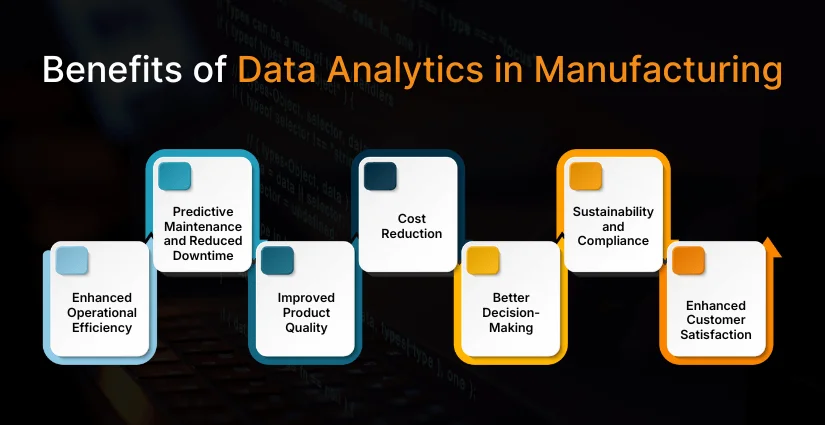
1. Enhanced Operational Efficiency
Analytics identifies inefficiencies and bottlenecks in production and helps companies streamline processes and maximize throughput. This reduces the cost of operation and increases the output.
2. Predictive Maintenance and Reduced Downtime
Predictive maintenance reduces unexpected maintenance of equipment, and this saves the money that would have been spent on machine downtime and repair. This guarantees production, which is constant and dependable.
3. Improved Product Quality
The quality monitoring is in real time, which means that any deviation is revealed in time, minimizing the defects and rework. Consequently, producers provide superior products at all times.
4. Cost Reduction
Data analytics allows smarter energy consumption, better inventory management, and less waste, which will significantly decrease operating expenses.
5. Better Decision-Making
Managers cano make better and more strategic decisions that are informed by facts rather than by intuition.
6. Sustainability and Compliance
Data analytics assists in monitoring the energy use, gases, and waste products, which will be compliant with the environmental standards and assist in sustainability projects.
7. Enhanced Customer Satisfaction
Happier customers will be the result of better quality of products, quicker delivery, and increased customization options that will drive long-term business growth.
Finally, the impact of data analytics in manufacturing is not limited to operational efficiency, but a data-driven culture that creates innovation and competitiveness.
Read More: Data Analytics in Insurance Industry: Key Use Cases & Benefits
Challenges of Data Analytics in Manufacturing
It is impossible to overlook the challenges of data analytics in manufacturing, as the benefits are huge. The manufacturers have to surmount a number of challenges in order to realize their full potential:
1. Data Silos and Integration Issues
Manufacturers usually gather information on a number of systems and machines that are not integrated. Such silos render the achievement of a single perspective on activities challenging.
2. Data Quality and Accuracy
To be effective, analytics requires data to be correct, comprehensive, and prompt. Poor data that is inconsistent will generate unreliable insights.
3. High Implementation Costs
Implementing sophisticated analytics systems is costly in terms of infrastructure, software, and professional staff- limitations for small companies.
4. Lack of Skilled Talent
There is a high demand for data science and analytics skills. Most of the manufacturing firms find it difficult to identify skilled professionals to oversee their analytics projects.
5. Cybersecurity Risks
Manufacturers are more exposed to cyber threats to sensitive production and operational data as they are becoming more data-driven.
6. Resistance to Change
The implementation of data-driven approaches tends to be opposed by employees who are used to the old way of running things.
To address these obstacles, a tactical plan, such as staff training, safe data handling, and cooperation with reliable technological specialists, will be needed, such as the Octal IT Solution.
Future of Data Analytics in Manufacturing
The future of data analytics in manufacturing is so bright with the development of technologies of Artificial Intelligence (AI), Machine Learning (ML), and the Internet of Things (IoT). The innovations will also help manufacturers to attain unprecedented efficiency, customization, and sustainability.
1. AI-Driven Automation
AI will contribute significantly to collecting, analyzing, and making decisions automatically. Intelligent factories will be able to self-optimize and modify the processes automatically based on current data.
2. Edge Analytics
With the increase in the number of IoT devices, edge analytics, or analysis of data in the location of collection, will enable quicker responses and immediate reaction, cutting down on latency and reliance on cloud infrastructure.
3. Digital Twins
The virtual image of a physical object, digital twins, will enable manufacturers to model the production process and forecast its performance in different conditions, which will further enhance efficiency and innovation.
4. Sustainability Analytics
With the increasing environmental laws and regulations, analytics will assist manufacturers in tracking and reducing their carbon footprints, waste, and energy usage.
5. Collaborative Analytics Ecosystems
The future will see manufacturers using cloud-based technologies enabling real-time interaction between suppliers, partners, and customers, which will lead to transparency and responsiveness.
Essentially, the future of data analytics in manufacturing lies in designing a complete, connected, intelligent, and sustainable manufacturing environment.
Learn More: Machine Learning in Manufacturing: Key Use Cases and Benefits
Impact of Data Analytics in Manufacturing
The influence of data analytics on manufacturing is felt in all the domains of the value chain, such as product design and production, distribution, and customer interaction. Data-driven manufacturing guarantees the improvement of the decision-making process, the increase of efficiency, and profitability.
By using advanced analytics, manufacturers can:
- Shorten production cycles
- Improve product customization
- Strengthen supply chain resilience.
- Drive innovation through R&D insights.
Finally, data analytics will make manufacturing a smart, adaptive, and customer-driven sector.
How is Data Analytics Used in Manufacturing?
It is interesting to know how data analytics is used in manufacturing and to discover its real potential. This is how the major manufacturers are using analytics in their day-to-day activities:
- Collecting data from machines, sensors, and ERP systems.
- Cleaning and processing data to ensure quality and reliability.
- Analyzing patterns and correlations to identify opportunities for improvement.
- Visualizing results through dashboards for real-time decision-making.
- Automating adjustments in production processes based on analytics insights.
Such systematic data utilization makes the manufacturers remain competitive, flexible, and adaptable to market forces.

Conclusion
The advent of data analytics in manufacturing is a groundbreaking change in the manufacturing process, product delivery, and product optimization. Through converting the raw data to practical intelligence, manufacturers are able to both increase productivity and cut costs, and produce high-quality products more quickly than in the past.
With the continued rise in the application of data analytics to manufacturing, the companies preparing to adopt it will be at the forefront of the industrial revolution. Nonetheless, the key to achieving success lies in eliminating such obstacles as data silos, skills gaps, and cybersecurity issues.
As a leading custom software development company, Octal IT Solution, we assist manufacturers to use the best of analytics with tailor-made solutions integrated with AI, IoT, and advanced data visualization. We will enable your business using real-time insights, which will inspire smarter decisions, performance, and sustainable growth.
No matter your area of interest, be it predictive maintenance, process optimization, or digital transformation, Octal IT Solution can be your reliable technology ally in the data-driven future of manufacturing.
FAQs
Data analytics is important to enhance efficiency, product quality, and decision-making. By considering machine, sensor, and production system data, manufacturers can identify inefficiencies, anticipate equipment failures, and plan operations to improve performance and eliminate unnecessary costs.
Predictive maintenance is based on real-time data and artificial intelligence models that can predict equipment failure before it happens. This will reduce unexpected downtime and increase the life span of the machine, minimizing the cost of maintenance, and the production cycles will become much smoother.
Although expensive analytics systems may be required, scalable and cloud-based solutions are currently available to small and medium-sized manufacturers. Collaboration with technology vendors such as Octal IT Solution can be used to deliver cost-efficient and tailored analytics solutions.
Manufacturing analytics takes the inputs in the form of data, which is provided by sensors (IoT devices), ERP systems, supply chains, quality control systems, and energy meters. Such detailed information gives a 360-degree perspective of the operations of production and contributes to data-informed decision-making.
Data analytics enables manufacturers to monitor and optimize energy use, reduce waste, and track emissions. By identifying inefficiencies and supporting eco-friendly practices, organizations can meet sustainability goals and comply with environmental regulations.
The information analytics help manufacturers to track and streamline the energy consumption, cut down waste, and monitor emissions. As it finds the inefficiencies and promotes environmentally friendly activities, it contributes to the achievement of the sustainability objectives and adherence to environmental standards by the organization.


 Get in Touch
 By
By September 18, 2025