


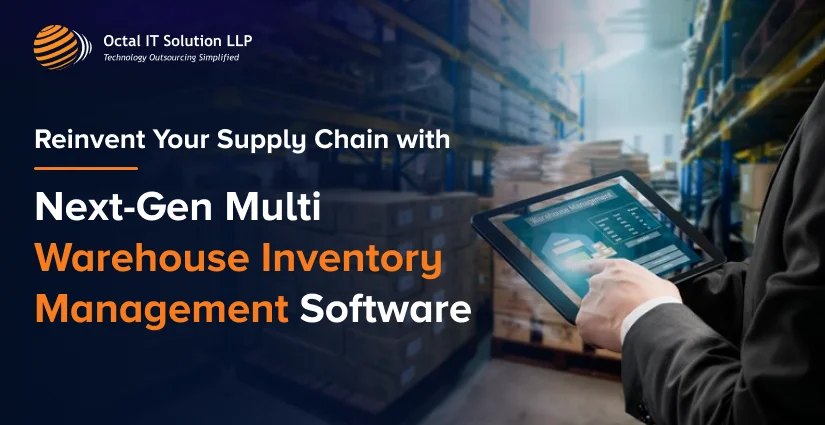
Modern supply chains are dynamic, and thus manual tracking, fragmented spreadsheets, and conventional warehouse tools are not sufficient for their management.
Customers are increasing in number and demanding faster fulfillment times, so businesses should be able to implement mighty digital systems that will make everything visible, intelligent, and automated in real time. It is at this point that multi-warehouse inventory management software comes in as a game-changer.
The global inventory management software market was valued at USD 2.31 billion in 2024, and is projected to reach USD 4.79 billion by 2032, reflecting a CAGR of 9.6% over the forecast period. Due to such popularity, the demand for top digital transformation services providers like Octal IT Solution has increased considerably.
Modern businesses are spread across various locations, operate omnichannel markets, and rely on the accuracy of stock flows.
To remain competitive, organizations are currently resorting to next-gen inventory management systems that are meant to ease workflow, cut operational expenses, and increase the efficiency of supply chains to a great extent.
Why Businesses Need Multi-Warehouse Inventory Management Today
Below are some reasons why multi-warehouse inventory management has become essential today.
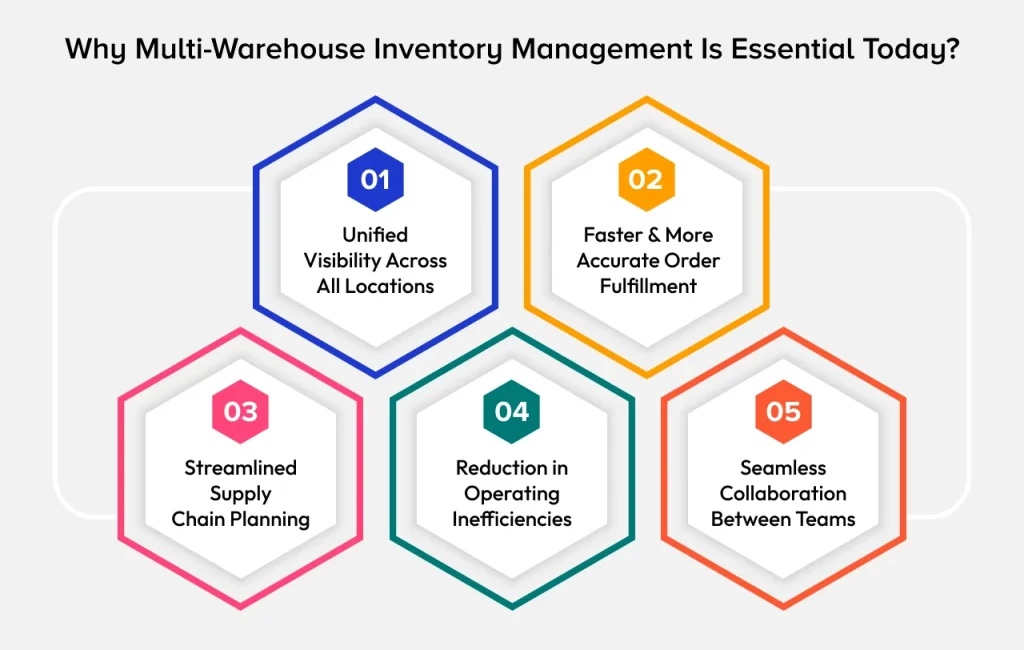
1. Unified Visibility Across All Locations
Centralized visibility enables organizations to monitor the amount of stock, incoming shipments, and outgoing orders at a number of warehouses in real time. This does away with any blind spots, minimizes discrepancies, and enhances replenishment, order routing, and demand forecasting decisions.
2. Faster & More Accurate Order Fulfillment
A multi-location system is helpful in smart order allocation. It can automatically select the most suitable warehouse to fulfill an order using available stock, distance, and delivery timeframes, thereby minimizing shipping delays and increasing customer satisfaction.
3. Streamlined Supply Chain Planning
Combinations of advanced analytics and supply chain management software aid in enabling the business to fit the distribution of inventory more effectively. It is possible to predict demand, seasonal changes, and the needs of a particular region, reducing the risks of stockouts and surpluses.
4. Reduction in Operating Inefficiencies
Manual errors are minimized by automating daily jobs in the warehouse, such as stock transfers, audits, reorder notifications, and shipping documents. This has a significant impact of saving labor expenses and at the same time bringing about increased consistency of operations in any distribution center.
5. Seamless Collaboration Between Teams
Because there is only one platform where all the data is sent, it is easy to coordinate the warehouse managers, the procurement team, and the logistics personnel. Live dashboard boards keep all the people in line with up-to-date stock knowledge and working priorities.
In the future, companies that seek innovation usually address a custom software development company to create unique applications to meet such complicated demands.

Common Multi-Warehouse Challenges and How the Right Software Solves Them
Managing stock across several locations brings problems that single-warehouse tools were never built to handle. Here are the most common ones and how a modern system addresses them.
1. Inaccurate Stock Counts Across Locations
When each warehouse updates its records separately, the numbers rarely match. Real-time synchronization keeps one verified count for every SKU, so teams stop working from outdated data.
2. Overstocking in One Location, Stockouts in Another
Without cross-warehouse visibility, surplus stock sits idle in one place while another runs dry. Automated stock-transfer rules and demand-based replenishment keep inventory balanced.
3. Rising Shipping and Fulfillment Costs
Orders shipped from the wrong location mean higher freight costs and slower delivery. Smart routing picks the nearest or most cost-effective warehouse automatically.
4. Disconnected Systems and Data Silos
ERP, eCommerce, POS, and accounting tools often run in isolation, which leads to manual entry and mistakes. API-based integrations connect them into a single flow of data.
5. Limited Planning and Forecasting Insight
Spreadsheets cannot reveal regional demand patterns or seasonal trends. Built-in analytics help teams plan purchasing and allocation with confidence.
Must-Have Features of Next-Gen Multi-Warehouse Inventory Management Software
Let us go through the major features that should be included in multi-warehouse inventory management software development.
1. Centralized Stock Database with Real-Time Sync
The system updates stock levels immediately in all channels and warehouses. This will avoid overselling, facilitate omnichannel selling, and ensure customers are never misled when purchasing products.
2. Intelligent Inventory Routing Algorithms
The newest invention uses AI-driven logic to send an order to the most efficient warehouse. The metrics for decision-making can include customer location, stock status, and service level, enabling the fulfillment strategy to be optimized without human intervention.
3. Barcode, RFID & IoT Integration
The use of modern tracking devices will aid in automating the process of counting, picking, and replenishing. The RFID- and IoT-based sensors help increase precision, minimize losses, and provide detailed information on product flow across the supply chain.
4. Multi-Channel Sales & Marketplace Integration
The software is compatible with online shops, marketplaces, and POS systems. This keeps the inventory of diverse orders in check when orders are received through different channels, and this prevents discrepancies that cause delivery errors.
5. Role-Based Access & Enhanced Security
The cloud-based systems will provide secure access to the data available on any device with tight control of user access. The sensitive transactional information is safeguarded against unauthorized access through audit logs, encrypted communication, and permission layers.
In other areas of the online space, businesses are adopting Custom software development services to make these features a part of their current working ecosystems.
How Cloud-Based Inventory Management Software Accelerates Digital Transformation
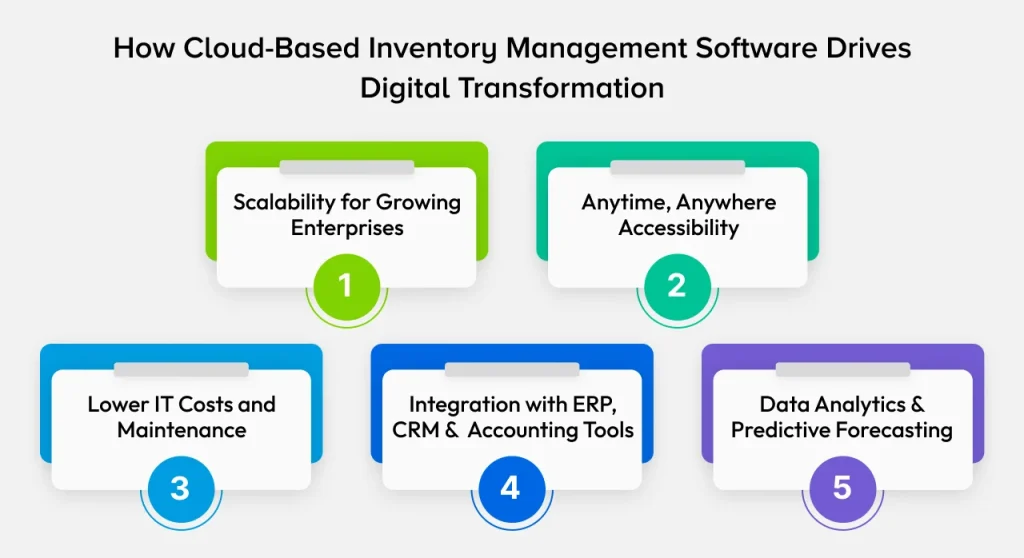
1. Scalability for Growing Enterprises
New warehouses, product categories, and user roles can be added to businesses with ease without limitations of the infrastructure. An inventory management software platform based on the cloud is expandable, hence allowing growth of the organization across geographical frontiers.
2. Anytime, Anywhere Accessibility
The implementation of the cloud enables teams to get insights on inventory remotely, an ideal scenario when a company has one or more warehouses distributed or even outsources logistics services. This contributes to timely decision-making and preparedness for disaster response.
3. Lower IT Costs and Maintenance
Cloud App development do not require costly on-site servers and frequent updates. Upgrades, security patches, and performance optimization are done by the service provider to minimize technical overhead and optimize system uptime.
4. Seamless Integration with ERP, CRM, and Accounting Tools
A fully networked system is in place to assist in the automation of purchase orders until shipping. Enterprise integration enhances financial precision, increases the synchronization of operations, and facilitates the integration of a unified digital environment.
5. Data Analytics & Predictive Forecasting
Complex analytics convert raw data to actionable information. By understanding the sales trends, businesses can also optimize their stock placement and predict future inventory needs, which helps them keep their supply chain lean and profitable.
It is also worth mentioning that organizations that have applied the mentioned transformations can also engage a CRM software development company to coordinate the sales and warehouse flows.

How to Choose the Right Warehouse Management Software for Your Business
1. Evaluate Industry-Specific Capabilities
The retail, manufacturing, pharma, and eCommerce sectors have dissimilar inventory problems. The most suitable warehouse management software solutions must support specialized operations such as batch tracking, cold storage, and kitting and assembly.
2. Check for Multi-Location Support & Stock Transfer Efficiency
A strong system allows the transfer of stock among warehouses within a short time and provides proper documentation. Routing and FIFO/FEFO controls can also be automated, which also contributes to the quality and consistency of products and operations.
3. Integration Flexibility with Existing Systems
Regardless of whether a company employs ERP, shipping tools, or procurement modules, it is vital to ensure that these are seamlessly integrated. It has APIs and third-party connectors, which are supported on a flexible platform to ensure that there is smooth movement of data through the business systems.
4. Customization and Workflow Automation
The solution chosen should be able to provide customizable workflows, automation via set rules, and custom dashboards. This flexibility enables the system to accommodate the operations of the firm, instead of requiring changes to the processes.
5. Scalability and Long-Term ROI
An enterprise inventory management system is not only future-proof but also designed to accommodate your present needs, and as you grow, it is ready to accompany you. Consider licensing, scalability of features, and support alternatives to achieve maximum long-term value.
A large-scale modernization of companies usually depends on the services of an enterprise app development company to develop extensive supply chain ecosystems aligned with each other.
How to Implement Multi-Warehouse Inventory Management Software Successfully
It is just half the battle when selecting a platform. Planning your implementation strategy ensures that you do not have any downtime, inaccurate data, or lack of team adoption.
1. Audit Your Current Inventory Processes
Identify processes around the receipt, storage, shipment, and transfer of goods at each of your locations. Highlight areas where there is room for error and inefficiencies, because these will be your requirements.
2. Define Goals and Requirements
Define what your goals are, for example reduction of stock-outs, improved order fulfillment rates, etc., and list all your requirements, including ERP, eCommerce, POS, and accounting integration needs.
3. Clean and Migrate Your Data
Ensure standardization of SKUs, units of measurement and supplier information before importing into your new inventory management system. It will save you from a lot of errors in the long run.
4. Integrate and Configure Workflows
Integrate your new platform with other systems and configure routing criteria, reordering policies, and transfers. First, conduct a pilot implementation at one of your warehouses.
5. Train Teams and Scale Gradually
Train people in logistics, warehousing, and procurement on the new workflows. Conducting a pilot first will enable you to identify any bugs.
Multi-Warehouse vs. Traditional Inventory Management: A Quick Comparison
| Feature / Capability | Traditional Systems | Multi Warehouse Inventory Management Software |
| Real-Time Updates | Limited, often manual | Instant updates across all locations |
| Order Routing | Manual decision-making | AI-driven intelligent routing |
| Multi-Channel Sync | Minimal support | Unified synchronization across platforms |
| Tracking Technology | Barcode-focused | RFID, IoT, and advanced automation |
| Scalability | Hard to expand | Easily scalable across warehouses |
| Data Analytics | Basic reporting | Predictive analytics & insights |
Future-Proof Your Supply Chain with Multi-Warehouse Inventory Management
Modern commerce is developing at an extremely fast rate that requires agility, speed, and precision, which the old system of inventory cannot provide. Next-gen multi-warehouse inventory management software will enable the business to have real-time visibility, streamline workflow, and provide powerful analytics.
These systems save costs, minimize mistakes, and improve customer satisfaction by achieving effective delivery across destinations.
Digital transformation is either a new experience or an upgrade of old systems; either way, investing in superior inventory technology will future-proof your supply chain.
With the right inventory monitoring software across multiple sites, the enterprise can optimize every level of its operations and build long-term competitiveness in an ever-changing marketplace.
When your organization wants to develop a flexible, scalable, and integrated system, an automation-based, cloud-based, real-time analytics supply chain management software platform will open the gateway to invincible operational efficiency.
FAQs
Next-gen systems use centralized cloud architectures, IoT integrations, and automated data syncing to provide instant visibility into stock levels, movements, and demand across every warehouse. This eliminates data silos and ensures all teams access the same accurate, real-time information.
Yes. Advanced multi-warehouse platforms can automatically recommend or initiate stock transfers based on preset rules, such as minimum stock thresholds, demand spikes, or regional sales trends. This helps prevent shortages and reduces excess inventory.
Most next-gen solutions offer seamless API-based integrations with popular ERP systems, online marketplaces, accounting software, and POS tools. This ensures smooth data flow across your operational ecosystem and prevents manual data entry errors.
These platforms are designed to scale easily, allowing businesses to add new warehouses, product lines, or sales channels without disrupting workflows. Automated planning, AI-driven forecasting, and flexible configuration options enable the system to adapt as operations expand.
The cost depends on the number of warehouses and users, as well as on required functionality and the number of systems to be integrated. Subscription-based products are charged per user or per location, while custom software requires development costs but suits your workflows. Clarifying the needs will give you an idea of the cost.
The implementation period depends on the level of complexity of your processes and the amount of data. Ready-made software may be configured within a few weeks, while a custom or enterprise-grade system with a number of integrations will take a few months. You may start with one warehouse to mitigate risks.
Inventory management software is responsible for stock quantity, orders and replenishment. WMS covers more complex tasks including bin location, picking and packing workflow, and labor management. Sometimes companies employ both of these solutions or choose a solution that combines both.


 Get in Touch
 By
 November 4, 2026