



Key Insights
- The cost to develop a taxi app like Hala Taxi depends on features, complexity, and team location, with MVP being a cost-effective starting point.
- The ride-hailing market is expected to reach $188.60 billion by 2026, showing strong future growth potential.
- AI, real-time tracking, and analytics are key trends driving efficiency and better user experience.
- Multiple revenue models like commission, surge pricing, and subscriptions improve profitability.
- Apps like Hala Taxi show how smart features and local strategies help succeed in competitive markets.
Brief Introduction to Ride-Hailing Apps like Hala Taxi
Before discussing the Hala taxi booking app development cost, let’s talk about the question that most business owners ask: Is building this app the right decision for your business? Yes, investing in ride-hailing apps like Careem Taxi is a competitive move, given the continued growth in demand in the global market.
According to the projection, the ride-hailing market is expected to reach US$ 188.60 Bn by 2026. Furthermore, the annual growth rate 2026-2030 of 5.08% is expected to result in a projected market volume of US $229.98 bn by 2030.
These increasing numbers are very fascinating and provide an opportunity for businesses to be one of the top competitors in a growing market. Now that you know, investing in this industry can provide you with some amazing opportunities. Moving forward to the question of what needs to be considered, the cost of development, and where to start, let’s jump into the blog.
In this blog, we will cover all the questions related to the cost and what are the major factors that can positively or negatively impact the growth.
Understanding the Cost to Build a Taxi Booking App like Hala Taxi in 2026
The overall cost to develop a taxi app like Hala depends not only on a single thing; it depends on diverse factors. These can be complexity, geographical location of the taxi booking app development company, and the user experience we are focusing on.
On average, the development cost of a taxi booking app in Dubai can range somewhere around AED 128,000- AED 1 Million+ ($5000- $300,000).
To break down this development price, let’s explore Hala taxi-like app development cost ranges based on demand in the team’s geo-location.
Geographical Location of Development Team
One of the major factors that affects the Careem taxi app development cost is the selection of the team for the ride-sharing app development company. The different locations can have different prices due to the lower labor cost, communication, and legal compliance.
Average Hourly Rate by Region
| Region / Location | Hourly Rate (USD) | Hourly Rate (AED) |
| North America (USA, Canada) | $100 – $180 | AED 367 – 660 |
| Western Europe (UK, Germany) | $70 – $140 | AED 257 – 514 |
| Middle East (UAE) | $50 – $120 | AED 184 – 440 |
| Eastern Europe | $40 – $90 | AED 147 – 330 |
| India | $20 – $50 | AED 73 – 184 |
| Southeast Asia | $25 – $60 | AED 92 – 220 |
Bonus Tips-
- Choosing a local UAE-based team can help with compliance and a faster go-to-market in Dubai.
- Outsourcing to India or Eastern Europe can reduce development costs by up to 40–60% without compromising quality (if managed well).
- A hybrid model (local consultant + offshore development team) is often the most cost-efficient and scalable approach.
Cost Impact by App Complexity
The cost of developing a taxi app increases with feature complexity. Basic apps are affordable, while advanced apps with AI, analytics, and scalability require higher investment. Choosing the right taxi app development services helps balance cost and performance.
| App Complexity Level | Estimated Cost (USD) | Estimated Cost (AED) |
| Basic (Core Features Only) | $25,000 – $50,000 | AED 92,000 – 184,000 |
| Moderate (Custom UI + Advanced Features) | $50,000 – $120,000 | AED 184,000 – 440,000 |
| Advanced (AI, Analytics, Scalability) | $120,000 – $250,000+ | AED 440,000 – 920,000+ |
Key Factors Affecting the Taxi App Development Cost:
Factors like team location, features, customization, and development approach impact overall cost. Hiring an experienced taxi booking app developer ensures better planning, optimized budget allocation, and efficient development without unnecessary expenses.
| Factor | Impact on Cost | Estimated Cost Impact (USD) | Estimated Cost Impact (AED) |
| Market Demand | Medium – High | +$5,000 – $20,000 | AED 18,000 – 73,000 |
| Client Requirements | High | +$10,000 – $50,000 | AED 37,000 – 184,000 |
| Location of Development Team | High | Varies (up to 60% difference) | Varies (AED 110,000 – 600,000+) |
| In-house vs Outsourced Team | High | +$15,000 – $80,000 | AED 55,000 – 295,000 |
| Client’s Budget | Medium | Flexible (scope-based) | Flexible |
| App Complexity (Features) | Very High | +$20,000 – $150,000+ | AED 73,000 – 550,000+ |
Bonus Tip
The biggest cost driver is app complexity + customization, so businesses should focus on launching with essential features first and scaling gradually to manage investment efficiently.
Hidden Costs No One Talks About
| Cost Factor | Estimated Cost (USD) | Estimated Cost (AED) |
| Driver Onboarding & Incentives | $5,000 – $30,000+ | AED 18,000 – 110,000+ |
| Customer Acquisition (CAC) | $10 – $50 per user | AED 37 – 184 per user |
| Payment Gateway Fees | 2% – 5% per transaction | 2% – 5% per transaction |
| Cloud Hosting & Infrastructure | $500 – $5,000/month | AED 1,800 – 18,000/month |
| App Maintenance & Updates | 15% – 25% of dev cost/year | 15% – 25% of dev cost/year |
| Customer Support Operations | $2,000 – $10,000/month | AED 7,300 – 37,000/month |
| Compliance & Licensing (Dubai) | $5,000 – $20,000+ | AED 18,000 – 73,000+ |
| Third-Party Integrations | $2,000 – $15,000 | AED 7,300 – 55,000 |
Why These Costs Matter
- Many startups underestimate post-launch expenses, leading to budget overruns
- Operational costs (drivers + marketing) often exceed the initial development cost within the first year
- Ignoring compliance (especially in Dubai) can lead to legal penalties or app shutdowns
Key Features to Include and Cost Breakdown
The features required for ride hailing app like Hala Taxi vary based on different user panels- namely the passenger, driver, and admin. Each is designed to serve specific functionalities and ensure smooth operation across the platform. In this section, I tried to mention all the essential and advanced features and what the taxi app development costs according to the integration of different features.
To help businesses plan better, these features can be further divided into two categories.
- MVP ( Minimum Viable Product)- This includes all the essential features required to launch the app and test in the market and the targeted audience.
- Full-fledged Product- This includes all the advanced features and added later on to enhance the user experience, scalability, and competitive advantage.
Note- The development of the app totally depends on the client’s choice; they can either choose MVP or Full-fledged product development, depending on the budget, time constraints, and business goals.
Now, let’s break down the feature list by panel.
Passengers Panel Features
Essential Features
- User Registration/Login- Sign up via email, phone, or social media
- Ride Booking- Enter pickup/drop location and request a ride
- Real Time GPS Tracking- Track driver location in real time
- Fare Estimation-Displays approximate ride cost before booking
- Payment Integration- Supports cards, wallets, and cash
- Ratings and Reviews- Feedback system for drivers
| Feature | Estimated Cost (USD) | Estimated Cost (AED) |
| User Registration/Login | $1,000 – $3,000 | AED 3,700 – 11,000 |
| Ride Booking | $2,000 – $5,000 | AED 7,300 – 18,000 |
| Real-time GPS Tracking | $3,000 – $7,000 | AED 11,000 – 26,000 |
| Fare Estimation | $1,000 – $3,000 | AED 3,700 – 11,000 |
| Payment Gateways | $2,000 – $6,000 | AED 7,300 – 22,000 |
| Ratings & Reviews | $1,000 – $2,500 | AED 3,700 – 9,200 |
Advanced Features
- Ride Scheduling-Book rides in advance
- Multiple Stops-Add multiple destinations
- In-app Chat/Call-Communication with driver
- AI-based Fare Optimization-Dynamic pricing based on demand
- Loyalty Programs-Rewards and discounts for users
| Feature | Estimated Cost (USD) | Estimated Cost (AED) |
| Ride Scheduling | $1,500 – $4,000 | AED 5,500 – 14,700 |
| Multiple Stops | $2,000 – $4,000 | AED 7,300 – 14,700 |
| In-app Chat/Call | $2,000 – $5,000 | AED 7,300 – 18,000 |
| AI-based Fare Optimization | $3,000 – $8,000 | AED 11,000 – 29,000 |
| Loyalty Programs | $2,000 – $5,000 | AED 7,300 – 18,000 |
Driver Panel Features
Essential (MVP) Features
- Driver Registration-Profile creation and document upload
- Ride Request- Notifications, Alerts for incoming ride requests
- Navigation & Route- Mapping GPS-enabled navigation
- Earnings Dashboard-Track daily/weekly income
- Availability Toggle- Go online/offline
| Feature | Estimated Cost (USD) | Estimated Cost (AED) |
| Driver Registration | $1,000 – $3,000 | AED 3,700 – 11,000 |
| Ride Request Notifications | $1,500 – $3,500 | AED 5,500 – 13,000 |
| Navigation & Route Mapping | $2,000 – $5,000 | AED 7,300 – 18,000 |
| Earnings Dashboard | $1,500 – $4,000 | AED 5,500 – 14,700 |
| Availability Toggle | $800 – $2,000 | AED 2,900 – 7,300 |
Advanced Features
- AI-Powered Dispatch- Smart driver allocation system
- Heat Maps (Demand Areas)-Shows high-demand zones
- Performance Analytics- Insights on driver performance
- Incentive Management- Bonuses and rewards tracking
| Feature | Estimated Cost (USD) | Estimated Cost (AED) |
| AI-Powered Dispatch | $4,000 – $10,000 | AED 14,700 – 37,000 |
| Heat Maps (Demand Areas) | $2,000 – $6,000 | AED 7,300 – 22,000 |
| Performance Analytics | $2,000 – $5,000 | AED 7,300 – 18,000 |
| Incentive Management | $2,500 – $6,000 | AED 9,200 – 22,000 |
Admin Panel Features
Essential Features
- Dashboard & Analytics- Overview of app performance
- User & Driver Management- Manage users and drivers
- Ride Management-Monitor and control rides
- Payment & Commission Management- Track transactions and earnings
| Feature | Estimated Cost (USD) | Estimated Cost (AED) |
| Dashboard & Analytics | $3,000 – $8,000 | AED 11,000 – 29,000 |
| User & Driver Management | $2,000 – $6,000 | AED 7,300 – 22,000 |
| Ride Management | $2,000 – $5,000 | AED 7,300 – 18,000 |
| Payment & Commission Mgmt | $2,500 – $6,000 | AED 9,200 – 22,000 |
Advanced Features
- Surge Pricing Management- Dynamic pricing control
- Reports & Insights- Business intelligence reports
- Marketing Tools- Promo codes and campaigns
- Fraud Detection System- Prevent fake bookings and misuse
| Feature | Estimated Cost (USD) | Estimated Cost (AED) |
| Surge Pricing Management | $3,000 – $7,000 | AED 11,000 – 26,000 |
| Reports & Insights | $2,000 – $5,000 | AED 7,300 – 18,000 |
| Marketing Tools | $2,500 – $6,000 | AED 9,200 – 22,000 |
| Fraud Detection System | $4,000 – $10,000 | AED 14,700 – 37,000 |
Technology Stack Behind Taxi Booking App Development Like Careem Taxi App
The car rental app development is a tedious process and thus requires several hands-on experiences that can build a scalable, real-time, and high-performance system that can manage thousands of users, secure transactions, and also live tracking.
A well-chosen technology stack directly impacts the app’s performance, scalability, and overall development cost. Here are some of the most used technologies that can be included in the taxi booking app development.
Core Technology Stack Breakdown
Below, we have mentioned the cost to develop a taxi booking app with different technological layers.
| Technology Layer | Tools / Technologies Used | Estimated Cost (USD) | Estimated Cost (AED) | Purpose |
| Programming Languages | Swift (iOS), Kotlin (Android), JavaScript, TypeScript | $10,000 – $30,000 | AED 37,000 – 110,000 | Core app development for mobile platforms |
| UI/UX Frameworks | Flutter, React Native, SwiftUI | $5,000 – $15,000 | AED 18,000 – 55,000 | Creating intuitive and responsive user interfaces |
| Backend Frameworks | Node.js, Django, Ruby on Rails | $10,000 – $25,000 | AED 37,000 – 92,000 | Handles server logic, APIs, and real-time operations |
| Databases | PostgreSQL, MongoDB, Firebase | $3,000 – $10,000 | AED 11,000 – 37,000 | Stores user data, ride history, and transactions |
| Location & Map Services | Google Maps API, Mapbox, GPS | $2,000 – $8,000 | AED 7,300 – 29,000 | Real-time tracking, route optimization, navigation |
| Third-Party APIs | Stripe, PayPal, Twilio, Firebase Cloud Messaging | $3,000 – $12,000 | AED 11,000 – 44,000 | Payments, SMS, chat, push notifications |
| Cloud & Infrastructure | Amazon Web Services (AWS), Google Cloud Platform (GCP) | $5,000 – $20,000/year | AED 18,000 – 73,000/year | Hosting, auto-scaling, data storage, performance |
Step-by-Step Process for Developing Taxi Booking Apps like Hala Taxi
The development of a ride-hailing app such as Hala Taxi should be approached with a strategy that balances strategy, technology, and implementation. Idea validation to launch every stage is vital to the success, cost, and scalability of the app. Along with these steps, one of the most important things that one should consider is hire mobile app developers.
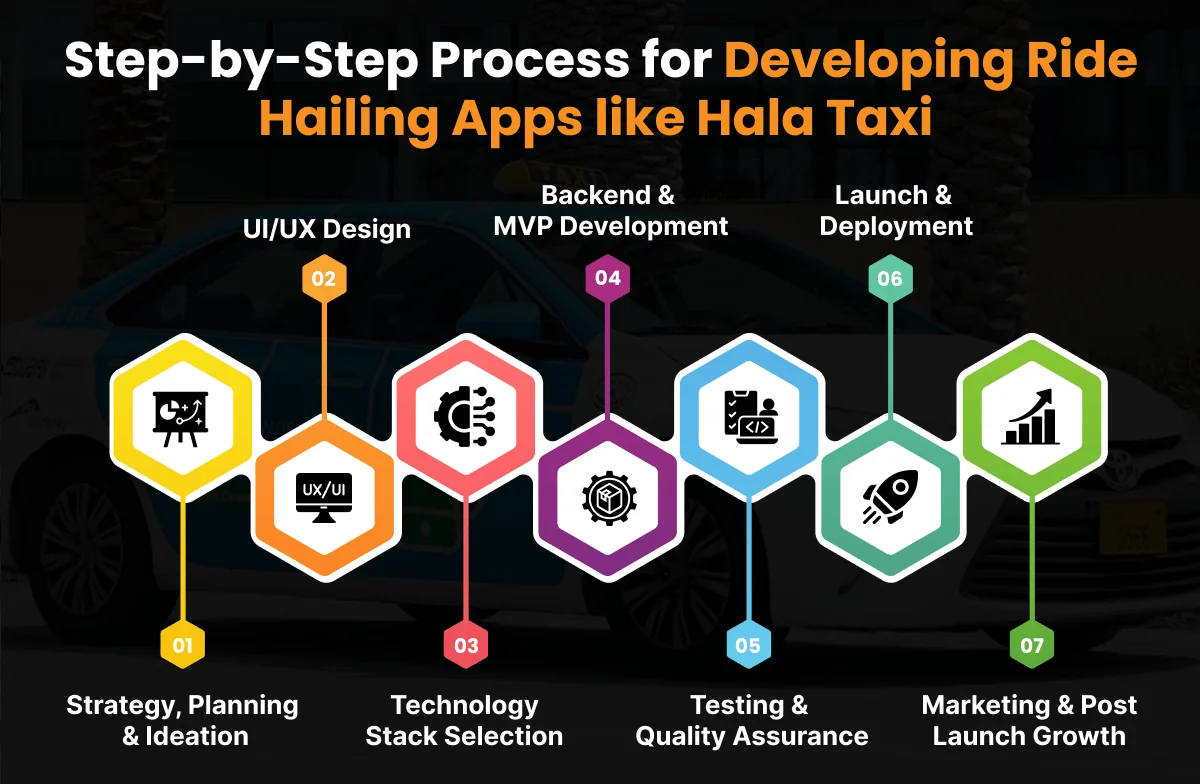
Step 1: Strategy, Planning & Ideation
Here, you will outline your business model, target audience, and unique value proposition, which forms the basis of your app development process. Competitor analysis and a choice of whether to create an MVP or a full-scale application also belong to it.
Timeline: 1–3 weeks
Estimated Cost: $2,000 – $8,000 (AED 7,300 – 29,000)
The presence of a robust planning stage will prevent unnecessary revisions in the future and will provide a successful way of development.
Step 2: UI/UX Design
After finalizing the idea, the next step will be to design an easy and smooth experience among the passengers, drivers, and the users of the administration. This involves wireframes, prototypes, and end-user design.
Timeline: 2–4 weeks
Estimated Cost: $5,000 – $15,000 (AED 18,000 – 55,000)
A properly thought-through interface enhances interaction with the users and is an important factor in customer acquisition.
Step 3: Technology Stack Selection
Choosing the right technology stack ensures your app is scalable, secure, and high-performing. This involves selecting frontend, backend, database, APIs, and cloud infrastructure. The correct technology stack will make your application scalable, secure, and high-performing. This is by choosing frontend, backend, database, APIs, and cloud infrastructure.
Timeline: 1–2 weeks
Estimated Cost: $2,000 – $6,000 (AED 7,300 – 22,000)
Proper choices in technology at this point can save a lot of money in the future in terms of maintenance and scaling.
Step 4: Backend & MVP Development
This is the fundamental stage of development where all three panels: passenger, driver, and the administration are constructed. The business is normally initiated with an MVP that can be launched faster with a minimum of features, such as ride booking, GPS tracking, and payments.
Timeline: 8–16 weeks
Estimated Cost: $25,000 – $100,000 (AED 92,000 – 367,000)
This stage takes the biggest share of the budget, since it is associated with real-time features and complicated back-end applications.
Step 5: Testing & Quality Assurance
The app is rigorously tested before it is launched to make sure that it is bug-free, secure, and can perform well under varying environments.
Timeline: 2–4 weeks
Estimated Cost: $5,000 – $15,000 (AED 18,000 – 55,000)
The appropriate testing would provide a pleasant user experience and eliminate expensive post-launch problems.
Step 6: Launch & Deployment
Once tested successfully, the application is then deployed in applications, such as Google Play Store and Apple App Store, as well as the deployment of the back-end server.
Timeline: 1–2 weeks
Estimated Cost: $2,000 – $8,000 (AED 7,300 – 29,000)
The early users and first impression are important and depend on a smooth launch.
Step 7: Marketing & Post-Launch Growth
After the app has gone live, marketing and user acquisition are the focus. These involve online campaigns, referral programs, and driver onboarding plans.
Timeline: Ongoing (initial 4–12 weeks critical)
Estimated Cost: $10,000 – $50,000+ (AED 37,000 – 184,000+)
An otherwise established app can find it hard to survive in a competitive market such as Dubai without adequate marketing.
Developing and launching a ride-hailing application, such as Hala Taxi, can be done in 4 to 8 months on average, and has a total cost of between $50,000 to 150,000 and more (AED 184,000 -550,000) depending on features, complexity, and structure.
The wiser course of action that businesses can adopt is to start small, release an MVP, and start growing slowly to maximize both costs and risks.
Future Trends that will Impact the Development of a Taxi Booking App like Hala Taxi
If you want to stay ahead of the competitive market, whether you are a small startup, a mid-level business, or an enterprise considering taxi booking app development company can provide you with the top solutions. Along with this, they have a team of expert developers who work on the growing technologies that can enhance your business outcome.
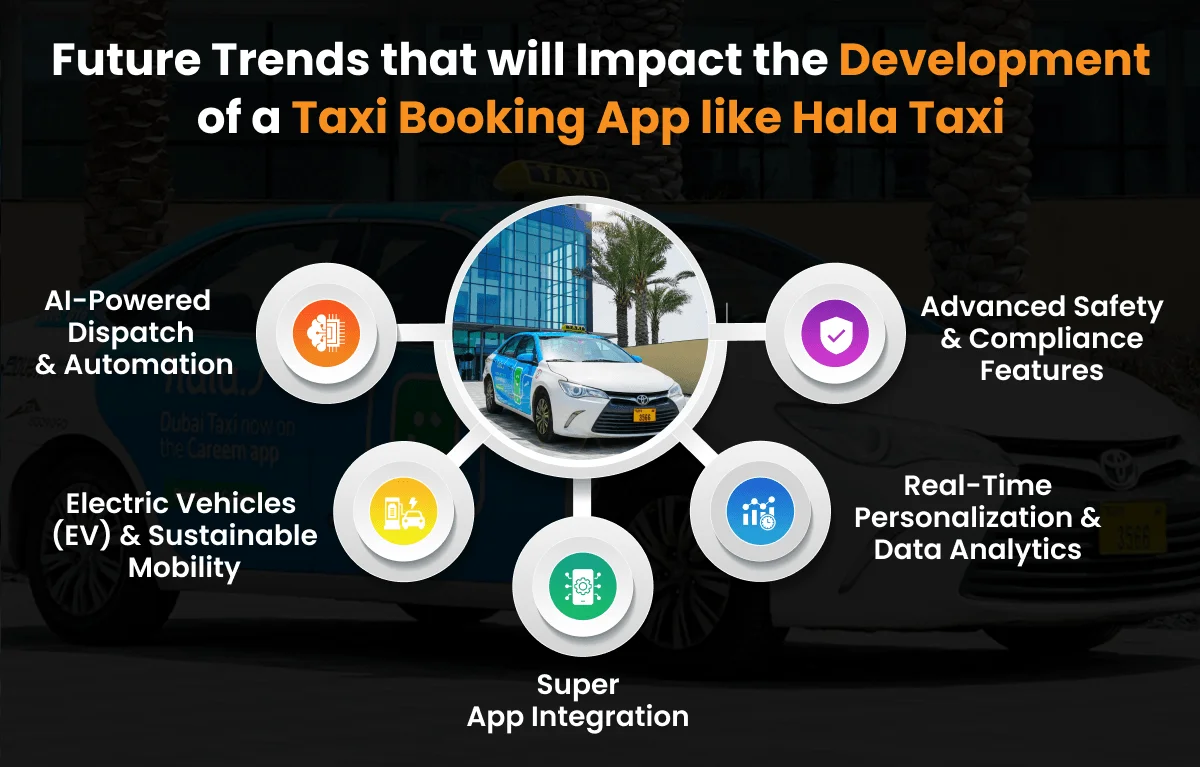
1. AI-Powered Dispatch & Automation
AI is changing the ride-hailing apps by automating the process of assigning drivers, preventing wait time, and optimizing routes. Smarter pricing mechanisms can also be implemented with the help of AI, and it enhances efficiency in general operations.
2. Electric Vehicles (EV) & Sustainable Mobility
As governments encourage clean transportation, the incorporation of EV fleets is emerging as a major trend. This not only saves operational costs in the long run, but also is geared towards sustainability, particularly in markets such as Dubai.
3. Super App Integration
Ride-hailing apps are becoming a multi-service platform, incorporating such services as food delivery, payments, and logistics. The trend increases user participation and develops new sources of revenue.
4. Real-Time Personalization & Data Analytics
In the contemporary world, personalized experiences are demanded. Using data analytics can be utilized in providing tailored ride recommendations, dynamic pricing, and better customer retention tactics.
5. Advanced Safety & Compliance Features
As the regulatory demands get tighter, apps are dedicating more effort to safety features, including SOS alerts, live ride tracking, driver verification, and AI-based fraud detection to create user trust and compliance.
How to Gain Competitive Edge in Dubai’s Ride-Hailing Market- Monetization Strategies
To gain a competitive edge in Dubai’s ride-hailing market, businesses must adopt smart monetization strategies like commission, surge pricing, and subscriptions. Partnering with a reliable taxi app development company in Dubai helps build scalable and revenue-driven platforms.
1. Commission on Each Ride
The first source of revenue is charging a commission (usually 15- 30%) on each ride completed. It ensures stable incomes because the platform grows with the number of rides.
2. Surge/Dynamic Pricing
Dynamic pricing is the one that changes fares according to the demand, time, and location. This enables maximizing the revenues during peak hours as well as persuading more drivers to be available when the demand is high.
3. Subscription Plans for Drivers
Providing drivers with subscription or membership plans (weekly/monthly) would allow offering such benefits as lower commission rates, priority access to rides, or other incentives, which would create a consistent cash flow.
4. Cancellation Fees
The fee applied to the cancellation of rides (by a rider or a driver) will allow compensating for the time loss and averting the abuse of the platform, which will also generate extra revenue.
5. In-App Advertisements
Placing targeted advertisements in the app, like local companies, restaurants, or services, is another source of revenue, which does not influence the primary ride-hailing experience.
How can Octal IT Solution be the Best Fit for Your Ride Hailing App Development Journey?
Octal IT Solution is a trusted taxi booking app development company that has experience in the development of scalable, high-performance mobility solutions. Having a great emphasis on custom development, Octal IT Solution provides custom applications that have real-time tracking and secure payment options, as well as the ability to provide passengers, drivers, and administration with a smooth user experience.
Octal It Solution uses MVP-first to assist the business in saving money on initial investment, going to market quicker, and growing in a cost-effective manner. Supported by the latest IT tools such as AI, cloud computing, and analytics, Octal IT Solution guarantees future-proofed applications as well as end-to-end support, ideation to after-launch maintenance.

Conclusion
A strategic combination of the appropriate features, scalable technology, and a precise idea of market movements is needed to create a taxi booking app, such as Hala Taxi, in 2026. Planning and development for future trends, each step is very important in realizing the success and profitability of the app.
Collaboration with a proven mobile app development company may harness the streamlining of the entire process, minimize risks, and ensure a shorter time-to-market. The competitive and future-ready ride-hailing platform can be constructed by businesses with the right approach and constant innovation.
 By
By March 6, 2026



 Get in Touch