


Capital Structuring and Technology Investments will become the most decisive elements in determining the growth of an enterprise in 2026. They will no longer exist as separate spheres of organizations, but rather, systematic capital choices will be connected with the digitalization of the modern world. Since using AI-based analytics to shift to agile financing strategies, companies should balance between the cost-effectiveness of financial operations and technological scalability to remain competitive in the long term.
Introduction
The business environment across the world is changing at an unprecedented rate. Businesses are moving into a digital-first world where technology expenditure is directly influencing market positioning, technological capabilities, and business resilience. Simultaneously, the institution of Capital Structuring, which forms the foundation of organizations to fund assets and growth, is being reinvented by smart automation, data analytics, and predictive financial designs.
By 2026, the intersection of finance and technology is not just going to transform balance sheets, but also determine the process of disruption adaptation in organizations. Companies that integrate organized capital schemes with Technology Investments will establish a platform of continuity of innovation and investor trust.
What Is Capital Structure?
Capital structure is a combination of debt and equity to finance the operations and growth of the business. The classical models focused on reducing the cost of capital. This definition, however, has been broadened to the digital valuation of assets in 2026, which includes the intellectual property, AI systems, data platforms, and even sustainability technologies.
Capital Structuring in Modern Times
- Digital Assets to Capital: The current state of thinking is that software IP, machine learning models, and automation frameworks are now reviewed as enterprise capital.
- Agile Debt Management: Businesses are optimizing debt maturity and interest risk by using data-driven platforms.
- Equity by Innovation: Technology-oriented companies are becoming targets of equity investors in sustainable and AI-driven growth paradigms.
- Hybrid Funding Mechanisms: Tokenization, crowdfunding, and digital bonds represent a new way for businesses to finance and manage money.
Combining the Capital Structuring concepts and the real-time analytics and automated tools, businesses will be able to predict ROI, risk management, and scalable Technology Investments that are aligned with the long-term strategic objectives.

The Changing Landscape of Technology Investments
Technology Investments The past has ceased to be limited to hardware or software upgrades; they include strategic enablement, the process of matching digital tools to the business growth objectives. In 2026, the focus of investments will go toward platforms that will promote agility, compliance, and predictive intelligence.
Strategic Investment Areas of 2026.
- Artificial Intelligence (AI): To model decision and financial intelligence, and automate.
- Blockchain: To make all transactions transparent and secure in the handling of data.
- Cloud Computing: To scale and CapEx reduction.
- Cybersecurity: With the breakthrough of the digital world, investment in security is not a negotiable issue.
- Sustainability Tech: A green technology integration strategy to appeal to ESG-driven investors.
These investments combine compounding benefits (increasing both technological maturity and financial health) when accompanied by structured capital strategies.
How to Market Software Consulting Services?
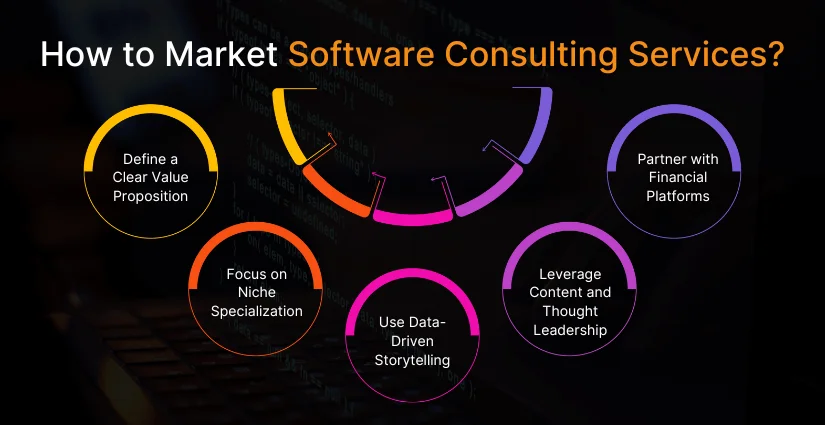
In a world where digital transformation is the new competitive edge, successfully marketing software consulting services has become a key factor for technology-based organizations. The difficulty is no longer the issue of software expertise selling but the issue of marketing the expertise as a business-enabling solution. In 2026, businesses will require consultants who can identify the alignment between technology implementation and quantifiable business value, innovation, and financial returns.
1. Define a Clear Value Proposition
You need to talk about the quantifiable results of your message and not only the technical characteristics. Emphasize your consulting knowledge and how you can assist your clients to achieve cost optimization, scale of operation, expedited time to market, and simplified workflows. Elaborately define ROI-based success to make your offering a reality to business decision-makers.
2. Focus on Niche Specialization
Specialization aids the consulting firms in standing out in the saturated market. Rather than attacking a broad industry, look at a niche like the finance, health, or retail verticals. Evidence of expertise in the domain assists the enterprises in believing that you can handle certain regulatory and operational issues with specific digital solutions.
3. Use Data-Driven Storytelling
Business consumers respond to facts, but not PR. Support your promotion using case studies, success stories with clients, and performance indicators that can be measured. To create your credibility with the brand, you can include KPIs, like the amount of time saved, the efficiency increased, or revenue growth obtained, which will motivate those who may visit your brand.
4. Leverage Content and Thought Leadership
Content is a strong marketing tool in 2026. Their release of a piece of thought leadership on issues such as Capital Structuring and Technology Investments places your company in the role of an advisor who can be relied upon to bridge the gap between digitalization of processes and optimization of financial operations. High-value enterprise leads can be obtained with the help of white papers, webinars, and LinkedIn insights.
5. Partner with Financial Platforms
Partnerships with fintech providers or SaaS platforms increase exposure and grow your service ecosystem. Strategic alliances can help you to combine your it consulting services with supplementary solutions, including analytics tools and accounting automation, to create a greater client retention and cross-selling potential.
A Strategic Playbook for Enterprises in 2026
By the year 2026, businesses should align Capital Structuring with the intelligent Technology Investments in order to be liquid, cost-efficient, and digitally competitive. Financial technology convergence will support organizations to make more sustainable, quicker, and data-driven business choices.
1. Adopt Dynamic Capital Models
- Substitute fixed capital allocations with AI-driven systems that provide real-time business and market responses.
- These are dynamic models that allow the CFOs to quickly redistribute their resources based on the changing priorities or shocks.
- Through the application of predictive analytics, enterprises are able to sustain efficiency in capital even when the market is volatile, which will guarantee the continuation of growth momentum.
2. Prioritize Technology ROI Metrics
- Assess every technological investment in direct terms of contribution to financial results and innovation potential.
- Measuring ROI by using automated dashboards assists the decision-maker in determining which technologies contribute to quantifiable business value.
- This accountability emphasis turns technology expenditure into a strategic asset rather than being used as an operating expense.
3. Align Finance and IT Teams
- Encourage co-working of CFOs and CTOs to make sure that formal capital approaches enable scalable innovation.
- An integrated solution facilitates the enhanced visibility of the budgeting, forecasting, and implementation processes.
- Its alignment in this aspect means that financial decisions allow technology leaders to focus on initiatives that can make them competitive and resilient.
4. Integrate Automation in Investment Accounting
- Install Investment Accounting Software Development tools, which would facilitate forecasting, compliance, and portfolio management.
- Automation reduces human error and increases the speed of the reporting process so that the finance teams can work on the analysis of strategy.
- It also provides transparency and real-time access to the investment performance to enable executives to make proactive changes.
5. Futureproof with ESG Integration
- Integrate sustainability into the capital and technology systems so as to draw investors, focusing on responsible development and openness.
- The inclusion of ESG metrics into financial planning not only helps in improving reputation but also allows access to new sources of funding.
- Businesses that use green technologies and ethical systems of financing will be in a better position to not only comply with the requirements of the regulators but also the stakeholders.
The Capital and Tech Matrix: Mapping Financing Models to Technology Priorities
To operationalize synergy between finance and tech, enterprises can adopt a matrix that maps financing models to technology priorities.
The Capital-Technology Alignment Matrix
| Financing Model | Technology Priority | Objective | Expected Outcome (2026) |
| Equity Financing | AI & Automation | Expand innovation and scalability | Enhanced productivity and new revenue streams |
| Debt Financing | Cloud Infrastructure | Reduce CapEx via predictable OpEx models | Operational agility and cost control |
| Hybrid Models | Cybersecurity & Data Compliance | Balance risk and performance | Strengthened trust and regulatory resilience |
| Tokenized Capital | Blockchain Systems | Decentralized transparency and asset fluidity | Increased investor engagement |
| Venture Funding | Sustainability Technologies | Fund innovation with green impact | ESG-driven growth and long-term capital access |
This matrix illustrates that each funding model must correspond with technology objectives, forming the foundation of structured capital strategies for 2026 and beyond.
Integrating Structured Capital Strategies with IT Consulting
Organizations in any sector are mounting the comprehension that financial health and technology development are no longer two distinct endeavors – they comprise two facets of the growth plan. With the growth in the complexity of financial systems and the market being more dynamic, organizations are increasingly seeking their consulting services to negotiate the merging of finance and technology.
Consulting partners are now becoming strategic enablers with extensive knowledge in cloud migration, process automation, cybersecurity, data analytics, and digital financing systems. They are not just implementation agents of technology, but they are also agents of change who coordinate financial ambitions with technological structures.
Businesses can achieve:
Better liquidity management: Automation of treasury operations will provide real-time tracking of the inflows and outflows of money, reduce idle cash, and maximize working capital.
Real-time capital view: Highest-order dashboards are fuelled by analytics and give precise data to CFOs and investors regarding the performance of fund utilization and ROI.
Reduced operational costs; cloud-based automation removes repetitions, manual errors, and improves efficiency in operations among the departments.
Improved investor reporting: Digital finance systems engage in transparency by automating compliance reporting, ESG monitoring, and disclosure of financial reports.
In addition, combining structured capital models with consulting-based innovation assists enterprises in getting a coherent perspective of both capital and technology environments. The resulting synergy results in more dynamic, resilient, and insight-based models of growth – required to survive in the data-based economy of 2026.
Enterprise Software Development and Capital Optimization
The history of enterprise technology is shifting the aspects of financial activities that are being managed, measured, and scaled. The enterprise software development services have been taking center stage in this transformation and are able to enable organizations to substitute the disjointed financial tools with intelligent end-to-end systems.
Firms are automating the tracking of funds, monitoring compliance, capital allocation, and forecasting risks using custom-built ERP and investment management systems. These systems have been tailor-made to make sure that capital structuring decisions are made precisely and openly.
The most prominent changes that are emerging are related to the following innovations:
- AI-powered investment dashboards: Elevate forecasting of capital flow so that decision-makers can optimize portfolios in line with real-time results.
- Auditing through Blockchain: Assures both transparent and undiscoverable accounting records, which boost investor confidence and compliance with authorities.
- Multi-bank integration API: Multi-bank integration allows fund management with various financial institutions in real time, ensuring precision and shortening the time spent on reconciliation.
- Cloud-native financial systems: Provide scalability and cost reductions, and convert CapEx-intensive models into predictable OpEx models.
With such innovations, companies are able to have a comprehensive visibility of their financial ecosystem. A combination of Capital Structuring and software intelligence bridges the gap that has always been there between the financial strategy and the technology implementation, and preconditions the future-proof business models that can be expanded on a global level.
Innovation Spotlight: Top Financial Business Ideas
Prior to entering the next level of digital finance in 2026, one should be acquainted with the innovative trends that are influencing the investment and operating strategies today. The top financial business ideas for 2025 were amazing. Now moving forward with the upcoming years, some of the great are listed below to show how technology is transforming the nature of financial services:
Algorithm-based: AI-powered micro-investment platforms: Democratizing access to investment to individuals via something called fractional ownership and AI-powered portfolio management.
Sustainable investment analytics: How data science can be used to measure and report ESG performance, to make capital decisions eco-conscious.
Invice financing on blockchain: Speeding up liquidity access to SMEs through a peer-to-peer lending platform and secure settlement of smart contracts.
Digital wealth management apps: Providing AI-based financial guidance and live monitoring, both to individual and business investors.
Predictive accounting automation: Use of machine learning to predict costs, identify anomalies, and improve the accuracy of compliance.
All these innovations can contribute to the emerging trend in terms of tech-integrated Capital Structuring and dynamic financial ecosystems. Those that embrace the models early have competitive advantages due to faster adaptation, improved governance, and increased engagement by the investors.
Emerging Trend: Stock Trading App Development
With the adoption of the retail investing boom and the growth of decentralized finance (DeFi), consulting a stock trading app development company has become one of the most profitable technology projects in the finance industry. Next-generation trading platforms are evolving beyond being straightforward trading tools and are increasingly being viewed as holistic wealth systems that require greater personalization and transparency.
Next-Gen Technology Features:
Unlike human-made recommendations: Portfolio recommendations using AI will consider user behavior, risk profiles, and market sentiment to provide a personalized trading strategy.
Safe transactions with blockchain: Smart contracts and distributed registers guarantee the integrity of transactions, privacy of data, and immediate settlement.
Voice interfaces: Enable traders to place orders without using their hands, which makes convenience and accessibility integrated.
ESG portfolio tracking: Provides investors with the opportunity to track the sustainability performance of their investments, which is in line with responsible investing objectives.
By incorporating these types of fintech products into enterprise ecosystems, it not only diversifies revenue pools but also improves digital asset pools and increases levels of customer engagement. Increasing the digital finance presence of a business, whether in terms of trading or wealth management products, is a lucrative investment in the short term and a strong brand reputation in the long term.
The Future Outlook: Finance-Technology Convergence in 2026
Those businesses that manage to navigate Capital Structuring and Technology Investments simultaneously will set the new financial nimbleness by 2026. Digital infrastructure, automation, and intelligent analytics will converge and transform the way CFOs and CIOs allocate resources, risks, and returns.
Technological data ecosystems will enable financial executives to transition to predictive, real-time management as opposed to reactive decision-making. Financial modeling, automated reporting, and cloud-based collaboration powered by AI will form agile frameworks that will be able to respond to changes in the market in real time.
The Major Results of this Convergence are:
- Less financial risks: continuous monitoring and predictive warnings assist firms in reducing volatility and enhancing governance.
- Greater transparency of investors: Automated auditing and open reporting systems make investments much more attractive and trustworthy in the long term.
- Quickly innovating: Built-in systems enable financial products and digital services to go to market faster.
- Growing sustainably with data: financing that is ESG-consistent, but uses intelligent robotics to guarantee its profitability does not impinge on responsibility.
The point is obvious: there will be businesses that combine financial architecture and digital infrastructure into the same ecosystem and will control the competition in 2026 and further.

Conclusion
Capital and technology no longer relate on a transactional basis but on a transformational basis. Flexibility in finance, operational insight, and durability in competitiveness will be opened up to the businesses investing in structured capital strategies and intelligent Technology Investments. With financial architecture and digital infrastructure evolving like they are, causing a blur of lines, the businesses that take decisive action in 2026 will become the major players in the next economic cycle.


 Get in Touch
![Mobile App Consulting: A Complete Guide With Services, Cost & Benefits [2026]](https://d274cmdd0goq94.cloudfront.net/wp-content/uploads/2026/05/Mobile-App-Consulting-1.webp)
 By
By May 12, 2026