


Key Takeaways
- Remote Patient Monitoring System enhances patient care by offering continuous support and data collection beyond clinic visits.
- The global RPM market is growing rapidly, expected to reach $30.9 billion in 2026, driven by increased chronic disease management and the need for home-based healthcare.
- Effective RPM systems require secure software integration, connecting devices, EHR systems, and clinical workflows to ensure data accessibility.
- AI plays a significant role in RPM, enabling predictive analytics, anomaly detection, and personalized patient engagement for better care outcomes.
- Organizations can choose between ready-made RPM platforms or custom solutions, depending on specific needs and workflow requirements.
Healthcare is now spreading past hospital and clinic doors.
Many people with diabetes, high blood pressure, heart problems, lung issues, and after-surgery needs do not just want checkups on a schedule. They need ongoing support.
Clinicians also face a practical issue. They must see how patients are doing between visits. They need dependable information without asking every person to come in.
This is why remote patient monitoring is gaining ground in day to day care.
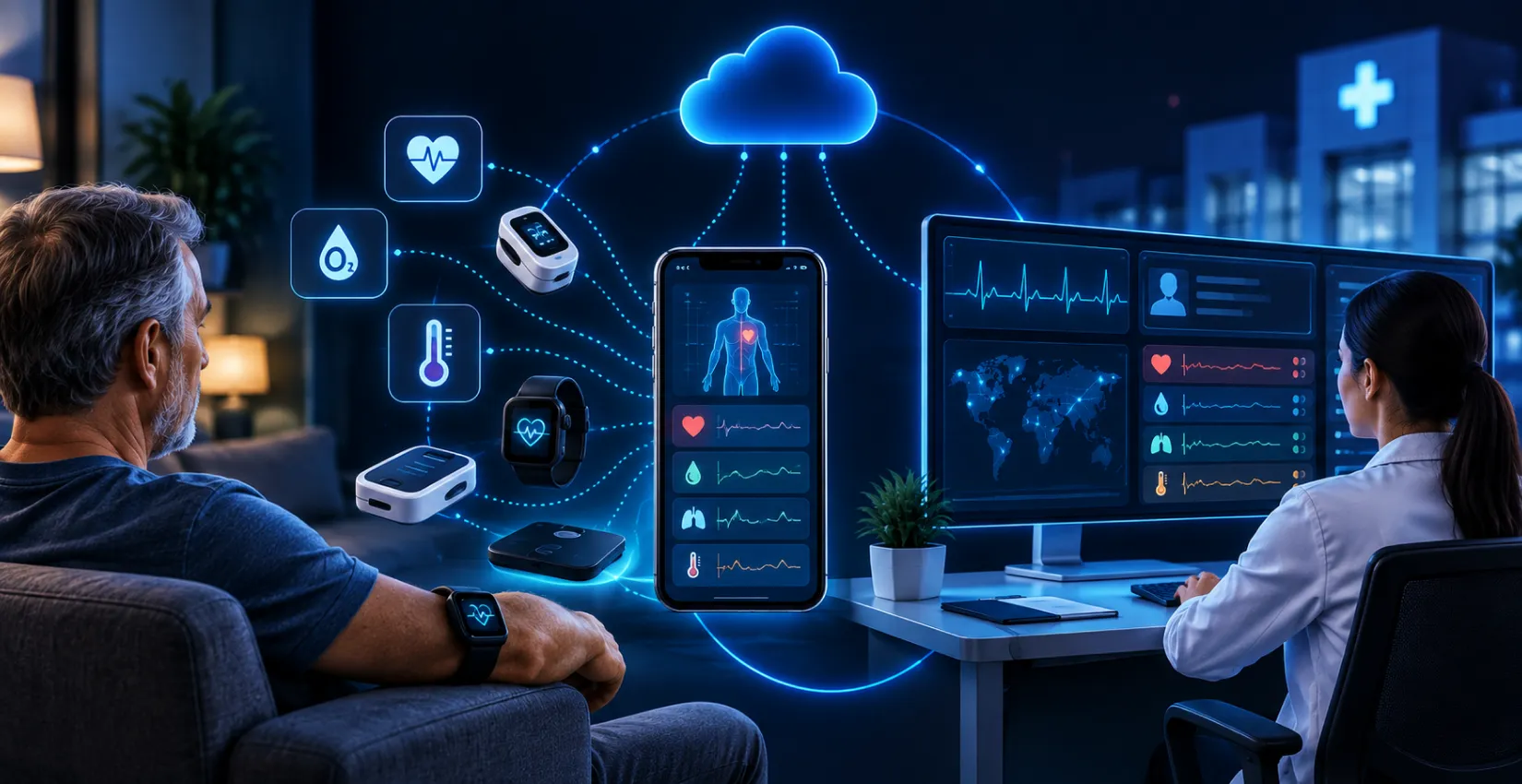
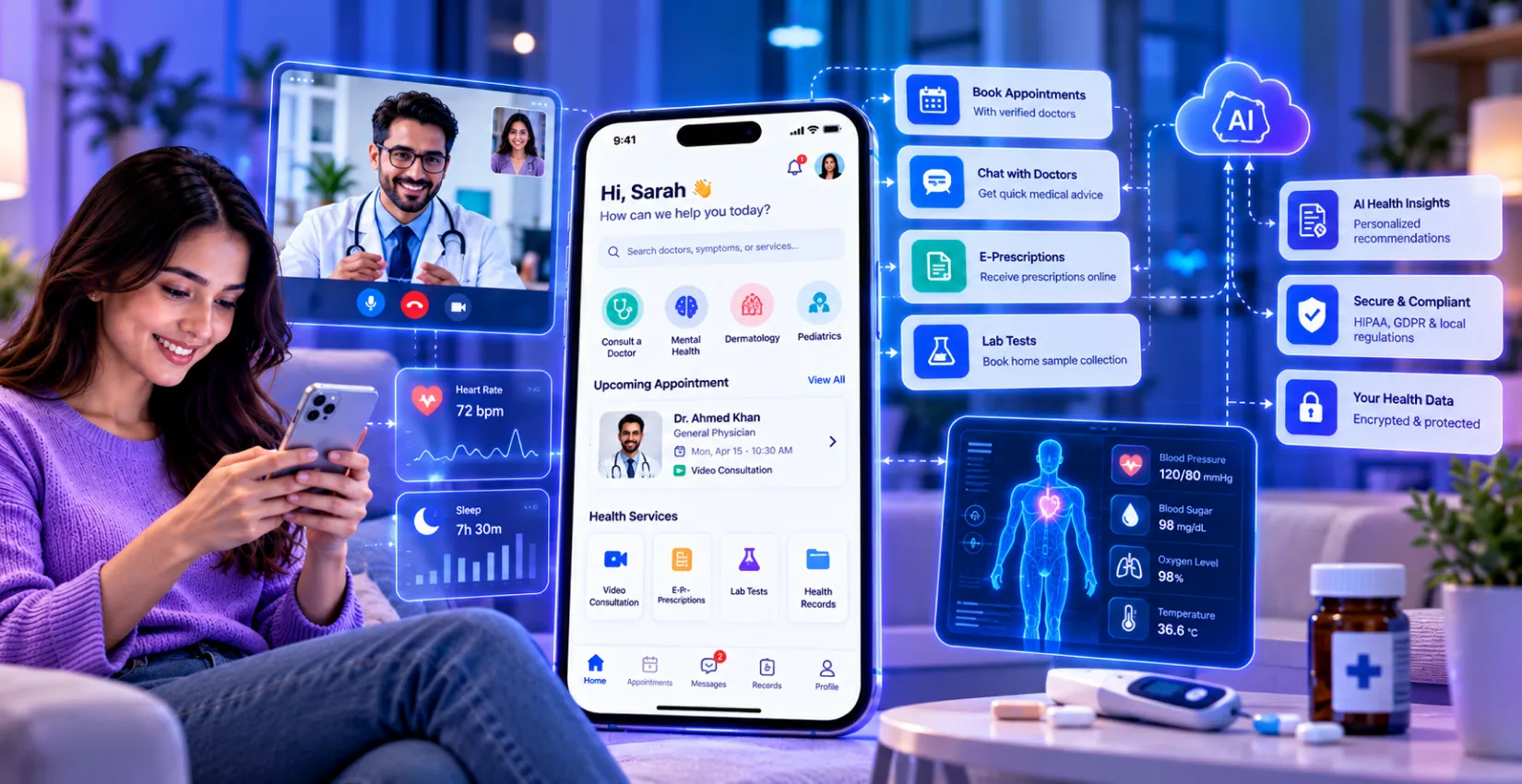
Remote patient monitoring brings together linked medical tools, health software, phone apps, cloud systems, and data analysis. It gathers health data in a patient setting outside the clinic. It then shares that information with approved staff.
The market reflects this change. The global remote patient monitoring system market was about $26.0 billion in 2025. It is expected to reach $30.9 billion in 2026. Grand View Research also projects a 20% CAGR by 2033.
Still, for hospitals, clinics, health networks, digital health startups, and device makers, putting RPM in place is not only a matter of buying connected devices.
The bigger task is building a secure, scalable software setup. That setup must connect patients, clinicians, monitoring devices, EHR systems, alerts, analytics, and clinical work steps.
This guide explains how custom RPM Software Development works in 2026, including architecture, essential features, device integration, technology stack, AI capabilities, compliance considerations, development process, cost, and future opportunities.
What Is Remote Patient Monitoring Software?
Remote patient monitoring software is a health tech tool. It gathers health data from patients who are not in a clinic. It then sends that data, handles it, and shows it for review.
With this approach, staff do not have to wait for the next visit. They can look at readings as they come in. They can also spot changes over time that may need follow-up.
An RPM setup may capture items like these:
- Blood pressure
- Blood glucose
- Heart rate
- Blood oxygen saturation
- Body temperature
- Body weight
- ECG data
- Respiratory information
- Activity levels
- Sleep patterns
The data can come from different sources. These include remote monitoring devices, wearables, sensors, or values entered by the patient.
Once collected, the readings move through a protected monitoring platform. They appear in clinician dashboards. In some cases, they also sync into current clinical tools.
Overall, patients and care teams stay in touch between appointments. Care visibility is not limited to single visits.
How Does a Remote Patient Monitoring System Work?
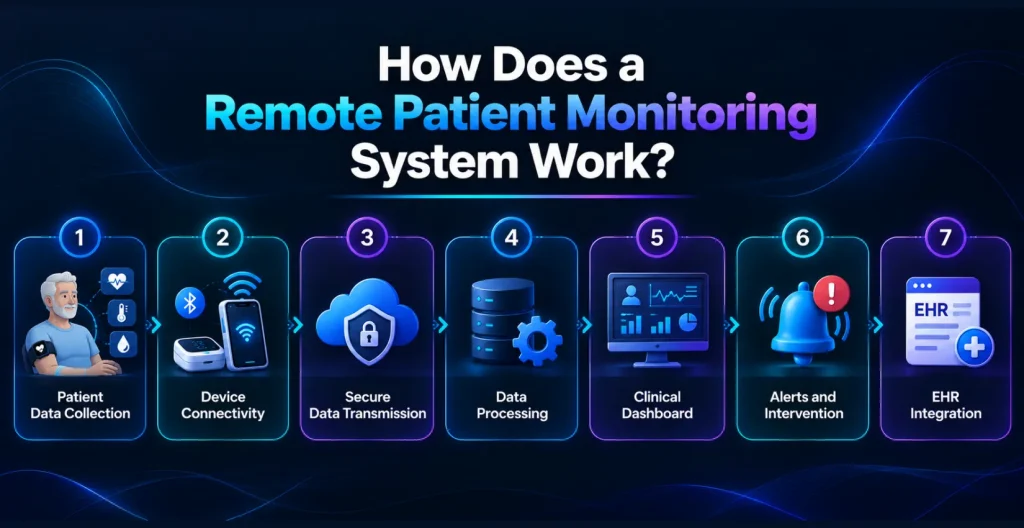
A custom RPM system generally follows a connected data flow: Here is what happens at each stage.
1. Patient Data Collection
Patients send readings from connected tools like blood pressure cuffs, glucose meters, pulse oximeters, body weight scales, ECG devices, and wearable trackers.
2. Device Connectivity
Each tool sends the data using Bluetooth, Wi-Fi, cellular service, or another supported link.
3. Secure Data Transmission
The readings are sent in a protected way to the RPM setup that runs in the cloud.
4. Data Processing
The platform checks the data, sorts it, and then prepares it for use.
5. Clinical Dashboard
Clinicians and care staff can open a single dashboard to see current values, past patterns, warning messages, and the care plan tied to the patient.
6. Alerts and Intervention
When a value goes beyond set clinical limits, the system can raise a notice based on the steps defined in the workflow.
7. EHR Integration
When it fits, relevant RPM updates can be matched to the patient’s main electronic health record.
Organizations that add RPM to wider healthcare IT solutions can link remote monitoring to the digital systems they already use.
Why Is Remote Patient Monitoring Growing in 2026?
RPM is shifting from a single digital health idea to a bigger network-based care plan.
Grand View Research expects the remote care market to rise from about $100.9 billion in 2026 to $219 billion by 2030. In that outlook, RPM is listed as the quickest expanding service part.
Several developments are driving this growth.
Increasing Chronic Disease Management Requirements
Chronic illness care often needs ongoing checks. Many patients need measurements over time. RPM helps care teams see what is happening between office visits.
Growth of Home-Based Healthcare
More people are getting health support at home. That includes monitoring and some follow-up care. This trend adds more pressure to build connected tools for at home use.
Growing Availability of Connected Medical Devices
Sensors outside clinics are becoming more common. Smartwatches, patches, rings, glucose monitors, blood pressure tools, and other devices can collect new kinds of data. The FDA posts details on approved sensor based digital health tools. This includes wearables and home use devices.
Expansion of Virtual Care
Virtual visits are also growing. RPM can work alongside telemedicine by adding real measurements during remote check ins.
AI and Healthcare Analytics
Systems that use healthcare analytics can sort through large sets of monitoring data. They can spot trends, flag key changes, and fit better into everyday clinician routines.
Who Needs Custom Remote Patient Monitoring Software?
Custom RPM is not only for hospitals.
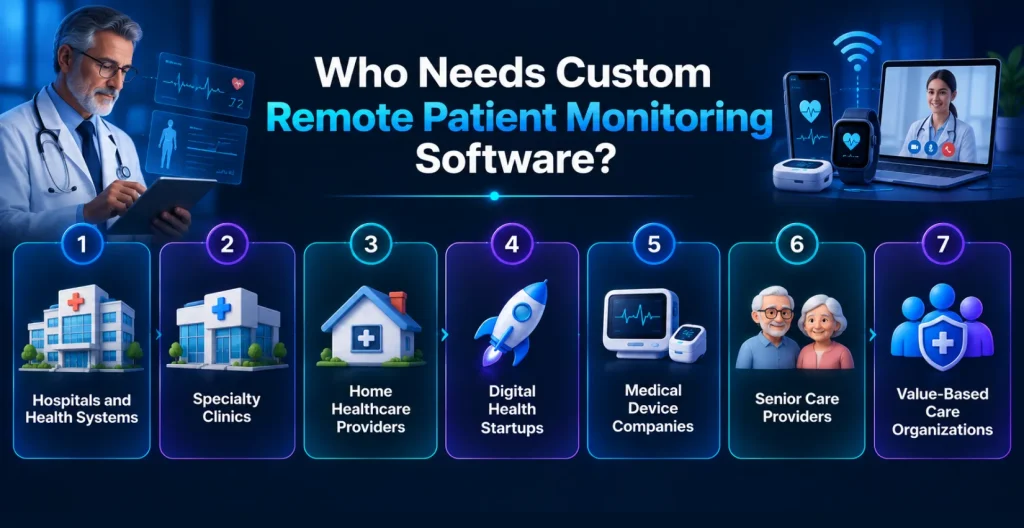
Many types of organizations can use remote patient monitoring. They can shape it to match how their teams work.
Hospitals and Health Systems
After discharge, hospitals can follow eligible patients. They can back chronic care programs too. They also keep an eye on certain patient groups after the patient leaves.
Specialty Clinics
Clinics in cardiology, diabetes care, respiratory care, nephrology, and rehab can set up monitoring for specific conditions.
Home Healthcare Providers
Home care teams can mix visits with ongoing digital monitoring.
Digital Health Startups
Smaller companies can build RPM tools for particular needs. This can include specific conditions, patient groups, or care models.
Medical Device Companies
Device makers can add companion software. That software can turn device readings into data clinicians can use.
Senior Care Providers
RPM can help care teams remotely track relevant health parameters for elderly patients.
Accountable Care and Value-Based Care Organizations
Connected monitoring can support proactive programs. It can also help with patient outreach and managing care use.
A healthcare software development company with experience can build these workflows. The build should fit the organization’s clinical needs, technical setup, security rules, and interoperability requirements.
Essential Remote Patient Monitoring Software Features
Choosing Remote Patient Monitoring Software features starts with the patient group and how the care team works day to day.
In many cases, a custom RPM setup still needs a few core interfaces. Usually those are for the patient, the clinician, and the admin.
Patient-Side RPM Software Features
Patient Registration and Profile
Patients can make accounts in a secure way and keep their key profile details up to date.
Device Pairing
A straightforward onboarding flow lets patients connect supported devices over Bluetooth, Wi-Fi, or cellular.
Health Metrics
Patients can view current measurements and historical information.
Medication Reminders
Planned alerts can nudge patients to take medicines on schedule.
Manual Data Entry
If devices do not send data, or if a metric needs self reporting, patients can add the needed details themselves.
Appointment Management
With integration tied to doctor on-demand app development, patients can book or reach consultations when remote data points to a need for review.
Educational Content
Materials matched to a condition can help patients understand their care plan.
Secure Messaging
Patients and approved members of the care team can talk through protected messaging.
Clinician-Side Remote Patient Monitoring Software Features
Doctors and nurses often need a clearer tool for daily patient work. It should support patient care in a way that saves time and helps with clinical tasks.
Important functionality can include:
- Patient lists
- Real-time health data
- Historical measurements
- Patient risk indicators
- Custom thresholds
- Alert management
- Care plan management
- Patient notes
- Messaging
- Device status
- Reports
- EHR access
- Analytics
Working with EHR software and its build system can also cut down on the need for clinicians to bounce between separate platforms that do not connect well.
Admin-Side RPM Software Features
Administrators may require:
- User management
- Role-based permissions
- Device management
- Organization management
- Workflow configuration
- Alert configuration
- Audit logs
- Reports
- Security controls
- Integration management
- System analytics
- Billing management
For enterprise deployments, administrator functionality becomes particularly important because a single platform may serve multiple hospitals, clinics, care teams, and patient populations.
Remote Patient Monitoring Dashboard Development
The clinical dashboard is a key part of an RPM system.
If the dashboard is built poorly, clinicians can feel swamped by data. A good Remote Patient Monitoring Dashboard Development plan should guide care teams to the right patients first. It should not require staff to check each number by hand.
A dashboard can include:
| Dashboard Component | Purpose |
| Patient Overview | Centralized patient information |
| Current Vitals | Shows latest measurements |
| Historical Trends | Displays changes over time |
| Alert Queue | Prioritizes readings requiring review |
| Risk Indicators | Highlights relevant patient risk information |
| Device Status | Identifies connectivity/device issues |
| Care Plans | Displays monitoring protocols |
| Communication | Supports patient-care team interaction |
| Reports | Generates clinical/operational reports |
| Analytics | Identifies trends across patient populations |
With custom work, each role gets what it needs. Doctors, nurses, care coordinators, and administrators can all view details that match their duties.
This is also where Custom Healthcare Software Development can help more than a generic tool that follows the same fixed steps for everyone.
Wearable Device Integration for RPM
RPM software gets much more useful when it can pull dependable data straight from linked devices.
In healthcare, common remote patient monitoring devices include:
- Blood pressure monitors
- Glucose meters
- Continuous glucose monitors
- Pulse oximeters
- Digital weighing scales
- ECG monitors
- Smartwatches
- Fitness trackers
- Temperature sensors
- Spirometers
- Cardiac monitors
- Sleep monitoring devices
The FDA says that wireless medical devices can use tools like Wi-Fi, Bluetooth, and cellular or mobile links to send patient data and help remote monitoring.
How Wearable Device Integration for RPM Works
The typical workflow is:
Device integration needs to account for more than simply establishing connectivity.
Developers should consider:
- Device protocols
- Data formats
- Synchronization frequency
- Connectivity interruptions
- Duplicate measurements
- Battery status
- Device authentication
- Error handling
- Data validation
- Device replacement
Organizations developing device-centric healthcare ecosystems can combine RPM with specialized IoT Healthcare Solutions to manage connected medical infrastructure at scale.
Role of IoT in Remote Patient Monitoring
IoT in remote patient monitoring acts like the link between people, medical devices, software systems, and clinicians.
With IoT-enabled RPM, health readings can be gathered all day and sent to cloud services in a safe way.
Its architecture may include:
Medical Sensor → Edge Device → IoT Gateway → Cloud Infrastructure → Analytics Engine → Clinical Dashboard
This approach helps by reducing manual typing, speeding up access to updates, and keeping watch over patients over time.
At the same time, building for healthcare brings hard issues. Devices may not work well together. There are risks around security. Networks can fail or be slow. Power use on devices matters. Firmware updates can be tricky. Data may be wrong or incomplete.
These points should be handled in the planning stage. They should not be treated as add-ons after the product is already built.
AI in Remote Patient Monitoring
AI is playing a bigger role in newer remote patient programs.
Rather than showing huge lists of readings in the same way every time, AI may help clinicians spot trends. It may also help them focus on what matters first.
AI use in Remote Patient Monitoring can show up in a few common areas.
Predictive Analytics
Software can review past and current data. It can then look for signals tied to shifts in a patient’s status.
Anomaly Detection
AI can flag readings that look out of place. It can also catch patterns that do not match a person’s usual range.
Intelligent Alert Prioritization
Instead of handling every alert the same way, newer tools can group alerts by risk rules. This can reduce noise for care teams.
Patient Risk Stratification
Clinicians can split patient groups using key risk factors. This can support better triage of work across teams.
Personalized Patient Engagement
The system can tailor messages and learning content. It can also adjust engagement steps based on how a patient responds over time.
Clinical Data Summarization
AI can condense long tracks of health data. Authorized care teams can then review shorter, clearer views.
For health organizations that want advanced intelligence, they can add Healthcare AI Solutions into RPM steps. They should still keep clinical review, testing, data protection, and required regulatory checks in place.
The FDA also points out that AI, automation, and interoperability are already enabling new functions in patient monitoring and control devices.
Remote Patient Monitoring API Integration
A standalone RPM platform creates another information silo.
A connected platform can become part of the organization’s broader healthcare infrastructure.
Remote Patient Monitoring API Integration can connect RPM software with:
- EHR/EMR systems
- Telehealth platforms
- Medical devices
- Laboratories
- Pharmacy systems
- Scheduling software
- Billing systems
- Identity management
- Communication platforms
- Analytics systems
Setting up a Healthcare API lets two systems share data in a safer way.
Some teams also want HL7 FHIR Integration. That way, healthcare records can move between systems using common formats.
Remote Patient Monitoring Software Technology Stack
Picking the right Remote Patient Monitoring Software Technology Stack depends on a few things. These include how large the platform is, what devices are in use, what systems must connect, the security rules, and where the product is going next.
A representative technology stack may look like this:
| Layer | Technologies/Options |
| Web Frontend | React, Angular, Vue.js |
| Mobile | Swift, Kotlin, Flutter, React Native |
| Backend | Node.js, Java, .NET, Python |
| Database | PostgreSQL, MySQL, MongoDB |
| Cloud | AWS, Microsoft Azure, Google Cloud |
| APIs | REST, GraphQL |
| Healthcare Interoperability | HL7, FHIR |
| Device Connectivity | Bluetooth/BLE, Wi-Fi, Cellular |
| Real-Time Communication | WebSockets, MQTT |
| AI/ML | Python, TensorFlow, PyTorch |
| Containers | Docker, Kubernetes |
| Security | OAuth 2.0, TLS, encryption, RBAC |
The final architecture should be selected based on actual clinical and business requirements rather than choosing technologies purely because they are popular.
For larger deployments, Cloud Healthcare Solutions can provide scalable infrastructure for handling growing patient and device volumes.
Security and Compliance in RPM Software Development
RPM platforms touch sensitive health data, so security needs to be planned from the start.
Security considerations can include:
- Encryption for data stored on systems
- Encryption for data sent over networks
- Access rules based on job roles
- Multi-factor login checks
- Audit trails that record key actions
- Session handling that limits risky access
- API protections for app-to-app calls
- Strong checks for known devices
- Backups and recovery plans after an outage
- Patch and weakness review over time
- Logs and monitoring for early signs of trouble
What rules apply can change with the area and the way the product is used. The list may include HIPAA, GDPR, FDA rules, local privacy statutes, and medical device obligations.
Some parts of the software can also fall under medical device oversight, depending on what the feature is meant to do. FDA notes that digital health tools fall into categories such as general wellness, health support, and true medical device use.
Because of this, a solid healthcare data management plan should be set up during the discovery stage, not after the platform is already finished.
Benefits of Remote Patient Monitoring
The benefits of remote monitoring extend to healthcare providers, patients, and care organizations.
Benefits for Healthcare Providers
RPM can provide:
- Better visibility between visits
- Longitudinal patient information
- Automated data collection
- More structured chronic care workflows
- Remote patient engagement
- Earlier visibility into relevant changes
- Centralized monitoring
- Data-driven care coordination
Benefits for Patients
Potential remote patient monitoring benefits include:
- Reduced unnecessary travel
- Greater convenience
- Better awareness of health measurements
- Easier communication with care teams
- Support for home-based care
- More continuous engagement
- Greater involvement in care plans
Benefits for Healthcare Organizations
Remote monitoring and management can help clinics reach more people. It can also make daily processes more consistent. Teams may get better insight into how things are running. It can even help enable new digital care efforts.
A good RPM system can fit into Patient Engagement tools too. It can link check-ins with messages to patients. It can add education and simple reminders. It can also help people follow their care plans.
Read Also: Top 15+ Healthcare App Development Companies in Dubai
How to Develop Remote Patient Monitoring Software: Step-by-Step Process
Building an RPM platform takes more thought than a typical consumer app.
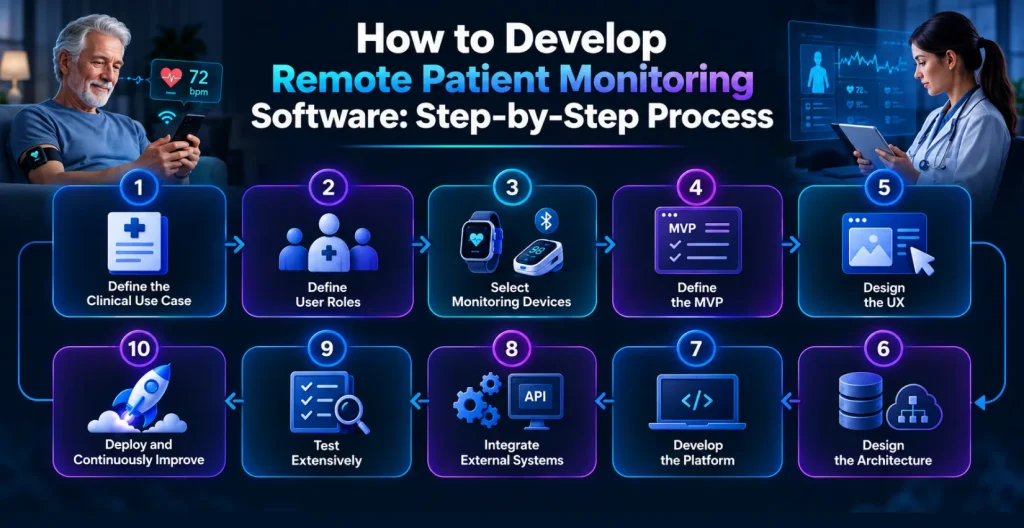
Step 1: Define the Clinical Use Case
Figure out who will use the system and what job it must handle.
You can start with a narrow area, such as:
- Diabetes monitoring
- Hypertension management
- Cardiac monitoring
- COPD management
- Post-operative recovery
- Elderly care
- Maternal health
If you begin with one clear workflow, the first version is easier to check.
Step 2: Define User Roles
Define who is included, for example: patients, physicians, nurses, care coordinators, administrators, and other groups.
Step 3: Select Monitoring Devices
Decide which device types and brands you will support. Also decide how device data will get into your software.
Step 4: Define the MVP
Focus on the core pieces first. This usually includes device links, patient profiles, measurements, alerts, dashboards, and clinician tasks.
Step 5: Design the UX
Make the patient screens easy to use, even for people who are not tech confident.
For clinicians, keep the screens focused on what they can do next, not on extra visuals.
Step 6: Design the Architecture
Plan:
- Backend
- Databases
- Cloud infrastructure
- APIs
- Device connectivity
- Security
- Interoperability
- Analytics
Step 7: Develop the Platform
Build patient applications, clinician portals, administrator dashboards, backend services, APIs, and device integrations.
Specialized Medical Software Development expertise is particularly valuable during this stage because healthcare software has additional requirements around reliability, privacy, interoperability, and compliance.
Step 8: Integrate External Systems
Link the EHR tools, medical devices, telehealth services, billing systems, and any other needed parts.
Step 9: Test Extensively
Testing should cover:
- Functional behavior
- Security
- Performance
- Device connectivity
- Data accuracy
- APIs
- Usability
- Accessibility
- Integration reliability
Step 10: Deploy and Continuously Improve
Watch how the system behaves in real use. Then refine it step by step to match clinical needs and business goals.
How Much Does Remote Patient Monitoring Software Development Cost?
The cost to build remote patient monitoring software can swing a lot. A small MVP for basic monitoring is not the same as a large enterprise health platform. They use very different tech work.
For planning in 2026, companies can look at ranges like these:
| RPM Solution | Estimated Development Cost | Approx. Timeline |
| Basic RPM MVP | $30,000–$60,000 | 3–5 months |
| Mid-Level RPM Platform | $60,000–$120,000 | 5–8 months |
| Advanced RPM Solution | $120,000–$250,000+ | 7–12 months |
| Enterprise Multi-Condition RPM | $250,000+ | 10–18+ months |
These numbers are planning estimates, not firm quotes.
Market competitor figures can be very different.
That is because teams use the term “RPM platform” in different ways.
For instance, one set of estimates for 2026 puts a custom platform that is ready to ship at about $150,000 to $350,000.
In that same example, a one-condition MVP is listed around $80,000 to $130,000.
So the right way to set your budget is to start from what you really need.
Look at your actual work steps, the systems you must connect, the devices involved, any rules you must follow, and the level of scale you expect.
What Factors Affect RPM Software Development Cost?
Development investment is shaped by several things.
Number of User Roles
When you add patients, clinicians, admins, caregivers, and org-level accounts, you also add more screens, rules, and access settings.
Number of Devices
Backing just one blood pressure unit is easier than handling many brands. More brands mean more checks and updates.
EHR Integration
A strong EHR connection usually brings more work. You must test more cases and keep data moving between systems.
AI Capabilities
Predictive analytics, anomaly detection, and intelligent prioritization introduce additional data engineering and model-development requirements.
Compliance Requirements
Security features matter, but so do papers, tests, records of changes, and outside regulations. These can widen the project.
Mobile Applications
If you build separate apps for patients and clinicians, expect more development and more maintenance.
Platform Scale
For 1,000 patients, the setup looks one way. For very large numbers of users plus many devices, the plan changes a lot.
Analytics
Population health views and custom reports add more work on both the server and the UI.
Using seasoned healthcare software development partners can help spot these cost drivers before you start building.
Custom RPM Software vs Ready-Made RPM Platforms
Healthcare organizations generally have two options: subscribe to an existing product or build a custom platform.
| Factor | Ready-Made RPM | Custom RPM Software |
| Initial Deployment | Faster | Longer |
| Upfront Investment | Lower | Higher |
| Customization | Limited | Extensive |
| Workflow Control | Vendor-dependent | Business-specific |
| Device Support | Predefined | Customizable |
| EHR Integration | Vendor-dependent | Custom |
| Branding | Limited | Full control |
| Scalability | Vendor-dependent | Architecture-dependent |
| Data/Feature Control | Limited | Greater control |
| Long-Term Product Ownership | Limited | Greater |
Some remote patient monitoring platforms are ready to use. They can fit well when a team wants the same basic features and a fast rollout.
Other groups lean toward custom software. This can matter if the workflows are unusual. It can also matter with special device setups, tighter links to other systems, or in-house methods. Some teams also want more say over the product changes over time.
When you look at different remote patient monitoring options, do not only stare at the monthly bill. It helps to think about the full cost over the long run.
How to Choose a Remote Patient Monitoring Software Development Company
Choosing a development partner for healthcare work is a big deal. Errors can hit safety, data protection, system connections, ease of use, and the path to meeting rules.
Look at remote patient monitoring vendors on these points:
- Healthcare domain expertise
- Medical device integration experience
- HIPAA/security knowledge
- HL7/FHIR experience
- IoT expertise
- Cloud architecture capabilities
- AI/ML experience
- EHR integration experience
- QA processes
- Post-launch support
A strong remote patient monitoring software team should be able to handle normal software work and also understand how care teams actually work day to day.
You can also compare well known healthcare software development firms in the USA and overseas partners. Use their published healthcare case studies as your main guide, not just hourly pricing.
Why Choose Octal IT Solution for RPM Software Development?
Building an RPM platform means you need skills in several areas. Those areas include healthcare know-how, cloud setup, connected devices, mobile apps, APIs, security, analytics, and interoperability.
Octal IT Solution can support healthcare teams, new startups, medical device companies, and digital health groups. We can tailor an RPM setup to fit each group’s day to day needs and goals.
Our development capabilities can cover:
- Patient mobile applications
- Clinician portals
- RPM dashboards
- IoT/device integration
- EHR/EMR integration
- HL7/FHIR interoperability
- Cloud infrastructure
- AI-powered analytics
- Alerts and notifications
- Patient engagement functionality
- API development
- Security implementation
- Analytics and reporting
As a healthcare app development firm, Octal IT Solution can help from the first discovery and planning steps. We also cover system design, build work, feature integration, test cycles, release to production, and later updates.
Some teams choose to pair RPM with their healthcare mobile app work. They may also link it with telehealth services, EHR tools, pharmacy flows, or wider healthcare platforms. This can support a more connected digital care setup.
Future of Remote Patient Monitoring
The future of remote patient monitoring will likely involve much more than collecting basic vital signs.
Several technologies are reshaping what RPM platforms can do.
AI-Powered Predictive Monitoring
AI may increasingly help care teams identify meaningful patterns across large volumes of patient information.
The growing role of AI in Healthcare Software Development can make RPM platforms more proactive and data-driven.
More Sophisticated Wearables
Smart patches, watches, rings, biosensors, and other devices will continue expanding the types of health information that can be collected outside traditional healthcare environments.
Hospital-at-Home Programs
RPM can become an important technology layer for eligible patients receiving higher-acuity care at home.
Connected Virtual Care
RPM, virtual consultation, messaging, and care coordination can increasingly operate as one connected experience through Telehealth Software Development.
Personalized Monitoring
Instead of applying identical thresholds and workflows to every patient, platforms may become increasingly personalized according to condition, history, risk, and care plan.
Better Interoperability
FHIR-based APIs and connected healthcare ecosystems can reduce information silos between RPM, EHR, telehealth, pharmacy, and other healthcare systems.
Intelligent Clinical Dashboards
Future dashboards may focus increasingly on prioritization and exceptions rather than requiring clinicians to manually review every incoming measurement.
The next generation of remote health monitoring software will therefore be less about collecting more data and more about transforming that data into useful, secure, and timely clinical information.
Final Words
Remote patient monitoring is shifting away from a single app or gadget. It is becoming a key part of connected care.
The best RPM solutions do more than send numbers to a screen. They link people, care teams, medical devices, EHR systems, cloud services, alert rules, reporting tools, and day to day workflows. All of this sits inside one guarded environment.
If a health organization is planning custom work for 2026, the first step is to set the clinical goal. Start there, not with the tech.
- Ask who you will watch.
- Decide which device types you will handle.
- Clarify what data should lead to a response.
- Define how clinicians will review and act on that data.
- List which systems must be tied together.
- When those points are set, the tech choices are simpler.
If you are looking at custom remote monitoring options, Octal IT Solution can support the architecture. They can also help with a feature plan, integration targets, the tech stack, and a rough build budget.
With a solid Custom Software Development Services plan, a team can create an RPM platform that fits today’s needs. It can also stay ready for new device support, new patient groups, and changing digital care models.

 Get in Touch
 By
 October 23, 2026