

Imagine you visited three hospitals last year for one broken bone. Each hospital asked you to redo the same X-ray. Your old reports never reached the new doctor on time. This happens to millions of patients every single day. Hospitals still guard health records like locked treasure chests. Nobody can access them quickly when it truly matters.
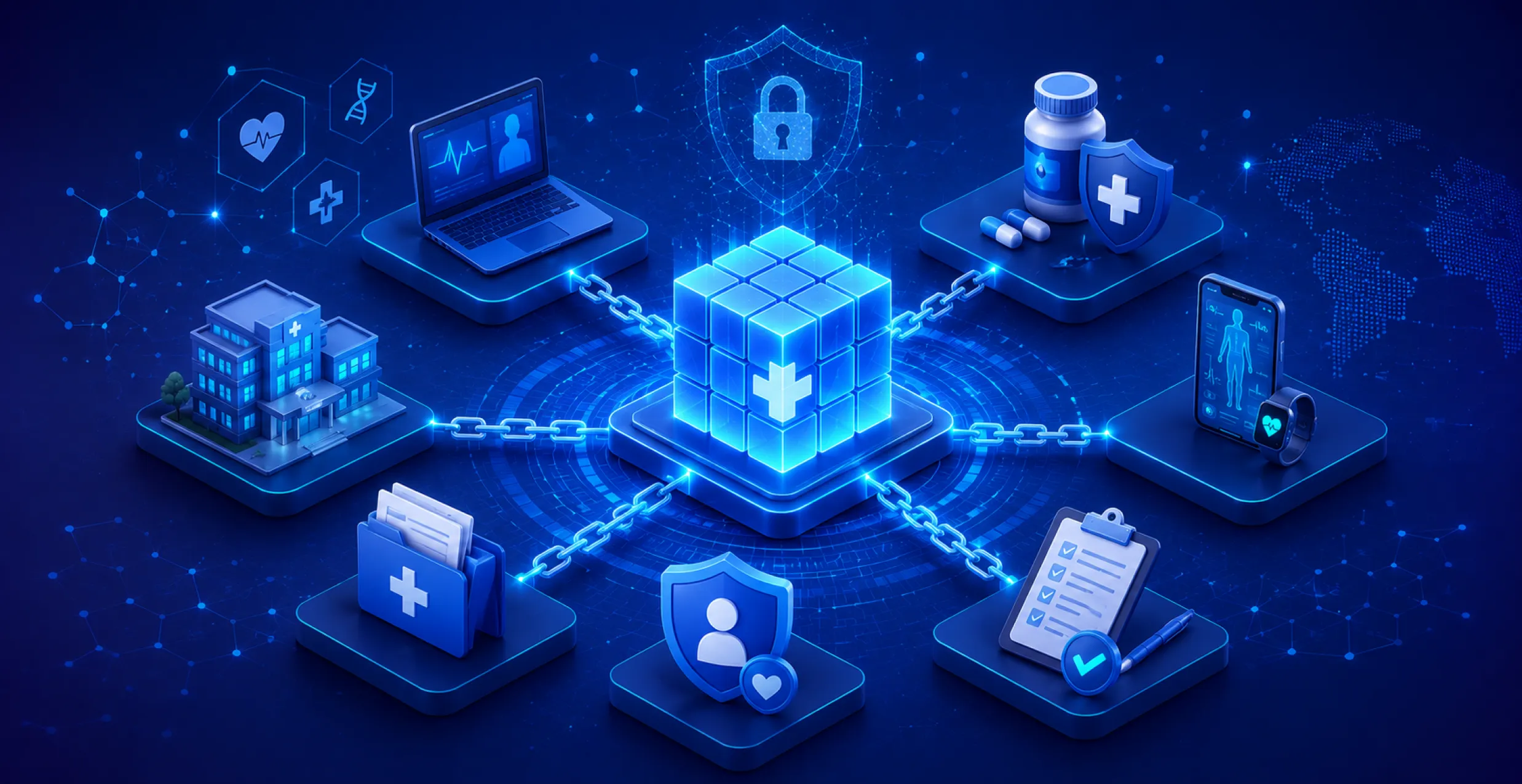
This is exactly where healthcare blockchain use cases change the story. Blockchain lets patients carry their own verified records everywhere they go. Doctors get instant access without endless phone calls or faxes.
Entrepreneurs now see huge potential provided by blockchain in healthcare use cases. This blog breaks that potential down in plain, simple language. Let’s explore how this technology is quietly rebuilding trust in medicine.
- Blockchain in Healthcare: Global Market Size
- Why is Blockchain Essential in Healthcare?
- Top 10 Blockchain Healthcare Use Cases in Digital Health
- How Much Does it Cost to Develop a Blockchain Empowered Healthcare App?
- Challenges and Real-World Roadblocks: Why Is Adoption Still Slow?
- Where Blockchain in Digital Health Is Actually Heading?
- How to Hire a Blockchain App Development Company?
- Conclusion
- FAQs
Blockchain in Healthcare: Global Market Size
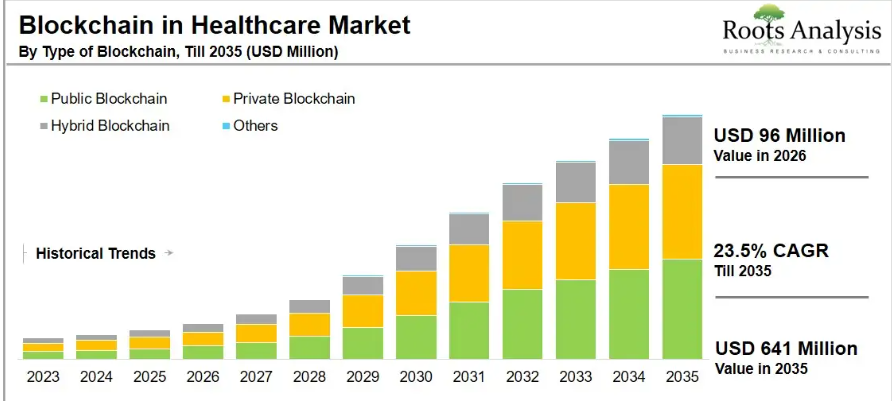
- According to a report published by Roots Analysis, blockchain in the healthcare market will be valued at US$96 million in 2026.
- In the same report, the expert predicts that the market will reach US$641 million in 2035. The CAGR between 2026 and 2035 will remain 23.5%.
- The report published by Business Research suggests that North America will be the major market that will experience this boom.
Why is Blockchain Essential in Healthcare?
Today, medical information is divided among hundreds of unlinked systems. Records from other hospitals are hard to trust at one hospital. This leads to wasted time, repeated testing, and treatment errors. Patients’ history is the number one culprit of suffering.
Blockchain resolves this issue by providing one common, tamper-proof ledger. All entries are time-stamped and cannot be changed secretly after they are written. This creates real trust among patients, doctors, and insurers from the very beginning. It also cuts out numerous costly intermediaries from healthcare processes. That’s why the use of blockchain technology in the healthcare sector is important.
Octal IT Solution feels this trust layer is the missing one in healthcare. Solving this before it happens will give the industry a head start from the entrepreneurs. Data is the lifeblood of the business, and its reliability saves lives and money.
Top 10 Blockchain Healthcare Use Cases in Digital Health
Blockchain is no longer confined to the realm of whitepapers and conferences. There are hospitals, insurance companies, and startups already using it every day. The following are the 10 most influential blockchain in healthcare use cases that are driving digital health in the present day:
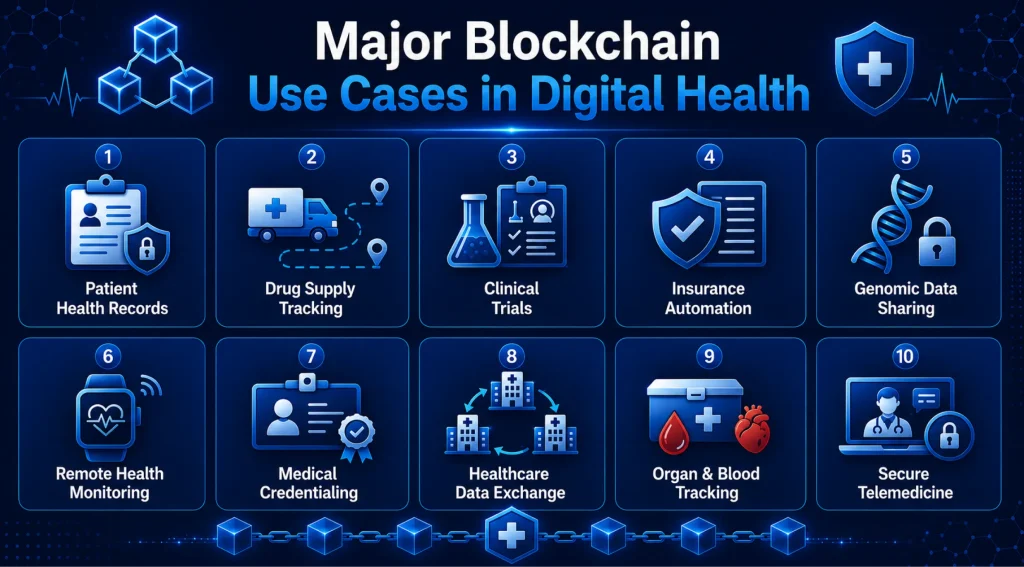
Patient-Owned Health Records: Moving Past the EHR Interoperability Mess
Conventional EHRs capture patient info within individual hospital databases. Patients rarely have complete control over their health records. Blockchain changes this with a personal digital vault for patients. Records are encrypted and only shared with the patient’s permission.
There is already a national blockchain health record system in Estonia that is successfully implemented. This single healthcare blockchain use case may solve a headache issue with interoperability, experts state.
Now think about changing doctors and having to move a single paper folder. This is definitely one of the most obvious blockchain in healthcare use cases right now. This is already happening under the direction of standards, such as HL7 FHIR and ONC rules. It’s time-saving, error-proof, and ultimately patient-centric.
Drug Supply Chain Verification: Stopping Counterfeit Medicines at the Source
Thousands of people die from the use of fake medicines worldwide every year. Lack of any mechanism to establish the source of a drug is common in supply chains. Blockchain enables every stage from the factory to the pharmacy to be recorded forever.
It is viewed by manufacturers, distributors, and pharmacists and trusted by all. This is a common method for tracking pharmaceutical shipments, as in the real industry project, ‘MediLedger.’ The impact of this healthcare blockchain use case is significant for millions of patients. Both the FDA and WHO actively track counterfeit drug threats worldwide. A scanned code allows one to know in a second if a medicine is authentic or not.
Fraudulent batches are identified before they can be placed on a shelf. This is an opportunity for entrepreneurs to scale a great deal in developing a supply chain tool.
Clinical Trials Reimagined: Tamper-Proof Data and Faster Recruitment
The recruitment process of clinical trials is often slow, and data integrity is unclear. In some instances, it can be difficult for researchers to establish that their findings were not manipulated. The blockchain adds a timestamp to each piece of trial data as soon as it is seen. This makes it almost impossible to tamper with and creates instant confidence in regulators. The FDA is moving toward more and more acceptance of blockchain for clinical trial record-keeping.
Major companies have already implemented blockchain trial systems, such as Pfizer. Quick and accurate information leads to quicker patient treatment. Smart contracts can also automatically match patients with appropriate trials.
This healthcare use case with blockchain could drastically reduce the cost of drug trials. It also builds trust in the approval process of new medicines among the public.
Insurance Claims and Smart Contracts: Cutting Down Fraud and Delays
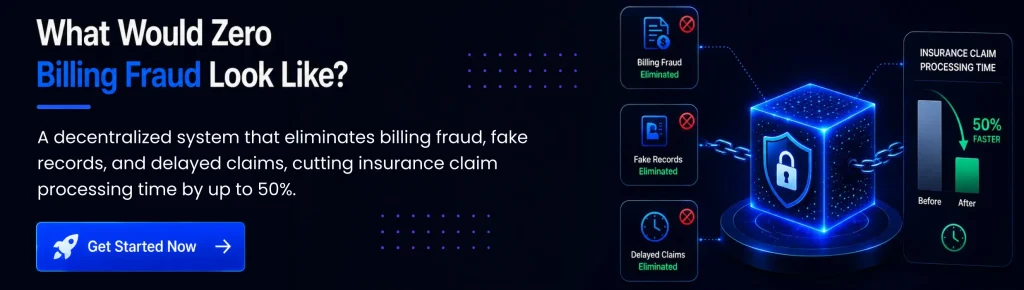
These days, insurance claims involve a lot of paperwork and back-and-forth. It can take weeks for patients to even get their basic claims approved. It is one of the smart contracts use cases that makes automatic payments when the agreed-upon conditions are fulfilled.
No manual review, no hidden delays, no disputes. There are already companies out there that are implementing this very same blockchain application in healthcare, Etherisc being one of them. Claims that are fraudulent are significantly reduced, as all records remain always verifiable. This will help save insurers millions and help patients get paid much sooner.
It’s one of the most blockchain-conversion-friendly use cases that healthcare companies can offer investors today. The quicker they can claim, the happier their customers will be and the better their insurer’s reputation will be.
Genomic Data Marketplaces: Letting Patients Monetize Their Own DNA
Patients pay little attention to genetic data, which is of huge value to research. Companies are gathering your DNA information and aren’t giving anything in return. Patients can securely share their data and even sell it in Blockchain based marketplaces.
Nebula Genomics is already offering rewards for its users who engage in a safe manner. All transactions are recorded, and patients always know who accessed them.
Interesting example for today’s blockchain use cases in healthcare. It contributes to a more level playing field in the research economy based on the genome. Patients receive privacy and a true financial interest in science.
Remote Patient Monitoring and IoT: Securing the Data Between Wearables and Doctors
Wearables now monitor your heart rate, glucose level, and sleep 24/7. That flow of sensitive data flows through many vulnerable networks every day. When it comes to this data being transported from device to doctor, blockchain is the answer. Each reading is verified and stored and can’t be tampered with.
Philips has already experimented with blockchain to create secure remote monitoring systems. This safeguards the patients suffering from chronic ailments who are counting on continuous monitoring. It also bolsters telemedicine initiatives that are geared towards rural and remote regions.
This is one of the fastest-growing blockchain use cases in the healthcare industry. When doctors can be confident in every diagnosis they make at a distance, it’s because they are presented with reliable and secure data.
Credentialing and Licensing: Verifying Doctors and Medical Staff Instantly
Most hospitals need to go to great lengths to manually check a new doctor’s license and history, which takes weeks. This process is slow, and sometimes things are concealed. Blockchain records secure credentials on a public, instantly accessible ledger.
ProCredEx, an industry consortium, already speeds up this exact verification process. Hospitals can save a huge amount of administrative costs and catch up with their staffing needs promptly. Patients also gain confidence knowing their doctor’s credentials were properly checked.
Another great healthcare use case of blockchain is to be noted. The main objective is to protect institutions and patients equally. The quicker someone is hired, the better the care provided during a real emergency.
Health Information Exchange Between Hospitals and Insurers
The exchange of patient data between hospitals and insurers is continually taking place via archaic, insecure channels. Each party can trust blockchain to provide a single secure channel. Permission is granted instantly, and access logs remain transparent at all times.
This significantly decreases the number of billing mistakes and rejected insurance claims. Also, it closely matches the ONC interoperability standards that are needed throughout the US healthcare systems. It is fast emerging as one of the most useful blockchain use cases in healthcare. Disputes are reduced at hospitals when shared ledgers take the place of the old paper trails.
Organ and Blood Donation Tracking From Donor to Recipient
Organ donation networks have trouble with tracking, matching, and the prevention of black market fraud. Each phase of the donor consent to the end of the transplant is documented on the blockchain. This makes it a clear chain that no one can be able to manipulate in the future in the shadows.
The verified record is trusted by donors, hospitals, and recipients. It is one of the quintessential life-saving blockchain use cases in healthcare. This has the benefit of quicker matching, which translates to shorter and safer wait times for patients.
Telemedicine Identity Verification and Secure Payments
Telemedicine platforms must verify the doctor and patient identities immediately. Blockchain verifies identity without revealing private data on the public blockchain. Instant and secure smart contract-based systems are also used for payments.
This not only reduces fraud but also helps create a sense of authenticity for virtual appointments. One of the freshest applications of a blockchain in healthcare is telemedicine security. It can provide an excellent first impression for the patron of the business, but also quickens the process of building patient trust.
Which of these use cases fits your business? Let’s map out the right blockchain solution for your healthcare needs. Talk to our team now!
How Much Does it Cost to Develop a Blockchain Empowered Healthcare App?
The range of costs is significantly different based on features, complexity, and your development partner. Properly budgeting for blockchain in healthcare use cases helps avoid unexpected expenses.
| App Complexity | Core Features | Estimated Cost | Timeline |
| Basic MVP | Records storage, patient login | 15,000 to 30,000 USD | 2 to 3 months |
| Mid-Level App | Smart contracts, insurance integration | 30,000 to 70,000 USD | 4 to 6 months |
| Enterprise Platform | Multi-hospital network, IoT integration | 70,000 to 150,000 USD | 7 to 12 months |
Cost By Development Stage
| Development Stage | Percentage of Total Cost |
| Research and Planning | 10 percent |
| UI and UX Design | 15 percent |
| Blockchain Development | 45 percent |
| Testing and Deployment | 30 percent |
Cost to Hire Different Team Members
| Team Role | Average Hourly Rate |
| Blockchain Developer | 40 to 90 USD |
| UI UX Designer | 25 to 50 USD |
| Project Manager | 30 to 60 USD |
| QA Engineer | 20 to 40 USD |
Octal IT Solution, among trusted blockchain development companies, offers transparent, custom project quotes. Hire us today and get competitive pricing for your upcoming blockchain project.
Challenges and Real-World Roadblocks: Why Is Adoption Still Slow?
Blockchain seems to be the ideal solution, but hospitals are not yet ready to embrace it. There are plenty of instances of proven blockchain healthcare applications that have an actual roadblock in front of them every day.
Regulatory Uncertainty
The laws governing healthcare vary from country to country, while the rules of blockchain are still unclear. Businesses are concerned about having systems built that they may be forced to shut down for later use.
High Implementation Cost
A substantial initial cost is needed to replace outmoded hospital systems. This is a transition that just isn’t viable for smaller clinics at this time.
Interoperability Gaps
There is a challenge of interoperability between various blockchain platforms. This restricts seamless interhospital data transfer.
Scalability Concerns
In a public blockchain, as the number of transactions increases, the speed of the blockchain can also decrease. Hospitals require a system to deal with millions of records per day.
Data Privacy Laws
The availability of sensitive data through public storage is complicated by regulations such as HIPAA and GDPR. Developers will need to create thoughtful and compliant privacy-centric solutions that will work around the restrictions.
Staff Training Gaps
There is a lack of knowledge and understanding of the underlying technology of blockchain among the hospital staff. It takes time, money, and many dedicated in-house resources to train.
Integration With Legacy Systems
There are still many hospitals using software developed decades ago. The integration of legacy systems with new blockchain platforms is no easy task.
Trust and Awareness
A lot of decision-makers still see blockchain as a needless piece of complexity. Trust takes constant upfront education and proven results.
Explore More: Blockchain application ideas for businesses
Where Blockchain in Digital Health Is Actually Heading?
With the existing adoption barriers adequately addressed, future prospects are bright. Healthcare use cases of the blockchain continue to appear, one after the other, each quarter.
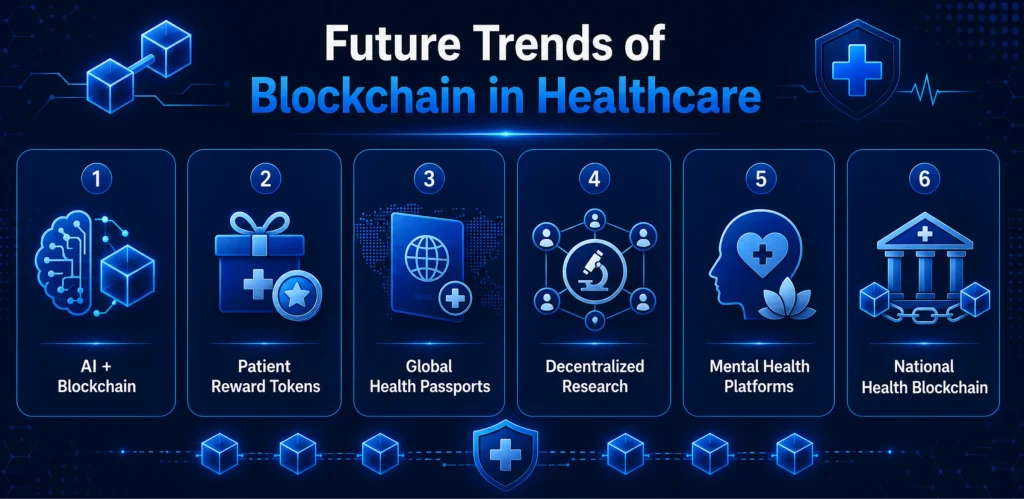
AI Plus Blockchain Integration
With AI and blockchain, diagnosis accuracy will increase tremendously. They will make predictions of outbreaks together, quicker than ever.
Tokenized Patient Incentives
Patients will be given tokens for responsibly sharing anonymized health data. This is not only a healthier lifestyle but a real financial incentive as well.
Cross-Border Health Passports
Vaccination and health records will be verified and transmitted across borders in real time. One secure, digital passport will be used for travelers to pass through checkpoints.
Decentralized Clinical Research Networks
Independent researchers will work together, sharing the data networks, which are tamper-proof. This will accelerate the research of rare diseases to a great extent.
Blockchain-Powered Mental Health Platforms
Private sensitive therapy records will be stored in an encrypted, patient-controlled platform. This will make it more likely that people will seek assistance.
Government-Backed National Health Chains
National blockchain health record systems will be introduced in more countries in the near future. This is the Estonian experience of 10 years that has already proven to be very successful.
How to Hire a Blockchain App Development Company?
Selecting a partner is one of the most important determining factors that will lead to the success of your healthcare project or its failure. The key players are well-versed in the applications of blockchain in healthcare.
Check Healthcare-Specific Experience
Search for a blockchain mobile application development company team that has true medical projects. The experience that is common across industries is not always a direct fit for the healthcare industry’s requirements.
Review Compliance Knowledge
Your partner should have a thorough grasp of HIPAA, GDPR, and other rules regarding healthcare in your region. Failure to comply with regulations can be a major hindrance to the project’s successful launch.
Ask for Case Studies
Past use cases of genuine blockchain prove real and practical experience. Don’t use vendors that only present generic marketing slides.
Evaluate Their Tech Stack
Inquire what blockchain development platforms they employ to develop solutions. Different projects require different solutions, with Ethereum, Hyperledger, and Corda each offering the right solution.
Understand Their Support Model
Post-launch support is as important as the initial quality of the development. Inquire about maintenance, updates and long-term partnerships.
Compare Consulting Approach
Before even writing a code line, Strong Blockchain Consulting Services provide guidance on strategy. This will save costly errors in development later on.
Conclusion
But blockchain is subtly changing the way health care providers talk to patients and insurers every day. Its effects are continuing to grow and go from secure records to quicker claims. Today’s entrepreneurs who grasp the potential applications of blockchain in the healthcare space are truly ahead of the curve.
This technology can be used to address genuine issues of trust, fraud, and slow processes. Octal IT Solution has assisted businesses in making these ideas come to life. You need to have an expert on your side, either for healthcare IT Solutions or for a complete healthcare app development team. The market is growing, and the first movers will reap the greatest rewards. It’s just a matter of the competitors getting your potential customers before you do.
If you are ready to utilize the blockchain use case in the healthcare industry, you can’t wait any longer. Ready to Build the Future of Healthcare? Octal IT Solution turns blockchain ideas into secure, real-world healthcare platforms.
 By
By August 21, 2026



 Latest Stories
 Get in Touch